Blog
A Homeowner’s Guide to Closed Cell Foam R Values


When it comes to insulation, numbers matter. For closed-cell spray foam, the key number you’ll hear is its R-value, which typically lands somewhere between a powerful R-6.0 to R-7.0 per inch. This makes it one of the most effective residential insulators you can get.
In simple terms, that high rating means you get incredible resistance to heat flow packed into a surprisingly thin layer.
Decoding Closed Cell Foam R-Values
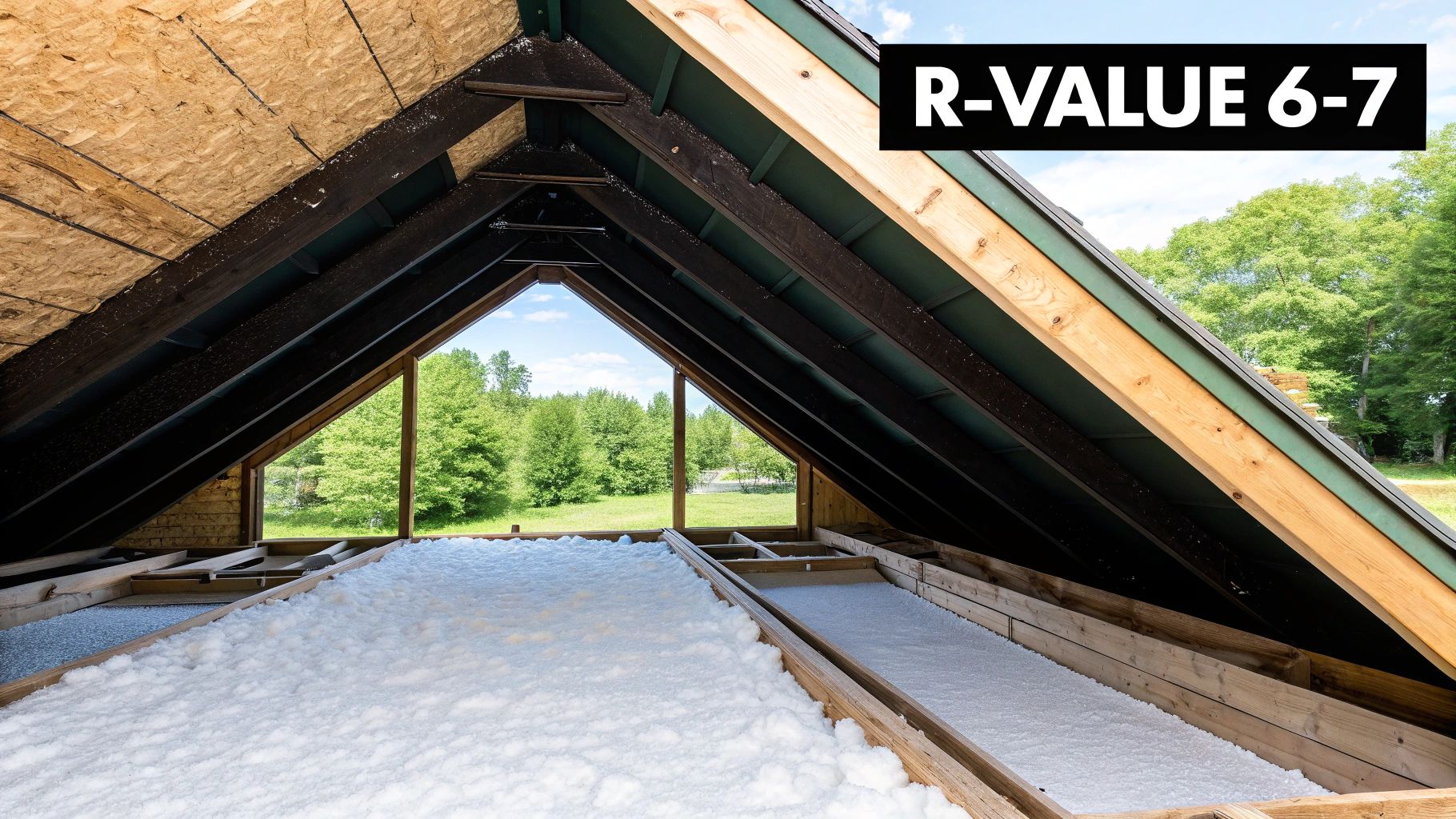
Think of R-value as the thermal superpower rating for your home. It’s a lot like how a high-performance cooler keeps your drinks icy on a blazing hot day; a material with a high R-value is fantastic at keeping your conditioned air inside and that sweltering South Florida heat out where it belongs.
The term R-value is just a technical way of measuring how well an insulation material resists heat trying to pass through it. The higher the number, the better it performs. And with closed-cell foam, you’re getting a whole lot of performance packed into every single inch. For a deeper dive into the basics, this guide on Understanding R-Value Insulation is a great starting point.
Why This Number Is a Game-Changer for Your Home
That impressive R-value of 6.0 to 7.0 per inch is precisely why closed-cell foam is such a dominant force in the insulation market. This isn't just about keeping warm up north; it's absolutely critical for us here in humid South Florida, where it boosts A/C efficiency and helps us win the constant battle against moisture in homes from West Palm Beach to Stuart.
This high thermal resistance isn't just a number on a spec sheet—it translates directly into real-world benefits you can feel and see:
- Lower Energy Bills: When you create a superior thermal barrier, your air conditioner doesn't have to cycle on and off constantly to keep your home cool. That means less work for your system and less money out of your pocket each month.
- Serious Comfort: A properly insulated home gets rid of those frustrating hot spots and drafts. The result? A consistent, comfortable temperature in every single room.
- Space-Saving Efficiency: Because its R-value per inch is so high, you can hit your target insulation level with a lot less thickness compared to other materials like fiberglass or cellulose.
In short, the high R-value of closed-cell foam isn't just a technical detail; it's the key to an energy-efficient, comfortable, and more affordable home. It’s your first and best line of defense against the relentless Florida sun.
Why Closed-Cell Foam Is a Smart Investment for Florida Homes
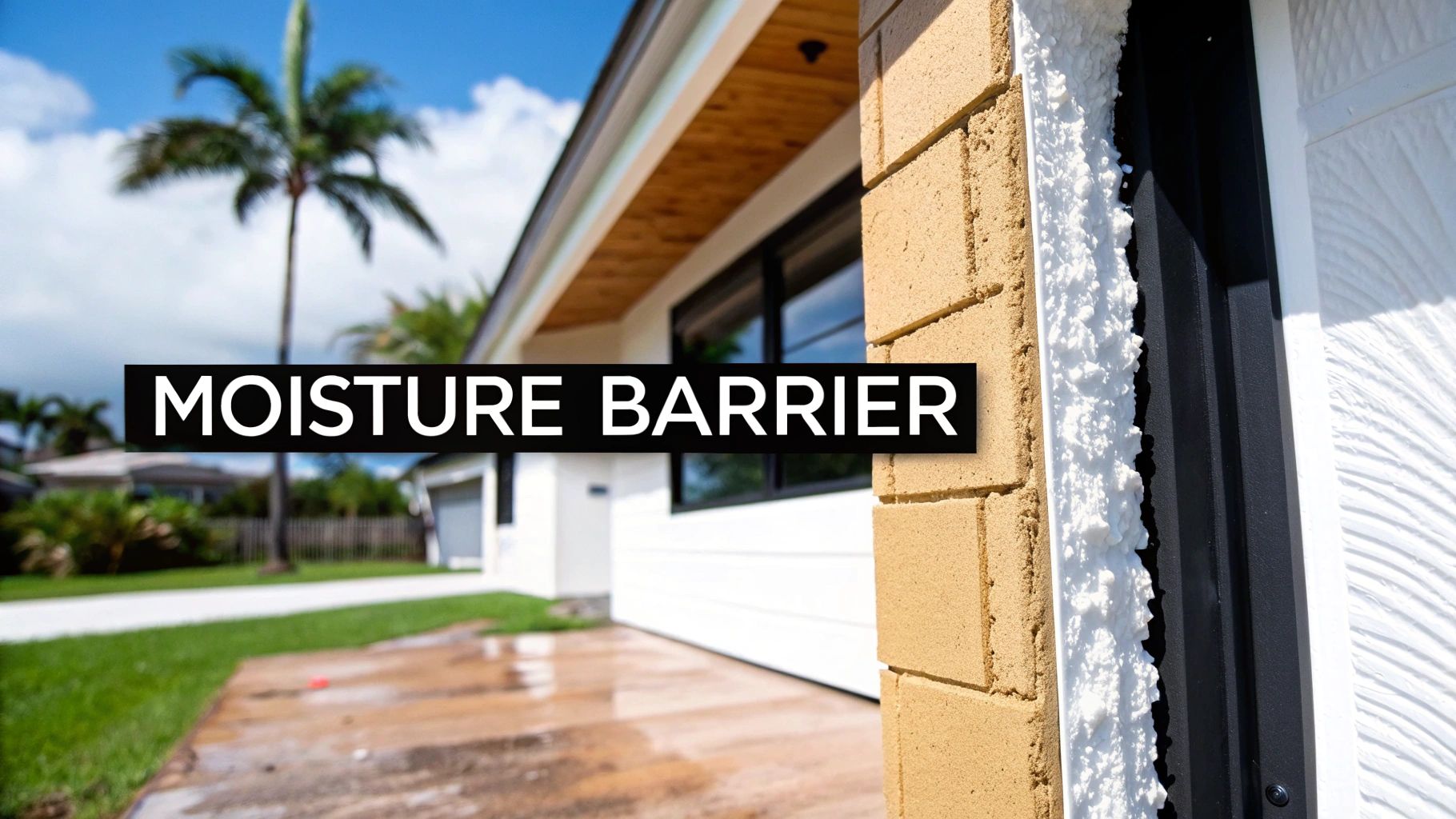
While the high R-value gets all the attention, the real magic of closed-cell foam in Florida is its one-two punch. It’s not just an insulator; it’s a heavyweight champion against our state’s biggest enemy: humidity.
Think about trying to block water with a sponge versus a solid sheet of plastic. Open-cell foam, with its softer, sponge-like structure, can take on moisture. In our relentless humidity, that’s a recipe for disaster, creating a perfect breeding ground for mold and rot inside your walls and attic.
A Fortress Against Moisture
Closed-cell foam is the exact opposite. Its dense, rigid structure is made of billions of tiny, sealed-off cells that water vapor simply can’t get through. This creates a powerful, continuous barrier that stops humidity dead in its tracks before it can seep into your home’s structure.
This isn’t just a nice little bonus; it's absolutely critical for the long-term health of your home. By shutting down moisture intrusion, closed-cell foam protects your home’s structural integrity and helps keep your indoor air clean and healthy.
For Florida homeowners, this is the ultimate two-for-one deal. You get exceptional thermal resistance to stay cool, plus an integrated moisture barrier that traditional insulation just can't match.
In the world of insulation, closed-cell spray foam is a powerhouse. It boasts an impressive R-value, typically landing between R-6.5 to R-7 per inch. That completely blows traditional materials like fiberglass batts (around R-3.1 to R-4.3 per inch) and cellulose (about R-3.5 per inch) out of the water. This high thermal resistance delivers superior energy efficiency, especially in the punishing climate of South Florida, where we at Airtight Spray Foam Insulation serve homeowners in Jupiter, Palm Beach Gardens, and beyond.
The Added Benefit of Structural Strength
Beyond keeping your home cool and dry, closed-cell foam offers another huge advantage: it actually makes your house stronger. As we spray it, the foam expands, hardens, and bonds tightly to every surface, essentially gluing the building components together.
This adds significant racking strength and rigidity to your walls and roof deck. When Florida's intense storm season rolls around, that extra structural support can provide a serious layer of defense against high winds, making your home a safer, more resilient structure. The benefits become even clearer when you see how it stacks up against other methods; check out our guide on spray foam vs. blown-in insulation for a full breakdown.
Real-World Factors That Affect Your R-Value
The closed-cell foam R-values you see on a product spec sheet are a bit like a car's sticker MPG—they’re measured under perfect lab conditions. But out here in the real world, things are a lot messier. Just like your driving habits and road conditions affect your actual gas mileage, several factors can change how well your insulation performs once it’s in your home.
Knowing what these are is key. It helps you understand why the quality of the installation is every bit as important as the quality of the foam itself. Getting it right is what ensures you actually get the thermal protection you’re paying for.
The Impact of Installation Quality
There’s a reason professional installation is non-negotiable for spray foam. Even the highest R-value foam on the market will fail if it isn’t applied correctly. Think of it like cranking up your AC on a blistering Florida afternoon but leaving a window cracked open—it doesn’t matter how powerful your system is if you’ve got a gap letting all that cool air escape.
A sloppy installation creates the same kind of weak spots in your home's thermal shield:
- Gaps and Voids: Even tiny, unsealed gaps around electrical boxes, pipes, or framing act as thermal bridges where heat can sneak right past the insulation.
- Uneven Thickness: If the foam isn't sprayed to a consistent depth, you’ll have under-insulated areas that become hot spots, bleeding energy.
- Poor Adhesion: The foam won't bond correctly if the surface isn't prepped right, which compromises both the air seal and the moisture barrier.
A skilled, professional installer knows exactly how to avoid these pitfalls. They create a continuous, seamless, and truly airtight barrier. That meticulous attention to detail is what locks in the foam's high R-value and delivers the performance you expect in the real world.
How Time Affects R-Value
Over its very long life, closed-cell foam does experience a tiny reduction in R-value called thermal drift. It happens because an incredibly small fraction of the insulating gas trapped inside the foam’s billions of cells eventually escapes and gets replaced by air.
But let's be clear: this process is extremely gradual and minimal. Modern closed-cell foams are engineered for incredible stability, designed to keep over 90% of their initial R-value for decades. The industry even has a specific metric for this called Long-Term Thermal Resistance (LTTR), which gives a more realistic picture of performance averaged over 15 years.
While a slight drift is normal, it’s important to remember that closed-cell foam's long-term performance still blows traditional insulation out of the water. Fiberglass, for example, can sag, compress, and lose a huge chunk of its R-value over time—especially when it gets damp, which is a constant battle here in Florida.
Calculating the Right Insulation Thickness for Your Home
Knowing the science behind closed-cell foam R-values is one thing, but turning that knowledge into a real-world plan for your home is what really matters. This is where we go from theory to action, figuring out exactly how much insulation you need to meet local building codes and your own comfort standards.
The good news? It's surprisingly simple. The calculation is straightforward and gives you the power to have a clear, informed conversation with your insulation contractor. You'll know precisely what’s needed and why.
The Basic R-Value Formula
To figure out the right thickness of closed-cell foam, all you need is a little division. The formula is as basic as it gets:
Required R-Value / R-Value Per Inch = Required Foam Thickness (in inches)
This calculation bridges the gap between a number on a building permit and the actual layer of protection being applied to your home. It demystifies the whole process and puts you in the driver's seat.
Let's walk through a common example here in South Florida. Most local codes require an R-value of R-38 in attics to fight back against the brutal radiant heat beating down on our roofs.
Example Calculation for an Attic:
- Code Requirement: R-38
- Our Closed-Cell Foam R-Value: R-7 per inch
- Calculation: 38 ÷ 7 = 5.43 inches
To hit that R-38 target, you’d need us to install about 5.5 inches of our high-performance closed-cell foam on your attic's roof deck. This creates a powerful thermal shield right where your home needs it most.
This same math works for any part of your home, from walls and crawl spaces to the roof itself. Just plug in the target R-value for that specific area. If you're building a new home, understanding the key questions for new home builders regarding insulation will help ensure these numbers are handled correctly from the start.
Customizing Thickness for Different Areas
Your home doesn't require the same insulation level everywhere. An unvented attic in Florida needs maximum protection, but your walls might have a different requirement, like R-13.
Here’s how that calculation would look:
- Wall Requirement: R-13
- Calculation: 13 ÷ 7 = 1.86 inches
In this scenario, just under 2 inches of closed-cell spray foam inside your wall cavities would be enough to meet code, giving you a fantastic thermal barrier and a complete air seal.
To give you an idea of what we see in the field, here’s a quick table showing how the math works out for different parts of a South Florida home.
Sample Thickness Calculation for South Florida Building Codes
This table shows example calculations for achieving common R-value targets in different parts of a home using closed-cell foam with an average R-value of 6.8 per inch.
| Application Area | Required R-Value (Example) | Required Foam Thickness (Inches) |
|---|---|---|
| Unvented Attic / Roof Deck | R-38 | ~5.6 inches |
| Exterior Walls (2×4) | R-13 | ~1.9 inches |
| Exterior Walls (2×6) | R-21 | ~3.1 inches |
| Floors / Crawl Spaces | R-19 | ~2.8 inches |
These calculations give you a solid baseline for planning your project and ensuring you meet or exceed local energy codes.
The infographic below shows the real-world factors that can impact how well your insulation actually performs once it's installed.
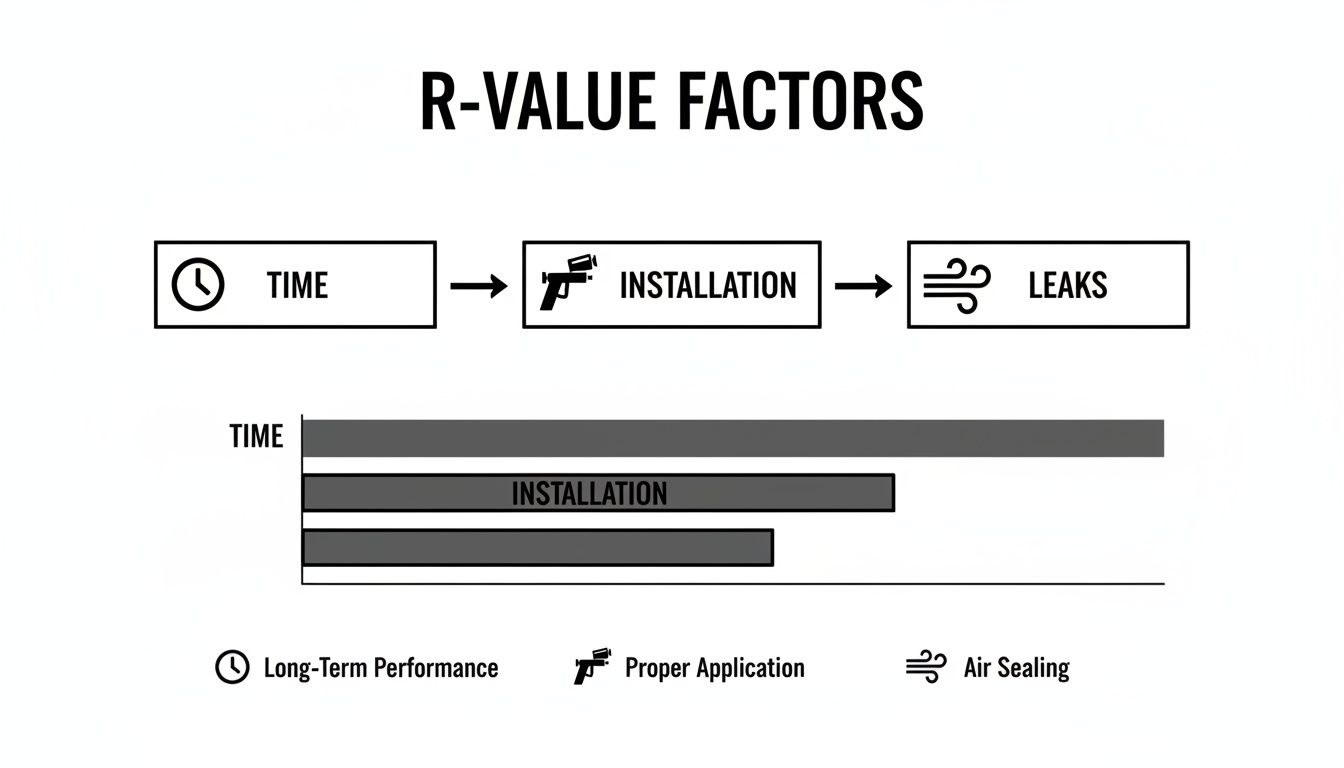
As you can see, time has a very small effect on performance. The real killers are poor installation and air leaks, which can destroy the effective R-value you're paying for. This is exactly why a professional application is non-negotiable—it guarantees the thickness we calculate is the performance you actually get.
Where High R-Value Closed-Cell Foam Really Shines
That high R-value you see with closed-cell foam isn't just a number on a spec sheet; it's a problem-solver. Think of it as a specialized tool engineered to handle the toughest insulation challenges in a home. Its unique blend of thermal resistance, serious structural strength, and near-total moisture impermeability makes it the go-to solution for spots where other insulations would quickly fail. When we apply it strategically, we can turn the most vulnerable parts of your property into high-performance, protected zones.
This isn't just a local trend, either. The global market for closed-cell spray foam hit USD 451 million in 2024 and is on track to reach USD 691 million by 2032. Why the surge? A big driver is the adoption of stricter energy codes that demand real-world performance—and closed-cell foam delivers by eliminating thermal bridging and air leaks that lesser products can't touch.
Transforming a Blazing Hot Attic into a Conditioned Space
Here in South Florida, your attic is on the front lines of the battle against heat. The sun relentlessly beats down on your roof all day, turning that space into a convection oven that radiates heat right down into your living room. The most effective way to win this fight is to stop the heat at the source by applying closed-cell foam directly to the underside of the roof deck.
Thanks to its powerful R-7 per inch, we can hit the code-required R-38 with just over five inches of foam. This creates what's called an unvented, conditioned attic, and the benefits are immediate:
- Blocks Radiant Heat: It acts as a shield, preventing the roof sheathing from super-heating and radiating that energy downward.
- Air-Seals the Entire Roof Deck: Every tiny gap, seam, and crack is sealed, stopping hot, humid air from being sucked inside.
- Protects Your HVAC System: If your air handler is in the attic, it’s now operating in a much cooler, drier space. This boosts its efficiency and can dramatically extend its lifespan.
Creating an Airtight Barrier in Exterior Walls
Your exterior walls are riddled with opportunities for energy loss and moisture intrusion. Small gaps around outlets, windows, and between framing studs are like open doors for your expensive conditioned air to escape and for humid outdoor air to creep in. Closed-cell foam expands to fill every single one of those voids, creating a single, solid barrier that handles thermal, air, and moisture control all in one shot.
This is a game-changer for concrete block walls, which are everywhere in our area but are notoriously tough to insulate well. Spray foam bonds directly to the block, giving you a continuous layer of insulation with none of the gaps or weak points you get with other methods. You can learn more in our guide to the insulation value of concrete block walls.
By applying just two to three inches of closed-cell foam, we can meet wall R-value requirements while simultaneously making the entire wall assembly stronger and completely airtight. Fiberglass batts simply can't do that.
Putting a Stop to Condensation in Metal Buildings
Metal buildings, workshops, and garages are condensation magnets. As the thin metal panels cool down overnight, they easily reach the dew point, causing moisture from our humid Florida air to condense and form droplets. Before you know it, you've got dripping, rust, and water damage to whatever you're storing inside.
Closed-cell foam is the definitive answer to this problem. When sprayed directly onto the interior of the metal panels, it solves the issue in two critical ways:
- It insulates the metal, preventing the surface temperature from ever dropping low enough to cause condensation.
- It creates a vapor barrier, completely blocking moist air from making contact with the cold metal surface in the first place.
This dual-action performance doesn't just manage condensation—it eliminates it entirely, protecting the building and everything in it while providing top-tier thermal control.
Getting the Job Done Right for Maximum Performance
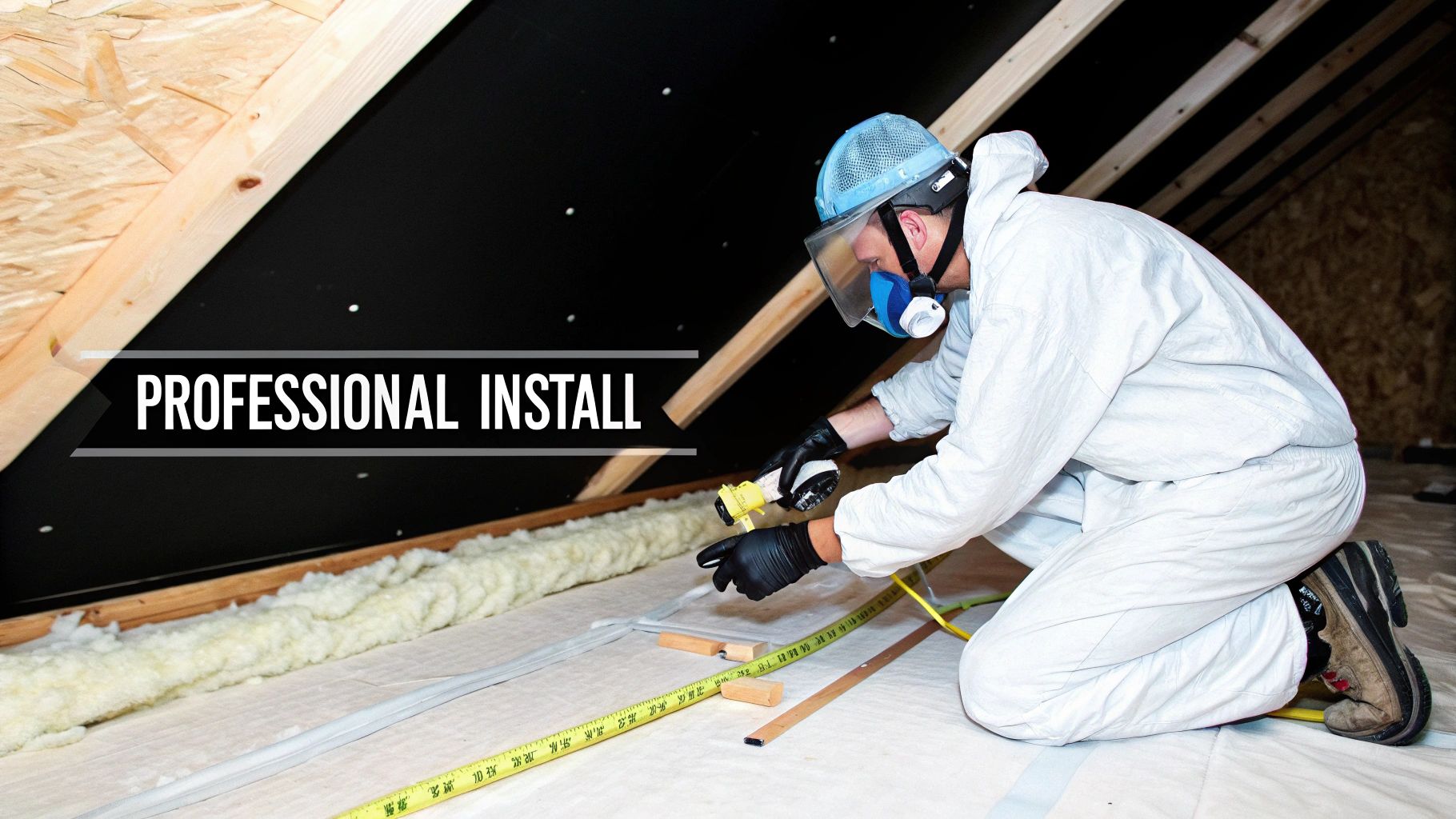
So, we've talked about the impressive closed cell foam R-values and all the science behind them. But at the end of the day, those numbers are just potential. To actually get the energy savings, moisture control, and structural integrity you're paying for, it all boils down to one thing: a perfect installation.
Think of it like buying a high-performance engine for a race car. It's useless if you don't have a skilled mechanic to install, tune, and connect it properly. Spray foam is no different. The expertise of the installer is every bit as important as the foam itself. They’re the ones who turn a chemical product into a seamless, high-performance part of your building.
A professional application ensures every inch of your property gets a continuous, airtight seal, delivering the full thermal performance you paid for without any gaps or weak spots.
This is where a proven process makes all the difference. It's not just about spraying foam on a wall. It starts with a thorough assessment of your property, followed by meticulously preparing every surface. The application itself has to be precise, maintaining a consistent thickness and getting a perfect bond.
Finally, a detailed quality check confirms the job was done right. Choosing an expert isn't just a good idea—it's the only way to guarantee your home achieves the comfort and efficiency you expect, turning a smart investment into real, lasting value.
Common Questions About Closed Cell Foam R-Values
When it comes to upgrading insulation, homeowners always have questions. It’s a big investment, and you deserve clear, straight-talk answers about closed cell foam R-values to feel confident you’re making the right move for your home.
We get it. That’s why we’ve put together some of the most common questions we hear every day from homeowners right here in South Florida.
Is a Higher R-Value Always Better for My Home?
Generally, yes, but it’s a bit more nuanced than that. The real goal isn't just "high R-value," it's the right R-value for the right place. An attic in our climate, for example, needs a massive R-value like R-38 to fend off the relentless sun beating down on the roof all day.
Your walls, on the other hand, might only need a lower R-value to meet code and keep you comfortable. Piling on more insulation than necessary in certain spots gives you diminishing returns. A professional assessment is the best way to figure out the perfect thermal resistance for each part of your house, so you get maximum energy efficiency without paying for overkill.
How Long Does the R-Value of Closed Cell Foam Last?
This is one of the best parts about closed cell foam—it’s built to last for the entire life of your home. It holds onto more than 90% of its initial R-value for decades, giving you consistent, reliable thermal protection year after year.
Unlike fiberglass that can sag, settle, or degrade if it gets wet, closed cell foam just stays put. That means the energy savings and comfort you feel on day one are the same ones you can count on for the long haul.
One of the key benefits of closed cell foam is its long-term stability. The high R-value you get on day one is nearly the same R-value you’ll have 30 years from now, making it a truly permanent solution.
Can I Install Closed Cell Spray Foam Myself?
We strongly, strongly advise against this. Installing closed cell foam isn’t a weekend DIY project; it’s a complex chemical process that requires expensive, specialized equipment, precise controls for temperature and pressure, and serious safety gear. We’re talking full-body suits and professional-grade respirators.
If the mix is even slightly off, or if it's applied incorrectly, you could end up with an ineffective thermal barrier, dangerous off-gassing, and major safety risks. To get the performance and closed cell foam R-values you’re paying for, professional installation is non-negotiable. Plus, its dense structure is a fantastic soundproofer—a benefit you can read more about in our guide on using insulation as a sound barrier.
Ready to get the right R-value for your home? The experts at Airtight Spray Foam Insulation provide tailored solutions that deliver maximum comfort and energy savings. Request your free, no-obligation quote today at https://airtightsprayfoaminsulation.com and see how our professional installation makes all the difference.