Blog
The Best Insulation for Heat in Hot Climates


When you’re trying to find the best insulation for heat in a hot, humid climate, you have to look beyond the basics. The real game-changer isn't just a high R-value; it's creating a complete air and moisture barrier. That’s where spray foam insulation, especially closed-cell, really shines—it’s not just insulation, it's a full-on climate control system for your building.
Why Choosing the Right Insulation for Heat Is Crucial
Living in South Florida means dealing with a relentless sun. Solar gain blasts your roof and walls, baking the house from the outside in, while that thick, humid air sneaks into every possible crack. This one-two punch forces your air conditioner into overdrive, sending energy bills through the roof and leaving your home feeling sticky and damp.
It's not enough to just have insulation. The specific type you choose, and how it performs against intense heat, air infiltration, and moisture, is what makes all the difference.
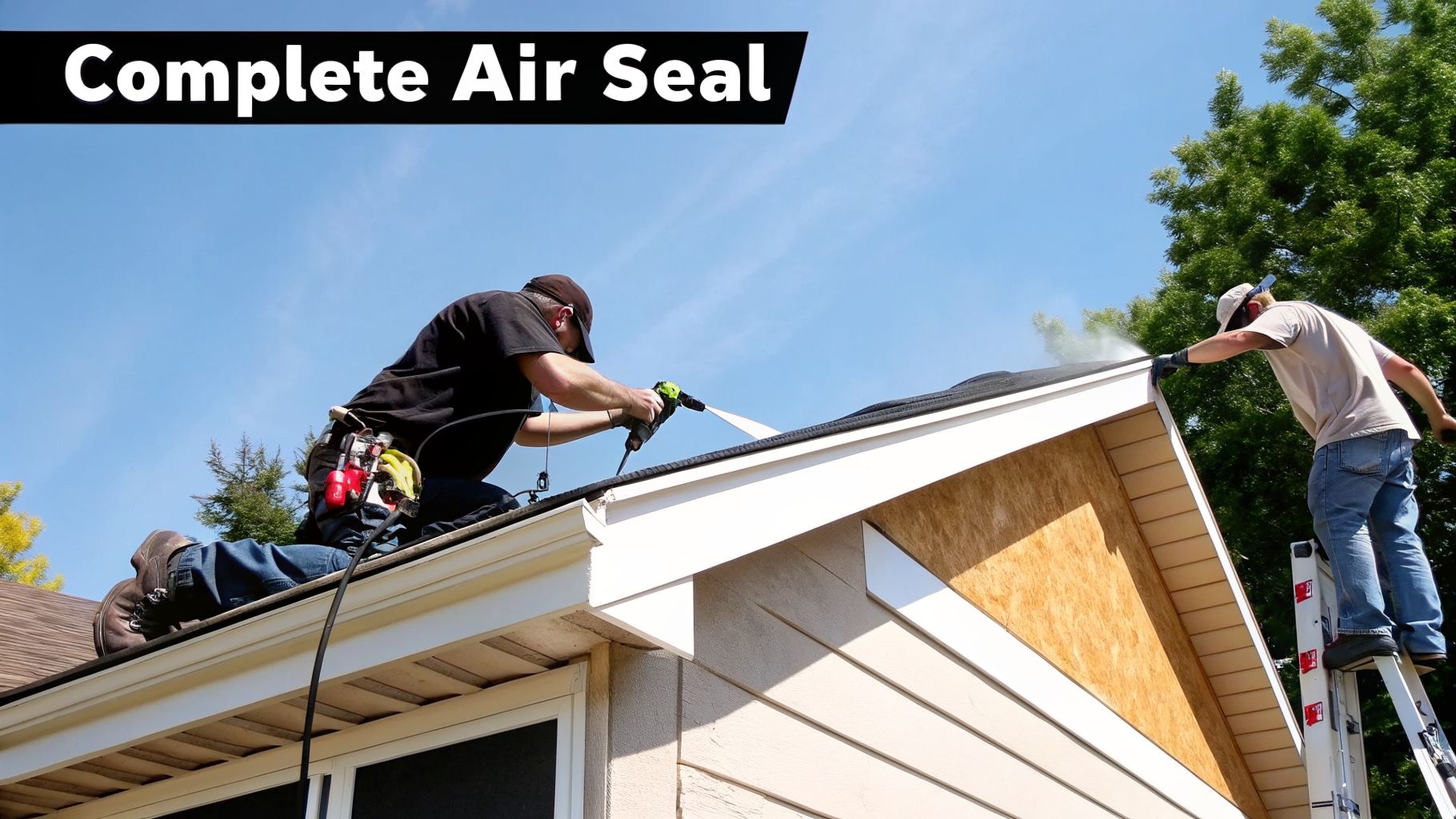
Beyond Standard Insulation Performance
This is where I see traditional insulation materials fail time and time again in our climate. They might look good on paper with a decent R-value, but they just can't stand up to the combined assault of extreme heat and constant humidity.
- Air Leakage: Old-school insulation batts and rolls have seams. Hot, humid air always finds these tiny gaps and pushes right through, a process known as convection. This is a massive source of heat gain that drives up your cooling costs.
- Moisture Intrusion: Many common insulation types are like sponges. They soak up moisture from the humid air, and once they're damp, their thermal resistance plummets. Worse, they become a perfect breeding ground for mold and mildew, which can damage your home's structure and destroy your indoor air quality.
In a hot, humid environment, stopping air movement is just as important as resisting heat conduction. An insulation that creates a perfect air seal is fundamentally more effective at keeping your home cool and dry.
A Holistic Approach to Climate Control
Think of your home's entire outer shell—your roof, walls, and foundation—as a single, continuous system. For it to work, every part has to connect perfectly to form an unbroken barrier against the Florida weather. Choosing the right insulation is a huge piece of that puzzle, but so are other elements like UV protection window treatments that help reduce solar heat gain.
A truly effective solution has to fight all forms of heat transfer and block moisture at the same time.
| Insulation Failure Point | Impact in Hot Climates | The Superior Solution |
|---|---|---|
| Air Leaks | Allows hot, humid air to pour in, maxing out your AC. | A monolithic air seal that stops convection cold. |
| Moisture Absorption | Kills R-value and invites mold and rot. | An impermeable material that blocks water vapor. |
| Heat Conduction | Lets heat pass directly through the material. | High thermal resistance (R-value). |
This is exactly why spray foam, particularly the closed-cell variety, is widely considered the best insulation for heat. It doesn't just sit in the cavities; it expands to fill every single void, creating one solid, airtight, and water-resistant barrier. It insulates, seals, and strengthens your home's defense against our challenging climate all in one step.
How Insulation Actually Manages Heat and Humidity
To pick the best insulation for heat, you have to know how that heat gets into your house in the first place. It's not just about stopping warmth—it’s about controlling the three ways heat moves: conduction, convection, and radiation. A real insulation strategy has to tackle all three.
Think of your home as a high-end cooler you've packed for a sweltering beach day. Its performance depends entirely on how well its walls fight off the heat trying to get in.
The Three Types of Heat Transfer
Conduction is heat moving right through solid materials. It’s what you feel when you grab a hot pan handle. In your house, the sun bakes your roof shingles, and that heat travels straight through the plywood, the rafters, and right into your attic.
Convection is heat riding on air currents. Think of the hot blast from a hairdryer. When hot, humid air from outside sneaks into your attic through gaps, vents, and soffits, it creates convective loops that heat up the whole house from the top down.
Radiation is heat traveling in waves. It's the warmth you feel from the sun or a bonfire, even from a distance. Your roof deck, after baking in the Florida sun all day, radiates heat downward, cooking everything below it—including your old insulation and the attic floor.
Beyond R-Value: The Role of Air Sealing
For decades, the industry has pushed R-value as the be-all and end-all of insulation. While you should start by understanding R-value insulation and its role in resisting conductive heat, that number becomes almost worthless if your house leaks air.
Traditional materials like fiberglass batts might boast a high R-value on the package, but they do absolutely nothing to stop air movement. All that convective heat pouring in through leaks will completely bypass the insulation, forcing your AC to run nonstop just to keep pace.
An insulation’s ability to create a complete air seal is often more critical for comfort and energy efficiency in a hot climate than its R-value alone. Stopping convective heat gain is the fastest way to lower cooling costs.
The Critical Fight Against Humidity
Here in South Florida, insulation has a second job: it has to be a moisture barrier. When our thick, humid air gets inside and hits a cooler, air-conditioned surface, it condenses. This is how you end up with serious moisture problems. You can get a deeper look at why this is so critical in our guide on the importance of a moisture barrier in insulation.
Materials that act like a sponge, such as cellulose or fiberglass, will soak up this condensation. This not only makes them a perfect breeding ground for mold but also causes them to lose their insulating properties altogether. The only real solution is a material that won't let water vapor pass through.
This is where you can see the difference spray foam makes. It expands to create one solid, seamless barrier that stops both air and moisture in their tracks, directly fighting convection and condensation. Some studies have shown that spray foam can cut heating and cooling costs by up to 50% compared to old-school methods. The closed-cell version—which is the industry standard—gives you incredible thermal resistance, with R-values ranging from 5.5 to 7 per inch.
Comparing the Best Insulation Materials for Hot Climates
Choosing the right insulation in South Florida isn’t about just picking the highest R-value off a shelf. You have to look beyond the label and see how these materials actually perform under the intense, real-world pressure of our sun and humidity. We’ve seen firsthand what works and what fails.
Let’s break down the main options—Spray Foam, Fiberglass, and Cellulose—and compare them where it really counts.
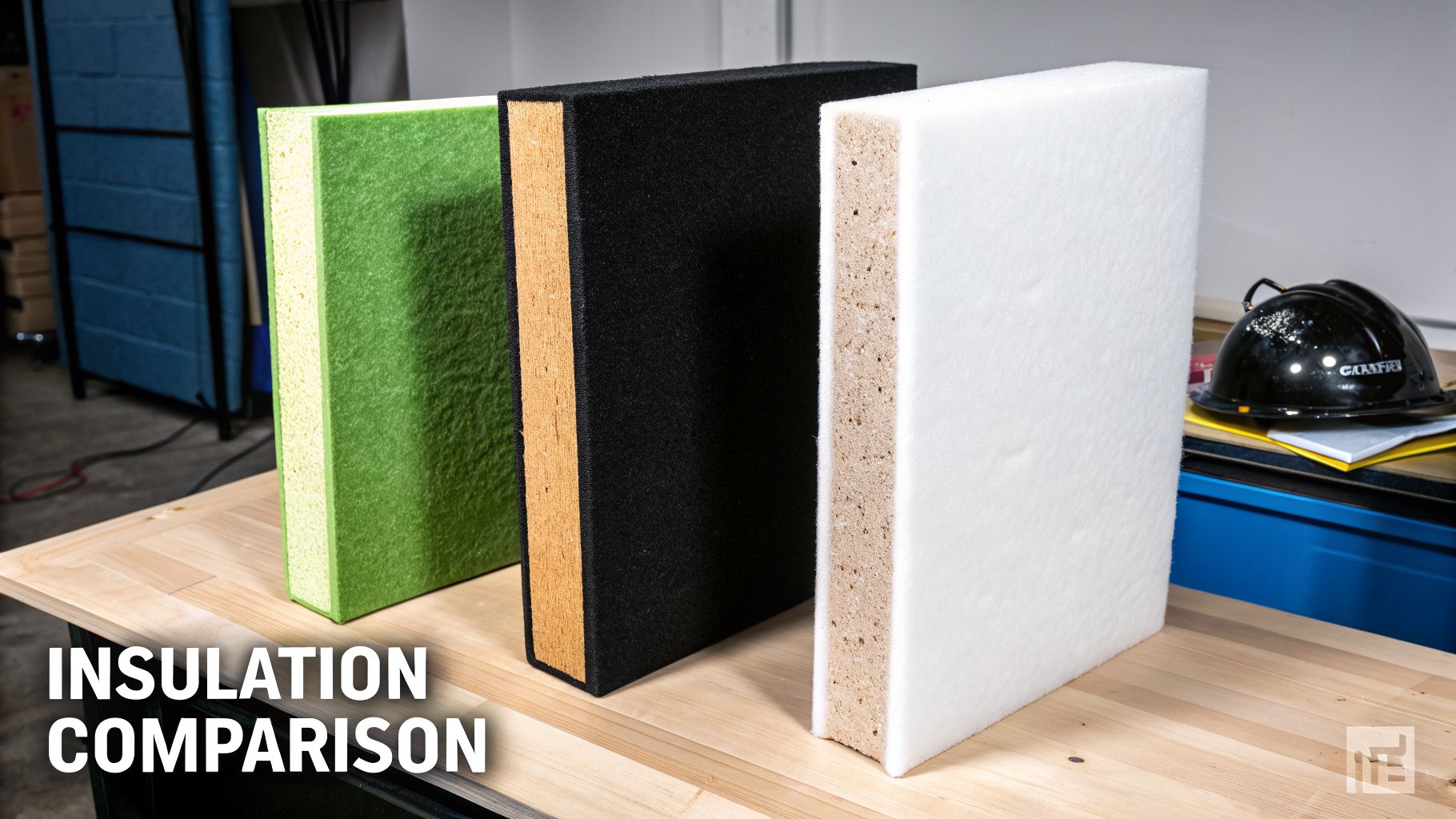
Thermal Performance and Air Sealing
An insulation’s stated R-value is just one part of the story. In a hot climate, stopping hot air from moving through your walls and attic is just as critical, if not more so.
Fiberglass (Batts and Blown-In)
Fiberglass is a common choice, offering an R-value of R-3.0 to R-4.0 per inch. But it has a major flaw: it doesn't stop air movement. It only traps it.
Think of it like a wool sweater. It’s warm, but wind cuts right through it. Hot, humid air easily moves through the gaps and seams in fiberglass batts, making that R-value far less effective in practice. Blown-in fiberglass covers better, but it still can’t create a true air barrier.
Cellulose (Blown-In)
Made from recycled paper, cellulose packs in a little tighter and has a slightly better thermal resistance, around R-3.2 to R-3.8 per inch. When dense-packed, it does a better job of slowing down air leaks than fiberglass.
But "slowing down" isn't the same as "stopping." Cellulose is still air-permeable. Over time, it’s also known to settle, creating gaps at the top of wall cavities and reducing its overall performance.
Spray Foam (Open-Cell and Closed-Cell)
This is where spray foam changes the game entirely. It’s not just an insulator; it’s an air barrier.
- Open-Cell Spray Foam: Delivers an R-value of R-3.5 to R-3.8 per inch and expands like shaving cream to seal every crack and hole. It creates a phenomenal air seal.
- Closed-Cell Spray Foam: This is the heavy-hitter, with a powerful R-6.0 to R-7.0 per inch. It forms a dense, rigid, and complete air seal, blocking heat and air movement entirely.
In a hot, humid climate, a complete air seal is the single most important factor for comfort and energy efficiency. Stopping convective heat gain is non-negotiable, and only spray foam insulation achieves this as a single product.
Moisture and Mold Resistance
Humidity is the enemy in South Florida. Any insulation that holds onto moisture will lose its effectiveness and become a perfect home for mold. We’ve torn out countless attics full of it.
Fiberglass in a Humid Climate
The fiberglass itself doesn't absorb water, but the air pockets within it do. Humid air gets trapped, condenses, and makes the insulation damp.
Once wet, fiberglass sags and compresses under its own weight, crushing its R-value. The organic dust and debris caught in the fibers become a food source for mold, creating a serious air quality problem.
Cellulose’s Moisture Problem
Cellulose is hygroscopic, which means it naturally soaks up moisture right out of the air. While it's treated with borates to resist mold, constant high humidity or a roof leak can easily overwhelm that protection.
Saturated cellulose is heavy, useless for insulation, and can take forever to dry out. All that trapped moisture can lead to wood rot in your home’s framing. You can see a more detailed breakdown in our guide comparing cellulose vs. spray foam insulation.
Spray Foam’s Impermeable Defense
Spray foam provides a real, dependable defense against moisture.
- Open-Cell Spray Foam: It is vapor-permeable, which sounds bad but is actually a benefit. If a roof leak occurs, water can pass through it, revealing the leak's location. The foam then dries out quickly without holding moisture or growing mold.
- Closed-Cell Spray Foam: This material is a true vapor barrier. Its structure is non-absorbent and completely waterproof. It’s the ultimate solution for humid attics and crawl spaces because it simply will not absorb moisture.
Long-Term Durability and Value
Good insulation should be a one-time investment that lasts for the life of your home. You shouldn’t have to worry about it again.
The Decline of Traditional Insulation
We see it all the time. Fiberglass batts sag and pull away from studs, creating huge gaps for heat to pour in. Blown-in fiberglass and cellulose both settle over time, losing up to 20% of their effectiveness in just a few years. They often need to be "topped up" every decade to maintain their original performance.
The Permanence of Spray Foam
Once applied, spray foam is there for good. It’s a rigid, permanent part of your home’s structure.
- It bonds directly to the surface, so it will never sag, settle, or shrink.
- The R-value and air seal you get on day one are the same ones you'll have decades from now.
- Closed-cell foam actually adds structural integrity, helping to reinforce your roof against high winds—a major plus in Florida.
Yes, spray foam has a higher upfront cost. But it delivers a far lower total cost of ownership because you install it once and it works for the life of the building. No re-dos, no top-ups, no worries.
Insulation Performance in a Hot and Humid Climate
Here’s a quick look at how these materials stack up when faced with the specific challenges of a climate like South Florida's.
| Insulation Type | R-Value Per Inch | Air Sealing Capability | Moisture Resistance | Best Use Case for Heat |
|---|---|---|---|---|
| Fiberglass | R-3.0 to R-4.0 | Poor | Poor | Not recommended in humid climates |
| Cellulose | R-3.2 to R-3.8 | Fair | Poor | Better than fiberglass, but still vulnerable |
| Open-Cell Foam | R-3.5 to R-3.8 | Excellent | Good | Attics, walls, soundproofing |
| Closed-Cell Foam | R-6.0 to R-7.0 | Excellent | Excellent | Attics, roofs, metal buildings, flood zones |
This table makes it clear that while some materials offer decent thermal resistance, they fall short on the two most critical factors for our climate: air sealing and moisture control.
The Clear Winner for Hot Climates
When you look at all the factors that matter in the real world, the choice is obvious. Fiberglass and cellulose are decent options for dry, moderate climates, but they just aren't built to handle the constant assault of heat and humidity we face in South Florida. Their weaknesses against air leakage and moisture make them a poor long-term investment.
Spray foam, especially closed-cell, was engineered to solve these exact problems. It delivers an unbeatable combination of high R-value, a perfect air seal, and a rock-solid moisture barrier in one application. For maximizing comfort and energy savings, it’s simply the superior choice.
A Closer Look at Spray Foam Insulation
When we’re talking about truly beating the South Florida heat, spray polyurethane foam (SPF) is in a league of its own compared to traditional insulation. It isn't just a material you stuff into a wall; it's an advanced solution applied as a liquid that expands on contact, sealing every single crack, seam, and imperfection. This process creates a single, unbroken barrier that's simply impossible to replicate with fiberglass batts or blown-in products.
That ability to form a perfect air seal is its biggest superpower. By completely stopping air leakage, spray foam shuts down convective heat gain—which is just a technical way of saying it stops hot, sticky outdoor air from getting into your cool, conditioned space. This takes a massive load off your HVAC system, leading to real energy savings and a home that's consistently comfortable.
But here's where the expertise comes in: not all spray foam is the same. You've got two main types, open-cell and closed-cell, and they have very different jobs. Understanding which one to use where is the key to getting the best insulation for heat and humidity control.
Open-Cell Spray Foam
Think of open-cell spray foam like a dense, high-quality sponge. It’s light, flexible, and has a soft texture because its tiny cells are left "open." This structure gives it a few specific advantages.
- R-Value: It delivers a solid thermal performance, coming in around R-3.5 to R-3.8 per inch.
- Air Sealing: It expands like crazy—sometimes up to 100 times its liquid size—filling every void to create an outstanding air barrier. This is great for stopping drafts and heat transfer.
- Sound Dampening: That soft, open structure is incredible at absorbing sound. It's a fantastic choice for quietening interior walls between a home office and a living room, or muffling outside noise.
The big catch, however, is that its open-cell structure makes it vapor-permeable. It breathes. While that can help you spot a roof leak because the water will pass through, it also means it’s not a moisture barrier. In a humid climate, you absolutely do not want to use it in places where it could get wet or in high-humidity zones like unvented attics without adding a separate vapor retarder.
Closed-Cell Spray Foam
Closed-cell spray foam is the heavyweight champion of insulation, especially for our climate. It cures into a hard, dense, and structurally rigid material with a completely different set of skills.
- R-Value: It packs an incredible thermal punch with an R-value of R-6.0 to R-7.0 per inch—one of the highest available. You get maximum insulation power in less space.
- Air and Moisture Barrier: This is the game-changer. The cells are totally sealed, making it impermeable to both air and water. It’s your insulator, air barrier, and vapor barrier all in one powerful application.
- Structural Strength: Because it’s so dense and rigid, closed-cell foam actually adds significant structural integrity to walls and roof decks. In Florida, where we deal with high winds, this is a huge bonus.
This trifecta of benefits makes closed-cell the go-to solution when you need uncompromising performance against heat and humidity. For a more granular breakdown, check out our guide on open-cell versus closed-cell spray foam.
For unvented attics in South Florida, closed-cell spray foam is the superior solution. Its ability to create a continuous, impermeable seal on the underside of the roof deck prevents hot, humid air from entering the attic and stops moisture from condensing.
Practical Use Cases: A Comparison
So, when do you use one over the other? It all comes down to the job at hand—the location and your primary goal.
| Application | Recommended Foam Type | Why It's the Best Choice |
|---|---|---|
| Interior Walls for Sound | Open-Cell | Its soft, spongy texture is highly effective at deadening sound transfer between rooms, at a lower cost than closed-cell. |
| Unvented Attics & Roofs | Closed-Cell | Provides the highest R-value and an integrated vapor barrier, crucial for preventing heat gain and moisture buildup in the most vulnerable part of the house. |
| Crawl Spaces | Closed-Cell | Its moisture-impenetrable structure is essential for insulating damp, humid crawl spaces and preventing mold, mildew, and wood rot. |
| Metal Buildings | Closed-Cell | Adheres directly to metal panels, stopping radiant heat and preventing condensation—a common and destructive problem in uninsulated metal structures. |
At the end of the day, what sets spray foam apart is its unique power to insulate and air seal in a single step. While open-cell has its place for controlling sound and sealing air leaks internally, closed-cell foam provides the tough, multi-layered defense you really need to conquer the brutal heat and humidity we face in South Florida.
Best Insulation Choices for Specific Applications
Knowing the science behind insulation is one thing; knowing where and how to use it in the real world is what actually turns a sweltering Florida building into a cool, efficient space. There’s no single “best” insulation for stopping heat. The right material completely depends on the job at hand.
Different parts of your property—your attic, walls, and even that metal shed out back—are hit with heat and humidity in unique ways. A smart approach means matching the right insulation to the right problem, ensuring you get the performance and value you’re paying for.
Attics and Roof Decks
Here in South Florida, the attic is ground zero for heat gain. On a typical summer afternoon, an uninsulated attic can easily soar to 150°F or higher. That punishing heat radiates straight down into your home, forcing your AC to run nonstop just to keep up.
The most powerful strategy we use is creating a sealed, or unvented, attic. We do this by applying closed-cell spray foam directly to the underside of the roof deck. This completely changes your home’s thermal boundary, moving it from the attic floor right up to the roofline itself.
The benefits are immediate:
- Radiant heat from the sun is stopped before it can even get into the attic.
- It forms a perfect air and moisture seal, locking out hot, humid air.
- Your attic stays dramatically cooler—often within 10-15 degrees of your home's air-conditioned temperature.
When your attic isn't an oven, your HVAC system and ductwork operate in a much friendlier environment, improving efficiency and extending their lifespan. For this critical job, closed-cell spray foam is the only product we trust to deliver these results.
Exterior Walls
Your home's walls make up its largest surface area, and they bake in the sun all day long. The old-school method of using fiberglass batts just doesn't cut it; they almost always leave gaps and voids around outlets, pipes, and studs, which become highways for heat and air to move through.
When we fill those wall cavities with spray foam, it expands to create a solid, seamless air barrier. Every last crack and crevice gets filled, killing drafts and stopping heat transfer in a way batts simply can't.
So, open-cell or closed-cell? It really comes down to your priorities. Open-cell foam gives you a great air seal and is fantastic for dampening sound, all at a more accessible price point. Closed-cell is the premium option: it has a higher R-value, adds serious structural rigidity to the wall, and acts as its own vapor barrier.
This chart breaks down the decision pretty clearly.
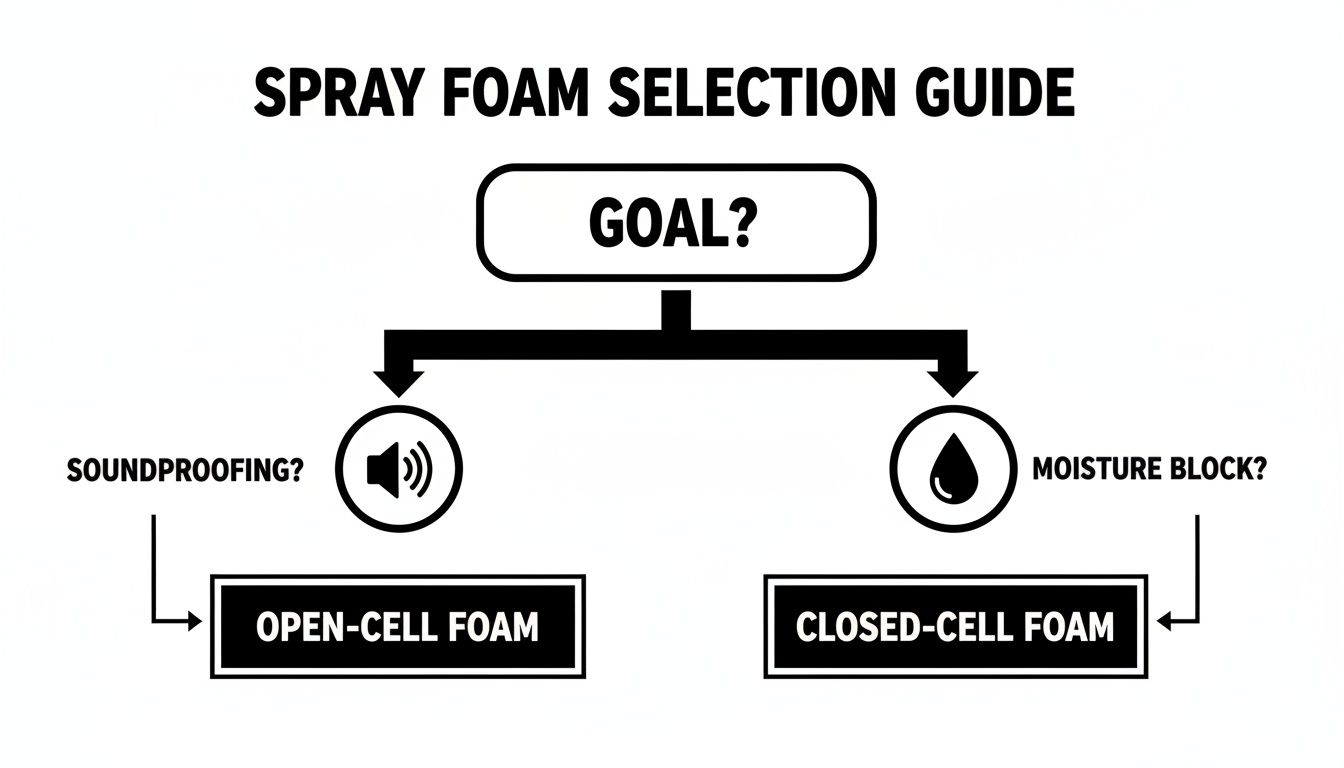
If your main goal is an absolute moisture lock and the highest possible thermal performance, the path leads directly to closed-cell foam.
Garages and Crawl Spaces
Garages and crawl spaces are usually afterthoughts, but they can funnel a surprising amount of heat and moisture into your home. Think about how hot a garage with a west-facing door gets in the afternoon—that heat seeps right through the adjoining walls.
Applying closed-cell spray foam in these areas is incredibly effective. Its rigid, waterproof structure is ideal for the damp, musty environment of a crawl space and tough enough to handle the abuse and temperature swings in a garage. Insulating these "buffer zones" makes a real difference in the comfort and efficiency of the entire house.
Metal Buildings
In the Florida sun, metal buildings are just giant ovens. The metal skin absorbs solar heat and radiates it inward, while daily temperature swings cause condensation—"sweating"—on the interior panels. That moisture leads to rust, drips, and ruined equipment.
For metal buildings, closed-cell spray foam is the definitive solution. We spray it directly onto the metal panels, where it does three crucial jobs at once:
- Stops Heat: It forms a thermal break, stopping the sun's heat from radiating inside.
- Controls Condensation: It keeps the metal surface from getting cold enough to form dew, eliminating sweating.
- Seals Leaks: It seals every panel seam and screw hole, creating a truly airtight structure.
It’s not just us, either. Homeowners are catching on, which is why the residential sector made up 49.3% of the spray foam market revenue in 2025. People are tired of high utility bills and are willing to invest in a real, high-performance solution. This shift shows spray foam isn't just a niche product anymore; it's a mainstream and proven technology. You can see more details on this trend in the full spray foam insulation market report.
Your Top Insulation Questions, Answered
After you’ve compared all the materials, the practical questions start to surface. We get it. Choosing the right insulation is a major decision for your home, and you need clear, honest answers before you invest.
Here are the most common questions we hear from homeowners across South Florida. We’ll cut straight to the point with answers based on what we see in the field every day.
Is Spray Foam Insulation Safe for My Home?
This is one of the first questions we get, and it’s an important one. The short answer is yes, absolutely—as long as it’s installed by a certified professional.
During application, two liquid components mix and react to create the foam. Once that reaction is finished and the foam fully cures (which usually takes about 24 hours), it becomes a completely inert, stable plastic. It doesn't "off-gas" or release any volatile organic compounds (VOCs).
In fact, a properly installed spray foam system actually improves your home's air quality. By creating a solid air barrier, it stops dust, pollen, and other outside pollutants from getting in. You end up with a cleaner, healthier home for your family.
The key to safety is professional installation. A certified team ensures the foam is mixed at the correct temperature and ratio, guaranteeing it cures properly and performs safely for the life of your home.
What Is the Real Cost of Spray Foam vs. Fiberglass?
Looking only at the upfront price tag is a mistake. While spray foam costs more initially, you have to consider the total cost of ownership to see the full picture.
Fiberglass is cheap to install, but its performance starts to degrade almost immediately in our humid climate. It sags, holds moisture, and loses its R-value, meaning you’ll likely pay again down the road to fix or replace it just to keep your home comfortable.
Spray foam is different. It’s a one-and-done investment. Because it creates a perfect air seal, you can see your cooling costs drop by up to 50%. Over time, the system pays for itself in energy savings. It won’t sag, settle, or absorb moisture, so it performs just as well on year 20 as it does on day one, making it a much smarter financial decision for the long haul.
Can I Install Spray Foam Insulation Myself?
Absolutely not. This isn’t a weekend warrior project. Installing spray foam is a complex chemical process that demands specialized, high-pressure equipment and a deep understanding of building science.
Our professional rigs precisely control the temperature and pressure to mix the two chemical components at the exact ratio. Get that mix wrong, and you end up with a mess—foam that doesn't cure, smells terrible, and offers none of the thermal or air-sealing benefits you paid for.
For both safety and performance, this job must be left to a trained and certified crew. We follow strict protocols to ensure the application is handled safely and the final product is stable, effective, and bonded perfectly to your home.
How Long Does Spray Foam Insulation Last?
This is where spray foam truly shines. When installed correctly, it forms a permanent, rigid bond with your home’s structure and will last for the life of the building. It’s an inert material that simply doesn’t break down.
- No Sagging: It sticks right to the sheathing and studs, so you’ll never see it pulling away or falling down.
- No Settling: Unlike blown-in materials, it won’t settle over time, which prevents gaps from forming at the top of your walls.
- Consistent R-Value: Its thermal resistance and air seal are locked in. The performance you get on day one is the performance you’ll have decades from now.
This durability is a world away from traditional insulation, which often needs a top-up or full replacement after just 10 or 15 years. Spray foam is the definition of a "one-and-done" solution, giving you reliable performance and peace of mind for as long as you own your property.
Ready to transform your home’s comfort and slash your energy bills? At Airtight Spray Foam Insulation, we provide expert spray foam solutions designed for South Florida's unique climate. Request your free, no-obligation quote today and discover how our Airtight Comfort System can make your space cooler, quieter, and more efficient.