Blog
Attic Insulation Florida: A Homeowner’s Guide to Comfort and Savings

Proper attic insulation in Florida is your home's first and most important line of defense against our relentless heat and humidity. It's the single biggest factor impacting your comfort and, you guessed it, your FPL bill.
Think of your attic as the hat your house wears. Without a good one, it just soaks up that blistering sun all day long, forcing your AC to work itself to death and sending your cooling costs through the roof.
Why Your Attic Is the Key to a Cooler Florida Home
That space above your ceiling isn't just for storing Christmas decorations—it’s a critical thermal buffer zone between your living space and the full force of the Florida sun.
Here in places like West Palm Beach and Jupiter, it’s not uncommon for an under-insulated attic to hit 130°F or higher on a normal summer afternoon. That scorching heat creates a massive radiator effect, constantly pushing warmth down through your ceilings and straight into your home.
This process forces your air conditioning system into a battle it was never designed to win. Your AC runs longer and harder just to keep up, leading to sky-high energy bills and putting a ton of premature wear and tear on your expensive equipment.
The Hidden Dangers Lurking in a Hot Attic
Beyond the obvious heat gain, a poorly insulated attic in Florida creates the perfect storm for a whole host of other serious issues. Our notorious humidity is always looking for a way in, and when that hot, sticky air meets a cooler surface in your attic, you get condensation. That moisture becomes a breeding ground for problems that can quietly destroy your home’s health and structural integrity.
Here’s what you’re really up against:
- Skyrocketing Energy Bills: Your AC is already the biggest energy hog in your house. A poorly insulated attic makes it work overtime, directly inflating your monthly power bill.
- Moisture and Mold Growth: Trapped humidity and condensation create a five-star resort for mold and mildew. This doesn't just damage drywall and wood; it can seriously impact your family's respiratory health.
- An Uncomfortable Home: That constant heat radiating from the ceiling leads to stuffy rooms and annoying "hot spots" that never seem to cool down, no matter how low you set the thermostat.
- Structural Damage: Over time, those extreme temperature swings and constant moisture can degrade roofing materials, rot wooden trusses, and weaken your home's entire structure, leading to expensive, unexpected repairs down the road.
By getting a handle on heat and moisture, proper attic insulation does so much more than lower your bills—it protects the very structure of your home and improves the air you breathe. It's truly a foundational investment for any Florida homeowner.
Choosing the Right Insulation for Florida's Climate
Picking the right attic insulation in Florida isn't just a home improvement project; it's like arming your house for a daily battle against our relentless heat and humidity. On the surface, different insulation types might look similar, but how they perform in this climate couldn't be more different. Think of it like choosing between a wool sweater and a high-tech rain jacket for a tropical storm—only one is actually going to keep you dry.
Traditional materials like fiberglass batts and blown-in cellulose are the "wool sweaters" of the insulation world. They work just fine in dry, northern climates, but they really struggle with the soupy, humid air we live with year-round. These materials act like sponges, soaking up moisture right out of the air. Over time, this causes them to get heavy, sag, and compress, which absolutely tanks their insulating power, or R-value.
Even worse, once they're damp, they become the perfect breeding ground for mold and mildew. This not only wrecks your indoor air quality but can also start to rot the very structure of your home. It’s a huge vulnerability, especially when Florida’s storm season rolls around.
The Superiority of an Air-Sealing Solution
This is where spray foam insulation comes in, acting as that high-tech, waterproof jacket. Closed-cell spray foam, in particular, does more than just slow down heat. It creates a solid, rigid barrier that completely blocks air and moisture from getting through.
When applied, it expands to fill every single crack, gap, and crevice in your attic, forming one continuous, airtight seal. This all-in-one air-sealing capability is what truly sets it apart, because it gets to the root cause of so many attic-related headaches.
As you can see, a hot attic is just the beginning of a chain reaction that leads to bigger issues.
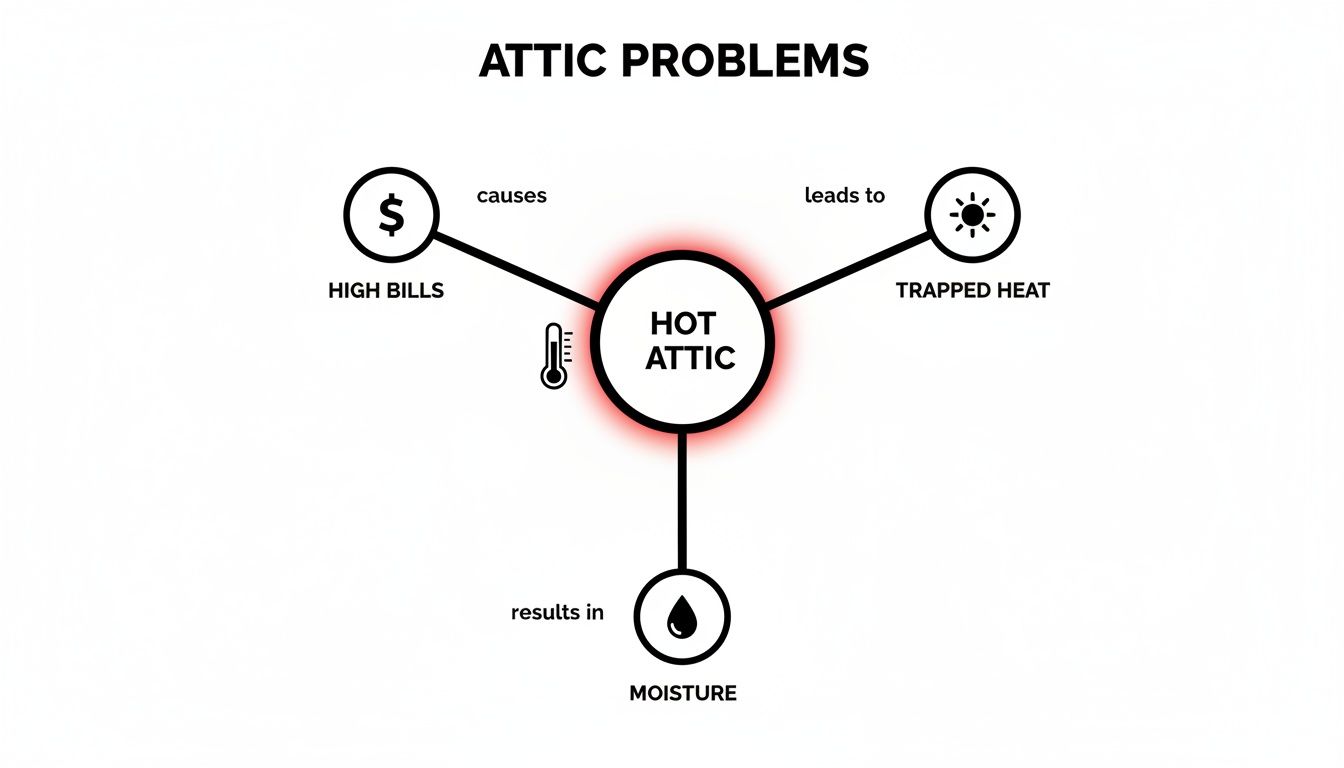
That trapped heat is the trigger for a whole cascade of expensive problems that ripple through your entire home.
To give homeowners a clearer picture, we've put together a simple table comparing how these materials stack up in the ways that matter most for a Florida home.
Florida Insulation Material Comparison
| Feature | Fiberglass/Cellulose | Spray Foam (Closed-Cell) |
|---|---|---|
| Moisture Resistance | Poor – Absorbs moisture easily | Excellent – Acts as a moisture barrier |
| Air Sealing | Fair – Allows air leakage | Excellent – Creates an airtight seal |
| R-Value Stability | Degrades when wet or compressed | High and stable; unaffected by moisture |
| Structural Integrity | Adds weight, can sag when wet | Adds rigidity and strength to roof deck |
| Mold/Pest Resistance | Prone to mold growth; can house pests | Inorganic; does not support mold growth |
| Hurricane Resilience | Can become waterlogged, leading to ceiling collapse | Adds "glue-like" bond, won't absorb water |
As the comparison shows, spray foam isn't just another insulation option—it's a comprehensive building envelope solution designed to handle the specific challenges we face here.
Insulation Performance During Florida Storms
The need for real moisture resistance becomes terrifyingly clear when you think about hurricane-force winds and driving rain. The structural failures we've seen in major storms prove how traditional insulation can become a massive liability when things get rough.
When Hurricane Andrew tore through, an astonishing over 80% of property losses were tied to roof failures and the water that poured in. That water soaked the old-school insulation, making it incredibly heavy and weakening the drywall ceilings underneath until they collapsed catastrophically.
Spray foam insulation completely changes this dynamic. Because closed-cell spray foam is rigid and doesn't absorb a drop of water, it actually adds structural strength to your roof deck. It won't become a water-logged weight threatening to bring your ceilings down during a storm.
This resilience makes it the clear choice for durable, long-term protection in our state. By creating a tough, integrated barrier, it helps fortify your home against the unique punishment our weather dishes out. Understanding how a proper air and moisture seal works is key, which is why we created a detailed guide on vapor barriers and insulation. This integrated approach is the secret to a truly protected and efficient home in South Florida.
The Sealed Attic Advantage for Energy Savings
For decades, many Florida homes were built with "vented" attics. It was a construction standard borrowed from colder climates where letting air circulate was a good thing. But in our hot, humid world, that strategy completely backfires. Vented attics basically act like a vacuum, constantly pulling super-heated, moisture-heavy air right into your home and turning that space into an unbearable heat trap.
This is exactly why modern building science has moved on to a far superior approach: the sealed or unvented attic.
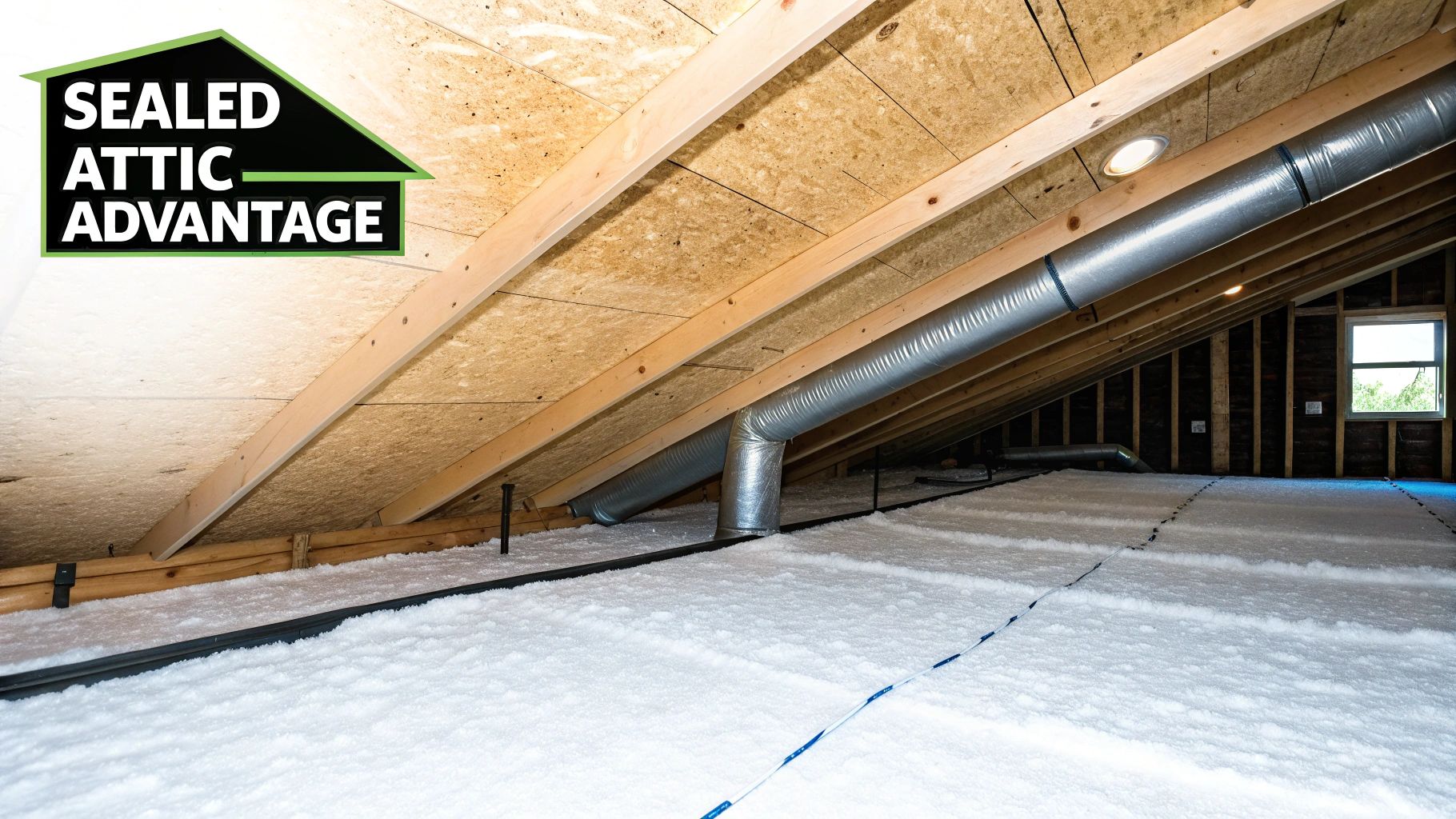
Instead of inviting the oppressive outside air in, a sealed attic system slams the door shut. By applying spray foam insulation directly to the underside of your roof deck, we fundamentally change the way your home functions. The technique literally moves your home's thermal boundary from the attic floor all the way up to the roofline.
Transforming Your Attic from a Furnace to a Buffer Zone
The results are nothing short of remarkable. Your attic goes from being an oven that can easily skyrocket to 130°F to a semi-conditioned space that stays much, much closer to the temperature inside your home.
Now, think about what's sitting up there in your attic: your HVAC unit and all its ductwork. In a traditional vented attic, this critical equipment is forced to operate in extreme heat. Your air conditioner has to work overtime just to cool the air inside the ducts before that air can even begin to cool your living room. It's an exhausting, inefficient cycle.
A sealed attic stops this madness. By bringing your HVAC system and ductwork inside the conditioned "envelope" of your home, you eliminate a massive source of energy waste. This pays off in several huge ways:
- Dramatic Energy Efficiency: Your AC isn't fighting a losing battle against attic heat anymore, so it runs less often and for shorter periods.
- Lower Utility Bills: Less AC runtime translates directly into real, noticeable savings on your monthly power bill.
- Improved Indoor Air Quality: Sealing the attic stops dusty, humid, and allergen-filled outside air from getting sucked into your home's air supply.
- Consistent Home Comfort: You'll finally get rid of those frustrating hot spots and enjoy a more stable temperature throughout the house.
The concept is simple: Instead of letting your attic work against your air conditioner, a sealed system makes them work together. This single change can have a profound impact on both your comfort and your wallet.
Quantifying the Savings in Florida
This isn't just theory; the energy savings have been proven right here in our backyard. Field studies by the Florida Solar Energy Center (FSEC) found that sealed attic construction can slash cooling energy use by around 8%. That might not sound like a huge number, but it adds up to hundreds of dollars in savings every single year for the average Florida homeowner.
And for homes with older, leaky ductwork—which is incredibly common—the savings can easily jump into the double digits. You can dig into the data yourself by exploring the University of Central Florida's research.
By creating a complete air seal, spray foam provides an advantage that goes beyond just resisting heat; it stops the very air movement that carries that heat in the first place. This comprehensive approach becomes even more powerful when paired with other technologies. To see how, check out our guide on how radiant barriers work with attic insulation. Simply put, the sealed attic is the modern standard for a high-performance home in Florida.
Decoding R-Values and Florida's Building Codes
You’ve probably heard the term R-value thrown around when talking about insulation. So what does it actually mean for your home here in Florida? Think of it as a material's defensive strength against heat. The higher the number, the better it is at stopping heat from moving through it. Simple as that.
For our relentlessly hot and humid climate, the Florida Building Code sets the bar for attic insulation somewhere between R-30 and R-38. This is the sweet spot for blocking the intense sun that bakes our roofs all day long from turning your living space into an oven. Hitting this target is a non-negotiable for an energy-efficient home.
But here’s something most people don't realize: relying on R-value alone can be a trap, especially with old-school insulation like fiberglass or cellulose. Sure, those materials might boast a high R-value on the box, but that number takes a nosedive the second air and moisture start moving through them. An R-38 fiberglass batt riddled with air gaps isn't performing anywhere close to its rating.
Why R-Value Is Only Half the Story
This is where the real-world performance of attic insulation in Florida comes into sharp focus, and it’s why spray foam is in a league of its own. While its R-value per inch is certainly impressive, its true value comes from creating a seamless, airtight seal.
Spray foam doesn't just put up a barrier against heat; it stops the super-heated, moisture-heavy air that carries that heat from getting into your home in the first place. This air-sealing power delivers a level of performance that a simple R-value number just can't measure.
That's a game-changer in our climate. While traditional insulation might technically meet the code on paper, it often fails miserably in practice because of air leakage. A professionally installed spray foam system doesn't just meet the building code—it blows past its intended purpose by creating a single, unbroken thermal and air barrier.
If you want to dig deeper into the numbers, you can learn more about the effective R-value of spray foam and see exactly why it's a superior choice.
What to Expect During Your Attic Insulation Installation
Knowing what happens during a professional attic insulation installation in Florida can take the mystery out of the whole project. At Airtight Spray Foam Insulation, we've honed a clean, methodical process designed to be efficient and keep disruptions to your daily life at a minimum. It’s a well-oiled machine from the moment we arrive to the moment we leave.
The first step is always a comprehensive, no-obligation home assessment. One of our experts will come out to your home, get up in the attic, and see exactly what we're working with. We'll measure the space, check for any tricky spots like air leaks or moisture problems, and get a feel for your home's unique needs. This is how we give you a precise, honest quote with a clear plan of attack.
Once you give us the green light, we’ll schedule the installation for a time that works for you. Our main job is to make this as smooth as possible for you and your family.
Preparing Your Home for Installation
Before our team even thinks about spraying, we take meticulous steps to protect your property. This prep phase is non-negotiable for a clean, professional job. We'll lay down protective coverings over your floors, furniture, and anything else in the work area to shield it all from dust and overspray.
Our technicians create a self-contained work zone, often sealing off the attic access from the rest of the house. This keeps the entire process confined right where it needs to be—in the attic. We treat your home like it's our own, making sure everything is buttoned up and safeguarded.
The success of an attic insulation project isn't just about the final product—it's about the care and precision taken at every step. A clean, well-managed installation is the hallmark of a true professional.
The Application and Curing Phase
With your home prepped and protected, our certified technicians get down to business. Decked out in full personal protective equipment (PPE), they use specialized equipment to apply the spray foam with expert precision. For a sealed attic, this usually means applying it directly to the underside of the roof deck, creating one solid, continuous barrier against the Florida heat.
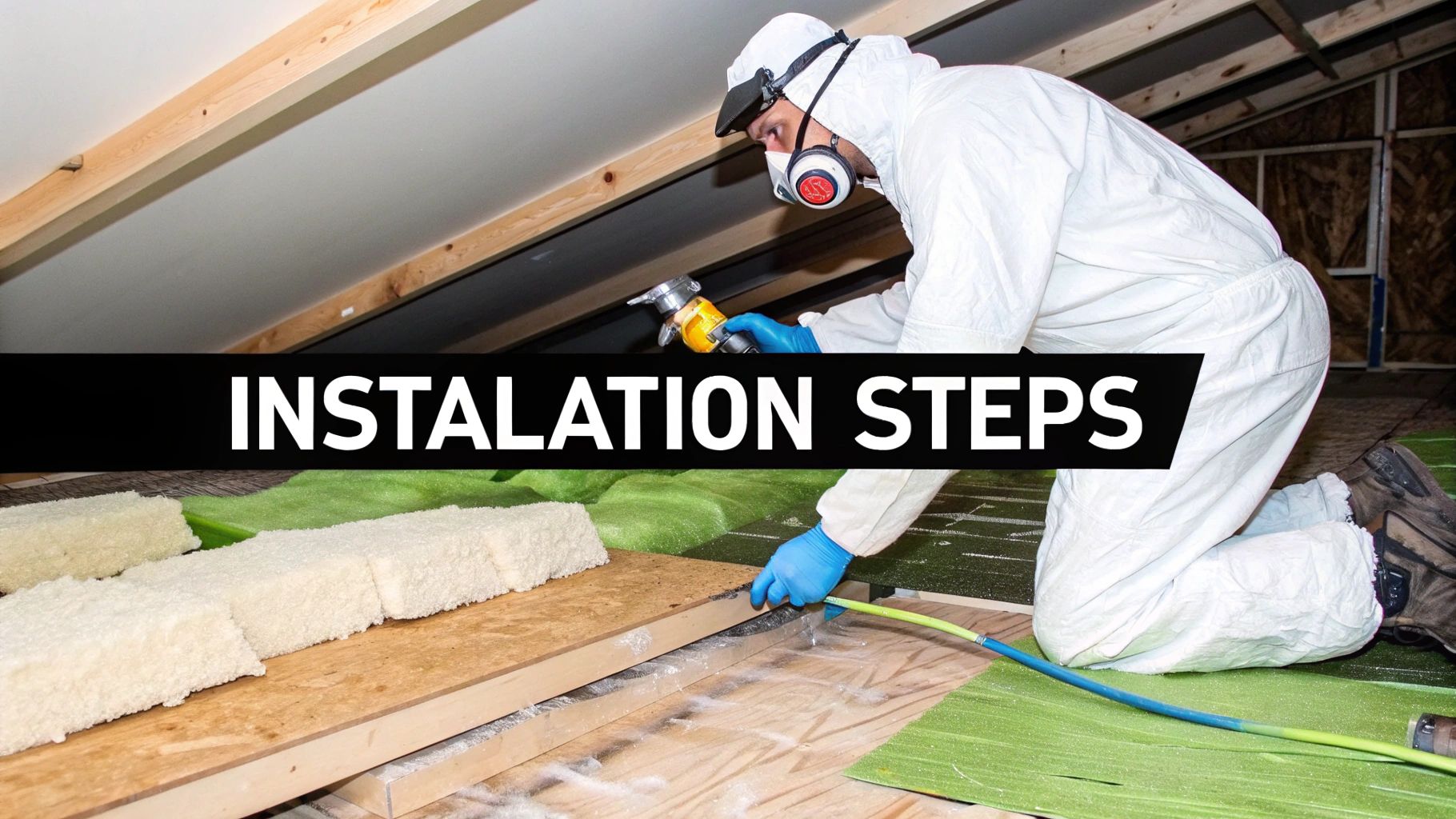
The crew works methodically to get complete coverage, sealing every last gap, crevice, and potential air leak. For a typical home, we can usually get the application phase done in a single day. The foam itself cures fast, becoming a solid, inert part of your home’s structure within 24 hours.
Final Cleanup and Quality Inspection
Our commitment to a job well done doesn’t stop when the spraying is finished. Once the insulation is in place, our team does a full, thorough cleanup of the work area. We pull up all the protective coverings, pack up our equipment, and clear out any debris, leaving your home exactly as we found it.
The very last step is a detailed quality inspection. A project manager will do a final walkthrough of the completed work with you, making sure the application meets our tough standards and, more importantly, your complete satisfaction. This final check is how we guarantee you get the full benefits of a professionally insulated attic and the peace of mind that comes with our 100% satisfaction guarantee.
Calculating Your Return on Investment
It’s easy to look at professional attic insulation in Florida as just another line item on a home improvement budget. I see homeowners make that mistake all the time. But the reality is, it’s a powerful investment that starts paying you back the moment it’s installed. While there’s an upfront cost, the financial returns are both immediate and long-lasting.
Of course, project costs vary. The biggest factor is the total square footage of your attic, followed by the type of insulation you choose. For instance, high-performance spray foam usually has a higher price per square foot than traditional fiberglass, but its ability to create a true air seal often leads to a much faster and larger return on your investment.
Breaking Down the Financial Benefits
The payback on this kind of project comes from several different directions, building a strong financial case for any homeowner in South Florida. It’s about more than just what you see on your FPL bill.
- Substantial Energy Savings: This is the most obvious return. By drastically reducing how hard your AC has to work, you can expect to slash your cooling costs by as much as 20% to 40%.
- Reduced HVAC Wear and Tear: Your air conditioner is one of the most expensive and hardworking appliances you own. Letting it run less often and more efficiently extends its lifespan, delaying thousands in repair or replacement costs down the road.
- Potential Insurance Benefits: Some homeowner's insurance policies actually offer discounts for homes with features that improve wind and moisture resilience. The structural integrity that spray foam adds can sometimes help you qualify.
Your return isn't just about the money you save; it's also about the expensive problems you prevent. A properly insulated and sealed attic is your home's best defense against moisture damage, mold growth, and the premature death of your HVAC system.
A huge part of the payoff is that dramatic drop in cooling costs. For even more ways to save, check out these 10 proven ways to lower your electric bill.
In our experience, most clients find the project completely pays for itself within just a few years from the energy savings alone. After that, it’s just money back in your pocket, month after month, for as long as you own your home.
We Get These Questions All the Time
It’s completely normal to have a few questions before you commit to a big home improvement project like upgrading your attic insulation. Getting clear, honest answers is the first step toward feeling confident about the long-term value you’re adding to your home here in Florida.
Is Spray Foam Insulation Safe for My Family?
Absolutely. When a certified pro handles the installation and follows the strict safety protocols, modern spray foam insulation is perfectly safe. The magic happens during the curing process—usually within 24 hours—when the material becomes completely inert and stable.
Once it's cured, it’s not off-gassing or releasing anything harmful. In fact, it does the opposite. By creating that signature airtight seal, spray foam actually improves your indoor air quality by blocking all the dust, pollen, and other gunk from outside from getting into your living space.
How Long Does Spray Foam Last?
This is where spray foam, especially closed-cell, really shines. It's built for the long haul. Unlike old-school insulation that gets damp, sags, and settles over the years, spray foam is a rigid, durable material that literally becomes one with your home's structure.
It holds its shape and its R-value for decades. Think of it as a one-and-done investment that will last the entire life of your house. You won't ever have to think about replacing it.
When you're vetting contractors for your attic project, checking their online reviews is a must. Solid research shows the impact of online reviews on home improvement contractors is huge—it directly reflects their reputation and how much you can trust them to do the job right.
Ready to feel the difference in your home’s comfort and see it on your FPL bill? Reach out to the experts at Airtight Spray Foam Insulation. We’ll give you a free, no-pressure quote and show you what a professionally sealed attic can do. Get Your Free Estimate Today!