
You're standing in a hot attic in Jupiter in July, and the job is already telling you what it needs. The roof deck is baking, the air feels heavy, and the wrong insulation will trap problems instead of solving them. In South Florida, the best closed cell spray foam isn't the foam with the slickest label, it's the foam that matches the assembly, keeps moisture under control, and still holds up when August heat and coastal humidity hit the same roofline.
| Criterion | Closed Cell | Open Cell |
|---|---|---|
| R-value per inch | R-6.0 to R-7.0 per inch, with common references around R-6 per inch | R-3.5 to R-3.8 per inch |
| Vapor control | Can function as a vapor retarder at sufficient thickness, with values below 0.1 perms at 3 inches or more | More vapor open |
| Air sealing | Reaches air barrier performance at about 1.0 inch | Usually needs about 3.5 inches to meet similar air-barrier thresholds |
| Rigidity | Dense, rigid, about 2 lb/ft³ | Softer, lower density |
| Best fit in South Florida | Thin cavities, roof decks, metal buildings, moisture-sensitive assemblies | Interior sound control, budget-led projects, some conditioned interior walls |
A homeowner in Palm Beach Gardens opens the attic hatch in midsummer and gets hit with a wall of heat. The roof deck is hotter than the living room below, the outdoor air is loaded with moisture, and every little air leak gives that humidity a place to move. That's the kind of job that makes generic national insulation advice fall apart fast.
South Florida isn't just about temperature. It's about heat gain, humidity, and moisture migration all happening at once, often in the same assembly. That's why a roof deck, garage ceiling, or metal building here can behave nothing like the same assembly up north. If the insulation can't slow air movement and resist moisture, the house keeps paying for it in comfort and durability.
Closed-cell foam gets used first in those scenes because it solves more than one problem at once. It insulates, it seals air leaks, and at the right thickness it becomes part of the moisture-control strategy. For a coastal climate, that matters as much as the number on the R-value chart. For a deeper look at the physics behind condensation and temperature drop, the dew point explainer at Airtight Spray Foam Insulation's dew point guide is worth reading before you choose an assembly.
Practical rule: if the attic or roof assembly already struggles with humidity, don't pick insulation just by cost. Pick it by how well it controls air and vapor movement in that specific space.
That's why this topic exists at all. South Florida buildings need a material that can handle heat, humidity, and tight framing conditions without turning the assembly into a moisture trap. Closed-cell foam usually gets the call because it does the most work in the least space.
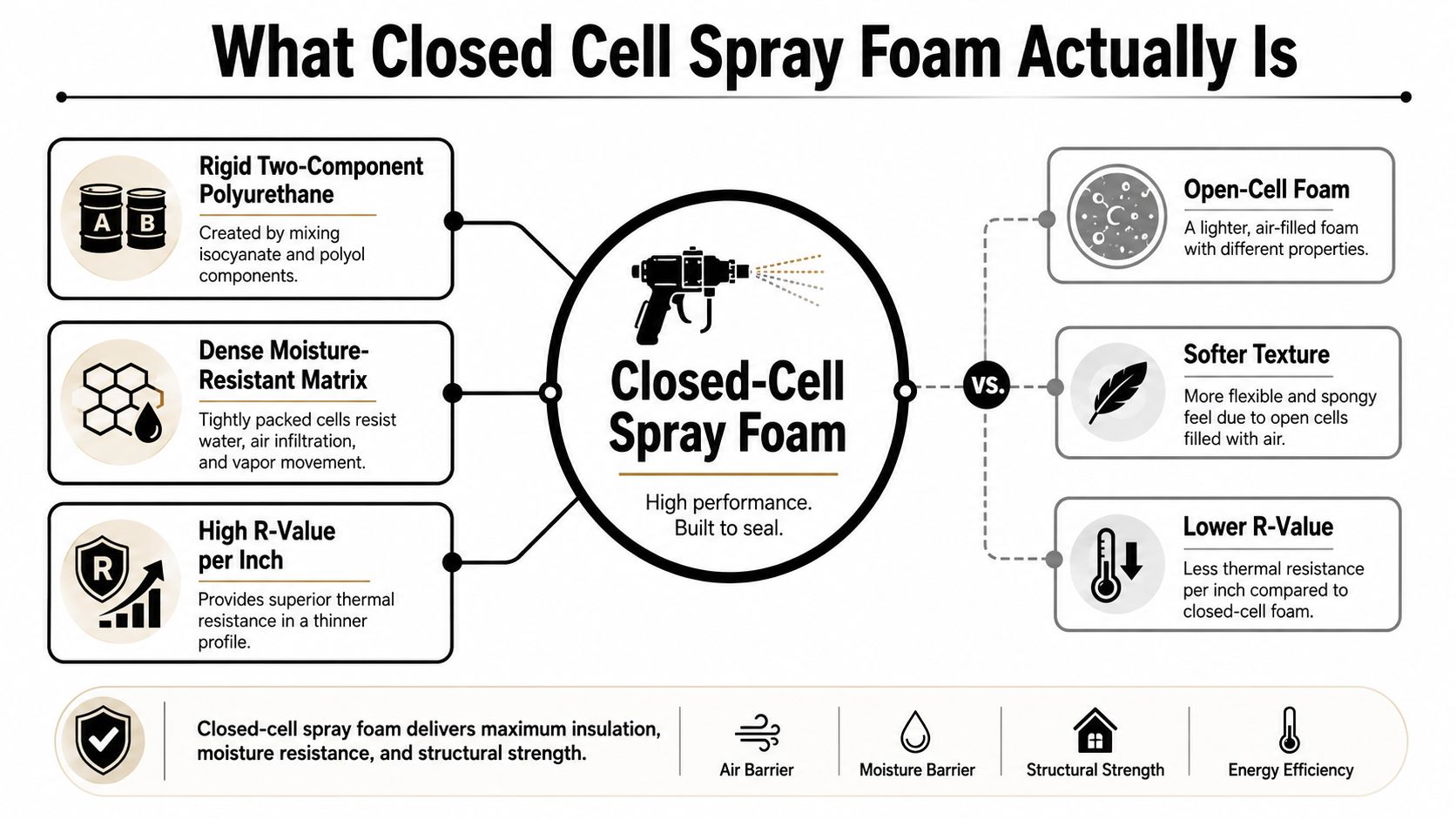
Closed-cell spray foam is a two-component polyurethane that's mixed on site and sprayed into place, where it expands into a dense, rigid layer. Once it cures, it forms a compact matrix with closed pockets, which is why it feels harder and performs differently than softer insulation products. The density is typically about 2 lb/ft³, and that rigidity is part of what makes it useful in roofs, walls, and metal buildings, where the assembly needs more than fluffy fill.
The value proposition is straightforward. Closed-cell foam typically delivers R-6.0 to R-7.0 per inch, while open-cell foam is commonly around R-3.5 to R-3.8 per inch. That means closed-cell foam gives roughly 70% to 100% more thermal resistance per inch than open-cell foam, which is why it's favored where depth is limited. In a shallow cavity or a roof assembly with tight space, that extra thermal resistance per inch matters immediately.
It also behaves like part of the building shell, not just a filler. DOE guidance notes that closed-cell spray foam is rigid, far more difficult to compress, and at typical thickness it functions as a vapor retarder. Technical references in the verified data also note vapor permeance around 0.8 to 1.5 perms at 2 inches, and below 0.1 perms at 3 inches or more, which is why installers often treat it as a Class I vapor barrier in the right buildup.
Field reality: a thin, well-installed layer of closed-cell foam can do the work of air sealing and moisture control that would take several separate products to approximate.
Closed-cell is the right fit when the assembly has limited room, moisture exposure, or a need for extra stiffness. Open-cell still has a place, especially when sound control or lower material intensity is the priority, but it doesn't bring the same compact thermal and vapor-control package. For a straight technical primer on the material itself, the overview at Airtight Spray Foam Insulation's closed-cell guide is a useful reference point.
The easy answer is that closed-cell wins in South Florida. The better answer is that it wins in the assemblies where vapor control, rigidity, and thin-cavity performance matter more than softness or budget. Open-cell can still be the smarter choice in the right interior application, especially when sound dampening and lower density are the goals.
Closed-cell's edge starts with thermal resistance. At R-6.0 to R-7.0 per inch, it packs more insulation into less depth than open-cell, which sits around R-3.5 to R-3.8 per inch. That makes closed-cell stronger in roof decks, exterior walls, and metal buildings where you can't just keep adding thickness and call it done.
Air and vapor behavior matter just as much in this climate. Closed-cell can function as an air barrier at about 1.0 inch, and it can drop below 0.1 perms at 3 inches or more, which gives it moisture-control authority that open-cell doesn't match. In South Florida, that can be the difference between an assembly that dries predictably and one that holds onto humidity in the wrong layers.
Open-cell does have strengths. It's softer, it usually costs less, and it can do a better job on interior sound control. In conditioned spaces where moisture risk is already controlled and the cavity depth isn't an issue, open-cell can be perfectly appropriate. That's especially true when the assembly doesn't need the extra rigidity or vapor resistance that closed-cell brings.
| Criterion | Closed Cell | Open Cell |
|---|---|---|
| R-value per inch | Higher, about R-6 to R-7 | Lower, about R-3.5 to R-3.8 |
| Vapor control | Stronger, can act as vapor retarder | More vapor open |
| Air sealing | Reaches air barrier performance at about 1.0 inch | Usually needs about 3.5 inches |
| Sound dampening | Moderate | Better in many interior uses |
| Structural contribution | Rigid, adds strength | Softer, less structural effect |
| Best climate fit | Humid, shallow, moisture-sensitive assemblies | Interior, budget-sensitive, sound-focused assemblies |
The right takeaway is simple. Closed-cell isn't “better” in every room, but it's usually better where South Florida buildings get punished most. For a broader product-selection perspective, the commercial comparison at Polyguard's closed-cell foam selection article reinforces the same assembly-first logic.
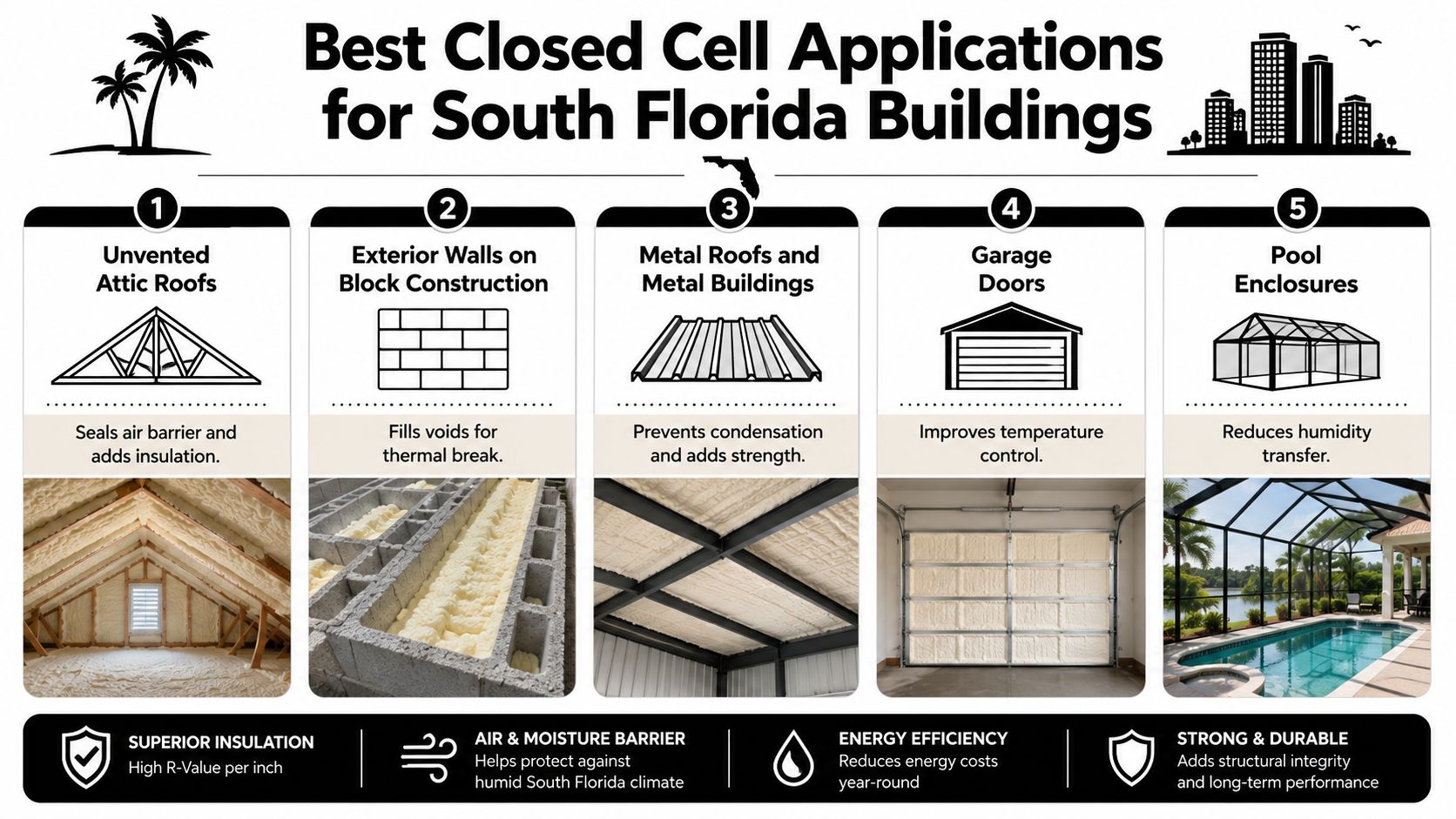
Closed-cell foam earns its keep fastest in assemblies that need moisture resistance, thermal performance, and compact coverage. In South Florida, that usually means roof decks, block walls, metal buildings, garages, and below-grade or rim areas where the edge of the house needs more protection than fiberglass can give it.
Roof decks are the classic use case. The attic gets brutally hot in summer, and unvented assemblies need a material that can air-seal while staying compact. Closed-cell gives that roof plane a stronger thermal and moisture-control layer without demanding much depth, which is why it's often the first product considered in retrofits and new construction alike.
On block construction, closed-cell helps reduce the thermal penalty of the wall assembly and closes off paths for humid air. In metal buildings, it's even more valuable because the material's rigidity and moisture resistance help address condensation risk on thin skins and framing members. The same logic applies to garages under living space, where temperature control and moisture management both matter.
Rim areas and below-grade bands are small spaces with outsized leakage problems. Closed-cell fits there because it can be installed in limited depth while still delivering a strong air seal and a high R-value per inch. That's where the material's compactness really becomes an advantage, not just a spec on paper.
Good assemblies don't ask one material to do a bad job. Closed-cell works best when the building needs a thin, durable layer that handles air and moisture at the same time.
The decision map below shows the five uses that usually make the most sense in South Florida. For roof decks and metal buildings in particular, closed-cell is often the most practical way to get both performance and durability in a single pass.
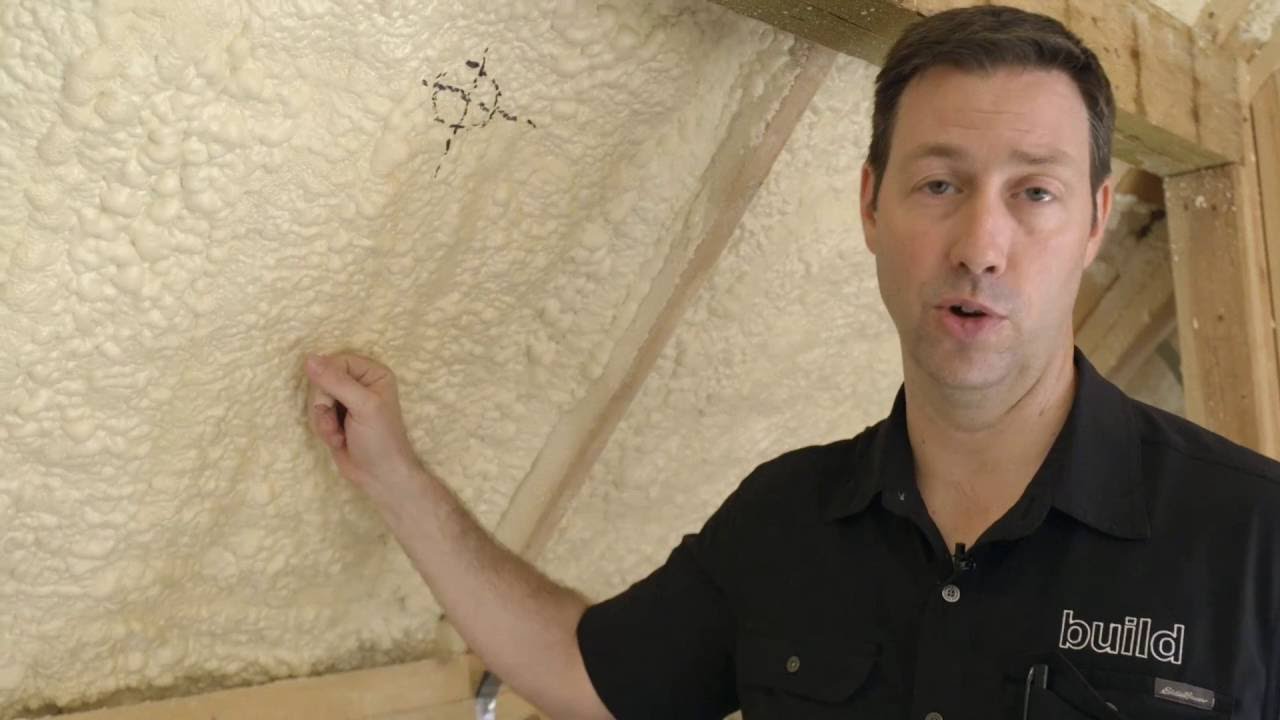
Closed-cell foam can look great on day one and still fail the job if the prep is sloppy. Moisture in the substrate, the wrong spray window, weak proportioning, or rushed coverage can turn a premium material into a callback. The foam itself matters, but the installer decides whether it performs the way the spec sheet says it should.
Wood framing moisture should be below 18% before application, and that field check is one of the most overlooked steps in consumer buying guides. In humid South Florida, that matters because trapping moisture in an assembly is a fast way to create a bigger problem than the one the insulation was supposed to solve. Surface condition and ambient conditions also need to line up with the manufacturer's application requirements.
Pass thickness matters. So does total thickness. A crew that hammers on too much material at once can create heat buildup and poor adhesion, while a crew that stops short leaves thin spots that undercut the whole assembly. Good installers keep the spray consistent, watch the lift, and verify coverage at transitions, corners, and penetrations.
The crew's equipment and credentials matter just as much. Manufacturer-certified installers, calibrated proportioners, and on-site verification of the mixing ratio all reduce risk. If the contractor can't explain what they're checking during the job, that's a problem.
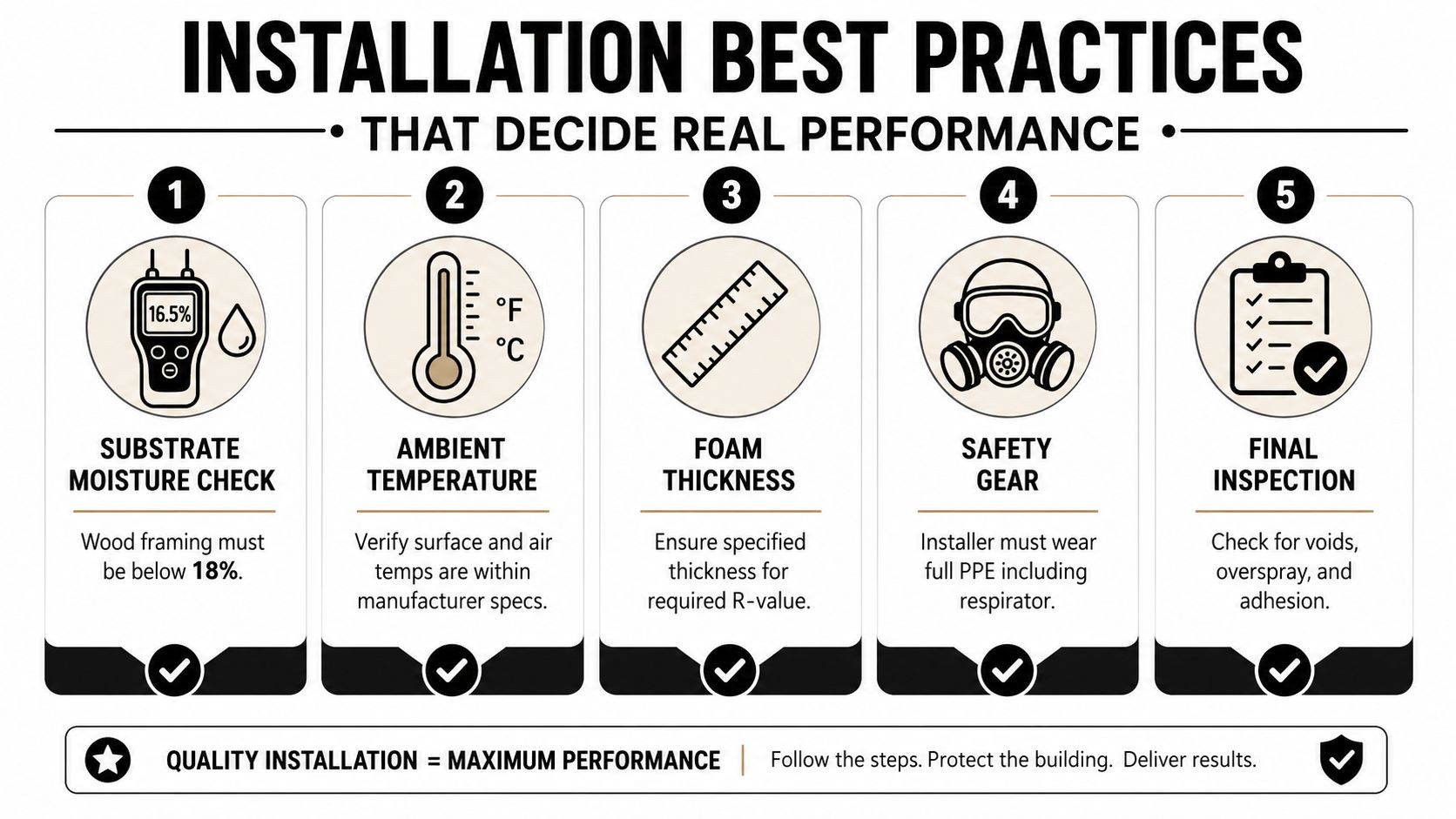
Ask for the post-install walkthrough. You want the crew to show you voids, overspray cleanup, adhesion at framing members, and the final thickness they actually delivered.
Homeowners usually want a simple question answered first. What does it cost, and what do I get back? The answer depends on the assembly, but the common South Florida conversation starts with installed pricing, then moves to cooling-load reduction, not just raw insulation value.
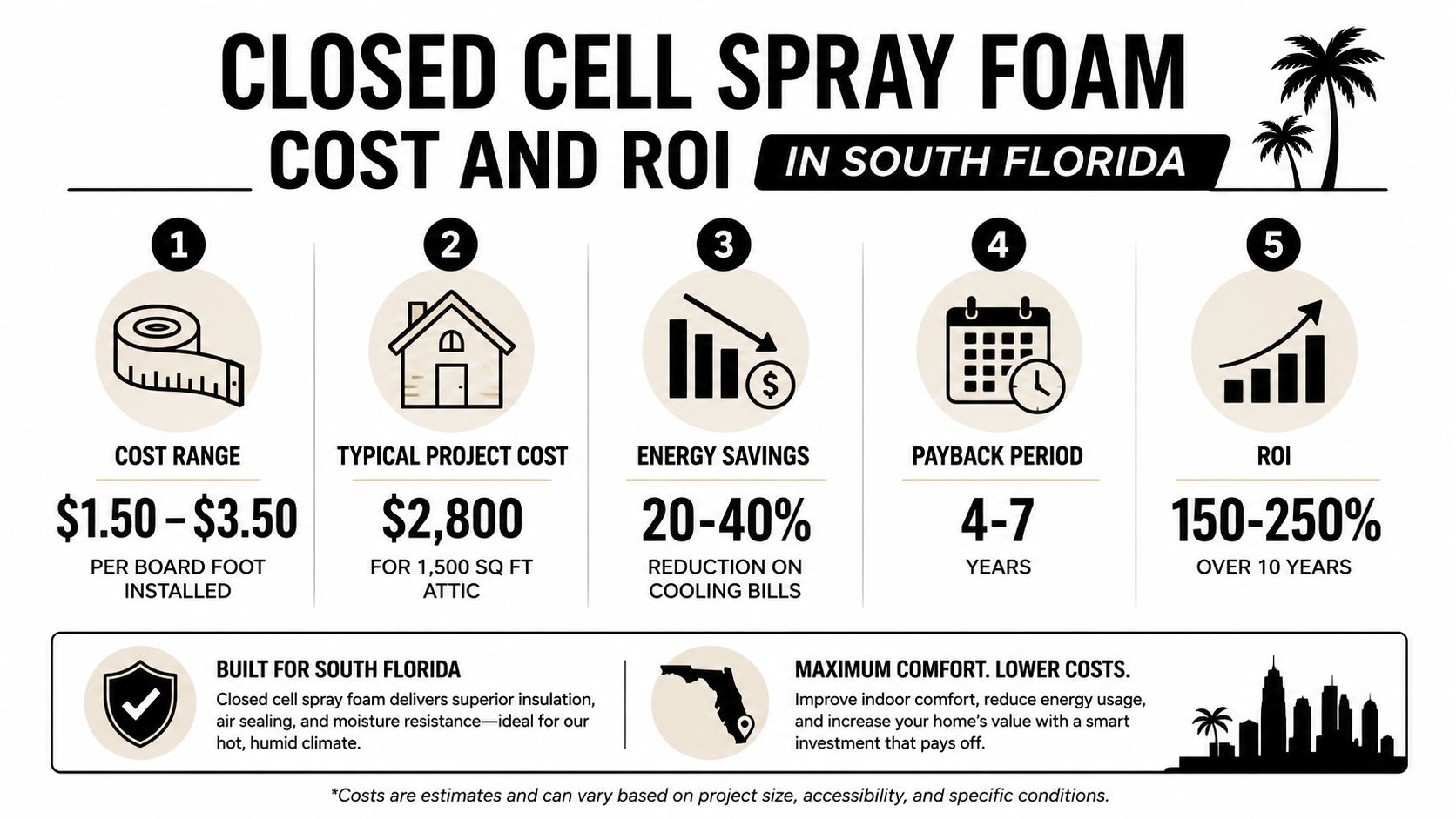
Projects are commonly discussed in installed board-foot pricing, and the visual below summarizes the typical range homeowners often see. For a roof deck or attic project, the quote may feel bigger than fiberglass at first glance, but that misses the fact that closed-cell is doing several jobs at once, including air sealing and moisture control.
For a more detailed breakdown of pricing structure, the article at Airtight Spray Foam Insulation's closed-cell cost guide is a useful companion when you're comparing estimates.
In South Florida, the return is driven mostly by cooling load reduction and the reduction of unwanted air exchange. That's why homeowners often judge the investment by monthly comfort as much as utility bills. The non-energy return matters too. Better humidity control, less indoor temperature swing, and a tougher assembly all count.
Payback only makes sense when the assembly is right. A premium foam in the wrong cavity is still the wrong fix.
The infographic below lays out the pricing and return framing that most homeowners use when they're deciding whether to move forward.
The best product can still lose if the installation team is weak. A good contractor should be able to tell you what formulation they're using, how they'll verify thickness, whether an ignition barrier is required, and what warranty applies to the job. If the answers sound vague, the estimate is too vague.
A few red flags show up again and again. The crew can't explain substrate moisture checks. They won't talk about lift thickness or final inspection. They push a one-size-fits-all answer for every attic, every wall, and every metal building. That's not building science, that's sales shorthand.
Closed-cell is not the right call everywhere. It can be overkill in conditioned interiors over already-conditioned space, and it can be the wrong move when an assembly has an uncertain moisture history that needs a more cautious approach first. Budget-led retrofits can also justify open-cell if the cavity and climate conditions make it a solid fit.
If you want a parallel checklist for vetting a mechanical contractor, the Diamond AC & Heating tips on choosing the right HVAC contractor are a smart read, because the same discipline applies here, clear scope, honest answers, and proof of workmanship.
The short decision test is this. Does the assembly need high R-value per inch, moisture resistance, and air sealing in one compact layer. If yes, closed-cell belongs in the conversation. If not, don't force it.
Closed-cell foam can last a long time when it's installed correctly, and warranty terms depend on the installer and manufacturer, so ask for both in writing before the job starts. Reoccupancy depends on the product and the crew's safety procedure, so don't assume a same-day return without getting a direct answer.
Off-gassing is another question that comes up on nearly every estimate. The safe answer is simple, follow the contractor's re-entry guidance and make sure the crew is using proper ventilation and PPE during installation. On code, some assemblies need an ignition barrier or other protective layer over spray foam, so that check belongs in the estimate, not after the foam is already on the job.
In storm conditions, closed-cell has a clear advantage over fiberglass batts and loose-fill because it stays rigid and rejects bulk moisture better in a wind-driven rain event. That doesn't make it a magic shield, but it does make it a stronger assembly choice in South Florida's weather pattern. If you're in Jupiter, Palm Beach Gardens, West Palm Beach, Wellington, or Stuart, ask for a free estimate and have the assembly evaluated before you choose a product.
If you want the right foam for a South Florida roof deck, wall cavity, or metal building, Airtight Spray Foam Insulation can evaluate the assembly and recommend the thickness and product that fits the job. Visit Airtight Spray Foam Insulation to request a free estimate and get a practical recommendation based on your building, not a one-size-fits-all sales pitch.