Your upstairs rooms feel hotter than the thermostat says they should. The AC runs for long stretches. You peek into the attic and see a blanket of fluffy fiberglass, so it’s reasonable to assume the house is insulated well enough.
That assumption is where a lot of South Florida homeowners get tripped up.
With fiberglass blown insulation r value, the number on the product matters, but it’s only part of the story. In a real attic, performance depends on depth, uniform coverage, air movement, and how the material handles our humid climate. A bag can promise one thing in controlled conditions, while your attic delivers something else entirely once heat, moisture, and installer shortcuts enter the picture.
Fiberglass can still play a role in an attic system. But if you’re judging it only by the advertised R-value, you’re missing the field conditions that decide whether your home stays cooler.
R-value is resistance to heat flow. The higher the number, the harder it is for heat to move through the material.
A simple way to think about it is a cooler. A cheap cooler and a heavy-duty cooler can both hold ice, but one slows heat transfer better. Insulation works the same way. It doesn’t create cool air. Your AC does that. Insulation helps keep outdoor heat from pushing into the house and indoor conditioned air from escaping.
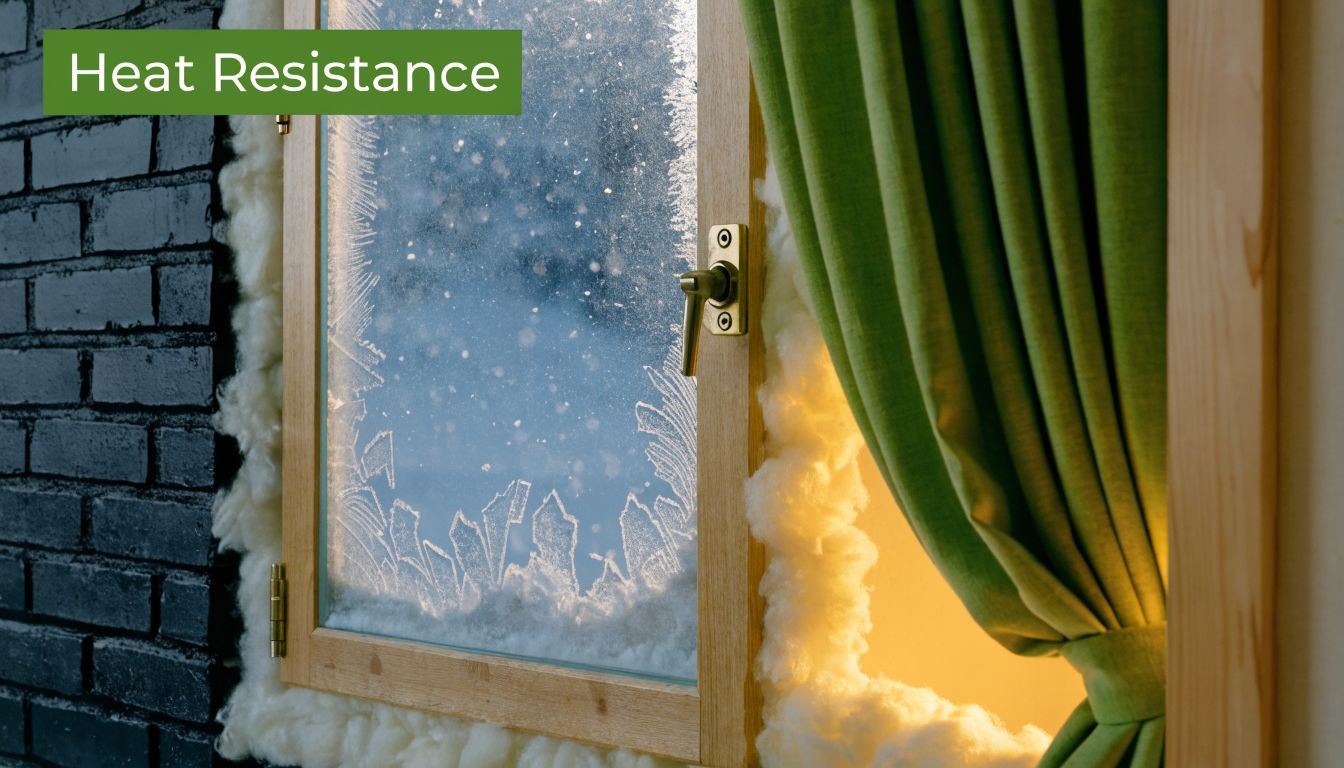
In attic applications, blown fiberglass doesn’t have one fixed number per inch. Fiberglass blown insulation currently offers R-values ranging from 2.2 to 2.8 per inch depending on density and formulation, with light, fluffy blown-in fiberglass commonly landing around R-2.2 to R-2.7 per inch, and denser formulations reaching about R-2.8 per inch, according to this fiberglass and cellulose R-value comparison.
That range matters because homeowners often hear a single fiberglass number and assume all blown products perform the same. They don’t. The installed density and the consistency of the coverage affect what you get.
Practical rule: R-value per inch is like the insulation’s grade on paper. Total attic performance depends on how much of it is installed, and whether it stays where it belongs.
There’s another piece homeowners often miss. R-value describes resistance through the insulation layer, but heat also moves through framing and other solid materials. If you want a plain-language explanation of that issue, this guide to thermal bridging is useful. Even decent insulation can underperform when heat bypasses it through structural members.
In South Florida, your attic is fighting heat for most of the year. That means the practical goal isn’t abstract. A better insulation layer helps the AC cycle more normally, keeps ceiling surfaces from radiating heat downward, and reduces those “why is this room still warm?” complaints that show up every summer.
The key takeaway is simple:
If you know that, you’re already ahead of most attic buyers.
The math is simple. Total R-value = installed depth in inches × R-value per inch.
If fiberglass is installed at a lower per-inch value, you need more depth. If it’s a denser product with a higher per-inch value, you need less. That sounds obvious, but many attics fail on this exact point because nobody measures the settled depth carefully.
Use a tape measure in several spots, not just one. Check the depth away from the attic hatch and away from the most visible high spots. Then multiply that average depth by the realistic per-inch range for blown fiberglass.
For homeowners who want a fast estimate tool, an insulation R-value calculator can help you translate inches into a target number.
Here’s the practical issue for South Florida homes. Reaching R-38 with blown fiberglass typically requires about 14 to 17 inches, using the R-2.2 to R-2.7 per inch range, based on this attic insulation R-value guide. That’s a lot of material depth in a real attic.
| Target R-Value | Required Insulation Depth (Inches) |
|---|---|
| R-30 | about 11 to 14 |
| R-38 | about 14 to 17 |
| R-49 | about 18 to 23 |
That chart is just the same formula applied to the published fiberglass range of R-2.2 to R-2.7 per inch. The lower the per-inch performance, the more depth you need.
In a South Florida attic, inches matter more than homeowners expect. A fluffy layer can look generous and still come up short.
Fiberglass looks thick before you do the math. That visual can be misleading. A loose-fill attic can appear well covered, but if you need mid-teens depth to reach a stronger target, a shallower install won’t get there just because it looks full.
A few practical points help:
For many homeowners, this is the moment fiberglass starts to look less like a compact solution and more like a depth-heavy one. In an attic with ducts, wiring, low clearances, and storage platforms, that trade-off becomes very real.
A perfect fiberglass attic has even depth from one end to the other, no thin spots around framing, no valleys near eaves, and no missed areas behind obstructions. That’s the ideal.
Actual attics rarely look like that for long.
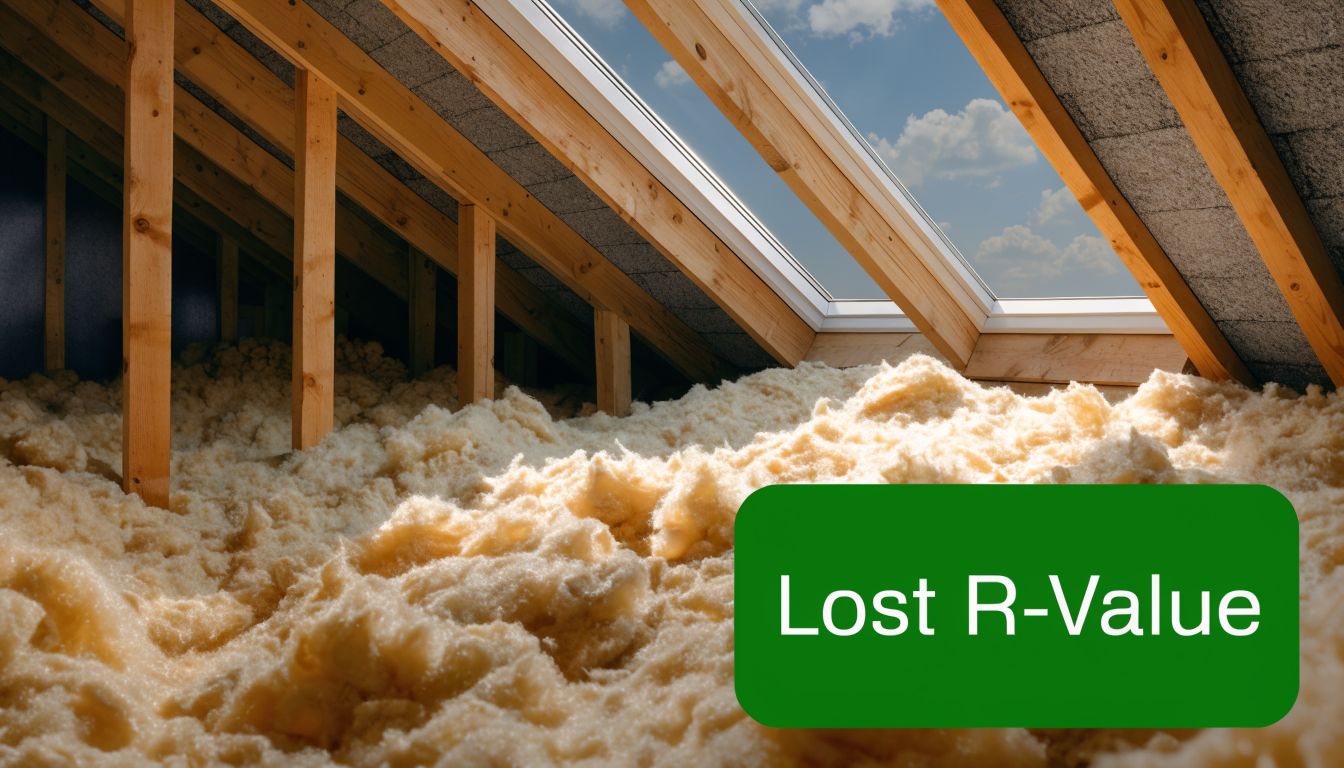
Most homeowners ask, “What R-value is fiberglass?” A better question is, “What R-value will this attic deliver after installation?”
Loose-fill products rely heavily on installer technique. The blower has to be set correctly. The hose has to be worked evenly. The crew has to mark and verify depth. If they rush, the attic ends up with hills, dips, and areas that are thinner than they appear from the access hatch.
That matters because the house doesn’t average heat gain the way a spreadsheet does. Heat looks for the weak spots.
Real-world performance falls apart as simulations show that if insulation is short by 2 inches over 50% of an attic, total R-value drops by 9%. If it’s 6 inches short on half the attic, the penalty increases to 25%, as explained in this analysis of insulation depth and poor installation.
That’s a big loss from what sounds like a small mistake.
Consider sunscreen: If you apply it heavily on your shoulders but leave patches on your back, your skin doesn’t care that the average coverage looked good. The exposed areas are where the damage happens first. Insulation behaves the same way. Thin zones become the fast path for heat.
The attic doesn’t reward “close enough.” It rewards uniform coverage.
Blown fiberglass can also lose effectiveness when the installed depth changes after the job is done. Even if the initial coverage looked acceptable, settled areas reduce total resistance because there’s less material in place.
This is one reason removal and replacement can make more sense than topping off a compromised attic. If old material is uneven, contaminated, or hiding problem areas, a clean reset gives the installer a chance to correct the assembly properly. Homeowners comparing those options can review insulation removal and replacement before deciding what condition their attic is really in.
A short visual helps show how installation details affect outcome:
If you’re inspecting a fiberglass attic, don’t just look for “some insulation.” Look for signs of consistency.
The headline number for fiberglass blown insulation r value only holds up when the blanket is deep and even. Once coverage gets sloppy, the attic starts performing like a patchwork instead of a barrier.
South Florida adds a problem that generic insulation advice often glosses over. Humidity changes the game.
Fiberglass insulates by trapping air within its structure. That works best when the material stays dry and the air spaces inside it remain undisturbed. In a hot, humid attic, moisture and condensation can interfere with those air pockets, and performance can slip from the tidy lab number homeowners were counting on.
There’s strong proof that fiberglass performance can drop sharply when conditions move away from the test environment. A landmark study found that loose-fill fiberglass lost 35% to 50% of its thermal resistance in cold conditions because convection inside the insulation carried heat through the material, as detailed in this review of loose-fill fiberglass performance in cold attics.
That study focused on cold climates, not South Florida. But it proves the larger point. Advertised R-values aren’t immune to field conditions. Environmental stress can change how fiberglass performs.
Here, the main stressor isn’t freezing weather. It’s heat, humidity, and moisture movement through the attic assembly.
Fiberglass is rated dry. South Florida attics don’t always stay dry.
When humid air gets into the attic and meets cooler surfaces, moisture can build where you don’t want it. Once fiberglass holds moisture, the material isn’t trapping insulating air as effectively. Instead of acting like a dry thermal blanket, it starts behaving more like a compromised filter.
That’s why roof condition and attic moisture control matter so much. If you’re evaluating the age and reliability of the roof above the insulation, this guide on how long a shingle roof lasts is a useful starting point. Insulation performance and roof condition are tied together more closely than many homeowners realize.
Moisture management also matters below the roof deck. Homeowners trying to understand where attic moisture comes from, and how assemblies are designed to control it, should look into vapor barriers in attics. Even a decent insulation product will struggle if the assembly allows ongoing moisture intrusion.
In South Florida, fiberglass can look fine from the hatch and still underperform. A dry, even, protected installation is one thing. A humid attic with air leakage, roof concerns, and damp insulation is another.
That’s why local performance has to be judged by more than the printed R-value. In this climate, moisture resilience is part of insulation performance, not a side issue.
Numbers get clearer when you put them into real homes.
A homeowner in Jupiter with a vented attic might aim for a stronger attic blanket to slow summer heat gain. A townhouse owner in West Palm Beach may have less attic space to work with and more mechanical congestion. In both cases, fiberglass can be installed, but the required depth becomes the central trade-off.
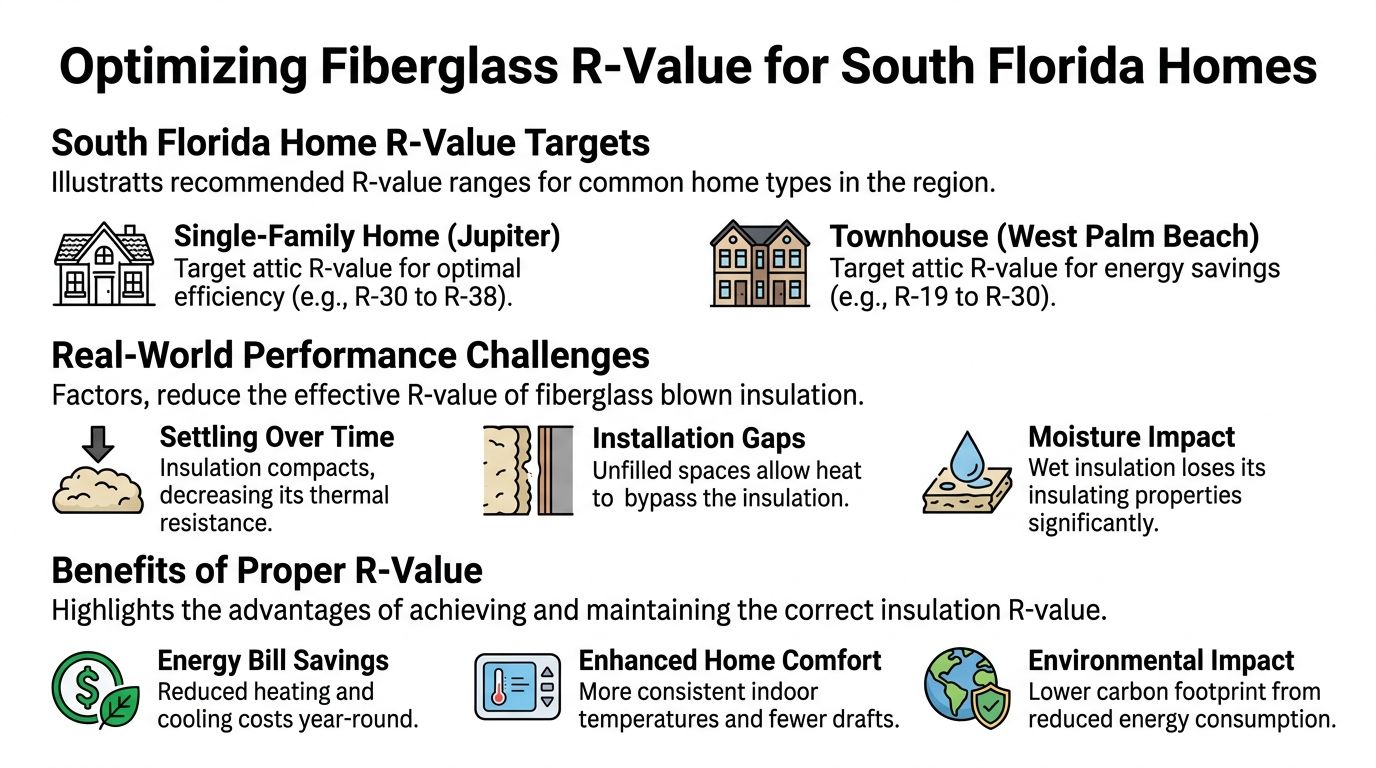
Take a standard single-family house with enough attic floor area to blow in a thick layer. On paper, fiberglass may seem straightforward because it can cover broad areas.
But if the target rises, depth rises with it. Blown-in fiberglass has a 40% to 65% performance disadvantage per inch compared with closed-cell spray foam, with fiberglass at R-2.2 to R-2.7 per inch and closed-cell foam at R-6.0 to R-7.0 per inch. To reach R-49, a home needs about 14 to 16 inches of fiberglass, while closed-cell foam needs about 7 to 8 inches, according to this attic insulation comparison.
That doesn’t automatically mean fiberglass is wrong. It means fiberglass is bulkier. If the attic has low clearance near the eaves, storage decking, or lots of ductwork, that extra depth isn’t a small detail. It affects how the whole attic can be used and how easy it is to maintain uniform coverage.
Townhouses often have tighter attic geometry. In those spaces, a material that needs more inches can run into practical limits faster.
Here’s the issue in plain terms:
A townhouse owner may decide fiberglass still fits the budget and the project. That can work if the installation is careful and the attic conditions are controlled. But if the space is shallow and mechanically crowded, thicker loose-fill becomes harder to execute well.
In cramped attics, material depth isn’t just a spec. It becomes an installation challenge.
Fiberglass performs differently depending on where it’s installed. In wall cavities, denser installation can improve per-inch performance compared with a loose attic application. That’s why homeowners shouldn’t assume attic fiberglass and wall fiberglass are interchangeable from a performance standpoint.
For South Florida homes, though, attic heat is usually the first battlefield homeowners feel. Ceiling load, duct temperature, and upper-floor comfort all point back to attic performance.
Fiberglass offers coverage. Spray foam offers more R-value per inch and a more compact thermal layer. In a humid climate, that thinner, denser approach can make practical sense where space is limited or moisture control is a major concern.
The point isn’t to force one answer for every house. The point is to read the trade-off clearly:
| Situation | Fiberglass Blown Insulation | Closed-Cell Spray Foam |
|---|---|---|
| Per-inch R-value | R-2.2 to R-2.7 | R-6.0 to R-7.0 |
| Depth to reach R-49 | about 14 to 16 inches | about 7 to 8 inches |
| Attic space impact | Higher | Lower |
| Best fit | Broad areas where depth is available | Tight or performance-sensitive assemblies |
For many South Florida homes, the fiberglass blown insulation r value discussion ends up being less about whether fiberglass works at all, and more about whether its required thickness and field sensitivity make sense for that specific attic.
The best insulation decision usually comes from better questions, not faster quotes.
If you remember one thing, remember this. The printed R-value is the starting point, not the finish line. In South Florida, real attic performance depends on installed depth, even coverage, moisture control, and whether the material can hold up under local conditions.
Before you approve any insulation job, ask direct questions and listen for direct answers.
What works is a complete view of the attic. That means the insulation material, the depth, the installation quality, and the moisture conditions all line up.
What disappoints is a shallow bid built around a bag rating and a quick blow-in. Homeowners see fresh fluffy insulation, assume the attic is fixed, and keep paying for poor comfort because the weak points were never addressed.
Ask the contractor how the attic will perform after installation, not just what product they plan to blow in.
If your attic has generous depth, stays dry, and can be insulated evenly, fiberglass may be a workable option. If the attic is tight, humid, hard to cover uniformly, or already showing signs of air and moisture problems, fiberglass becomes a more fragile solution.
That’s the key decision. Not “Is fiberglass insulation good or bad?” but “Will this material still perform once it’s in my attic, under my roof, in my climate?”
Homeowners who ask that question usually make better choices.
If you want a second opinion on your attic, Airtight Spray Foam Insulation serves homeowners and builders across South Florida with practical guidance on insulation performance, moisture control, and air sealing. If you’re comparing fiberglass to a more compact, moisture-resistant option, their team can evaluate the attic conditions and help you choose a system that fits the house instead of forcing the house to fit the material.