If you own an older home in South Florida, you know the feeling all too well. The air conditioner seems to run 24/7, yet some rooms never quite cool down, and that familiar sticky humidity hangs in the air. This isn't just a comfort issue—it's a flashing red light that your home is fighting a losing battle against our climate because of old, failing, or non-existent insulation.
Homes built before modern energy codes were put in place are often riddled with air leaks, turning them into massive energy sponges that soak up your hard-earned money.
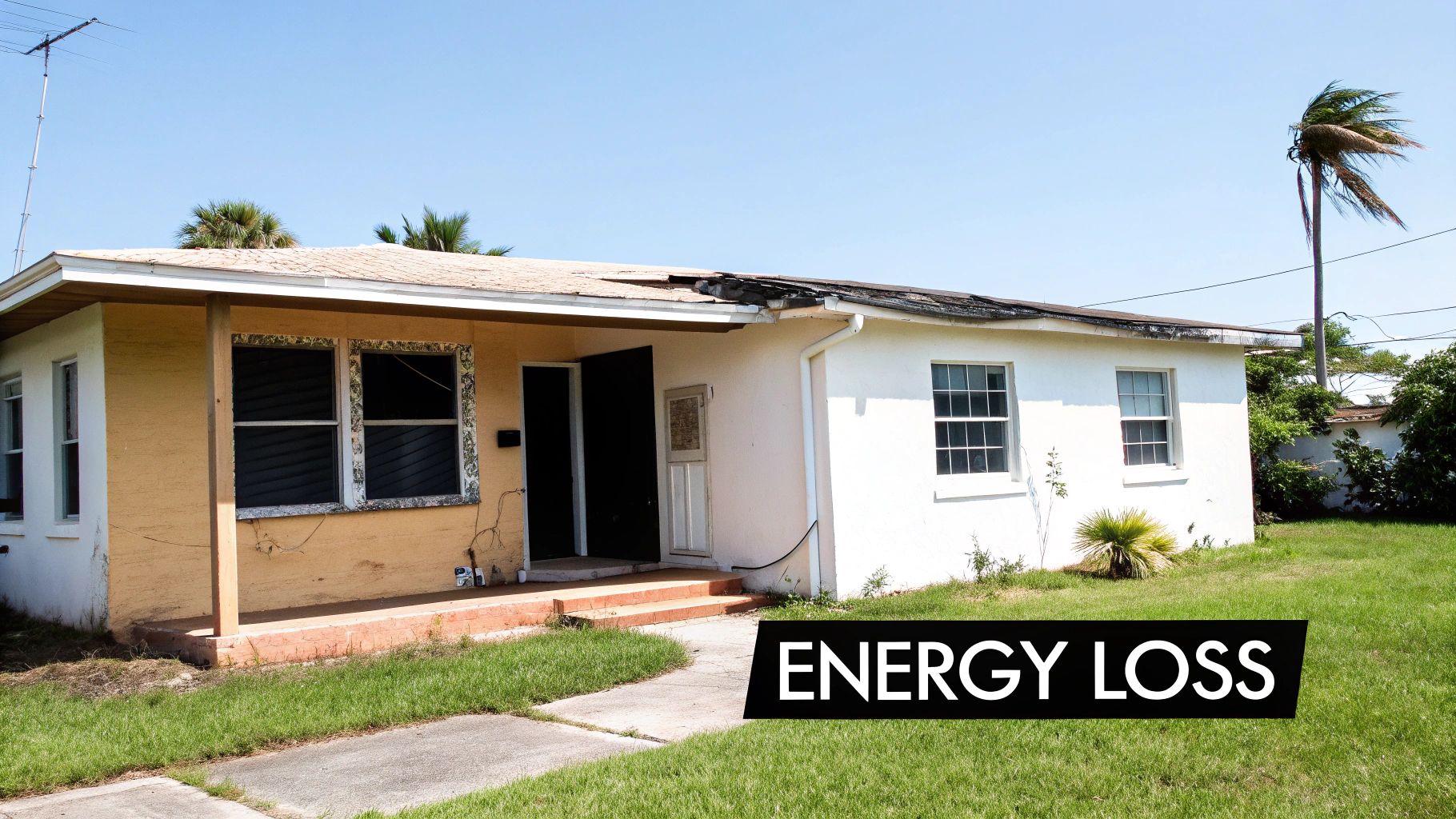
Many of the classic homes you see in places like Jupiter and West Palm Beach were built with materials that just weren't designed for our intense, year-round heat and suffocating humidity. If there's any original insulation left, it’s probably thin, compacted fiberglass that lost its mojo decades ago.
This creates a vicious cycle of energy waste. As your expensive, conditioned air seeps out through countless gaps, hot and moisture-heavy air pushes its way inside, forcing your AC to work even harder.
Picture your house as a leaky bucket. You can keep pouring cool air into it, but it's never going to stay full. Those air leaks are the holes in the bucket, and in older homes, we find them in the same predictable spots:
All these little leaks add up, forcing your HVAC system into overdrive just to keep you comfortable and sending your utility bills through the roof.
The real enemy in a South Florida home isn't just the heat—it's the oppressive moisture that tags along. Ineffective insulation and air leaks don't just make you uncomfortable; they invite humidity into your home's structure, which is a recipe for musty smells and potential mold growth.
So, what's the game plan for insulating an old house to solve these deep-rooted problems? The key is creating a complete, unbroken air barrier.
Modern solutions, particularly spray foam insulation, do more than just slow down heat—they stop air movement cold. While upgrading your insulation is the main goal, it's also smart to explore other tricks like how to cool a room without AC, as these strategies work best in a well-sealed home.
By expanding to seal every last crack and crevice, spray foam transforms your home from that leaky bucket into a sealed, efficient, and finally comfortable oasis.
Before you can even think about insulating an old house, you have to play detective. Your home is practically screaming at you, telling you where it’s losing the fight against South Florida's oppressive heat and humidity. You just need to know how to listen. Pinpointing these hidden energy weak spots is the single most important first step you can take.
The absolute best place to start your investigation is almost always the most neglected: the attic.
On a typical summer day, that space can easily hit 130°F, radiating a ton of heat straight down into your living areas. A quick look around up there can tell you a lot. Is the insulation patchy? Can you see the tops of the ceiling joists? If you can see the drywall of your ceiling from above, you've got a massive energy leak, no question about it.
You might also spot old, matted-down fiberglass batts that have turned a dingy gray or black. That's a dead giveaway that air has been filtering through it for decades, pulling dust and whatever else is in the attic along with it. This stuff isn't just failing to insulate; it’s actively hurting your home's air quality.
The attic is a huge problem, but it's rarely the only one. Your home's entire "building envelope"—the barrier separating your cool, conditioned air from the outside—is probably full of leaks. Grab a flashlight and check these usual suspects for obvious gaps:
All these small leaks add up to a big problem called air infiltration. It's a constant stream of hot, humid air pouring into your house, forcing your AC to work overtime just to keep up.
Sealing these gaps is every bit as crucial as adding new insulation. The impact is huge. According to the U.S. Department of Energy, properly air sealing can slash infiltration by 50-80%. That translates to real money—a 10-20% reduction in your annual utility bills.
A visual inspection is a solid start, but it won't catch everything. Things like thermal bridges—where heat bypasses your insulation right through the wood framing—are completely invisible. This is where a real, professional energy audit becomes priceless.
An energy audit isn't just a guy walking around with a clipboard. It's a data-driven diagnostic for your home. Using tools like an infrared camera and a blower door test, an auditor can pinpoint your energy losses with scientific precision.
An infrared camera gives you a heat map of your walls and ceilings, instantly revealing hidden spots with missing insulation. But the real game-changer is the blower door test. By depressurizing your house, this test makes every single tiny crack and crevice whistle, showing exactly where you're vulnerable. To see how this works, you can learn more about what a blower door test is and why it’s the gold standard for measuring air leakage.
Once you have this detailed report, you're no longer guessing. You have a clear roadmap of your home's unique problems, which lets you have an intelligent, productive conversation with an insulation pro about what will actually fix them.
When you're figuring out how to insulate an old house in South Florida, you learn pretty quickly that it’s a totally different beast. Our relentless humidity means some of the most common insulation types can actually do more harm than good, getting damp, compressed, and basically useless over time. The real goal isn't just to block heat—it's to build a rock-solid barrier against both air and moisture.
For older homes around here, that points us away from the old-school stuff and directly toward modern solutions. You need something that doesn't just fill a cavity between studs but actively seals the entire structure. This is where spray foam insulation really pulls away from the pack.
For decades, fiberglass batts were the standard. They're cheap and seem easy enough to install, but they have a fatal flaw in a place like Florida: they do nothing to stop air movement. Fiberglass is designed to trap still air, but it doesn't create an actual seal.
That means hot, sticky air can wiggle right through it, carrying moisture that eventually condenses inside your walls and attic. Before you know it, those batts become a breeding ground for mold and mildew, all while losing their insulating power as they sag and get damp.
Spray foam insulation is a game-changer. It’s applied as a liquid that expands into a solid foam, sticking to every surface and sealing every last crack and pinhole it touches. This creates a true, monolithic air barrier, which stops humid air from getting into your home in the first place.
But not all spray foam is created equal. There are two main types, and picking the right one for the job is crucial.
Open-Cell Spray Foam: Think of this as a dense, flexible sponge. It's an incredible sound absorber, which makes it a great pick for interior walls to quiet down the house. It’s also vapor-permeable, meaning it lets moisture pass through. In some specific cases, like under a roof deck, this can actually be a plus because it helps you spot a leak instead of trapping the water.
Closed-Cell Spray Foam: This is the heavy hitter for our climate. It cures into a very rigid, dense material with a seriously high R-value—typically R-6.5 to R-7 per inch. The key here is its closed-cell structure, which makes it completely impermeable to both air and water. It acts as its own built-in vapor barrier, which is a massive advantage in our constant battle with humidity.
The right insulation does more than just lower your energy bills. In South Florida, choosing a material like closed-cell spray foam that creates a complete air and moisture barrier is a long-term investment in your home's structural health and your family's comfort.
This decision tree gives you a simplified path for starting a home energy audit—a critical first step before you choose any insulation material.
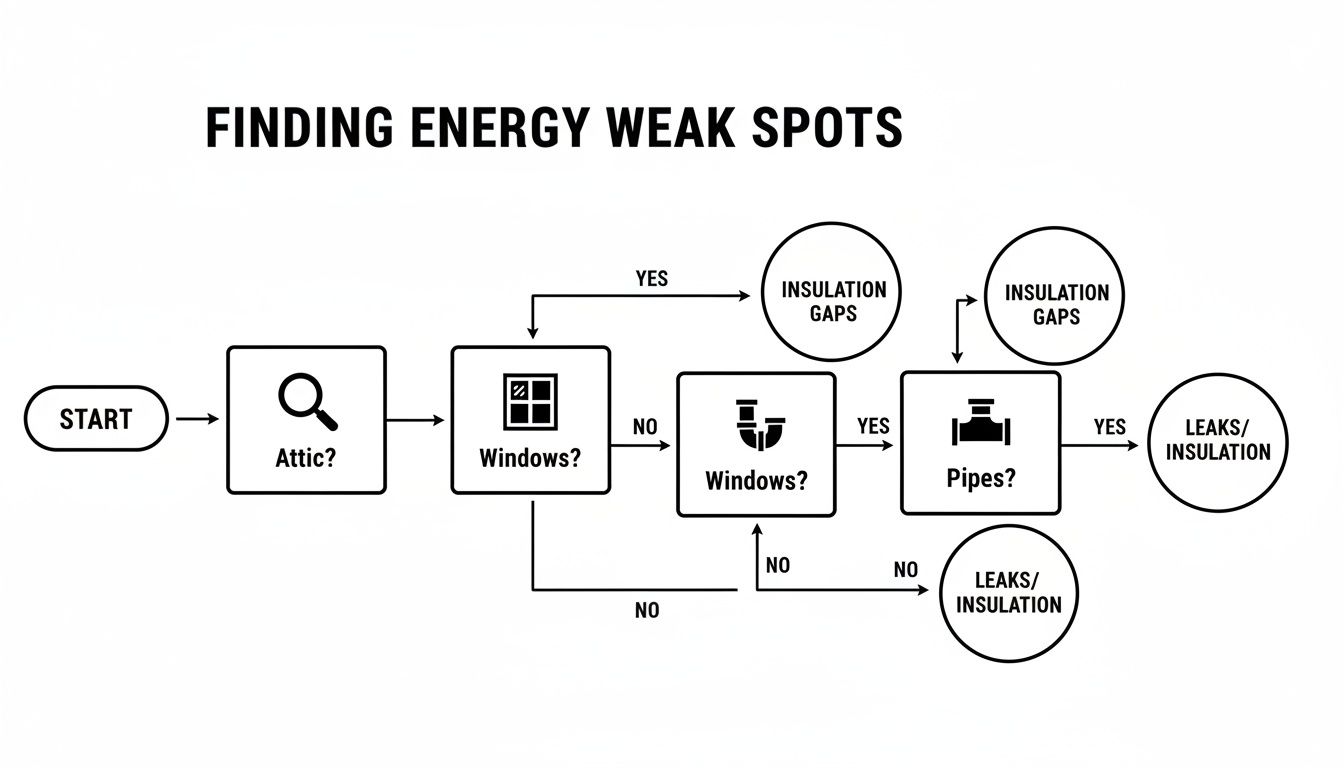
The flowchart reinforces that a thorough home assessment is the only way to create an insulation plan that will actually work. You have to know where the problems are before you can fix them.
To put things in perspective, let’s compare how these materials really stack up in a typical South Florida home. This table cuts through the noise and focuses on the factors that matter most down here.
Here’s a breakdown of the most common insulation materials, looking specifically at how they perform in our hot and humid environment. The focus is on R-value, air sealing, and—most importantly—moisture resistance.
| Insulation Type | R-Value (per inch) | Air Seal | Moisture Barrier | Best For |
|---|---|---|---|---|
| Closed-Cell Foam | R-6.5 – R-7.0 | Excellent | Excellent | Attics, roof decks, walls where structural rigidity and moisture blocking are critical. |
| Open-Cell Foam | R-3.5 – R-4.0 | Good | Poor | Interior walls for sound dampening, attics where budget is a primary concern. |
| Fiberglass Batts | R-3.0 – R-3.7 | Poor | Poor | Budget-constrained projects in dry climates; generally not recommended for Florida attics. |
| Cellulose | R-3.2 – R-3.8 | Fair | Poor | Can absorb moisture, making it a risky choice for humid environments without a perfect vapor barrier. |
The takeaway is clear: closed-cell spray foam consistently wins on the metrics that make a real difference in our climate. While open-cell has its place for sound control, its inability to block water vapor makes closed-cell the undisputed champion for insulating the shell of an older Florida home. It gets to the root cause of high energy bills and indoor humidity, offering a much more permanent and effective solution.
The idea of tackling a major home upgrade can feel overwhelming, especially when you’re figuring out how to properly insulate an old house. You might be picturing a messy, drawn-out construction project. But a modern, professional insulation install is anything but—it’s a clean, precise, and surprisingly efficient process.
Let’s pull back the curtain on what to expect when a team like ours shows up, from the first hello to the final walkthrough.
It all kicks off with a detailed consultation. We're not there just to sell you a product; we're there to diagnose your home's performance issues. We listen to what you're dealing with—whether it's an unbearably hot upstairs bedroom or a constant battle with humidity. That conversation, combined with a hands-on inspection, lets us map out a custom plan for your home's unique challenges.
The scale of this problem is massive. An estimated 65% of U.S. homes built before 1980, like many of the charming older houses here in Palm Beach Gardens, are severely under-insulated. This costs homeowners a collective $15 billion in wasted energy every single year. You can dig deeper into how older homes are affected by visiting this home improvement history resource.
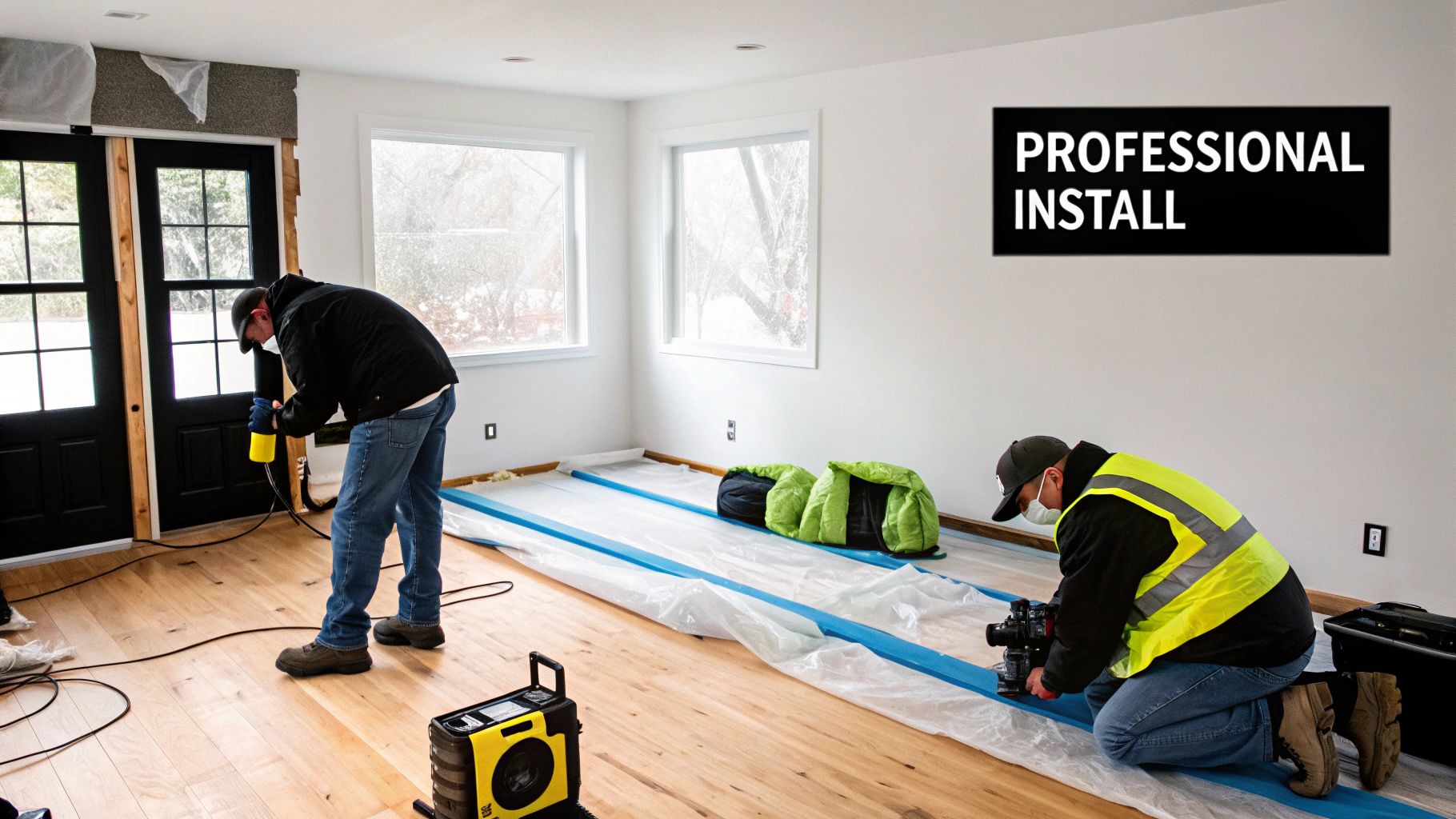
On installation day, our crew’s first job is to protect your home. This isn’t a rush job. It’s a meticulous prep sequence that ensures a flawless application. Think of it like a surgical procedure—the prep is just as critical as the operation itself.
We lay down plastic sheeting to create clean pathways from the front door to the work area. Any furniture, fixtures, or belongings near the application zone are completely covered and sealed off. Our goal is simple: leave your home even cleaner than we found it.
This level of prep is non-negotiable for a professional team. It's the clearest signal that a company respects your property and is committed to quality from the get-go. If a contractor tries to skip this step, consider it a major red flag.
Once your home is prepped and protected, the real work begins. Our truck is essentially a mobile, self-contained plant. It houses all the equipment needed to mix and apply spray foam at the exact temperature and pressure required for a perfect cure. You’ll see hoses carefully run into the work area, leading to an applicator gun wielded by a trained technician in full personal protective equipment (PPE).
Here’s a quick look at what happens in different parts of the house:
Safety is paramount. We establish a controlled work zone and ensure the area is properly ventilated during and after application as the foam cures. This is a chemical reaction, and handling it correctly is a job for trained pros only.
After the application is complete and the foam has fully cured, our crew shifts into cleanup mode. All the protective sheeting and materials are removed, and we sweep and vacuum the area to make sure no trace of our work is left behind. We don't consider the job done until your home is back to normal—only now, it's far more comfortable and efficient.
The last step is a final walkthrough with you. We’ll show you the finished work, explain exactly what we did, and answer every last one of your questions. This is your chance to see the quality firsthand and understand how it’s going to transform your home’s performance. A truly professional job isn't just about spraying foam; it’s about delivering a complete, confidence-inspiring experience that solves your home's comfort problems for good.
Learning how to insulate an old house in South Florida means understanding that beating the heat is only half the battle. The other, equally critical part of the equation is managing our relentless humidity.
Modern insulation, especially spray foam, creates an incredibly tight air barrier. That’s fantastic for energy bills. But a home that’s sealed up that tight needs a smart way to breathe, or you’ll trap moisture and create a whole new set of problems with indoor air quality.
Old, drafty houses breathe on their own, sure, but it's completely uncontrolled. They're constantly sucking in hot, humid, unfiltered air. When we use spray foam to seal those leaks, we stop the chaos and take control. It's a massive upgrade, but it means we have to provide a new, controlled way for the house to get fresh air.
Here in our climate, one of the most powerful strategies you can adopt is creating a conditioned attic. This is a total departure from the old-school thinking of insulating the attic floor and trying to vent out the punishing heat. Frankly, that traditional approach just doesn't work well here.
Instead, we apply spray foam directly to the underside of the roof deck. This move accomplishes two critical things at once:
By doing this, you bring your entire attic—including all your ductwork and your HVAC air handler—inside the conditioned bubble of your home. This is a huge win. Your AC system no longer has to wage war, pushing cold air through ducts cooking in a 130°F environment.
A conditioned attic doesn't just lower your energy bills; it fundamentally protects your HVAC system, improves its performance, and significantly reduces the risk of condensation and moisture problems that plague traditional Florida attics.
This approach forces you to see insulation not as just a product, but as a core piece of a complete system for a healthier, more comfortable home. Once your home is properly air-sealed, your HVAC can finally do its job the way it was designed to. It can control the temperature, filter the air, and—most importantly for us—manage humidity levels everywhere.
For older homes that have been air-sealed for efficiency, you have to bring in fresh air deliberately. That's where options like an ERV or HRV ventilation system come in. These systems are designed to exchange stale indoor air for fresh outdoor air while recovering the energy in the process, so you get the ventilation without the high energy penalty.
Making the switch from a vented to a sealed attic is a pivotal step in modernizing an older home. It requires a solid understanding of how a moisture barrier functions. To get a better handle on this, you can explore the relationship between a vapor barrier and insulation in our detailed guide and see how it all applies to our unique climate challenges.
Ultimately, this balance transforms your house from a leaky, inefficient structure into a high-performance system built for the realities of South Florida.
When you start digging into the idea of insulating an older home, the questions come up fast. After 25 years in this business, I’ve heard just about all of them from homeowners right here in South Florida. Let's get you some straight answers to the most common ones.
This is always the first question, and the only honest answer is: it really depends. The final price tag is a mix of the total square footage, which parts of the house you’re tackling (attic, walls, etc.), and whether open-cell or closed-cell foam is the right fit for the job.
But I always tell people to think of it less as a cost and more as a long-term investment in how your home actually performs. Most homeowners see a dramatic drop in their cooling bills, often saving 15% or more every year. When you look at it that way, the project can pay for itself in just a few years.
The only way to get a firm number for your specific house is to have a professional take a look. We can give you a free, no-obligation estimate to see exactly what your home needs.
In nearly every situation, the answer is a hard yes. That old, packed-down fiberglass or dusty cellulose isn't just failing to insulate; it’s often a breeding ground for allergens, dust, and trapped moisture.
For spray foam to do its job and create that seamless, monolithic air barrier, it needs a clean surface to bond to. It has to adhere directly to the wood of your roof deck and wall studs. Any professional installer worth their salt, including our team at Airtight, will tell you that removing the old stuff is a standard, non-negotiable part of prepping the job correctly.
Trying to spray new foam over old, failing insulation is like painting over rust. You're just hiding the problem, not solving it. A clean, properly prepared surface is absolutely critical for a high-performance, long-lasting result.
I hear this concern a lot, and it usually comes from a slight misunderstanding of how a healthy, modern home should work. Spray foam is designed to make your house incredibly airtight. That's the whole point—it's where all the energy efficiency comes from. It stops the uncontrolled, chaotic air leaks that make older homes so inefficient and uncomfortable.
A truly modern, healthy home pairs that tight seal with controlled, mechanical ventilation. Your HVAC system is built to do exactly this: circulate fresh, filtered air on your terms. You get to eliminate the drafty, humid, pollen-filled air and replace it with a system that gives you total control over your indoor environment. It's a massive upgrade that creates a home that's both remarkably efficient and genuinely healthier to live in.
Absolutely. This is a huge benefit that often gets overlooked, especially for us here in South Florida. When closed-cell spray foam is applied to the underside of a roof deck, it does way more than just insulate. It acts like a powerful glue.
The foam literally bonds the roof sheathing (the plywood) directly to your roof rafters. This dramatically increases the entire roof's resistance to wind uplift—that's the force that tears roofs apart during a hurricane. While it’s not a replacement for code-required hurricane straps, it adds a serious layer of structural integrity that can make a real difference when a storm rolls through. For an older home, that extra reinforcement is an invaluable advantage.
Ready to transform your old house from an energy-wasting, leaky box into a comfortable, efficient, and resilient home? The experts at Airtight Spray Foam Insulation have the experience and technology to seal your home against the South Florida climate for good. Request your free, no-obligation quote today and discover the Airtight Comfort System.