Blog
What Is a Blower Door Test and Why Your Home Needs One

Ever wonder if you’re paying to air-condition the entire neighborhood? A blower door test is how you find out.
Think of it as a comprehensive health check-up for your home’s “skin” or building envelope. It’s a diagnostic test that precisely measures your home’s airtightness, finding all the hidden cracks and gaps that waste energy, create uncomfortable drafts, and let humid South Florida air inside.
The test gives you a hard number—a score—that tells you exactly how leaky your house is, providing a clear roadmap for making smart improvements.
Uncovering Your Home’s Hidden Leaks

Every house is protected by a building envelope—the combination of your walls, roof, foundation, windows, and doors that separates your comfortable, conditioned living space from the outdoors.
Ideally, this envelope should be as airtight as possible. But in reality, most homes are full of tiny, unseen penetrations around plumbing, wiring, windows, and attic hatches. A blower door test is specifically designed to measure the combined effect of all these leaks.
The process itself is straightforward. A powerful, calibrated fan is mounted in a temporary, airtight frame in an exterior doorway. The fan pulls air out of the house, creating a slight vacuum inside. This is called depressurization. As the indoor pressure drops, the higher-pressure air from outside is forced in through every single crack and crevice.
Why This Matters for Your Home
Those small, hidden leaks add up to big problems. They directly impact your wallet, your comfort, and even your health. Sealing them up, especially in our humid climate, offers some serious advantages.
- Slash Your Energy Bills: Air leaks can be responsible for 15-25% of a home’s cooling and heating costs. When you stop conditioned air from escaping, your AC system doesn’t have to run constantly just to keep up.
- Live More Comfortably: Are some rooms always hotter than others? Do you feel annoying drafts? Those are classic symptoms of a leaky home. An airtight building envelope means consistent, even temperatures from room to room.
- Breathe Cleaner Air: Uncontrolled leaks don’t just let in air; they pull in dust, pollen, and most importantly here in Florida, humidity. Sealing your home gives you control over your indoor air quality and helps prevent moisture-related issues.
To give you a quick overview, here’s a simple breakdown of what a blower door test accomplishes.
Blower Door Test at a Glance
| Concept | What It Is | Why It Matters |
|---|---|---|
| Building Envelope | The outer shell of your home (walls, roof, windows) that separates inside from outside. | A leaky envelope wastes energy, reduces comfort, and lets in pollutants and moisture. |
| Depressurization | The process of using a fan to lower the air pressure inside your home. | This forces outside air to rush in through every crack, making leaks easy to find and measure. |
| Airtightness Score | A specific number (like ACH50) that quantifies how leaky or tight your home is. | It provides a baseline to measure improvements against and helps meet building code requirements. |
| Leak Detection | The hands-on process of using tools (like smoke pencils or thermal cameras) to pinpoint where air is entering. | It shows you exactly where to seal, ensuring you fix the right problems for the biggest impact. |
Essentially, the test gives us the “what” (your airtightness score) and the “where” (the exact location of the leaks), so we can create an effective plan to fix it.
This whole concept isn’t new. The modern blower door test actually started in Sweden back in 1977 as a way to put a real number on building performance. By the early 1980s, the door-mounted fans we use today became the gold standard in the U.S. for home energy audits. You can read more about the history and evolution of blower doors to see how far the technology has come.
How a Blower Door Test Actually Works
So, what really happens during a professional blower door test? It’s a pretty straightforward process that turns your home into a measurable, controlled environment for a little while. It’s surprisingly quiet and precise, and the whole point is to give you a clear, honest picture of your home’s performance.
Let’s walk through how a certified technician takes your house from a collection of potential leaks to a clear roadmap for real improvements.
The whole thing starts with the setup. The technician picks an exterior door—usually the front one—and fits a flexible nylon panel right into the frame. This creates a temporary, airtight seal.
Mounted in the middle of this panel is a big, calibrated fan. This isn’t your average box fan; it’s a precision instrument hooked up to a pressure gauge called a manometer. This fan-and-gauge combo is the heart of the test, letting the technician control and measure the air moving through your home with incredible accuracy.
Setting the Stage for an Accurate Reading
Before the fan even spins up, the technician preps the house to mimic its normal “closed-up” state—think of it as a hot summer afternoon when all the windows are shut. This standardization is key to getting a reliable result that we can actually compare to building codes and energy standards.
Here’s the typical prep list:
- Close all exterior windows and doors. This ensures we’re only testing the unintended leaks in the building envelope.
- Open all interior doors. This allows air to move freely, turning the whole house into one big zone for the test.
- Turn off combustion appliances like furnaces, gas water heaters, and fireplaces. This is a critical safety step to prevent the test from pulling dangerous gases like carbon monoxide back into your home.
- Shut down exhaust fans, range hoods, and clothes dryers that vent outside.
Once that’s done, your home is officially ready for the test.
Putting Your Home Under Pressure to Find Leaks
With everything prepped, the technician turns on the fan, pointing it so it blows air out of the house. This starts lowering the air pressure inside compared to the pressure outside. The target is a standard pressure difference of 50 Pascals (Pa).
What does 50 Pascals feel like? It’s about the same force as a steady 20-mph wind blowing against every single surface of your house at once. This consistent pressure is what makes the test work—it forces outside air to whistle through every tiny crack, gap, and unsealed penetration in a way we can measure.
This depressurization makes all those invisible air leaks suddenly very active and easy to find. The manometer constantly reads two things: the pressure difference and how much air the fan has to move (measured in Cubic Feet per Minute, or CFM) to hold that 50 Pa difference. The leakier the house, the harder the fan has to work, and the higher the CFM number will be.
Pinpointing the Exact Leak Locations
Getting a number for total leakage is great, but the real value is finding out where the leaks are. A good technician uses the depressurized state of the house to hunt down the specific culprits. While the fan is running, you can often just feel the drafts with your hand, but pros use some specialized gear for better precision.
Two of the most common tools are:
- Smoke Pencils: The technician uses a small device that lets out a thin, harmless trail of smoke. When they hold it near a window frame, electrical outlet, or light fixture, you can see the smoke get sucked right into the gap. It’s undeniable proof of a leak.
- Infrared (IR) Cameras: On a day with a good temperature difference between inside and out, an IR camera is a game-changer. It shows cold outside air streaming in through weak spots in the insulation. These leaks show up as dark blue or purple streaks on the screen, creating a thermal map of your home’s problem areas.
This diagnostic part is where the magic happens. It’s one thing to hear you have a “leaky house,” but it’s another thing entirely to see exactly where your cool, conditioned air—and your money—is escaping. This step turns abstract data into a real, actionable to-do list.
Decoding Your Blower Door Test Results
Once the blower door test is done, your technician will hand you a report full of numbers and jargon. It can look a little intimidating at first, but figuring out what these results mean is the key to unlocking a more efficient, comfortable home. The two big metrics you’ll see are CFM50 and ACH50.
Think of these numbers as your home’s official airtightness score. They don’t just tell you if you have leaks—they tell you exactly how big those leaks are.
CFM50: The Total Size of Your Leaks
The first key metric is CFM50, which stands for Cubic Feet per Minute at 50 Pascals. This number tells you the total volume of air leaking into your home every minute when the fan pulls the house down to a pressure of 50 Pascals.
Imagine taking every single crack, gap, and unsealed wire penetration in your home and combining them into one giant, imaginary hole in the wall. The CFM50 value tells you how much air is rushing through that single hole. A bigger CFM50 number means a bigger imaginary hole—and a leakier house. For example, a CFM50 of 2,500 means 2,500 cubic feet of air are being sucked into your home every single minute during the test.
This infographic gives you a good idea of the pressure conditions we’re talking about.
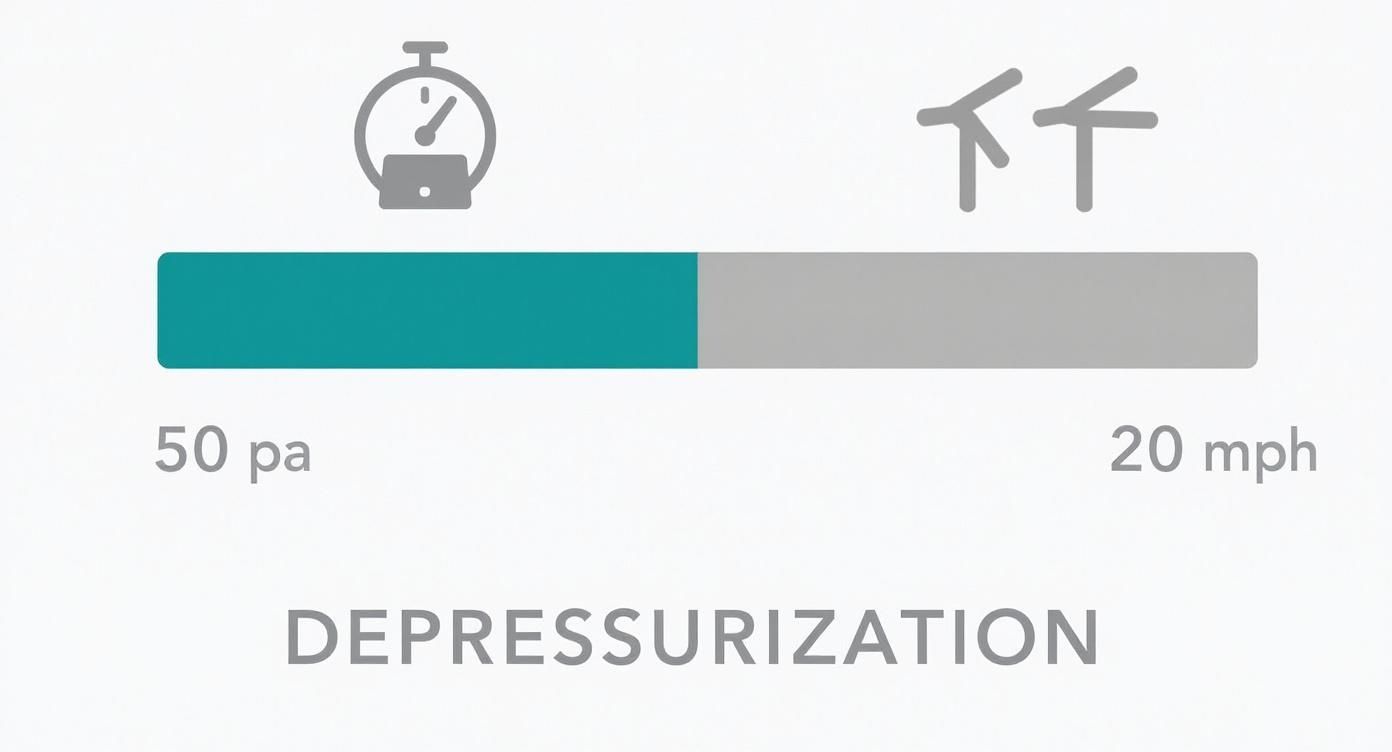
That 50 Pascals of pressure is the equivalent of a steady 20 mph wind hitting every single surface of your house at the same time.
ACH50: The Air Exchange Rate
While CFM50 gives you the raw leakage volume, ACH50 puts that number into a more useful, real-world context. It stands for Air Changes per Hour at 50 Pascals, and it tells you how many times the entire volume of air inside your house is completely swapped out with outside air in one hour.
This metric is calculated using the CFM50 number and the total volume of your house. This is why a smaller home with a moderate CFM50 score could actually have a higher ACH50 than a much larger home with the exact same leak volume—the air is turning over much faster relative to its size.
ACH50 is the gold standard for comparing how airtight homes are. It’s a lot like a car’s MPG rating—it gives us a universal benchmark to compare your home’s performance against building codes and other houses, no matter their size.
What Is a Good Blower Door Test Score?
So, what do these numbers actually mean for you? Simple: a lower ACH50 score is always better. It means you have a tighter, more energy-efficient home.
The scores from a blower door test give you a clear roadmap. They tell you where your home stands now and what kind of improvements are possible.
Interpreting Your ACH50 Score
This table breaks down what different ACH50 ranges generally mean for a home’s performance.
| ACH50 Score | Airtightness Level | Typical Implications |
|---|---|---|
| Over 10.0 | Very Leaky | Common in older, un-renovated homes. Expect high energy bills, drafts, dust, and poor humidity control. |
| 5.0 to 10.0 | Moderately Leaky | Typical for many existing homes. There is significant room for improvement with air sealing and insulation. |
| 3.0 to 5.0 | Fairly Tight | A good target for most homeowners. Modern building codes often require new homes to be at or below 3.0 ACH50. |
| Below 3.0 | Very Tight | A high-performance home. Excellent energy efficiency and comfort, but may need mechanical ventilation for fresh air. |
Airtightness isn’t just an abstract number; it has a direct, measurable impact on your wallet. While older homes might leak like a sieve at over 10 ACH50, newer homes built to code often achieve 3 ACH50 or less. One study on blower door-guided weatherization projected energy savings of about 20% after homeowners made the recommended air sealing improvements.
You can dig into historical blower door test studies and see the data for yourself. This connection between the test score and real-world savings is exactly why understanding what is a blower door test is so valuable for any homeowner looking to make smart, effective upgrades.
Why Airtightness Is a Game Changer for Your Home
Understanding your blower door test results is one thing, but connecting those numbers to your daily life is where the real value lies. Airtightness isn’t just a technical term for builders; it’s a fundamental quality that dramatically impacts your wallet, your comfort, and the health of your home. It’s the difference between a home that works for you and one that constantly works against you.
Think of it this way: a leaky home is like trying to keep a cooler cold with the lid cracked open. You can keep adding ice (or running your AC), but you’re fighting a losing battle against the outside air. A blower door test helps you find that crack so you can finally shut the lid.
Slashing Your High Energy Bills
The most immediate and satisfying benefit of a tighter home is the money you save. Air leaks force your HVAC system into a relentless cycle of overwork, especially here in the sweltering heat of South Florida.
When your cool, conditioned air escapes through gaps in the attic, walls, and floors, hot, humid outdoor air rushes right in to replace it. This means your air conditioner has to run longer and harder just to keep up. Sealing those leaks with a high-performance solution like spray foam insulation stops this wasteful cycle cold. You keep the conditioned air inside where it belongs, allowing your HVAC system to run less, use less energy, and ultimately lower your monthly utility bills.
Creating a More Comfortable Living Space
Beyond the savings, a truly airtight home is just plain more comfortable to live in. If you’ve ever dealt with annoying drafts, cold floors, or certain rooms that are always hotter than the rest of the house, you’ve experienced the symptoms of a leaky home firsthand.
These comfort issues are a direct result of uncontrolled air movement. Leaks around windows, doors, and electrical outlets create drafts that make you feel chilly even when the thermostat says otherwise. In the summer, hot attic air gets pulled into your living spaces, creating stuffy, uneven temperatures. By tightening up the building envelope, you eliminate these problems at their source.
An airtight home provides a consistent, stable indoor environment. It’s about achieving that perfect, even temperature throughout your house so you can finally get rid of those hot spots and enjoy every single room.
Improving Indoor Air Quality and Moisture Control
In a humid climate like ours, controlling moisture is non-negotiable. Uncontrolled air leaks don’t just let in air; they pull in everything that comes with it—dust, pollen, pollutants, and a tremendous amount of humidity. This unwanted moisture is a major threat to your home and your health.
When humid outdoor air is drawn into wall cavities or your attic, it can condense on cooler surfaces, creating the perfect conditions for hidden mold and mildew. This not only damages your home’s structure but also releases spores that can trigger allergies and respiratory issues. An airtight home gives you back control over your indoor environment.
A great case study on a leaky home built in 1915 showed just how big of an impact airtightness can have. Before sealing, the home had a massive heating load, but after air sealing, its energy demand dropped by nearly 90%. This highlights how a blower door test can reveal a huge potential for savings. You can read more about how blower door testing quantifies energy improvements on Retrotec.com.
By sealing leaks, you block the primary pathway for excess humidity, protecting your home from moisture damage and making it a healthier place to breathe. This is a core component of our Airtight Comfort System, which is designed from the ground up to create a sealed, comfortable, and healthy living space.
Turning Test Results into Smart Home Improvements
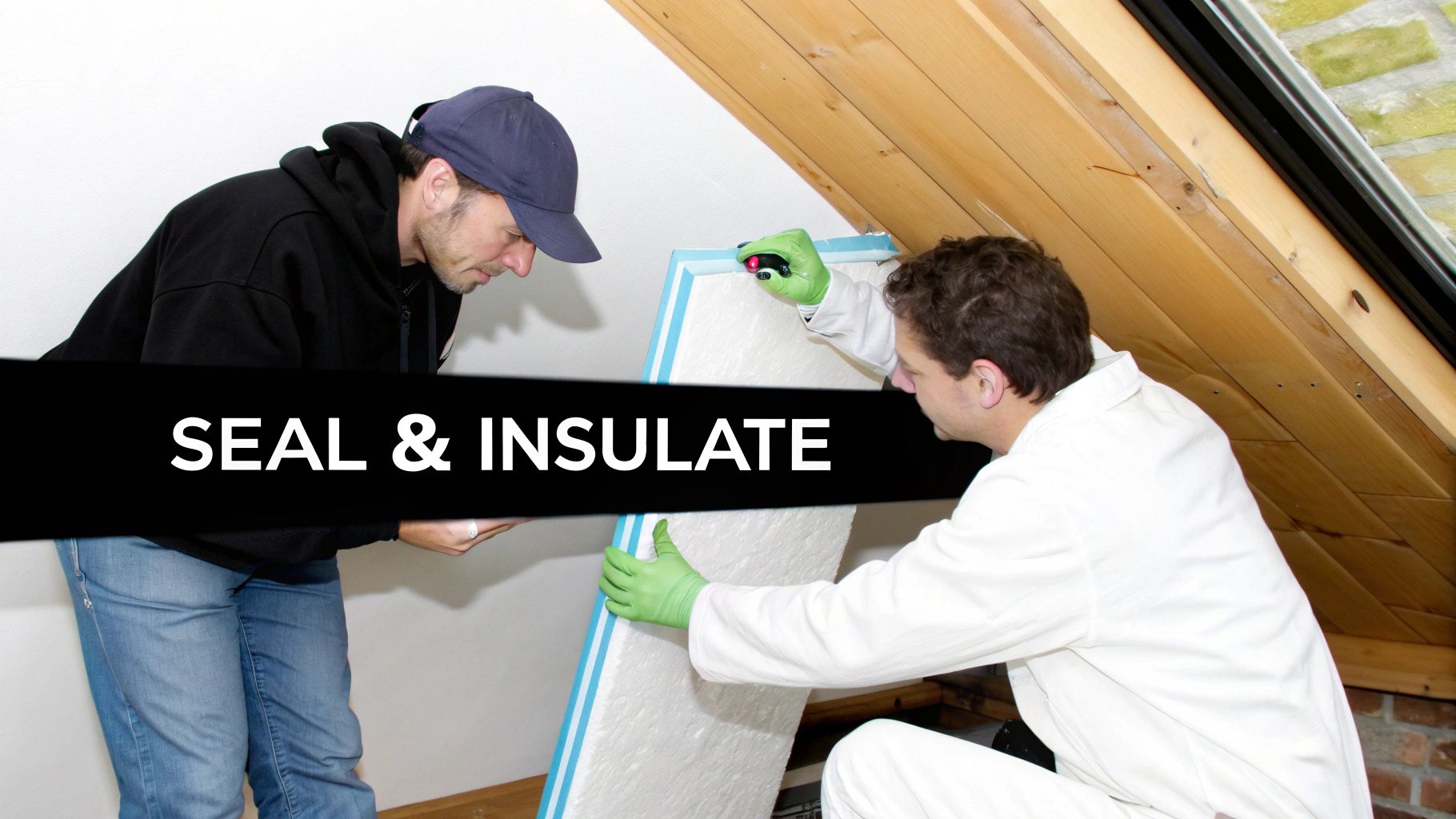
A blower door test report isn’t just a bunch of numbers—it’s your roadmap to a better-performing home. Now that you know exactly how leaky your house is, you can stop guessing and start making targeted, effective upgrades that actually work. The report gives you the “what” (your ACH50 score) and, more importantly, the “where” (the leak locations), so you can fix the biggest problems first.
This is about making smart, data-driven decisions. Instead of randomly caulking windows, you can use the diagnostic info from the test to prioritize the repairs that will make the biggest dent in your energy bills, comfort, and air quality. By tackling the most significant air leaks, you’re investing your money where it counts, finally solving those nagging issues with drafts, humidity, and crazy-high cooling costs.
Identifying the Most Common Leakage Culprits
During a blower door test, we almost always find the biggest air leaks aren’t where you’d think. Sure, old windows and doors contribute, but the real villains are the hidden holes and gaps in your home’s structure. All those small, overlooked penetrations add up, acting like a window that’s been left wide open.
Here are some of the usual suspects a test will uncover:
- Attic Hatches and Pull-Down Stairs: These are notoriously leaky. An unsealed attic hatch is often one of the single biggest sources of air leakage in a home, constantly sucking hot, sticky attic air right down into your living space.
- Recessed Lighting Fixtures: Those old-school “can” lights that aren’t rated for direct contact with insulation (non-IC rated) are basically open vents to your attic.
- Plumbing and Electrical Penetrations: Every single spot where a pipe, wire, or duct punches through a wall, floor, or ceiling is a potential air leak. You’ll find tons of these under sinks, behind appliances, and in utility closets.
- Connections Between Walls and Floors/Ceilings: The seams where your walls meet the floor and the ceiling are major offenders, especially where framing sits on the subfloor or connects to the attic.
Your blower door test report turns these invisible problems into a concrete to-do list. When you prioritize the biggest leaks first, you ensure your time and money go toward fixes that deliver the most significant improvement in your home’s performance.
From Diagnosis to Solution with Air Sealing and Insulation
Once you’ve found the leaks, the solution is almost always a one-two punch: air sealing and insulation. Air sealing plugs the holes, and insulation slows down heat transfer. You have to do both for either to work properly. Piling more insulation into a leaky attic without air sealing first is like wearing a heavy winter coat with the zipper wide open—it just doesn’t work.
This is where modern materials really shine. Traditional insulation like fiberglass batts or blown-in cellulose can’t stop air from moving right through them. They provide some thermal resistance, but they do nothing to seal the leaks.
Spray foam insulation is a far better solution because it does both jobs in one shot. It expands to fill every last crack and gap, creating a powerful, seamless air barrier that stops leaks cold. At the same time, it delivers an excellent R-value, dramatically cutting down on heat gain from the outside.
Prioritizing Upgrades with Spray Foam Solutions
Because spray foam is both an air barrier and an insulator, it’s the perfect tool for fixing the common leak points a blower door test finds. Here’s how it tackles those problem areas head-on:
- Attics: By applying spray foam directly to the underside of the roof deck, we create a sealed, conditioned attic. This single step eliminates leaks from recessed lights, the attic hatch, and even your ductwork because they’re now all inside the conditioned part of your home.
- Walls and Floors: In wall cavities or under floors, spray foam seals perfectly around electrical outlets, plumbing pipes, and framing gaps. It creates a solid, continuous barrier against air and moisture getting in.
Using your test results as a guide, you can work with a professional to map out the best strategy. If you’re weighing different insulation materials, understanding their real-world performance is key. We’ve put together a detailed comparison of spray foam vs. blown-in insulation that shows how each one fits into a complete air sealing strategy. This knowledge helps you make an informed decision that solves your home’s specific problems and meets your energy-saving goals.
How to Prepare for a Blower Door Test
A little prep work goes a long way toward making sure your blower door test is accurate, safe, and runs smoothly. Taking a few minutes to get your house ready before the technician arrives helps them get a true reading of your home’s air leakage, giving you reliable data to work with.
Think of it like setting the stage. By controlling a few simple variables, you ensure the test itself goes off without a hitch.
Your Pre-Test Checklist
Before the appointment, just run through these quick tasks. They only take a few minutes but make a huge difference in the quality of the results.
- Clean Out Your Fireplace: If you have a wood-burning fireplace, please scoop out any ash. When the house is depressurized, that fine ash can get pulled right back into your living space and make a mess.
- Ensure Clear Access: Our technician will need a clear path to all exterior doors, windows, crawl spaces, and any attic hatches. Clearing junk out of the way beforehand saves a lot of time.
- Secure Loose Papers: The fan creates a pretty noticeable breeze inside. It’s a good idea to weigh down any loose papers, light decorations, or anything else that might get blown around during the test.
- Plan for Pets: The test is perfectly safe, but the noise and air movement can make some pets anxious. It’s often best to have them crated or secured in a separate room where they’ll be comfortable.
These small steps prevent delays and help the technician focus on one thing: accurately diagnosing your home’s performance.
Plan on being there for the test, which usually takes about an hour. This is your best chance to walk around with the technician and see for yourself exactly where the leaks are. Watching them use a smoke pencil or thermal camera to reveal hidden gaps is a real eye-opener.
Budgeting for Your Blower Door Test
Knowing the cost helps you plan your home improvement journey. A standalone blower door test is a targeted diagnostic tool with a clear purpose, but for homeowners wanting the full picture, it’s often included as part of a comprehensive home energy audit.
The investment gives you invaluable information about where your home is wasting energy. You can explore more topics on home performance in our online learning center to see how diagnostics like this fit into a bigger strategy for creating a more comfortable, efficient home.
Common Questions About Blower Door Tests
Even after walking through the process, it’s natural to have a few questions. We get these all the time from homeowners, so here are some quick, straightforward answers to put your mind at ease.
Will a Blower Door Test Damage My Home?
Absolutely not. A professional blower door test is a completely safe and non-destructive process. The fan creates a pressure difference of 50 Pascals, which sounds technical but is really just the equivalent of a gentle 20 mph wind blowing against your house.
This level of pressure is far too low to harm your home’s structure, windows, or doors. All it does is make the existing leaks show themselves so we can find them.
Can I Stay Home During the Test?
Yes, and we strongly encourage it! Being there is one of the most valuable parts of the whole experience. You get to walk around with the technician and see with your own eyes exactly where your home is bleeding energy.
It’s one thing to hear about “air leakage,” but it’s another thing entirely to watch a smoke pencil trace a hidden leak around a window frame or an electrical outlet. The process is not loud and is completely safe for everyone, including kids and pets (though it’s a good idea to keep pets secured so they don’t get nervous).
How Often Should I Get a Blower Door Test?
For most people, a blower door test isn’t a routine maintenance item like an annual AC tune-up. It’s a powerful diagnostic tool you use at specific moments to get a clear picture of your home’s performance.
- To diagnose existing problems: If you’re dealing with high energy bills, drafts, or humidity issues, a test gives you a clear baseline.
- Before a major renovation: Planning to replace windows or insulation? A test shows you what you’re starting with.
- After work is completed: A post-renovation test is the only way to verify that the upgrades actually improved your home’s airtightness.
Think of it like a one-time check-up to guide your home improvement strategy. Unless you take on another major renovation down the road, you probably won’t need a second test for many, many years.
Is This Test Required by Building Codes?
In many places, yes—especially for new construction. Both the International Energy Conservation Code (IECC) and many local Florida building codes now require blower door testing for all new homes.
This isn’t just about red tape; it’s about ensuring modern homes meet minimum airtightness standards, often a score of 3.0 ACH50 or less. It’s a clear sign that building a tight, efficient home is no longer optional—it’s a fundamental part of quality construction today.
Ready to stop guessing where your energy dollars are going? At Airtight Spray Foam Insulation, we use blower door testing to pinpoint exactly where your home is losing energy and design a spray foam solution to fix it for good. Request your free, no-obligation estimate today and discover how much more comfortable and efficient your home can be.