Blog
A Guide to Rigid Insulation on Roof Systems in South Florida

When we talk about insulating a roof in South Florida, we're not just talking about keeping a house warm or cool. We're talking about creating an unbreachable shield against some of the most intense heat and humidity in the country. This is where rigid insulation comes in—it’s not your typical fluffy attic insulation. Instead, think of firm, high-density foam panels installed directly onto your roof deck to create a continuous thermal barrier.
Unlike batt-style insulation that can sag, compress, or absorb moisture over time, these strong, lightweight boards hold their shape and their R-value. That makes them incredibly effective at stopping heat right where it hits first: the roof.
Why Rigid Insulation Is Your Roof's Best Defense
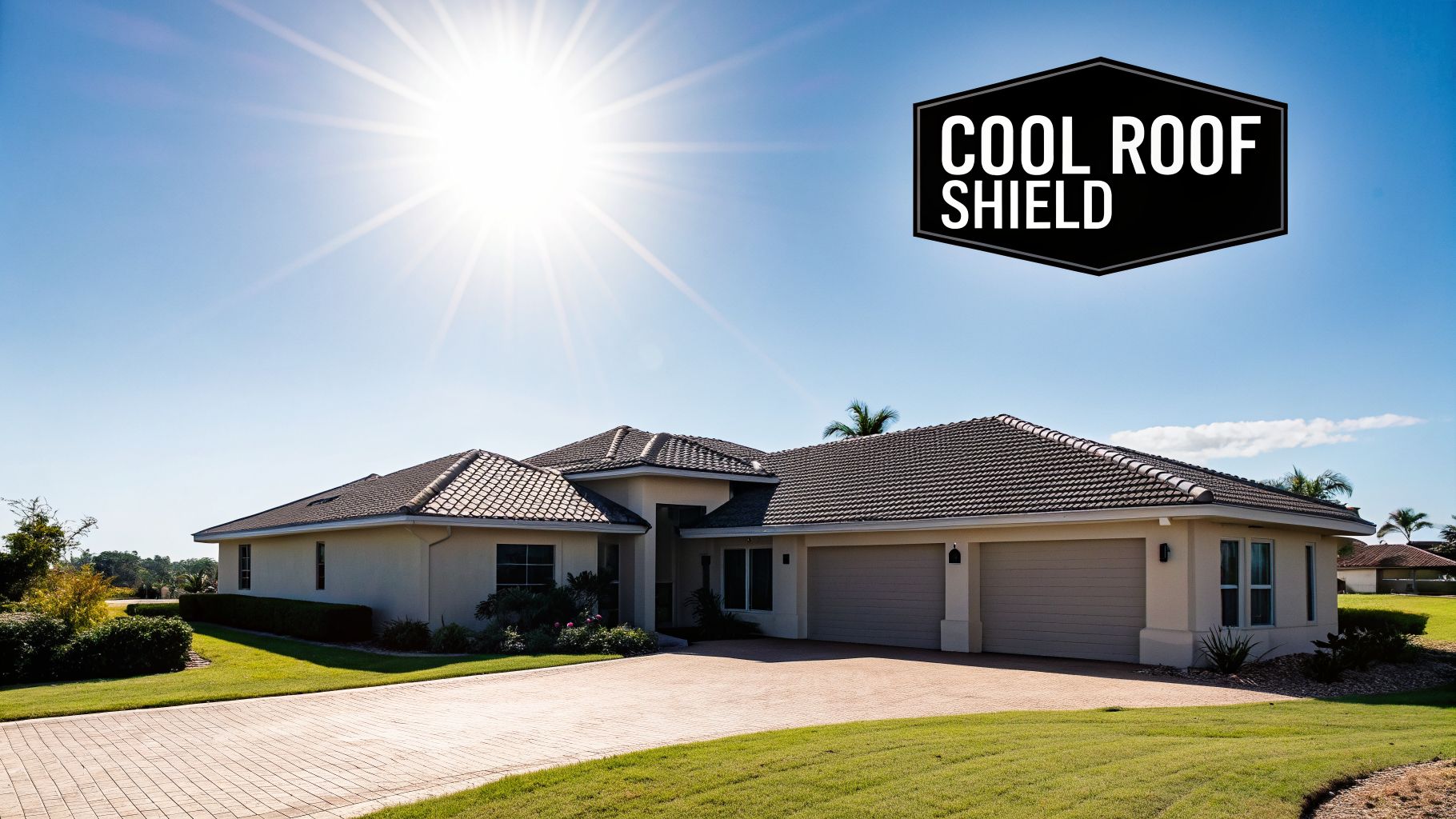
Think of your home like a high-end cooler you'd take to the beach. Here in South Florida, that cooler's lid—your roof—is getting baked by the sun all day, every day. If that lid is flimsy or has gaps, the ice inside doesn't stand a chance. It’s the same with your home; without a solid, well-insulated "lid," your air conditioner is fighting a losing battle, and your house never really gets comfortable.
This is exactly why installing rigid insulation on your roof is such a game-changer. These panels create an unbroken thermal shield, giving your home its first and most important line of defense against our relentless climate.
A Superior Shield Against Heat and Humidity
The South Florida climate is a one-two punch: blistering radiant heat from above and oppressive humidity that works its way into everything. I've seen countless attics where traditional insulation, like fiberglass batts, has failed. It sags between the joists, creating thermal gaps, and even worse, it can absorb moisture like a sponge, losing its effectiveness and becoming a breeding ground for mold.
Rigid foam boards are built differently. We install them as a continuous, gap-free layer right over your roof decking. For homeowners in Jupiter, Palm Beach Gardens, and Wellington, this approach delivers some serious advantages:
- An Unbroken Thermal Barrier: By blanketing the roof's structural wood, rigid foam stops thermal bridging—that's when heat sneaks into your attic through the rafters and framing, completely bypassing the insulation.
- Serious Moisture Resistance: Most rigid foam is "closed-cell," which means it physically cannot absorb water. In our humid climate, this is absolutely critical for preventing rot and mold.
- Added Structural Stability: These firm boards add a surprising amount of strength and support to the entire roof system, which is a nice bonus to have when hurricane season rolls around.
The whole point of a high-performance roof is to create a total separation between your cool, conditioned living space and the brutal outside world. Rigid foam insulation is how you achieve that separation, stopping heat before it even gets a chance to enter your attic.
To really get why rigid foam works so well, you first have to understand the basics of energy-efficient insulation. In this part of the country, a properly insulated roof isn't a luxury—it's a necessity. It’s the single most impactful investment you can make to slash those crazy high energy bills, keep your family comfortable, and protect your home from the constant threat of moisture damage.
Comparing the Main Types of Rigid Foam Board Insulation
When we're on a job site discussing insulation options for a roof, I always tell people it’s not about picking the “best” board, but the right board for the job. Walking into a supplier, you’ll see a few main types of rigid foam, and they all have their place. But what works up north in a dry climate can be a disaster here in South Florida.
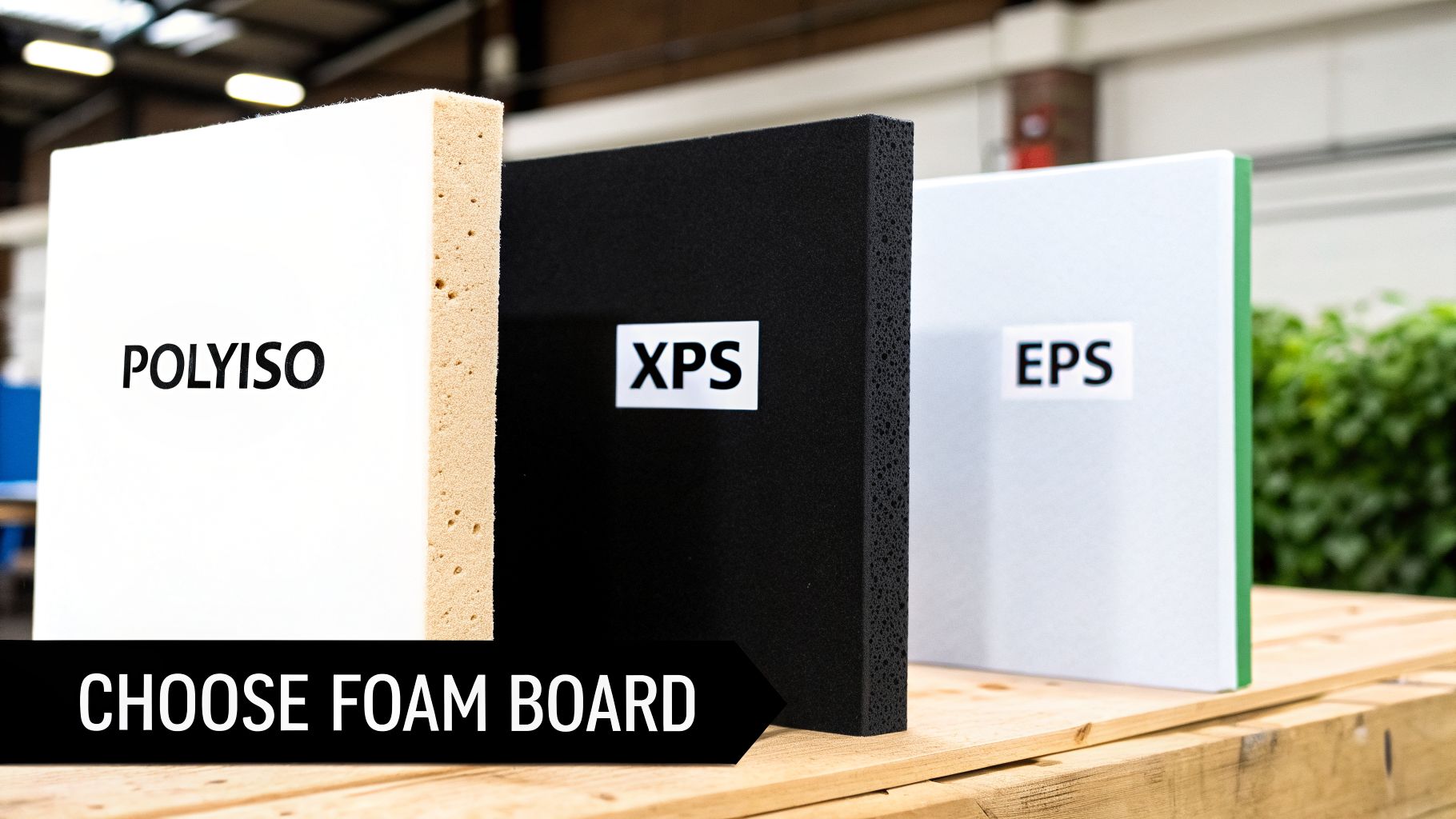
Choosing the right insulation is a bit like picking tires for your truck. You wouldn’t use street tires for mudding, and you shouldn’t use an insulation that can't handle our relentless humidity and heat. Let’s break down the big three—Polyiso, XPS, and EPS—so you know exactly what you’re putting between your home and that Florida sun.
Polyisocyanurate (Polyiso) The R-Value Champion
Around the industry, we just call this Polyiso or iso. This is the heavyweight champion when it comes to R-value. It’s almost always sold with a foil facer, which is a huge plus for us because it reflects radiant heat—a non-stop battle in our climate.
Polyiso gives you the most insulation power in the thinnest package. For instance, a simple half-inch HD Polyiso cover board brings an R-value of 2.5, while a standard gypsum board of the same thickness barely offers R-0.5. This lets us hit tough energy code requirements without making the roof assembly excessively thick and heavy.
But here’s the trade-off: Polyiso's weak spot is moisture. The foam core itself is closed-cell, but if that foil facer gets nicked or the edges are exposed during install, water can find its way in. That’s why we’re fanatics about proper installation—taping every seam perfectly and ensuring zero punctures. It’s not optional.
Extruded Polystyrene (XPS) The Moisture-Proof Workhorse
You've definitely seen Extruded Polystyrene (XPS) before. It’s the rigid foam that comes in those distinct pink, blue, or green colors at the big box stores. Its R-value is a step below Polyiso, usually around R-5 per inch, but its real superpower is how it handles water.
The closed-cell structure of XPS is incredibly dense and uniform, making it practically waterproof. This is a game-changer in South Florida, where we live with crushing humidity and tropical downpours. If a little water ever gets past your main roofing membrane, XPS acts as a rock-solid second line of defense, keeping that moisture from soaking your roof deck. This durability is why it’s a go-to for rigid insulation on roof systems where moisture is the number one enemy.
Expanded Polystyrene (EPS) The Versatile Budget Option
Expanded Polystyrene (EPS) is the white foam board that looks like a compressed collection of tiny beads—think of a high-tech coffee cooler. It has the lowest R-value of the three, typically around R-4 per inch, but it brings a lot of versatility to the table, especially for the cost.
Unlike XPS, standard EPS is "open-cell," which means it can take on water. However, you can get it in higher densities that significantly improve its moisture resistance. A huge advantage of EPS is that its R-value is dead-stable over its entire life. It also has the ability to dry out if it gets wet, which can be a strategic benefit in certain vented roof designs.
To make the choice a little clearer, we've put together a quick comparison of how these three materials stack up for a South Florida roof.
Rigid Foam Insulation Types at a Glance
This table breaks down the key differences between Polyiso, XPS, and EPS to help you decide which material is the best fit for your roofing project.
| Insulation Type | R-Value per Inch | Moisture Resistance | Best For |
|---|---|---|---|
| Polyisocyanurate (Polyiso) | R-6.0 to R-7.0 | Good (When Sealed) | Achieving the highest thermal performance with the thinnest possible profile; great for meeting strict energy codes. |
| Extruded Polystyrene (XPS) | R-5.0 | Excellent | Unvented roof assemblies or any application where superior, long-term defense against water and humidity is the top priority. |
| Expanded Polystyrene (EPS) | R-4.0 | Fair to Good | Cost-effective projects, vented roof assemblies, and applications where a stable, long-term R-value is more critical than the highest initial rating. |
Ultimately, each of these foam boards can work, but the application has to be right. When you’re dealing with a commercial structure like a metal building, for example, the specific layers and choice of foam become absolutely critical.
If that's a project you're tackling, you should check out our guide on selecting the right insulation for metal building roofs to see just how deep this rabbit hole goes.
The True Benefits and Drawbacks of Rigid Insulation in a Humid Climate
Deciding to put rigid insulation on your roof is a major move, especially here in South Florida where the climate is relentlessly tough on our homes. The benefits are huge, but you have to look at the full picture—the good, the bad, and the expensive—to make sure it's the right investment for your property.
Think about your attic on a brutal August afternoon. It's an absolute oven up there, easily hitting 140°F or higher. All that heat radiates straight down through your ceiling, and your AC runs nonstop, fighting a losing battle.
Now, imagine that same roof with a layer of rigid foam installed correctly. The heat is stopped dead at the roof deck. Your attic goes from being an oven to a much cooler, more stable buffer zone. That’s the core of what rigid foam does: it provides incredible thermal performance where it matters most.
The Clear Advantages for South Florida Homes
The magic of rigid foam is its ability to create an unbroken thermal shield across your entire roof. By blanketing the roof deck, it stops radiant heat before it ever has a chance to bake your attic. The result is a home that's noticeably cooler and energy bills that are significantly lower.
But it’s not just about blocking heat. These dense panels bring a few other key advantages that are almost tailor-made for our environment:
- Exceptional Moisture Control: Old-school insulation acts like a sponge in our humid air. Most rigid foam, on the other hand, is closed-cell, which means it can't absorb water. This gives you a powerful defense against moisture getting in and helps stop mold and mildew from growing—a constant fight we have down here.
- Added Structural Integrity: The dense, solid nature of these boards actually adds a layer of strength to your whole roof structure. It’s a bit of extra reinforcement that provides more protection against high winds and flying debris, which is always welcome when hurricane season rolls around.
- Long-Term Performance: Rigid foam doesn't sag, get compressed, or break down from moisture over time. It holds its R-value and keeps doing its job for the entire life of your roof. It's one of those "do it right once" solutions that you don’t have to worry about again.
Acknowledging the Potential Drawbacks
Of course, no solution is perfect. Getting a high-performance roof with rigid insulation means clearing a few hurdles, and you need to be ready for them. The biggest one is the higher upfront investment. The materials aren't cheap, and the specialized labor needed for a proper installation costs more than just blowing fiberglass into an attic. That initial price tag is a real factor for many homeowners.
And that brings me to the next point: the performance of rigid insulation is 100% dependent on the quality of the installation.
The effectiveness of a rigid foam system lies in the details. Even small gaps, un-taped seams, or improper fastening can create thermal bridges and pathways for air and moisture, completely undermining the system's performance. It’s not a DIY-friendly project.
This absolute need for an expert installer is a drawback in itself. You can’t just hire any roofer; you need to find a contractor who really gets these systems and understands how critical it is to create a perfect air and thermal seal. Cutting corners here is a recipe for failure.
Finally, you can run into compatibility issues. Tying rigid foam into an existing roof, with its vents, pipes, and unique structure, requires careful planning to make sure you're not accidentally creating new problems, like trapping moisture where you don't want it.
To really get into how these materials work together to create a complete defense, you can learn more about the role of a dedicated moisture barrier in insulation systems. The benefits of thermal control and moisture resistance are real, but they only pay off when the drawbacks of cost and installation complexity are managed correctly from the very start.
Creating the Ultimate Roof with Hybrid Rigid and Spray Foam Insulation
While laying rigid foam boards over a roof deck is a huge step up for your home's thermal performance, what if you could take it even further? For homeowners and contractors in South Florida who are serious about getting the absolute best energy efficiency and resilience, there's a system we consider the gold standard. It combines the strengths of two powerful insulation types into one hybrid solution.
This approach pairs the continuous thermal shield of rigid insulation on the roof with the unmatched air-sealing power of spray polyurethane foam (SPF). Think of it as a "belt and suspenders" strategy—it’s an engineered system designed to leave no weakness unaddressed, giving you total home comfort and protection.
The Best of Both Worlds: A Hybrid Insulation Strategy
This process creates an incredibly well-insulated and super-sealed thermal envelope, which is exactly what you need in our demanding climate. It starts just like a standard rigid foam installation, with boards like Polyiso or XPS laid directly over the exterior roof deck. This first layer acts as the primary thermal break, stopping the sun's intense heat before it has a chance to bake your home’s structure.
But the real magic happens from inside the attic. After the rigid boards are down, we apply closed-cell spray foam insulation from underneath. This liquid foam expands on contact, filling every single joint, seam, and tiny imperfection between the rigid boards above. It perfectly seals around trusses, pipes, and any other penetrations with absolute precision.
This combination gives you a one-two punch that neither material could deliver on its own:
- The rigid board provides a consistent, high R-value blanket across the entire roof plane.
- The spray foam completely eliminates air leakage while creating a second, powerful moisture barrier from below.
By combining these two technologies, you are effectively creating a monolithic, airtight, and super-insulated lid for your home. The spray foam perfectly complements the rigid boards, sealing their only potential weakness—the seams—to form a truly seamless barrier against heat and humidity.
This advanced method isn't just a niche idea; it's a direct response to the growing demand for superior roofing. The global market for roof insulation reflects this trend, driven by homeowners who see the immense value in high-performance systems. The market was valued at $10.89 billion in 2025 and is projected to climb to $11.41 billion in 2026, a clear sign that energy efficiency is a top priority. You can dig into what's driving this growth in this detailed industry report.
Why This Hybrid System Excels in South Florida
For properties in Jupiter, Wellington, and right across Palm Beach County, this hybrid system offers unmatched performance where it matters most. This dual-barrier approach creates a roof assembly that is incredibly resilient against the specific challenges we face down here every day.
1. Unbeatable Air Sealing
Even with the most careful taping, tiny gaps can still exist in a system using only rigid boards. Spray foam makes this a non-issue. As it expands, it creates a 100% airtight seal, stopping hot, humid air from ever infiltrating your attic. This is critical for keeping your air conditioner from constantly running just to keep up.
2. Superior Moisture Defense
Closed-cell spray foam is an excellent vapor retarder and simply does not absorb water. When applied to the underside of the roof deck and rigid boards, it forms a secondary waterproofing layer. This provides robust protection against wind-driven rain and helps us manage condensation risks from the inside. You can get a deeper understanding of how this works by reading about the benefits of a complete spray polyurethane roof system.
3. Enhanced Structural Strength
When closed-cell spray foam cures, it becomes incredibly dense and hard, acting almost like a high-strength adhesive. It essentially "glues" the roof sheathing, rigid boards, and trusses together. This significantly increases the roof's overall structural rigidity and its resistance to wind uplift—a major advantage during a hurricane.
This hybrid approach really represents the pinnacle of modern building science put into practice. It’s an investment in creating a building envelope that is not just insulated but completely sealed, delivering a level of comfort, efficiency, and durability that sets a new standard for homes in our unique climate. For any property owner serious about long-term performance and protection, this is the ultimate solution.
Getting the Installation Right: Code, Condensation, and Best Practices
Installing rigid insulation on a roof isn't like nailing down shingles. It’s a game of precision. A perfect job creates a seamless, unbroken thermal shield for your home. But a sloppy installation? That just leaves tiny gaps and vulnerabilities that our brutal South Florida heat and humidity will find and exploit every time.
Success comes down to a few non-negotiable details that any true professional has mastered.
First, you have to stagger all the board seams. You can never have the corners of four boards meeting at a single point. By offsetting the joints, you eliminate a direct highway for heat and air to travel through, which is crucial for stopping thermal bridging and making the whole roof stronger.
Then, you have to tape every single one of those seams with a high-performance, code-approved tape. This isn't just to hold the boards in place. It's about creating a single, continuous air and moisture barrier over the entire roof. Skipping this step is like building a boat and leaving a few hairline cracks unsealed—it might look okay on the surface, but it’s guaranteed to fail when it matters most.
Navigating Florida's Tough Building Codes
Florida’s building codes are no joke, especially when it comes to roofs. The Florida Building Code (FBC) has some of the most demanding requirements in the country for wind uplift and hurricane resistance. When you add a layer of rigid insulation, you're fundamentally changing the roof assembly, and every single component has to meet these incredibly high standards.
Proper fastening is where most installations either pass or fail. The type, size, and spacing of the fasteners are all specified with one thing in mind: making sure your roof doesn’t peel off in a hurricane. A building inspector will be looking for a few key things:
- Correct Fastener Type: Are the screws and plates specifically designed for rigid foam and approved for High-Velocity Hurricane Zones (HVHZ)?
- Proper Spacing: Does the layout follow the engineered fastening pattern? This always means more fasteners along the perimeter and corners, where wind forces are the strongest.
- Appropriate Embedment: Is every screw driven deep enough into the structural roof deck to get the necessary grip?
Getting this wrong isn't just about failing an inspection. It's about risking a total roof failure during a storm. This is why you absolutely must work with a contractor who lives and breathes Florida’s building codes.
Designing to Control Condensation
In South Florida, condensation isn't a risk; it's a reality we have to design for. A poorly planned insulated roof can easily trap warm, humid air against a cooler surface, creating a perfect recipe for hidden moisture, rot, and mold growth inside your roof structure.
The entire strategy revolves around controlling the "dew point"—the exact temperature where water vapor turns back into liquid.
A correctly designed system puts the rigid insulation—the thermal boundary and air barrier—on the outside of your roof deck. This keeps the wood structure of your roof within the conditioned or semi-conditioned envelope of the building, preventing it from ever getting cold enough for our humid air to condense on it.
This proactive design is the only way to ensure your investment pays off for decades instead of causing a moisture nightmare down the road. When you're in the planning stages, digging into a good new roof installation guide can give you a better picture of how all the pieces fit together.
For ultimate performance, we sometimes combine rigid board insulation with spray foam to create a "hybrid" system. It’s the best of both worlds.
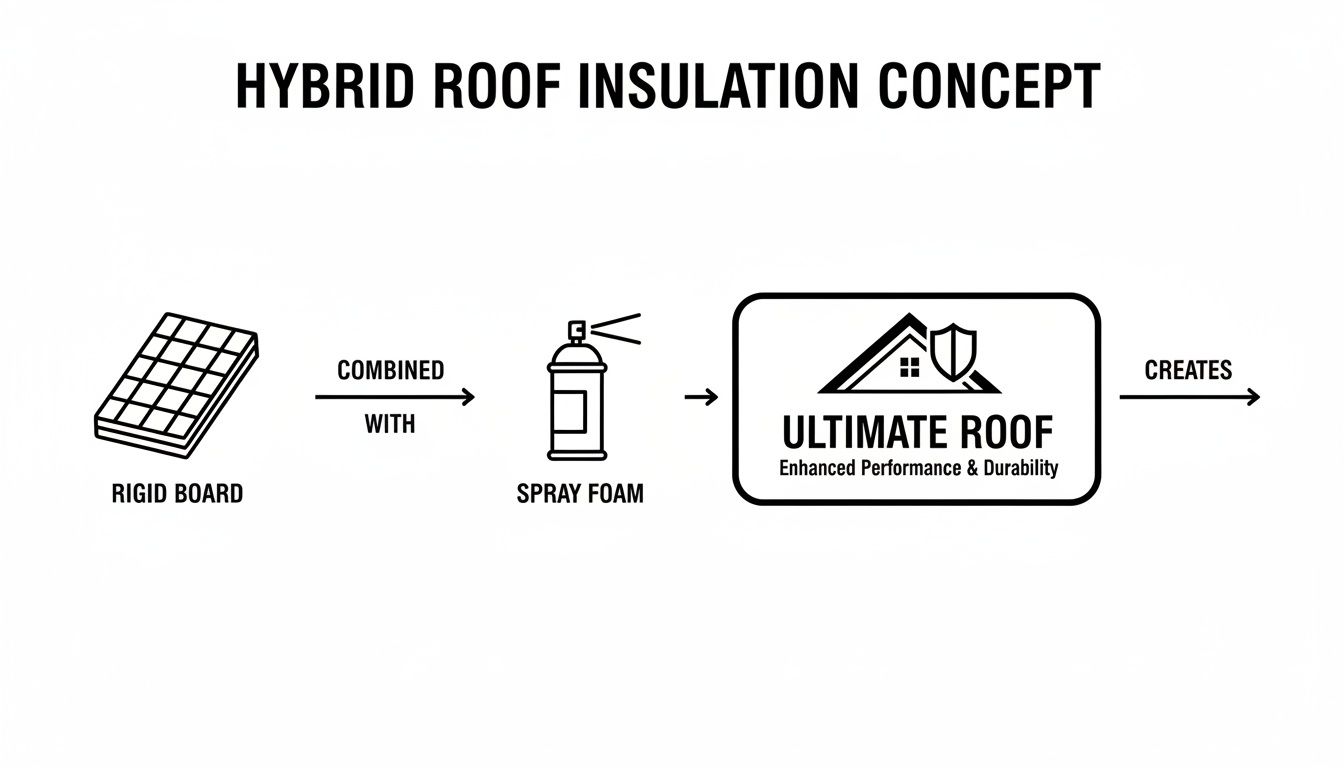
As you can see, the spray foam perfectly seals all the seams and any complex penetrations, while the rigid board provides the bulk of the R-value. This kind of high-performance approach is becoming more and more common as homeowners and builders look for truly resilient solutions. The numbers back it up, too—the U.S. roof insulation market was already valued at $2.7 billion in 2021 and is only expected to grow. For those of us in the business, it's clear that mastering these advanced insulation techniques is the future.
Where Do You Go From Here?
We’ve covered a lot of ground—from the science behind high-performance roofs to the specific materials that work best here in South Florida. It should be clear by now that using rigid insulation on your roof, especially when paired with spray foam, is the single most powerful way to fight back against our relentless heat and humidity.
The real win here isn't just about shaving a few dollars off next month's power bill. It's about an investment that delivers real, measurable returns for years, even decades, to come.
Turning Knowledge into a High-Performance Home
Making the leap to a truly efficient home is a big decision, but the payoff is something you’ll feel right away. This isn’t just about buying a new product; it’s about investing in a complete system that adds value in multiple ways:
- Finally Stop Overpaying FPL: Give your air conditioner a much-needed break by blocking heat at the roofline, before it ever gets a chance to bake your attic.
- A New Level of Indoor Comfort: Imagine your home staying consistently cool and comfortable, even on those brutal August afternoons. No more hot spots or rooms you can’t use.
- A Healthier Place to Live: A properly sealed and insulated roof is your best defense against moisture intrusion, which dramatically cuts the risk of mold and mildew.
- A Real Boost in Property Value: In this market, a modern, resilient, and genuinely energy-efficient roof is a powerful selling point that makes your property stand out.
Whether you're a homeowner in Wellington sick of sky-high energy bills or a contractor in Jupiter focused on building premium, future-proof properties, a modern insulated roof system is the smartest path forward.
The most important choice you'll make isn't about which foam to use or the exact R-value. It’s about who you trust to put it all together. The success of any rigid insulation on roof project lives and dies with the skill of the installers.
Let's Talk About Your Project
Knowing the theory is one thing. Putting it into practice is another. Every home in Palm Beach Gardens, Stuart, and West Palm Beach is different—each with its own history, quirks, and challenges. A cookie-cutter solution is guaranteed to fail here.
That's why getting a professional assessment is non-negotiable. We invite you to connect with our team of local experts who live, work, and build in the same climate you do. We can provide a free, no-obligation estimate that's built around your home's specific needs, ensuring the job gets done right the first time. Let us help you design a system that delivers the comfort, savings, and peace of mind you deserve.
Answering Your Questions About Rigid Roof Insulation
When you're looking at a new roof, the details can feel overwhelming. We get it. To cut through the noise, we've put together straightforward answers to the questions we hear most from homeowners about rigid roof insulation.
Can I Put Rigid Insulation on My Existing Roof?
Yes, in many situations, we can add rigid insulation right on top of your existing roof deck when you're getting a new roof. This is what we call a "roof-over" or an "overlay" in the industry.
But it’s not a simple yes-or-no answer for every home. First, a professional has to get up there and do a thorough inspection. We need to be absolutely sure the underlying structure is sound and can handle the extra weight. Critically, the entire new system has to meet Florida's strict building codes for wind uplift and structural strength.
What Kind of Savings Can I Realistically Expect on My Energy Bills?
This is the big question, isn't it? While the exact number depends on your home’s size, age, and how leaky it currently is, the results are almost always dramatic. It's common for homeowners here in South Florida to see their energy bills drop by 20-40%, sometimes even more, after upgrading to a proper rigid insulation on roof system.
The savings come from a one-two punch. The rigid foam acts like a shield, blocking the relentless radiant heat from the sun. At the same time, a well-sealed system stops the air leaks that make your A/C run constantly. It's that powerful combination that delivers such impressive results.
The real goal isn't just piling on R-value; it's about creating a seamless thermal and air barrier. When you stop both heat transfer and air leakage at the roofline, you'll feel the difference immediately—and see it on your next cooling bill.
How Long Does This Stuff Actually Last?
When it’s installed the right way by a skilled crew as part of a complete roofing system, rigid foam insulation is incredibly tough. We expect it to last as long as the roof itself, which is typically 20 to 30 years, if not longer.
Think about it this way: unlike other insulation that can get compressed, sag, or break down when it gets wet, rigid foam holds its shape and its R-value for decades. It's naturally resistant to moisture, pests, and rot, so your investment keeps working for you for the entire life of your roof.
Ready to make your home a more comfortable, efficient place to live? The experts at Airtight Spray Foam Insulation have the local knowledge and hands-on skill to design the perfect high-performance roof system for your property, one that’s built to handle South Florida's unique climate. Transform your property by visiting us at https://airtightsprayfoaminsulation.com to request your free, no-obligation estimate today.