Blog
A Pro’s Guide to Insulate Basement Walls

To get the most out of insulating your basement walls, you have to tackle moisture first. After that, it’s all about creating a seamless thermal barrier with materials that won’t quit, like spray foam or rigid foam boards that laugh at mold and seal every tiny air leak.
This single upgrade can take a damp, cold area and turn it into a comfortable, energy-efficient living space. We’ve seen it time and time again—it leads to significant savings on utility bills and a nice bump in home value.
Why Insulating Your Basement Is a Game Changer
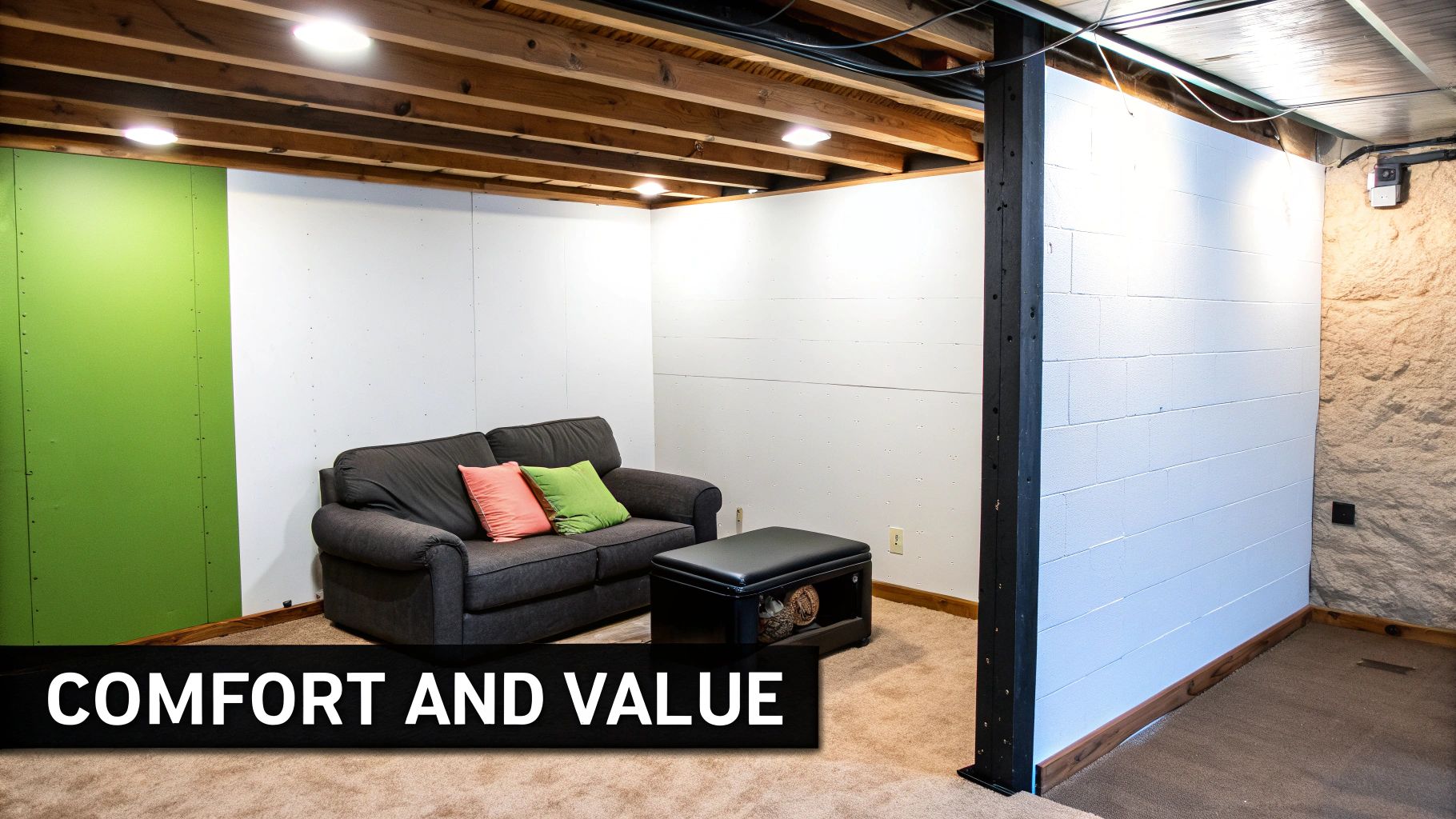
Most people start thinking about insulating their basement walls to save on energy bills, but the real payoff goes so much deeper. A properly insulated basement isn’t just a warmer room—it’s a fundamental upgrade that improves the health, comfort, and even the structural integrity of your entire home.
It’s the critical difference between a forgotten storage zone and a valuable, functional extension of your living area. Too many homeowners just accept that their basements will be damp, chilly, and musty. But those aren’t inevitable problems; they’re symptoms of poor thermal control and moisture that isn’t being managed. The right insulation strategy solves both issues head-on.
Transforming Your Home from the Ground Up
The main job of basement insulation is to stop heat and cold from moving through your concrete foundation walls. Since basements are below ground, they’re in constant contact with the earth, which stays at a pretty steady temperature all year. In a humid climate like South Florida, this creates a constant battle.
Warm, moist air from inside your home hits those cool concrete walls and immediately condenses. This persistent dampness is the perfect breeding ground for mold and mildew, leading to that familiar musty smell and terrible indoor air quality. A continuous layer of the right insulation creates a barrier, keeping the warm indoor air from ever touching the cool concrete.
This separation gives you a few key advantages:
- Moisture and Mold Control: By stopping condensation, you cut off the main water source that mold needs to grow. That means a healthier environment for your family.
- Serious Comfort: Insulation keeps the temperature stable, making the basement as comfortable as any other room in your house. Say goodbye to frigid floors and drafty corners.
- More Usable Space: A warm, dry basement can become a home office, a playroom, or an entertainment center. You’re not just adding comfort; you’re adding valuable square footage and boosting your property’s resale value.
Choosing the Right Material for the Job
Picking the right insulation is critical, especially for a below-grade space where moisture is the enemy. Here’s a quick rundown of the most common options to help you see what works best where.
Quick Guide to Basement Insulation Materials
| Insulation Type | Average R-Value per Inch | Moisture Resistance | Best For |
|---|---|---|---|
| Closed-Cell Spray Foam | R-6.5 to R-7 | Excellent | Creating an all-in-one air, vapor, and thermal barrier on concrete walls |
| Rigid Foam Boards (XPS/EPS) | R-4 to R-5 | Good to Excellent | DIY-friendly projects, continuous insulation behind framing |
| Fiberglass Batts | R-3.1 to R-3.7 | Poor | Interior framed walls only after a proper vapor barrier is in place |
| Mineral Wool Batts | R-3.7 to R-4.2 | Good | Sound dampening and fire resistance in interior basement walls |
While options like rigid foam are good, our experience in South Florida has shown that nothing beats closed-cell spray foam for creating a truly bulletproof seal against moisture.
The Rise of Modern Insulation Solutions
The push for better basements has fueled some serious innovation in insulation. In fact, the global market for retrofitting basement wall insulation hit a staggering USD 6.4 billion in 2024. That number shows a massive shift as homeowners finally recognize the performance benefits of modern materials.
Closed-cell spray foam, for instance, has become the go-to choice, especially in damp regions like ours. Unlike old-school fiberglass batts that act like a sponge for moisture, closed-cell foam is completely impermeable. It sticks directly to the concrete, creating an all-in-one air, vapor, and thermal barrier. This single, monolithic seal is incredibly effective at stopping leaks and drafts before they can even start.
A well-insulated basement does more than just save you money on heating and cooling. It fundamentally changes how you use your home, unlocking potential you probably didn’t realize was there.
Beyond just temperature control, good insulation offers excellent sound dampening. The dense structure of materials like spray foam can dramatically cut down on noise coming from outside or between floors. You can learn more about how insulation acts as a sound barrier in our dedicated guide.
Ultimately, deciding to insulate your basement walls is a smart investment in your home’s long-term health and your family’s everyday comfort.
Choosing Your Insulation: Spray Foam vs. The Alternatives
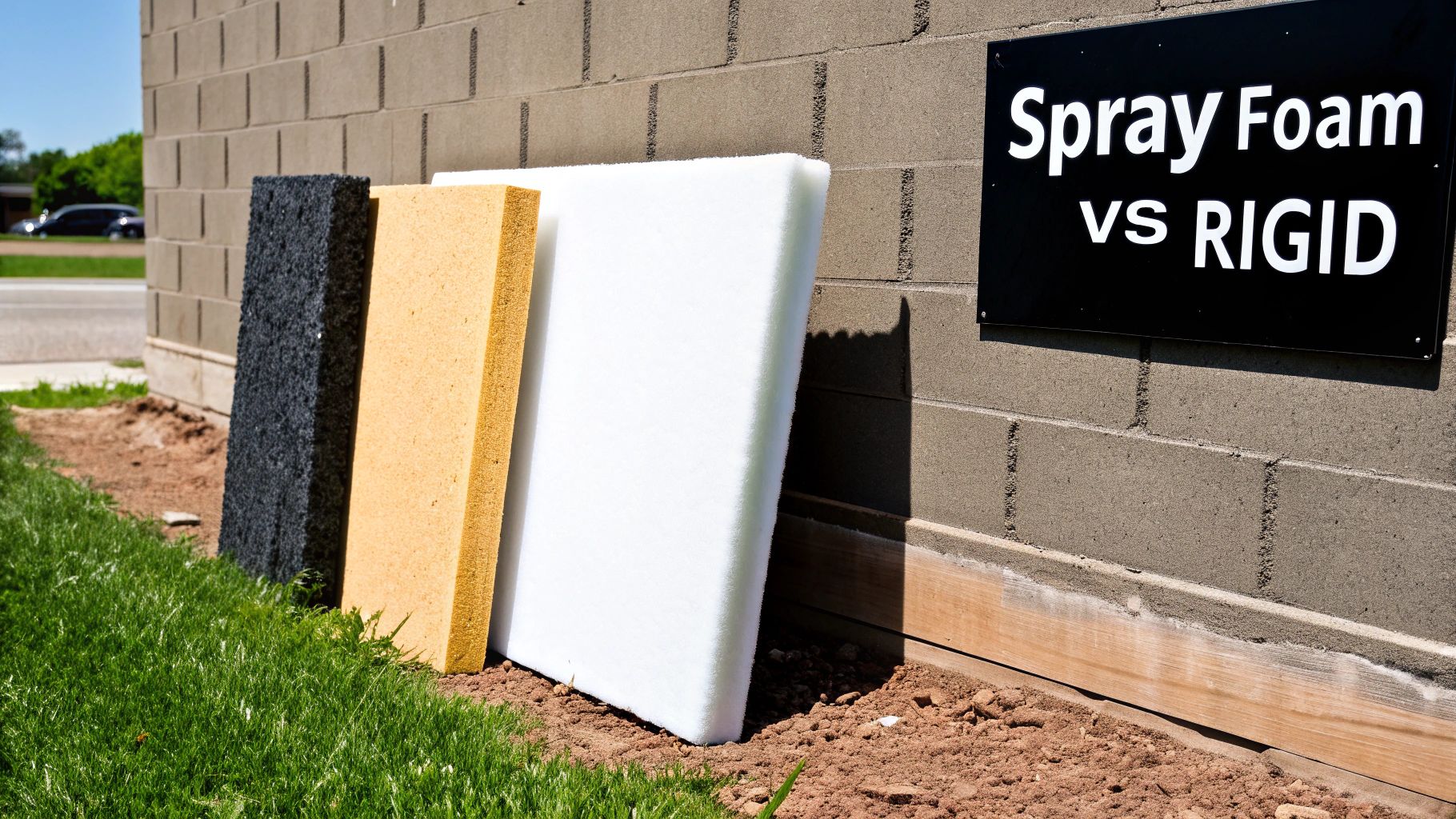
When it’s time to insulate your basement, you’re really looking at three main contenders: closed-cell spray foam, rigid foam boards, and the classic fiberglass batts. Each one has its place in a home, but when we’re talking about a damp, below-grade space, your choice becomes critical. Get it wrong, and you’re looking at trapped moisture, mold, and a project you’ll have to redo.
Let’s cut through the noise and look at how these materials actually perform in the real world. You’ll quickly see why one is the clear winner for basements, especially in humid climates like ours in South Florida.
The Powerhouse: Closed-Cell Spray Foam
There’s a reason closed-cell spray foam is the premium solution. When a pro applies it, the foam expands to fill every single crack and crevice, creating one solid, seamless barrier that locks directly onto the concrete. This isn’t just insulation—it’s an all-in-one air, moisture, and thermal shield.
For a basement, its advantages are just undeniable:
- Impermeable to Water: This is the big one. Closed-cell foam is non-porous. Water can’t get through it, and it won’t soak up moisture, making it your best line of defense against dampness.
- Superior R-Value: It packs the highest R-value per inch, typically R-6.5 to R-7. That means you get maximum insulating power without eating up a ton of interior space.
- Structural Rigidity: Once it cures, the foam actually adds a bit of structural strength to the wall assembly, essentially gluing everything together.
The bottom line? You get a completely sealed envelope that stops humid indoor air from ever touching those cool concrete walls. This shuts down the condensation cycle that is the root cause of most basement mold.
The DIY Favorite: Rigid Foam Boards
Rigid foam boards, like Expanded Polystyrene (EPS) and Extruded Polystyrene (XPS), are another common choice. They come in big, easy-to-handle sheets you can cut and stick to the walls with adhesive. For a skilled DIYer who doesn’t mind meticulous, time-consuming work, they can be a solid option.
Expanded polystyrene (EPS) is a particularly big player in the insulation market. It’s projected to grab 27.8% of the market revenue share in 2024, and for good reason—it’s lightweight, relatively cheap, and resists moisture well. You can dig into more market data over at Grandview Research.
But rigid boards have a major weak spot: the seams. Every joint between boards, every cutout for a pipe, and every gap along the floor is a potential air leak. You have to be incredibly thorough with caulk or canned foam, or you’ll compromise the whole system.
While rigid foam is a good material in its own right, getting that truly airtight seal is tough. Just one unsealed gap can undermine the performance of the entire wall and let moisture in.
The Problem with Fiberglass Batts
And then there’s fiberglass—the fluffy pink stuff everyone recognizes. It’s cheap and fine for walls inside your house, but it’s almost always a disaster when put directly against concrete basement walls.
Fiberglass works by trapping air, but it has a fatal flaw in damp spaces: it acts like a sponge. When warm, humid basement air drifts through it and hits the cold concrete, condensation forms and soaks right into the batts. You’ve just created a perfect breeding ground for mold and rot. Worse, it loses all its insulating power when wet, making it completely useless.
A Head-to-Head Comparison
To make things even clearer, let’s put these materials side-by-side specifically for a basement job.
| Feature | Closed-Cell Spray Foam | Rigid Foam Boards (XPS/EPS) | Fiberglass Batts |
|---|---|---|---|
| Moisture Handling | Excellent (acts as a vapor barrier) | Good (requires sealing all seams) | Poor (absorbs moisture and promotes mold) |
| Air Sealing | Excellent (monolithic, seamless barrier) | Fair (depends on perfect seam sealing) | Poor (air passes through it easily) |
| R-Value per Inch | R-6.5 to R-7 | R-4 to R-5 | R-3.1 to R-3.7 |
| Installation | Professional installation required | DIY-friendly but labor-intensive | Easy to install but wrong for this application |
| Best Application | Direct to concrete for a complete, permanent seal | Continuous insulation behind interior framing | Only for interior framed walls, never on concrete |
Yes, spray foam has a higher upfront cost. But its unbeatable performance as a combined air, moisture, and thermal barrier makes it the most reliable and effective long-term investment you can make to insulate your basement walls. For a deeper dive, check out our comparison of spray foam vs. blown-in insulation.
How to Prep Your Basement for Insulation
Jumping straight into framing and insulation is one of the costliest mistakes you can make when finishing a basement. I’ve seen it happen time and again. Proper preparation isn’t just a preliminary step; it’s the most critical phase of the entire project.
Insulating over an existing moisture issue doesn’t solve a thing. It just hides the problem, trapping water against your foundation and creating a perfect, dark environment for mold to absolutely thrive.
Before any insulation even gets near your walls, you need to play detective. Your one and only goal here is to find and fix every single potential water entry point. You have to be certain the space is completely dry and stable. A small, overlooked crack today can easily lead to thousands of dollars in mold remediation and repairs down the road.
Hunting Down Moisture at its Source
First things first: a thorough inspection of your foundation walls, both inside and out. Turn off the lights and grab a powerful flashlight. Hold it at an angle against the concrete as you scan the walls—this trick makes small cracks, stains, and imperfections pop right out.
Keep an eye out for these telltale signs of trouble:
- Active Leaks or Damp Spots: These are the most obvious red flags. Note any areas where the concrete is visibly wet or dark with moisture, especially after a heavy rain.
- Foundation Cracks: Pay close attention to both vertical and horizontal cracks. While thin vertical or diagonal cracks are often from normal concrete curing, horizontal cracks can signal more serious structural pressure from outside.
- Efflorescence: This is that chalky, white crystalline powder you sometimes see. It’s a deposit left behind as water evaporates from the concrete. If you see it, you know for a fact that water has been moving through that wall.
Any active leak has to be addressed immediately. Don’t just slap a patch on it from the inside and hope for the best. You need to stop the water at its source, which is almost always on the outside.
Pro Tip: Check your exterior grading. The ground around your foundation should slope away from the house—a drop of at least six inches over the first ten feet is the rule of thumb. Also, make sure your gutters and downspouts are clear and dumping water far from your home’s base. This is your first and best line of defense.
Sealing Cracks and Cleaning Walls
Once you’ve identified the problem areas, it’s time for repairs. For minor cracks, a high-quality polyurethane caulk or hydraulic cement can provide a durable, waterproof seal. You want to fill the crack completely, following the product’s instructions to ensure a solid bond. For larger or more concerning structural cracks, it’s always best to consult a foundation repair specialist.
After all your repairs are fully cured, the walls need a deep clean. This isn’t just about making things look nice; it’s essential for making sure adhesives and insulation will actually stick properly.
Use a wire brush to scrub away any loose concrete, dirt, and every trace of that chalky efflorescence. Next, wash the walls with a solution of TSP (trisodium phosphate) or a heavy-duty concrete cleaner to get rid of any oils or residues. Now, let the walls dry completely—and I mean completely. This can take several days. Running a dehumidifier will speed up the process and help stabilize the air.
Removing Old Materials
Finally, rip out any existing materials that could interfere with the new insulation or trap moisture. This means any old, water-damaged drywall, failing paint, or any existing fiberglass batts that have been exposed to dampness. You need a clean, bare concrete canvas to work with.
Taking the time to get this prep work right ensures that when you insulate basement walls, your investment is protected and will perform correctly for years to come.
Understanding how different materials interact is key. To learn more, our guide on the insulation value of concrete block walls offers some great insights into thermal performance. This meticulous prep work sets the stage for a successful, long-lasting project that adds real value and comfort to your home.
A Practical Walkthrough of the Installation Process
Alright, you’ve done the hard prep work. The walls are clean, dry, and sealed up tight. Now for the main event—actually getting the insulation in place.
This is where you’ll really start to see the thermal envelope of your home come together. Whether you hired a pro for spray foam or you’re tackling rigid foam boards yourself, being methodical is what makes the difference. We’ll walk through it phase by phase, focusing on the techniques that deliver a complete, effective barrier.
The goal isn’t just to cover the walls. It’s to create a continuous, unbroken layer. Every single gap, seam, and pipe penetration is a potential weak spot for air and moisture to sneak through. Taking the time to get these little details right is what separates a high-performance basement from one that’s going to cause headaches down the road.
Framing for Success: The Crucial Air Gap
Before any insulation actually touches the walls, you have to think about your framing. A common approach is to build the new stud walls on the floor, then tilt them up into place and secure them. Simple enough.
But here’s the most important detail: always leave a small gap—usually one to two inches—between the back of the wood framing and the concrete foundation. This isn’t wasted space; it’s a critical design feature. This air gap lets you install a continuous layer of insulation behind the studs, which prevents thermal bridging. That’s just a technical term for when heat bypasses your insulation by traveling right through the wood studs.
This technique makes sure the insulation itself is doing all the heavy lifting, creating a true thermal break and maximizing your wall’s overall R-value.
Sealing the Gaps and Penetrations
Before you install the main layer of insulation, you’ve got to hunt down all the small but significant sources of air leaks. The biggest culprits are always the rim joist area and any spot where pipes, wires, or vents punch through the foundation.
- The Rim Joist: This is the wooden band that sits right on top of your foundation wall, where the floor joists rest. It’s a notoriously leaky spot in almost every basement.
- Pipes and Wires: Every utility line coming through the concrete is surrounded by a small gap that lets in unconditioned air—and sometimes pests.
Your best friend for this job is canned spray foam. Carefully apply it around every single penetration and in each cavity of the rim joist. The foam expands to create a permanent, airtight seal. This step is non-negotiable and has to be done before you cover these areas up.
This diagram visualizes that essential prep sequence: inspect, seal, and clean your walls before moving on.
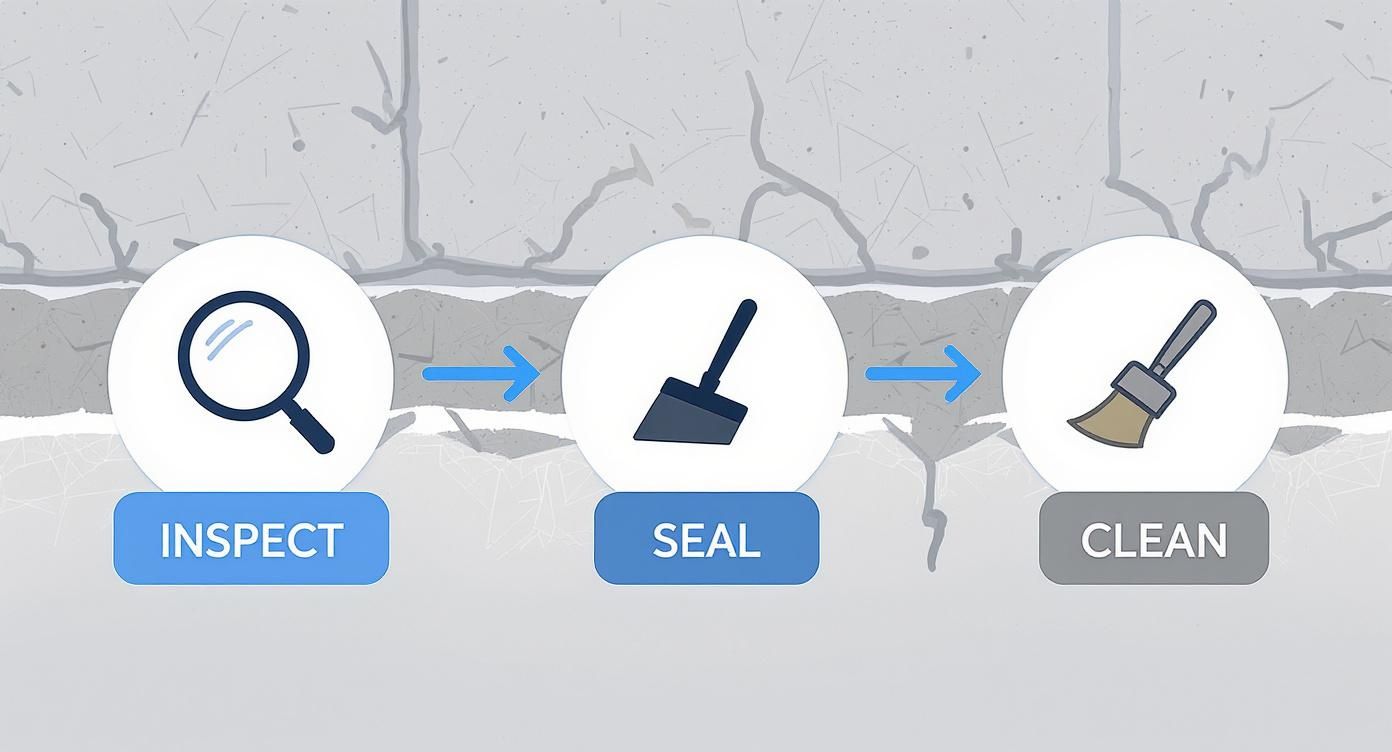
It’s a simple flow, but it emphasizes that a successful project is built on a solid, dry foundation where you’ve handled moisture issues at their source.
Applying Your Insulation
With the little gaps sealed and the framing in place (if you built it first), it’s time to apply the main insulation. How you do this depends entirely on the material you chose.
For DIY Spray Foam Kits
If you’re using a two-part froth pak, safety is paramount. Wear your full personal protective equipment (PPE)—I’m talking respirator, goggles, and gloves. Make sure the basement is well-ventilated. Apply the foam between the studs in a smooth, even layer, aiming for your target thickness. Remember, this stuff expands fast, so start with a light coat.
For Rigid Foam Boards
Cut the foam boards to fit snugly between your framing studs. If you’re insulating first, you’ll cut large sheets to fit against the concrete wall. A long utility knife or a specialty foam board cutter works well. Secure the boards to the concrete with a compatible foam board adhesive, then tape all the seams between boards with a high-quality construction tape to create a continuous air barrier.
A Pro Tip: When cutting foam boards for a tight fit, I’ve found it’s often better to cut them about 1/4 inch smaller than the cavity. Then, use canned foam to seal the edges. This guarantees a perfect, airtight seal around the entire perimeter of each board.
The rising demand for better home comfort is driving serious growth in the wall insulation market, which is projected to hit USD 59.8 billion by 2034. The residential sector is leading this charge, holding a commanding 48.8% market share in 2024 as more homeowners choose to insulate basement walls. You can find more market data by reading the full research about wall insulation market trends.
Fireblocking and Thermal Barriers
Your job isn’t done once the foam is in place. Building codes have strict fire safety requirements, and these are absolutely not optional. Both spray foam and rigid board insulation are combustible, so they must be separated from the living space by a thermal barrier.
Typically, this means covering the entire insulated wall with 1/2-inch drywall. The drywall has to be installed properly—taped and mudded—to meet code.
You’ll also need to install fireblocking. This involves placing pieces of wood or other approved fire-resistant materials within concealed spaces (like at the top and bottom of stud cavities) to stop the spread of fire. Check your local building codes for the specific requirements on where to place fireblocks and what materials to use. This final step ensures your newly insulated basement is not just comfortable and efficient, but also safe and fully code-compliant.
Budgeting Your Project and Calculating ROI
Figuring out the numbers is a huge part of any home improvement job, and insulating your basement walls is no exception. While the upfront cost can feel a bit steep, it’s best to look at it as a long-term investment—one that pays you back in more ways than one.
To get a realistic budget, you need to think beyond the price tag of the insulation itself. You’ve got to factor in all the materials, labor, and any extra tools or prep work involved. This gives you the full financial picture so you can make a smart decision without any surprise costs popping up later.
Breaking Down the Costs
The total cost of your project is going to hinge on a few key things: how big your basement is, the type of insulation you pick, and whether you hire a pro or do it yourself. Let’s walk through some real-world numbers to give you a solid starting point.
- Professional Spray Foam Installation: This is the top-tier option for performance and durability. You can generally expect to pay somewhere between $3.50 and $5.50 per square foot. That price almost always includes both the materials and the expert labor you need for a perfect application.
- DIY Rigid Foam Boards: If you’re going the DIY route with XPS or EPS rigid foam, your biggest expense will be the materials. Two-inch rigid foam boards typically run from $1.50 to $2.50 per square foot. Just remember to also budget for construction adhesive, seam tape, and canned foam for sealing gaps—that stuff can easily add another 15-20% to your material bill.
Don’t forget about potential tool rentals if you don’t already own them, like a powder-actuated tool for attaching furring strips to the concrete walls. Those small expenses can really add up.
One of the most common mistakes I see is underestimating the cost of prep work. If you need to fix foundation cracks or do a serious deep clean, factor those costs into your budget from day one.
Calculating Your Return on Investment
The true value of insulating your basement walls goes way beyond a number on an estimate. Your return on investment (ROI) really comes from two places: immediate savings on your energy bills and a long-term boost in your home’s value.
Tangible Financial Payback
| Cost Factor | DIY Rigid Foam (1,000 sq ft) | Pro Spray Foam (1,000 sq ft) |
|---|---|---|
| Material & Labor Cost | ~$2,500 – $3,000 | ~$3,500 – $5,500 |
| Annual Energy Savings | ~$300 – $500 | ~$400 – $700+ |
| Estimated Payback Period | 5 – 8 years | 6 – 9 years |
| Added Home Value | Good | Excellent |
Homeowners who properly insulate their basements can see a 15-25% reduction in their total heating and cooling costs. For a lot of families, that adds up to hundreds of dollars in savings every single year. That recurring return starts to chip away at the initial project cost pretty quickly.
The bigger financial win, though, often comes from the jump in property value. A dry, comfortable, finished basement is a massive selling point. By turning an unfinished space into truly usable square footage, you’re not just making your home more enjoyable—you’re making a strategic upgrade that can deliver an ROI of 70% or more when it’s time to sell.
Finally, always check for local incentives. A lot of utility companies and even state governments offer rebates or tax credits for energy-efficient upgrades. A quick search on your local utility’s website could uncover programs that help soften the upfront financial hit and make your project even more affordable.
Common Questions About Basement Insulation
When it comes time to insulate your basement, a lot of the same questions tend to bubble up. It’s totally normal to feel a bit overwhelmed, especially when you start hearing conflicting advice from different sources. Let’s cut through the noise and tackle the most common points of confusion with some clear, practical answers.
Getting these details right from the very beginning is the key to avoiding costly mistakes down the road. More importantly, it ensures your project actually delivers the comfort and energy savings you’re after. These are the questions we hear constantly, so we’ve put together the answers you need to move forward with confidence.
Do I Actually Need a Separate Vapor Barrier?
This is probably the biggest point of confusion we see, and the real answer is a firm “it depends” on the type of insulation you’re using. The goal is always to stop warm, moist indoor air from hitting the cool concrete and condensing, but slapping up the wrong barrier can cause a lot more harm than good.
Some materials are just built differently. Closed-cell spray foam and XPS rigid foam boards, for example, are what we call vapor retarders. They’re non-porous by nature, so they stop moisture dead in its tracks. When you install these materials directly against the concrete, they become your all-in-one insulation and vapor barrier. You absolutely do not want to add a separate plastic sheet over them.
The cardinal sin of basement insulation is trapping moisture. If you put a plastic vapor barrier on the warm side of an installation that already has a vapor-proof foam layer, you create a “moisture sandwich.” This traps water right inside your wall cavity, which is a perfect recipe for rot and mold.
Now, if you were to use something like fiberglass or mineral wool batts (which we don’t recommend against concrete for this very reason), you would absolutely need a separate, perfectly sealed vapor barrier on the “warm-in-winter” side to protect the insulation from your home’s humidity.
Can I Just Insulate the Parts of the Basement I Use?
It’s tempting to try and save a few bucks by only insulating the walls of that future home office or gym, but it’s rarely a winning strategy. For insulation to really work its magic, it has to create a continuous, unbroken thermal blanket around the entire space.
When you only insulate a section of the basement, you leave huge gaps in that blanket. Heat and cold will simply sidestep the insulated sections by traveling right through the uninsulated concrete walls—a process known as thermal flanking. This move drastically guts the overall effectiveness of your project and can still lead to condensation problems in the uninsulated areas.
Think of it like wearing a top-notch winter coat but leaving it completely unzipped. You’re getting some protection, sure, but the cold air is still going to find its way in and make you uncomfortable.
That said, if the budget is incredibly tight, insulating a section is better than nothing. Just go into it with your eyes open:
- You won’t get the full energy-saving benefits.
- The uninsulated sections will stay cold and be prone to dampness.
- You’ll end up with an uneven temperature profile across the basement.
For the best performance and to truly solve moisture problems for good, insulating the full perimeter is the professional standard.
What R-Value Is Right for My Basement Walls?
There’s no single magic R-value that fits every situation; it all comes down to your local climate and building codes. The R-value is just a simple measure of how well an insulation material resists heat flow—the higher the number, the better the performance.
For most climates, building codes typically require an R-value of R-10 to R-15 for continuous insulation on basement walls. Here in a humid region like South Florida, hitting at least an R-10 is non-negotiable for preventing condensation.
Hitting that target depends entirely on the material you choose:
- Closed-Cell Spray Foam: With a powerful R-7 per inch, a 2-inch application gets you to R-14.
- XPS Rigid Foam: This comes in at R-5 per inch, so you’d need a 2-inch board for R-10 or a 3-inch board for R-15.
- EPS Rigid Foam: Typically R-4 per inch, so you’d need a 2.5-inch thickness to reach R-10.
Before you buy a single board or schedule an installer, always double-check with your local building department. Confirming the specific R-value requirements for your area ensures your work is not only effective but also fully code-compliant.
At Airtight Spray Foam Insulation, we specialize in creating durable, moisture-resistant solutions that stand up to South Florida’s unique climate. If you want to ensure your basement is insulated correctly the first time, request a free, no-obligation quote from our experienced team. Learn more at https://airtightsprayfoaminsulation.com.