
An installed insulated garage door usually costs $750 to $1,900 for a single door and $1,500 to $3,700+ for a double door. In South Florida, the price driver isn't solely door size. It's the combination of R-value, insulation type, and hurricane-rated construction that determines whether the upgrade helps.
If your garage feels like a heat box by midafternoon, you're not imagining it. In Jupiter, Palm Beach Gardens, West Palm Beach, Wellington, and Stuart, the garage door often takes the hardest solar hit on the house. A thin, non-insulated door turns that heat into a steady load that pushes into adjacent rooms, warms stored items, and makes the whole space harder to control.
A lot of homeowners shop garage doors by style first. That makes sense. The door is one of the biggest visual features on the front of the home. But in South Florida, an insulated garage door is less about luxury and more about controlling heat, humidity, noise, and long-term wear. Done right, it becomes one part of a larger airtight system. Done poorly, it's an expensive panel with gaps around it.
For many Florida homes, yes. But not for the reason most national articles give.
The usual advice treats insulation like a cold-climate feature. Here, the issue is different. South Florida garages absorb intense outdoor heat for long stretches of the day, and that heat doesn't stay neatly inside the garage. It moves through shared walls, ceilings, ductwork, and connecting doors. If the garage is attached, the house feels it.
A basic insulated garage door can be a worthwhile upgrade if your current door is thin, loud, and heat soaked by afternoon. The investment becomes easier to justify if the garage shares a wall with a bedroom, laundry room, or living area, or if you use the space for more than parking.
The broad installed cost range is established, but performance matters more than sticker price. Insulated garage doors range from R-6.3 to R-20.4, while non-insulated doors sit around R-0 to R-2, according to HomeGuide's insulated garage door cost breakdown. That gap is meaningful in a hot climate, but only if the rest of the garage envelope supports it.
Practical rule: In South Florida, buying the door alone is rarely the full fix. The door helps most when the garage walls, ceiling, and perimeter leaks are addressed too.
If your garage is a metal structure, workshop, or detached building, the same system thinking applies. This guide on spray foam options for metal structures is useful because it shows how insulation choices change once radiant heat and thin metal surfaces enter the picture.
A premium insulated door won't solve a garage that leaks air at every edge. It also won't offset an uninsulated ceiling over the garage or a wall shared with conditioned space that was never properly sealed.
That's why homeowners looking at full-garage comfort usually get better results when they think beyond the door itself and review how to insulate a garage properly. The smart investment isn't just the panel that goes up and down. It's the whole assembly that controls heat and moisture.
By the time a South Florida garage door faces a full afternoon of sun, the cheap quote usually stops looking cheap. Homeowners see one price on the estimate, then later find out the number did not include reinforced track, upgraded springs, better perimeter seals, or the permit work needed for a wind-rated installation.
Installed price still starts with the door itself. As noted earlier, insulated models cost more because you are buying a thicker assembly, added insulation, and hardware that can safely carry the extra weight. In this climate, that premium only makes sense if the door is part of a tighter garage system instead of a stand-alone swap.
Here's the cost breakdown visual to keep the categories straight.
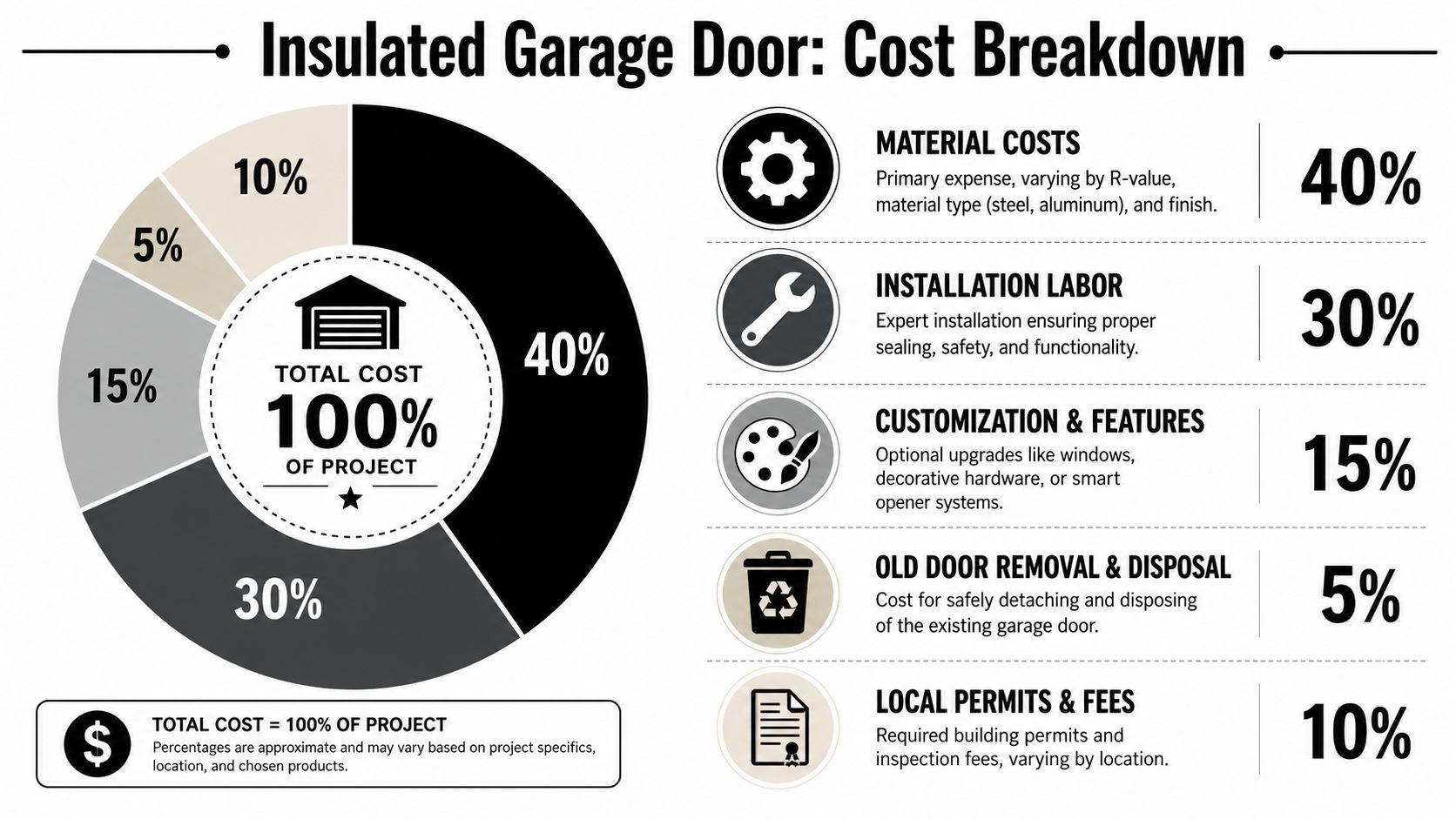
The material cost matters, but South Florida labor and code requirements often move the quote just as much.
| Cost factor | What changes the price |
|---|---|
| Door size | A wider opening needs more material, heavier-duty hardware, and more install time. |
| Insulation type | Polystyrene usually costs less. Polyurethane raises the price because it adds rigidity and better thermal performance. |
| Door construction | Basic steel is usually the value choice. Wood-look finishes, composite overlays, and specialty materials raise both material and labor cost. |
| Wind-load rating | Reinforcement for storm pressure, upgraded track, and code-approved anchoring can add a noticeable premium in South Florida. |
| Glass and design upgrades | Windows, custom colors, decorative hardware, and smart opener add-ons increase the final number quickly. |
Three-car layouts and high-end finishes change the budget fast. So do custom sizes, which are common on older homes where the opening is not perfectly standard.
Many homeowners find this aspect confusing. Two estimates can both say "insulated garage door" and still cover very different scopes of work.
Check for these items before you compare numbers:
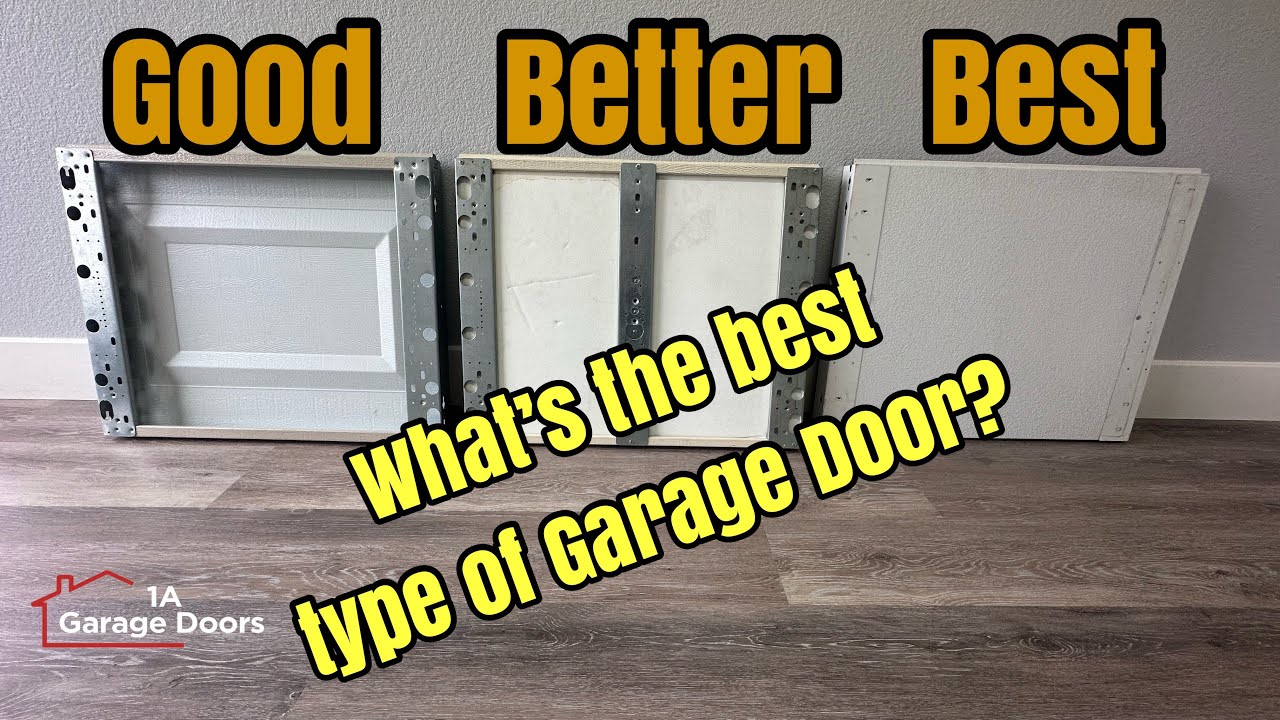
This walkthrough helps visualize what installers are dealing with during replacement.
A good quote answers a building-performance question, not just a product question.
If the garage shares walls or ceiling with conditioned space, the door should be priced as one part of the garage envelope. A better-insulated door with poor side sealing still lets hot, wet air pour in. A wind-rated door with weak perimeter details still leaves comfort on the table. That is why I tell homeowners to read the proposal like a system checklist.
Ask what insulation is inside the panels, what wind rating applies to your opening, what seals are included, and whether the installer looked at the rest of the garage envelope. If you need a clearer baseline on thermal performance, this garage insulation R-value comparison helps put door specs in context with the rest of the assembly.
The best value in South Florida is rarely the lowest bid. It is the quote that gives you a door, hardware, sealing, and code-ready installation that works with the heat, humidity, and storm exposure your garage deals with every day.
R-value is simple in concept. It measures thermal resistance, or how well the door slows heat moving through it. Higher R-value means stronger resistance to outdoor heat pushing inward.
For garages in South Florida, that matters most on doors exposed to direct sun for long periods. A garage door with more thermal resistance won't turn the space into conditioned living area by itself, but it does reduce how aggressively the door acts like a hot metal radiator.
The useful comparison isn't insulated versus insulated. It's insulated versus almost nothing.
As noted earlier, insulated doors span a much higher R-value range than non-insulated models. That doesn't mean you should chase the highest number available without context. In practice, homeowners should weigh the insulation type and the quality of the overall door assembly, not just the marketing label.
A good way to think about it is this:
For a broader view of thermal performance across materials, this insulation R-value comparison guide is a helpful reference.
The material inside the door changes performance more than many homeowners realize.
Dons Garage Doors' comparison of insulated garage doors notes that polystyrene is around R-9, while polyurethane runs about R-14 to R-18. The same source says the cost difference is often under $1,000 for a 16-foot door, yet polyurethane can roughly double insulation value while also improving durability and noise reduction.
| Feature | Polystyrene Insulation | Polyurethane Insulation |
|---|---|---|
| Typical R-value | R-9 | R-14 to R-18 |
| How it's used | Rigid panels fitted into the door | Foam fills the cavity more completely |
| Cost position | Lower upfront cost | Higher upfront cost |
| Noise control | Better than non-insulated | Better sound dampening |
| Best fit | Budget-conscious upgrade | Better long-term performance in demanding conditions |
If you're choosing strictly on lowest upfront cost, polystyrene can still be a valid upgrade from a non-insulated door.
If you're trying to control solar heat gain, reduce panel vibration, and get a more solid-feeling door, polyurethane is usually the stronger choice.
"The cheapest insulated door isn't always the cheapest ownership decision."
That is especially true when the garage is attached to the home, exposed to strong afternoon sun, or used for storage that suffers in high heat. In those situations, polyurethane's better thermal performance and more rigid construction usually justify the added spend.
South Florida isn't just hot. It's hot, humid, storm-prone, and hard on building assemblies that aren't sealed well.
A garage door here takes repeated UV exposure, wind-driven rain, salt air in many locations, and wide temperature swings between outdoor surfaces and conditioned interior spaces. Generic garage door advice often ignores that combination. It treats the door as a stand-alone product instead of part of the home's pressure, moisture, and heat-control system.
Most homeowners notice heat first. They open the garage in late afternoon and feel the blast. But humidity and air leakage are usually the hidden issue.
A door panel can have a respectable R-value and still underperform if outside air slips around the perimeter. Door Systems' discussion of insulated versus non-insulated garage doors states that sealing gaps and adding weatherstripping can reduce energy loss by 20% independently, and that the thermal performance of the door drops sharply when leakage around the frame and walls isn't addressed.
That point matters more in Florida than in many other regions. Humid air doesn't need a big opening. A small perimeter gap is enough to feed condensation risk, muggy conditions, and extra cooling load.
When the garage shares walls or ceilings with conditioned space, the garage becomes part of the home's defensive line against heat and moisture.
These are the trouble spots that usually matter most:
A high-R garage door with leaky framing is like buying a good cooler and leaving the lid cracked.
South Florida buyers also need to think about wind-load performance. That's not a cosmetic upgrade. It's structural protection.
An insulated door may cost more partly because stronger construction often pairs with heavier-duty hardware and reinforced components. In hurricane-prone areas, that added strength isn't wasted money. The value comes from choosing a door that can handle local code expectations and the reality of storm season.
If a homeowner asks whether insulation or hurricane rating matters more, the honest answer is that both matter. In this market, the best value often comes from a door that handles heat and storm demands together, then gets sealed into a garage envelope that doesn't leak around it.
A South Florida garage can hit punishing temperatures by midafternoon, especially on a west-facing wall. If there is a bedroom over the garage or a laundry room beside it, that heat does not stay isolated. It pushes into the house, makes nearby rooms harder to cool, and keeps the garage sticky long after sunset.
That is where ROI usually shows up here. Not as a neat payback chart, but as lower heat gain into connected rooms, better garage usability, and less runtime pressure on the AC serving the house. If you want a second opinion on the comfort side, these expert tips for garage climate control are worth reading.
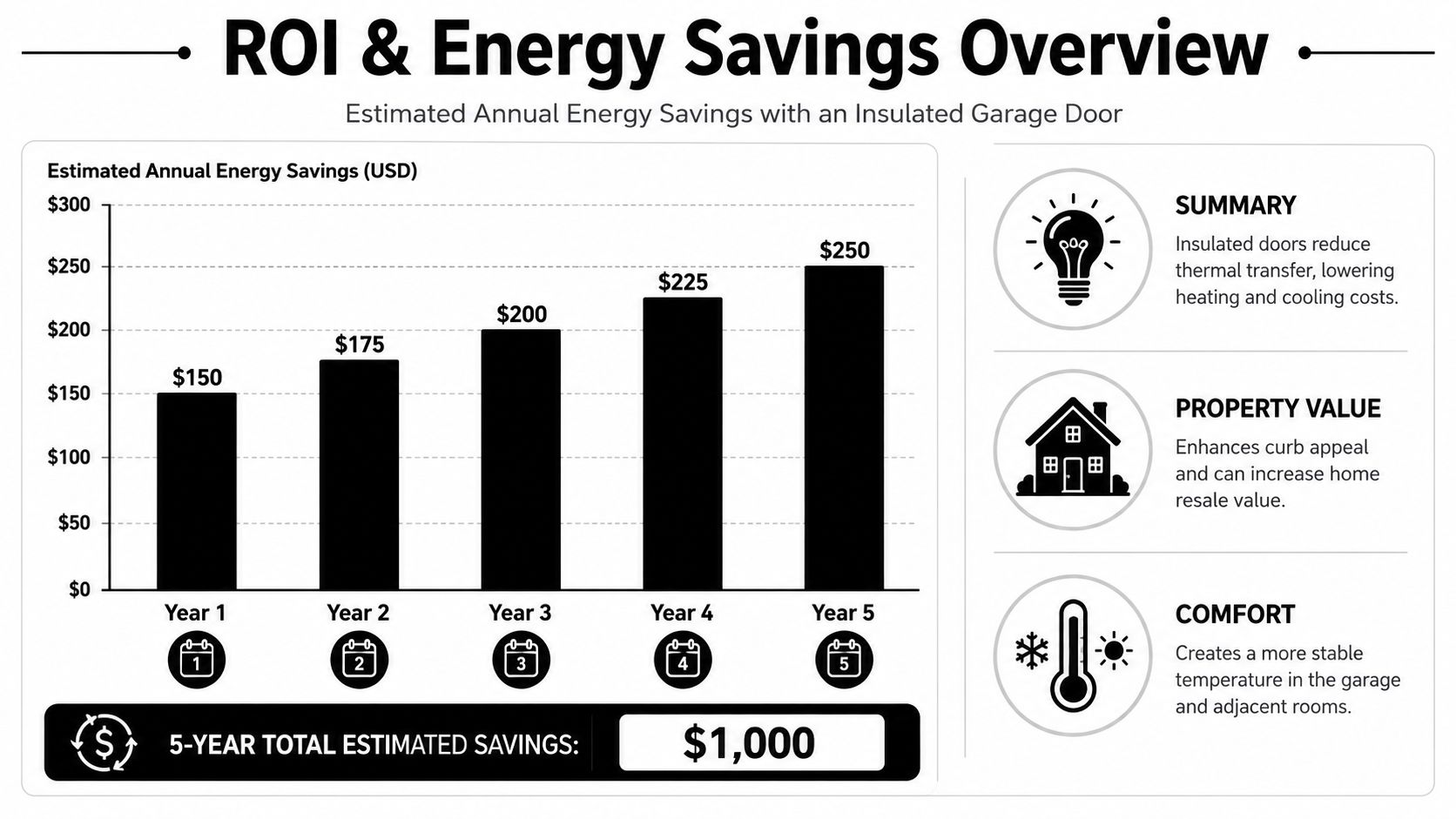
In attached garages, the biggest benefit is often indirect. The door cuts some of the thermal load at the largest moving opening, which helps the rooms next to or above the garage stay more stable.
That value tends to show up in a few practical ways:
A door by itself rarely produces dramatic utility savings in our climate. South Florida humidity and solar load expose weak points fast. If the side jambs leak, the bottom seal skips across an uneven slab, or the ceiling above the garage is bare, the door cannot carry the whole job.
That is why I look at the garage as part of an Airtight Comfort System, not as a one-item upgrade. The door matters. The perimeter seals matter. The walls, shared ceiling, attic access, and any duct leakage matter too.
The return becomes much more tangible when the insulated door is installed into a garage envelope that is controlled.
Use this filter before you spend the money:
Homeowners also ask about tax incentives. Garage doors generally are not the part of the project that drives federal energy credit eligibility, but the bigger home-efficiency package may. This guide to the federal home energy efficiency credit explains where those incentives can apply.
If an insulated garage door seems underwhelming after installation, the usual problem is not the panel. It is the air leakage and missing insulation around the rest of the garage.
For South Florida homes, the best return comes from solving heat, humidity, and air leakage together. An insulated garage door is often a good buy. It becomes a much better one when it is part of a sealed, insulated garage envelope instead of a stand-alone purchase.
DIY looks tempting because labor is part of the insulated garage door cost. But this is one of the worst places to chase savings if you care about safety and real performance.
Garage doors are heavy. Insulated ones are heavier. Springs, tracks, panel alignment, opener force settings, and bottom-seal contact all have to work together. A door that looks installed can still be badly installed.
The first risk is physical safety. Torsion springs store serious energy, and mistakes around spring tension can cause severe injury.
The second problem is more common and less dramatic. Homeowners install the door, it opens and closes, and they assume the job is done. But the panel may not be balanced correctly, the side seals may not sit tight, the header gap may remain open, or the bottom seal may only touch the slab in sections. In a humid climate, those details are the difference between "insulated" and useful.
A good installer should deliver more than assembly. They should leave you with a door that is:
Professional installation is also where local code and wind-load requirements are less likely to get missed. In South Florida, that matters. An insulated garage door isn't just another home improvement item. It's a moving exterior assembly exposed to heat, moisture, and storms. That combination rewards precision.
In South Florida, a garage can have a brand-new insulated door and still feel damp, hot, and uncomfortable by midafternoon. That usually surprises homeowners. The problem is rarely the door alone.
A few practical questions come up again and again when people are trying to decide whether the added cost is worth it.
Do insulated garage doors reduce noise?
Usually, yes. An insulated door tends to sound less hollow, vibrate less, and soften street noise better than a basic pan door. You will hear the difference most on attached garages and homes near busy roads.
Do windows hurt insulation performance?
Yes, to a degree. Glass adds heat gain and lowers the door's overall thermal performance compared with a solid insulated model. If you want daylight or curb appeal, that can still be a fair trade. Just go in knowing you are choosing appearance over peak performance.
Does door color matter in Florida?
Yes. On a west-facing or south-facing garage, a dark door absorbs more solar heat than a lighter finish. That does not make dark colors wrong. It just means the rest of the garage envelope needs to work harder.
Is an insulated door enough if the garage still feels hot?
Often, no. If humid air is getting in around the jambs, the attic above is underinsulated, or the walls are bare block with no thermal control, the door cannot carry the whole load.
The best way to judge insulated garage door cost is to treat the door as one part of the garage envelope, not the whole fix. In our climate, heat and moisture do not care where they enter. They move through the weakest parts first. That might be the door perimeter, the ceiling, the shared wall to the house, or the slab edge.
That is why I advise homeowners to look at the garage as an Airtight Comfort System. The door matters. So do the seals, surrounding framing, ceiling insulation, and air leakage paths. If one piece is upgraded and the others are left loose, the result is usually underwhelming.
For many homes, the right sequence is straightforward. Replace the door if the existing one is old, uninsulated, damaged, or not rated for local wind requirements. Then seal the opening correctly. After that, address the walls and ceiling so the full assembly performs like a conditioned buffer zone instead of a hot box attached to the house.
If you want a real-world assessment of how your garage door, wall insulation, ceiling insulation, and air leakage are working together, Airtight Spray Foam Insulation can help. Their team serves South Florida homeowners and builders with garage, wall, attic, and metal-building insulation solutions designed for heat, humidity, and long-term comfort. Request a free estimate to find out what it takes to turn your garage into a properly sealed, usable space.