
If you're standing in a South Florida metal garage right now and it feels hot, sticky, and slightly damp, you're dealing with more than bad comfort. You're dealing with a building assembly that's letting humid air hit metal surfaces it shouldn't reach.
That's why people who want to insulate a metal garage often ask the wrong first question. They ask which product has the highest R-value. In this climate, the first question is whether the insulation system will control air movement and condensation. If it won't, the garage can still sweat, drip, rust tools, and make stored items smell musty even after you spend money on insulation.
Metal buildings don't forgive shortcuts. A small gap at a panel lap, a leaky roll-up door, or loose insulation around penetrations can undo a lot of the benefit you thought you paid for. In South Florida, the assemblies that hold up are the ones that treat heat and moisture as the same job.
A lot of garages in this area look fine from the driveway and fail from the inside. The roof starts sweating in the morning. The walls feel clammy. Cardboard boxes soften. Hand tools pick up surface rust. You open the garage after a rain and get hit with that damp, stale smell.
That's the part many homeowners miss. The problem isn't only that the garage gets hot. The main problem is that warm, moist air finds cold metal, and once that happens, you get condensation.
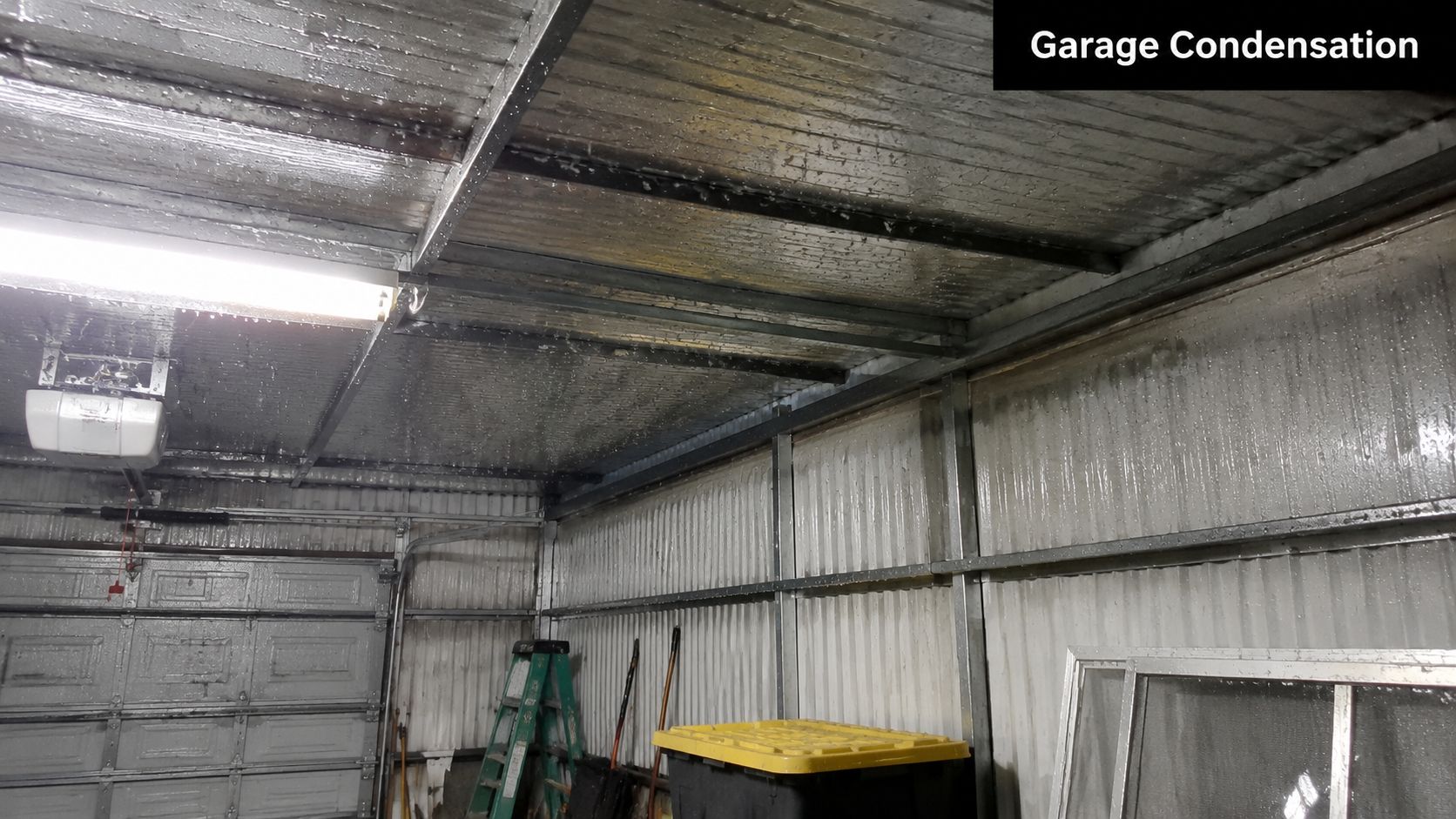
Many popular guides treat garage insulation like a simple temperature-control upgrade, but independent steel-building guidance points to the main failure mode as moisture accumulation on cold metal surfaces, especially where warm indoor air can reach the roof or wall skin. That's why continuous insulation and sealed penetrations matter as much as nominal R-value, as noted by independent steel-building guidance on prefab metal garage insulation.
In the field, that shows up as what a lot of owners call garage rain. The metal skin cools, humid air reaches it, and water forms where you don't want it. If the garage stores a vehicle, boat gear, power tools, paint, holiday bins, or gym equipment, moisture becomes the main threat.
Practical rule: In South Florida, I don't treat metal garage insulation as a comfort add-on. I treat it as a condensation-control system first.
A properly insulated metal garage is more stable day to day. The garage doesn't swing as hard between blazing hot afternoons and damp early mornings. That matters if the space is attached to the house, used as a workshop, or holds anything sensitive to moisture.
Good insulation in a metal garage can help with:
A lot of failures come from treating insulation like a blanket instead of part of an assembly. If the garage still leaks humid air around the shell, the moisture problem stays alive. That's also why homeowners who are sorting out moisture control usually need to understand how a garage vapor barrier works in real conditions, especially where metal skin, air leakage, and humidity overlap.
The Department of Energy says insulation reduces heating and cooling costs by resisting heat flow, and that matters here because cooling drives most decisions in this region. But in metal garages across South Florida, the daily complaint usually starts with humidity, not utility math.
That's why insulating a metal garage isn't optional busywork. It's a building-performance decision. If the garage stays wet inside the assembly, the space will never feel right, no matter how much material gets stuffed into the walls.
The right product for a metal garage in South Florida isn't the cheapest material at the store. It's the material that still works after humidity, air leakage, fastener penetrations, and real-world installation quality are factored in.
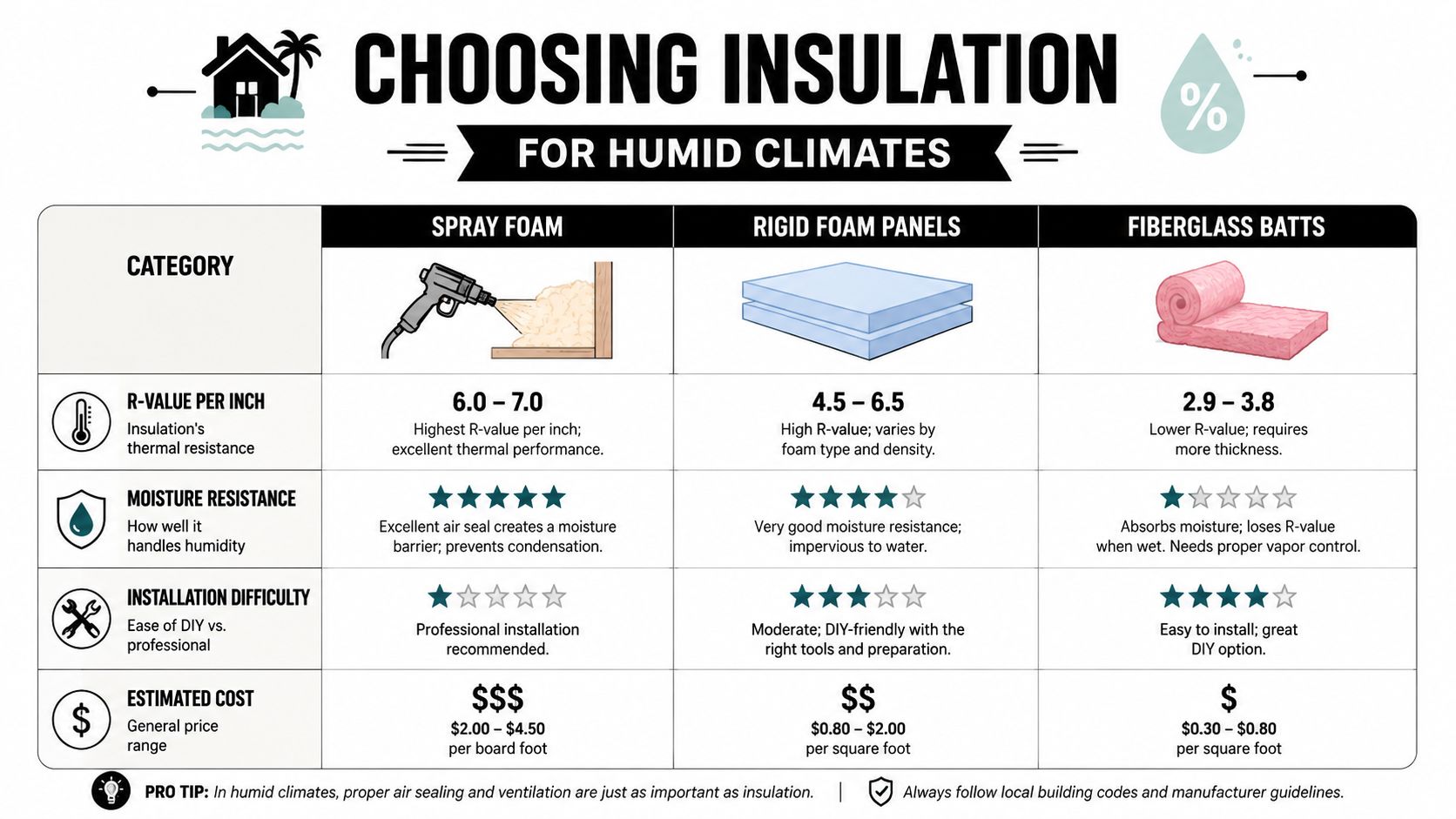
For humid metal buildings, closed-cell spray foam solves problems other materials can't solve on their own. It insulates, air seals, and helps control moisture in one application. That's the big reason it has become a leading modern option for metal garages. One metal-building guide recommends R-13 to R-19 for walls and R-19+ for roofs in hot climates, and it specifically highlights closed-cell spray foam as effective for preventing condensation on metal panels in that setting, according to this metal-building insulation guide.
What works:
What doesn't:
If you're weighing foam types, this guide on open-cell versus closed-cell insulation is useful because the difference matters a lot more in a metal garage than it does in a simple interior partition.
Fiberglass stays popular because it's familiar and usually cheaper at the start. In a dry assembly with careful fitting and proper facing details, it can do its job.
In humid metal garages, fiberglass becomes risky when installers leave voids, compress the material, or ignore air leakage. It doesn't stop moving air by itself. If humid air gets around it and reaches the metal skin, condensation can still happen. That's when people say, “I insulated the garage and it still sweats.”
Cheap insulation isn't cheap when it has to be redone after moisture gets into the assembly.
Fiberglass can make sense when budget is tight and the system is designed carefully, but it has less tolerance for sloppy work than many people think.
Rigid foam board can be a strong option because it can provide good thermal resistance with relatively limited thickness. It also gives installers more control over flat surfaces than batt insulation does.
The catch is in the seams. If the joints, edges, and penetrations aren't sealed well, the boards don't deliver the air control people expect. In metal garages, that gap between “installed” and “installed correctly” is where many projects lose performance.
Rigid board is often attractive for owners who want a cleaner interior build-out, but it needs careful detailing around framing, trim, and transitions.
Reflective foil products have a place, but they get oversold. Industry guidance notes that reflective foil systems are relatively low-R, with one installation source stating about R-3 to R-7 depending on configuration and installation quality, as discussed in this budget-focused metal building insulation guide.
That doesn't mean they're useless. It means they have to be installed for the job they perform. Some reflective systems need a deliberate air space to perform properly. If someone presses them tight against the wrong surface or skips the air gap, they underperform.
| Material | R-Value / Inch | Moisture Resistance | Air Seal Quality | Best For |
|---|---|---|---|---|
| Closed-cell spray foam | High | Strong in humid assemblies | Excellent | Garages with condensation issues, roof-first upgrades, conditioned or semi-conditioned spaces |
| Fiberglass batts | Varies by product | Weak if the assembly gets damp or leaky | Poor on its own | Budget builds with careful detailing and dry, controlled assemblies |
| Rigid foam panels | High relative to thickness | Good when seams are detailed well | Good if seams are sealed | Flat surfaces, controlled retrofits, assemblies with careful trim work |
| Reflective insulation | About R-3 to R-7 depending on configuration and installation quality | Depends on assembly design | Limited unless paired with additional sealing | Non-conditioned spaces or targeted radiant-heat control |
If the goal is to insulate a metal garage that already shows signs of sweating, I'd put closed-cell spray foam at the top of the list. It addresses the primary failure point, which is humid air reaching metal.
If the budget won't support that approach, the next best move is to build the assembly around meticulous air sealing and moisture control, not just insulation thickness. In this climate, material choice matters. Installation quality matters just as much.
Most bad metal garage insulation jobs don't fail because the owner picked the wrong product from a brochure. They fail because the installation skipped the details that stop air and moisture.
For a metal garage, one of the most important performance upgrades is to pair insulation with a continuous air barrier. Practical guidance for these buildings is straightforward: clean the substrate, seal panel laps and fastener penetrations, then install insulation. That same guidance also calls out gaps around doors, windows, and outlets as common bypass points that lower effective R-value and let moist air reach cold metal surfaces, as described in this metal building installation guide.
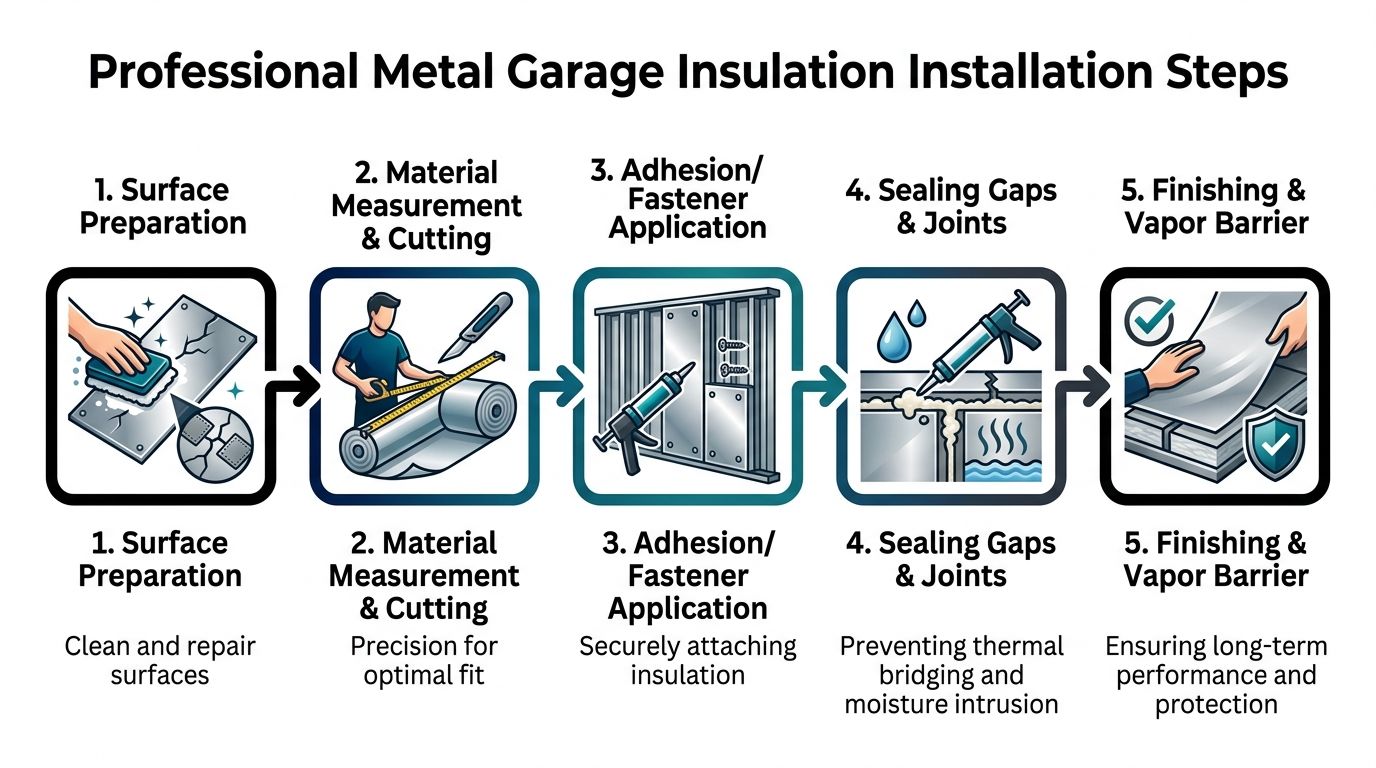
A garage shell has to be dry, clean, and sound before insulation goes in. Dust, oil, corrosion, loose fasteners, and existing leaks need attention first.
If a roof panel is already taking on moisture or a wall seam is loose, insulation won't fix the defect. It only hides it. That's a common mistake in fast-turn jobs. Someone wants the space insulated by the end of the week, so the prep gets rushed.
A proper start usually includes:
If air can move freely through the assembly, the rated insulation value won't match real performance. Metal garages leak at the same places over and over.
The usual trouble spots are:
Field note: A small leak at the top of the wall can create a much bigger moisture problem at the roof than owners expect.
Installation quality separates a durable assembly from a pretty one. A garage can look finished and still be leaking badly behind the liner.
Different insulation systems need different details. As a result, a lot of DIY advice becomes misleading because it treats every product like it installs the same way.
Spray foam can be applied directly to the underside of roof panels to create an airtight seal. In humid or mixed climates, closed-cell foam is generally preferred in metal assemblies where condensation control matters more than sound absorption.
What a good foam install looks like:
What a bad foam install looks like:
Fiberglass has to fit snugly without compression. Once it's mashed into place around framing or stuffed behind obstructions, its real-world performance drops.
The common failures are predictable:
These systems can work, but some require the reflective layer to sit closest to the outer metal and maintain an air gap. Guidance for metal buildings commonly recommends at least a 1/2-inch to 3/4-inch air gap for that setup to perform as intended. If the installer skips that spacing, the system won't behave the way the owner expects.
A lot of underperforming radiant-barrier jobs come from one issue. The installer treats the material like a universal wrap and ignores the assembly detail that makes it functional.
Expert guidance on metal roof assemblies also stresses that some systems need deliberate air space and careful treatment of purlins, furring strips, and roof-deck conditions. The right answer isn't universal. Spray foam can eliminate air leakage directly, while reflective or blanket systems may still need separated layers or ventilation details, as discussed in this guide to insulating a metal roof without an attic.
Insulation shouldn't be the last thought in the room. The final layer matters for durability, appearance, and maintenance.
A clean finish might include paneling or drywall, depending on the garage use. In a workshop, the finish should hold up to impact and humidity. In a storage building, access for future electrical work might matter more than appearance.
A contractor who knows metal garages should be able to answer these questions clearly:
If those answers are vague, the job probably will be too.
When owners budget a metal garage insulation job, they usually focus on price first. That makes sense. But cost alone doesn't tell you much unless you connect it to how the garage is used and what problem you're trying to solve.
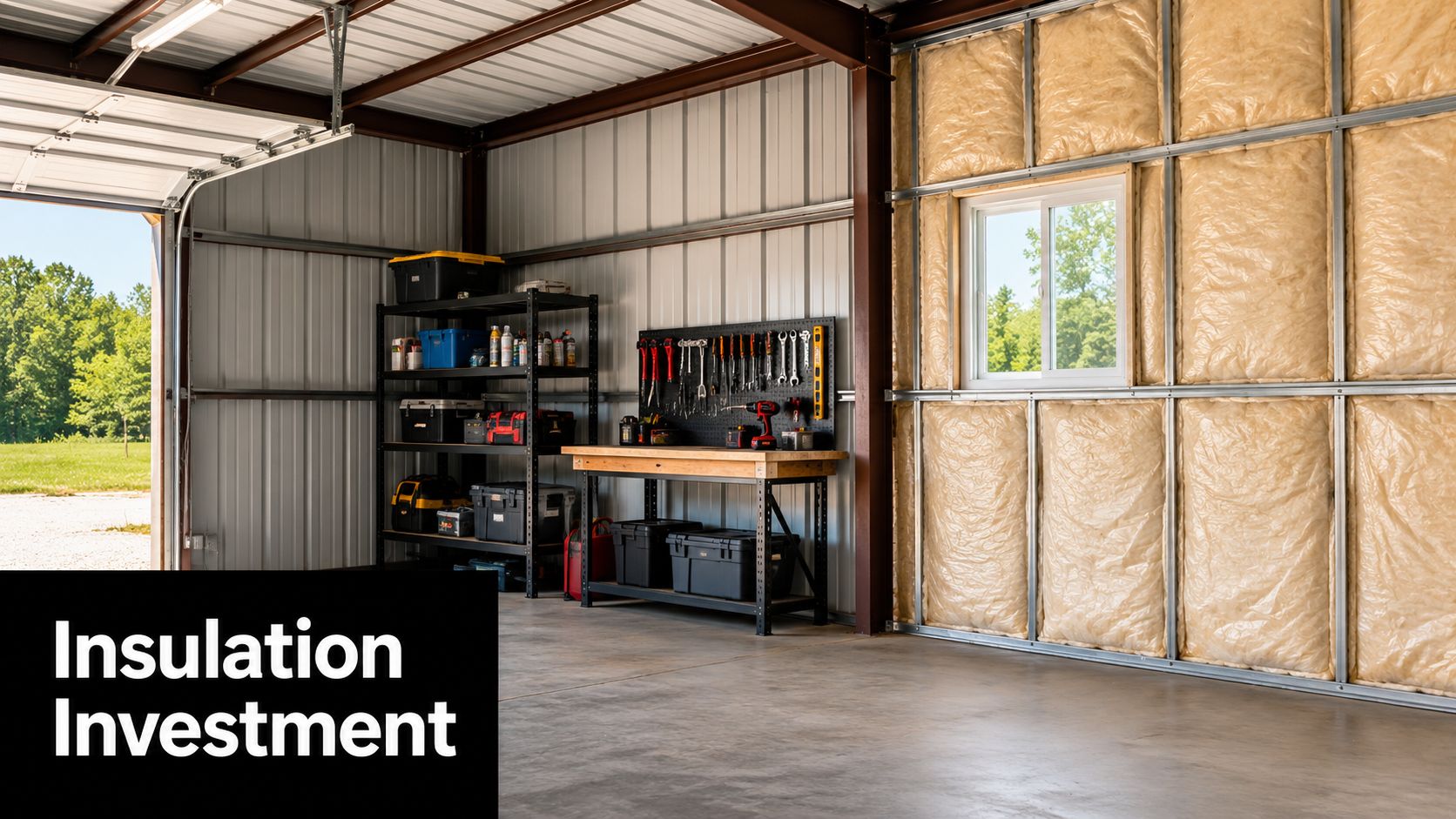
The Department of Energy says insulation reduces cooling costs by resisting heat flow, which is part of the value proposition in South Florida. For metal buildings, commonly cited R-values run from R-8 to R-30, with standard fiberglass products including R-13, R-19, R-25, and R-30 configurations, according to the Department of Energy insulation guidance.
A lot of people shopping insulation assume a higher number automatically means a better result. In a humid metal garage, the actual answer is more specific than that.
R-value tells you how well a material resists heat flow. It does not tell you whether the assembly leaks air, whether humid air can still reach the metal skin, or whether the installer left weak spots around penetrations. That's why two garages can use insulation with similar nominal ratings and perform very differently in daily use.
If you want a rough planning tool for thermal targets, an insulation R-value calculator helps frame the discussion around building area and intended use. It's useful for early budgeting, but the final recommendation still has to account for the garage shell and the moisture load.
In real jobs, cost usually moves based on a handful of factors:
Owners sometimes ask for exact square-foot pricing before anyone has looked at the garage. That rarely leads to a useful answer. In South Florida, the hidden cost driver is often the correction of air leaks and moisture pathways, not just the insulation itself.
Bottom line: The cheapest proposal often assumes the fewest details. In a metal garage, the details are the whole difference.
The return isn't only on the utility bill. For attached garages, reduced heat flow can support the comfort of adjacent rooms. For detached garages, the payoff may show up in better storage conditions, cleaner tools, less moisture odor, and a space that sees use.
Here's a practical way to frame ROI:
For a quick visual on how insulation upgrades change the feel of a working garage, this walkthrough is worth watching.

Any time you insulate a metal garage, especially if you're conditioning the space or adding an interior finish, check local code and permit requirements. In counties and municipalities across South Florida, the expectations can vary by use, by whether the garage is attached or detached, and by the scope of the remodel.
That's another reason ROI should be calculated around the whole project, not just bags of insulation or foam thickness. A garage that's properly detailed, permitted where required, and designed for the local climate usually costs more upfront than a quick patchwork job. It also avoids the expensive cycle of insulating, discovering moisture problems, and tearing things back open.
The right way to insulate a metal garage depends on who's using the building and what failure would hurt the most. A homeowner worried about stored belongings doesn't think like a general contractor trying to avoid callbacks. A property manager doesn't think like either one.
If you own the garage and use it for storage, hobbies, parking, or overflow space, focus on what the room feels like after a humid week, not just during a hot afternoon. If the garage already smells damp, if tools are rusting, or if the roof has shown signs of sweating, prioritize air sealing and condensation control over bargain insulation.
For many homeowners, the practical choices break down like this:
A professional installer can also tell you whether the door, wall transitions, or roof assembly are weak points before you spend money in the wrong place.
Contractors building or renovating metal garages in South Florida need to think beyond passing insulation specs on paper. The assemblies that generate complaints usually aren't the ones with too little material. They're the ones with uncontrolled leakage at joints, trim, openings, and roof transitions.
What usually prevents callbacks:
For new construction or retrofit work where spray foam is part of the solution, Airtight Spray Foam Insulation is one local option for installing open-cell and closed-cell foam in garages, metal buildings, and related assemblies across South Florida.
Property managers usually care about durability, maintenance, and tenant usability. In that context, insulation isn't just about comfort. It's about reducing moisture complaints, protecting the building interior, and making accessory spaces more practical over time.
The strongest strategy is usually the one with fewer failure points:
If the garage has to stay serviceable with minimal upkeep, pick the system that depends least on perfect conditions after installation.
For managers overseeing multiple properties, consistency matters. A durable, repeatable insulation standard is often more valuable than chasing the lowest initial bid on each unit.
If your metal garage in South Florida stays hot, damp, or starts showing condensation, Airtight Spray Foam Insulation can help evaluate the assembly and recommend a practical insulation approach for the roof, walls, and openings. Learn more or request a quote through Airtight Spray Foam Insulation.