If your front door feels a little sticky, the hallway near the entry always seems more humid than the rest of the house, or your AC never quite gets ahead of the afternoon heat, the problem may be smaller than you think. In South Florida, a thin gap around a door, window, attic hatch, or garage entry can pull in warm, wet air all day long.
That's where closed cell foam weatherstrip earns its keep. Not the cheap foam that flattens fast and turns into dust, and not the kind of generic advice you get off a hardware store shelf card. In Jupiter, Palm Beach Gardens, West Palm Beach, Wellington, and Stuart, weatherstripping has to deal with heat, humidity, salty air, wind-driven rain, and constant door use. If the material can't handle moisture and repeated compression, it won't last.
A good seal should do three things at once. It should block air, resist moisture, and keep enough spring in the material to stay in contact after months of opening and closing. Closed-cell foam does that better than many lighter options, especially on exterior openings where Florida homes take the most abuse.
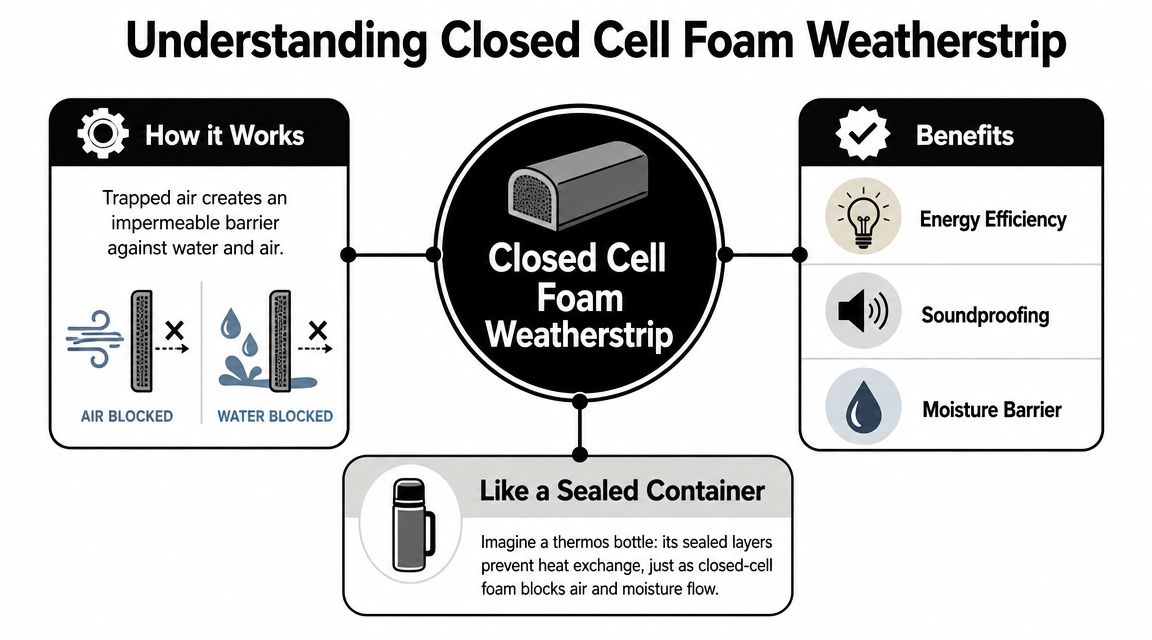
Closed cell foam weatherstrip works because of its internal structure. The easiest way to think about it is this: closed-cell foam is like a wall made of tiny sealed bubbles, while open-cell foam is more like a sponge. A sponge has pathways that let moisture and air move through it. Sealed bubbles don't.
That sealed structure is the whole point. Technical references describe closed-cell foam as a low-permeability seal because its cells are fully enclosed, which lets it act as a barrier against air, moisture, and vapor rather than just a soft cushion for a door or window to press against (technical foam tape overview).
When a homeowner presses on a strip of foam and says, “It feels about the same,” they're usually missing what matters. The actual difference isn't how soft it feels in your hand. It's what happens after that foam sits in a damp door jamb through a Florida summer.
With closed-cell foam:
That matters around entry doors, sliding glass doors, window stops, attic hatches, and access panels where you're trying to stop outside air from feeding indoor humidity.
Practical rule: If a weatherstrip mainly works as padding, it's the wrong product for a South Florida exterior opening. You want a gasket effect, not just softness.
A lot of products on the shelf get lumped together as “foam tape,” but they don't perform the same way. Closed-cell material is chosen when the seal itself has to resist air and water intrusion. Open-cell products can still have a place in low-demand interior spots, but they usually aren't what I'd trust around an exterior opening that gets hit with heat and humidity every day.
The same principle shows up in spray foam insulation. If you want a simple breakdown of how foam insulation seals by controlling air movement, this explanation of how spray foam insulation works is a useful companion.
A good way to judge closed cell foam weatherstrip is to stop thinking of it as trim and start thinking of it as a compressible gasket. Once you see it that way, the selection process gets clearer. You're not buying “something soft to stick on the frame.” You're choosing a material that has to hold contact, keep outside air out, and stay stable in a wet climate.
South Florida punishes weak weatherstripping. Heat builds pressure around sun-baked doors and windows. Humid air looks for any path inside. Afternoon rain hits frames that already warmed up all morning. A strip that works fine in a mild climate can fail fast here.
The first property to pay attention to is vapor resistance. At about 2 inches thick, closed-cell foam is typically rated at less than 1 perm, while open-cell foam is around 15 perms at the same thickness. The same source notes that closed-cell foam can deliver R-6.0 to R-7.0 per inch (closed-cell and open-cell performance comparison). For a homeowner, that means closed-cell material does a much better job resisting moisture diffusion while also adding meaningful thermal resistance.
“Perm” sounds technical, but the idea is simple. It's like the difference between a rain jacket and a bath towel. One resists moisture movement. The other lets moisture move in and hang around.
In South Florida, that difference shows up around:
If a seal lets vapor move too easily, moisture can keep feeding the area around the opening. That's when homeowners start noticing musty smells, swollen trim, or paint that doesn't seem to hold up.
Some people hear “weatherstrip” and think insulation value doesn't matter because the strip is narrow. In practice, small gaps matter because they're often continuous. A thin leak line running the full perimeter of a door can move a lot of unwanted heat and humidity.
Closed-cell foam helps in two ways. It blocks air movement, and the material itself has meaningful insulating value. That's useful around west-facing doors, metal-framed access panels, attic doors, and garage entries where Florida heat pushes hard.
For a deeper look at thermal performance in this category, this page on closed-cell insulation R-value per inch gives the broader insulation context.
A Florida seal has to manage more than a draft. It has to manage heat, wet air, and daily expansion and contraction around the opening.
A weatherstrip can test well on day one and still disappoint if it doesn't keep its shape. In this climate, material longevity comes down to whether the strip still rebounds after repeated compression and whether it keeps contact after months of exposure.
What usually fails first isn't the idea of weatherstripping. It's the wrong product in the wrong location. Thin, soft foam on a heavily used front door often loses effectiveness early. Closed-cell products generally do better where the seal has to stay firm and consistent.
Homeowners usually compare materials by price first. I get it. The roll on the shelf with the lower sticker price looks tempting, especially if the gap seems minor. But in Florida, material choice affects service life more than people expect.
Closed cell foam weatherstrip isn't the answer for every opening, but it's the material I'd lean toward when an exterior seal has to resist moisture and keep its shape over time. One industry source notes that closed-cell foam has a density of about 1.75 pounds per cubic foot or more, and that sealed-cell structure is what helps it resist compression set and maintain sealing performance through repeated use (closed-cell density and durability details).
| Material | Moisture Resistance | Durability / Compression Set | Best Use Case |
|---|---|---|---|
| Closed-cell foam | Strong choice for resisting air and moisture movement | Better suited to repeated compression and recovery | Exterior doors, windows, attic hatches, garage access points |
| Open-cell foam | Less suitable where humidity and moisture exposure are constant | More likely to lose effectiveness in demanding exterior conditions | Light-duty interior or sheltered low-demand areas |
| EPDM rubber | Good option where a flexible gasket is needed | Often durable in movement-heavy applications | Door bottoms, some window channels, garage door components |
The biggest advantage is that closed-cell foam acts like a seal, not just a filler. On a front door in South Florida, that matters because the strip has to handle hot air pressure outside, cooler conditioned air inside, and repeated opening and closing. If it flattens and stays flat, the leak comes back.
That's what compression set looks like in real life. The door still closes. The weatherstrip still appears to be there. But the material has lost the spring that made the seal work in the first place.
Open-cell foam usually gets picked because it's cheap, easy to trim, and easy to find. For a temporary fix or a protected interior use, that can be enough. Around a main entry door, exposed window, or humid garage connection, it often isn't.
The trade-off is simple:
EPDM rubber deserves mention because some openings are rough on foam. A door bottom that drags, a threshold with uneven contact, or a moving channel can call for rubber or a sweep assembly instead of adhesive foam tape alone.
If you're sorting through the broader material differences, this open-cell vs closed-cell insulation comparison helps explain why sealed-cell structure changes performance.
Don't buy weatherstripping by softness alone. Buy it by how well it survives compression, humidity, and the specific motion of the opening.
For many South Florida exterior applications, closed-cell foam is the smarter middle ground. It's easier to retrofit than many rigid systems, more moisture-resistant than open-cell foam, and often more forgiving for homeowners who want a clean peel-and-stick install.
Walk around a typical South Florida home and the weak points show up fast. The front door gets blasted by wet air every time it opens. The sliding glass door at the patio sees heat, grit, and heavy use. The garage feels like an oven by late afternoon. The attic hatch leaks hot air even when the rest of the house looks sealed.
Those are the places where closed cell foam weatherstrip usually makes the most sense.
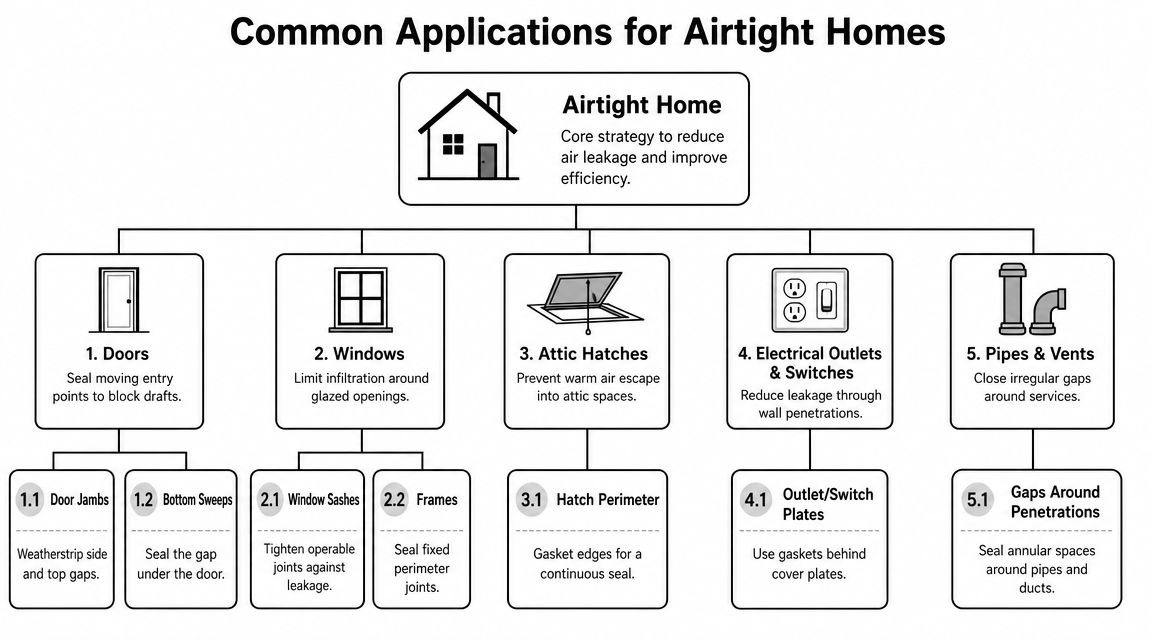
A main entry door needs a seal that rebounds every time the slab shuts against the stop. Closed-cell foam works well here because it can compress and still maintain contact if you've matched the thickness to the gap.
Look closely at the latch side and top corners. Those spots often leak first. If the door is out of alignment, though, new foam won't solve the root problem. It only works if the frame and slab can meet evenly.
Sliding doors are tricky because they combine movement, dirt, and moisture. Closed-cell foam can help in the right fixed locations, but moving channels may need a different gasket style. On windows, it's useful where the sash closes against a stop and a compressible seal can do its job without interfering with operation.
Areas I check most often include:
If bugs are part of the complaint, weatherstripping and screen maintenance often go together. Homeowners dealing with gnats, palmetto bugs, or no-see-ums can also use Sparkle Tech's bug proofing tips to tighten up the insect side of the problem.
These are two of the most overlooked leak sites in Florida homes.
A garage door perimeter often leaks enough hot, damp air to turn the garage into a heat reservoir. Even if the garage isn't conditioned, that heat pushes into adjacent rooms and makes the whole house work harder. Closed-cell foam is also useful on attic hatches, especially where the hatch closes against a trim lip and needs a compressible gasket around the perimeter.
Pool equipment rooms, laundry access doors, and storage doors don't get much attention until the interior starts feeling clammy. These are good candidates for closed-cell foam because they often face direct humidity exposure and don't need an elaborate weatherstrip system to improve noticeably.
The main idea is simple. Use closed-cell foam where you need a repeatable compression seal on a frame that closes square.
Most weatherstripping failures start before the backing ever gets peeled. The surface is dusty, the frame is still humid from cleaning, the wrong thickness gets picked, or the installer stretches the tape to make it fit. Then a few weeks later the strip shrinks, peels, or the door gets hard to close.
Closed-cell foam can be a very good retrofit product, especially because common peel-and-stick versions are made for simple installation. Some vinyl closed-cell foam tapes are designed to seal gaps from 3/16 inch down to 1/16 inch, which is a good reminder that sizing matters as much as material choice (closed-cell foam tape sizing example).
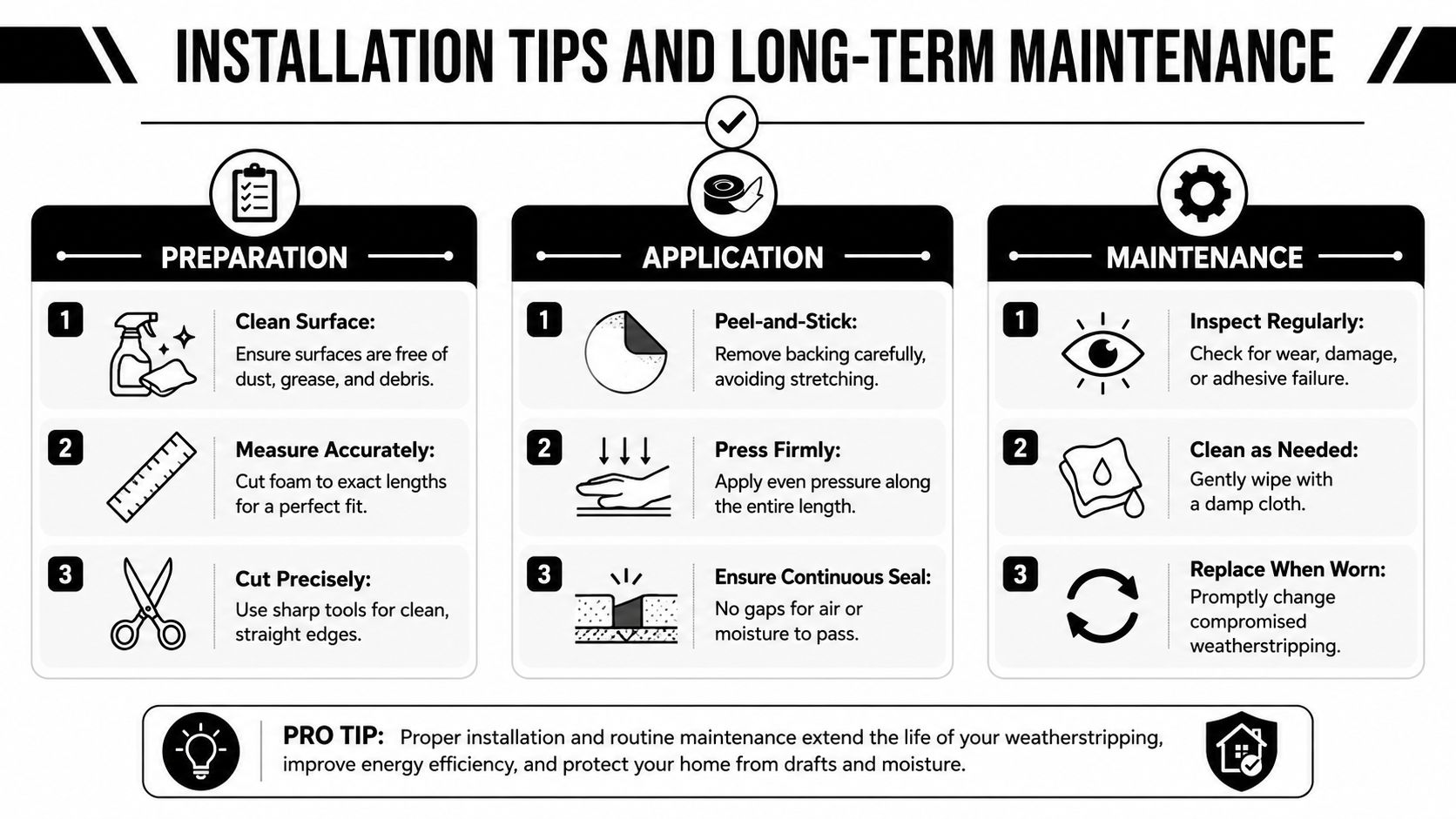
Adhesive-backed foam hates contaminated surfaces. On Florida homes, that contamination is often sunscreen residue near a patio door, fine dust in the garage, oxidation on painted trim, or just a damp frame from morning humidity.
A good prep routine usually includes:
If the frame is chalky, flaky, or loose-painted, the adhesive is only sticking to a failing surface layer. That's not a weatherstrip problem. That's a prep problem.
Most DIY installs go wrong because people measure the open gap and buy something that looks close, but weatherstrip has to work under compression. Too thin, and the door shuts without making real contact. Too thick, and the closing force goes up, the adhesive gets stressed, and the strip wears out faster.
Field advice: Measure the gap, then think about how the door closes against it. The right strip should compress enough to seal without making the hardware fight.
For garage openings, seal shape and door movement matter even more than on a standard entry door. If you're working on that area specifically, Danny's Garage Door Repair advice is a practical reference because garage door weatherstripping has its own fit and alignment issues.
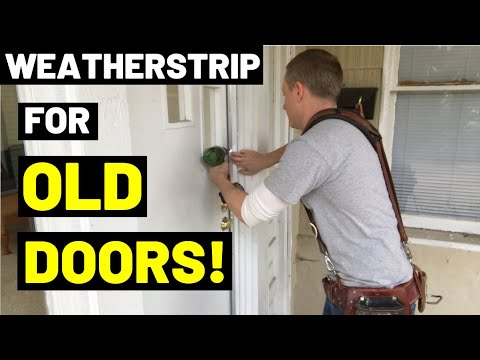
Here's a helpful visual before you install anything:
This is an old mistake and still one of the most common. If you pull adhesive foam tight as you apply it, it will try to return to its original length later. That can leave gaps at corners or pull the ends back.
Better habits look like this:
Weatherstrip doesn't need much maintenance, but it does need inspection. I tell homeowners to look for loss of bounce, peeling adhesive, torn edges, and shiny flattened spots where the foam no longer springs back.
You can often clean lightly so dirt doesn't grind into the surface. But once the material has taken a set and stopped recovering, cleaning won't fix the seal.
If the problem turns out to be larger than trim-level weatherstripping, a broader air-sealing approach may be more appropriate. In those cases, a contractor that works with building-envelope sealing, such as Airtight Spray Foam Insulation, can address leakage beyond the door or window perimeter.
Sometimes the weatherstrip is the problem. Sometimes it just reveals a bigger one.
If you replace foam around a door and still feel damp indoor air, still see condensation, or still notice one room staying warmer than the rest, the leak may not be at the door alone. The frame could be out of square. The wall cavity around the opening may be poorly sealed. The attic hatch could be leaking into the same pressure boundary. The garage connection might be feeding heat into adjacent rooms.
A few signs usually tell you DIY weatherstripping has hit its limit:
That's a big deal in South Florida because comfort problems usually come from a chain of leakage points, not a single crack. A better door seal helps. But if the attic is also pulling in hot, wet air, the house can still feel clammy.
If a room feels humid after you've already handled the obvious door and window gaps, stop buying more tape and start looking at the whole air boundary.
A professional can tell the difference between a weatherstrip issue and an envelope issue. That saves time, repeated DIY work, and the frustration of replacing seals that were never the main problem.
The right next step usually isn't more material. It's identifying where outside air is entering and solving it at the source. For some homes, that's still a simple adjustment and re-weatherstrip. For others, it means moving beyond tape and treating the house as a full system.
If your home still feels humid, drafty, or uneven after the obvious gaps have been sealed, Airtight Spray Foam Insulation can help evaluate the larger air-leakage problem. They work across South Florida and focus on sealing the parts of the building envelope that weatherstripping alone can't fix.