
A lot of South Florida homeowners arrive at insulation the same way. The air conditioner seems to run all day, some rooms stay warmer than others, and the electric bill feels out of proportion to how comfortable the house is. In Jupiter, Wellington, Palm Beach Gardens, and nearby communities, that frustration usually comes from two things working together: heat gain and humid air sneaking into the house.
Insulation helps with both, but only when the material matches the climate and the installation is done well. Cellulose dense pack insulation is one option that gets attention because it uses recycled content, can work well in enclosed wall cavities, and can reduce air movement when it's installed correctly. It deserves a fair look.
It also deserves a climate-specific look. South Florida isn't a mild, dry environment where many generic insulation articles seem to live. Homes here deal with heavy humidity, wind-driven rain, long cooling seasons, and storm exposure. Those conditions change how you should think about any insulation system, especially one that can absorb and release moisture.
When homeowners talk about insulation, they often focus on one number: R-value. That matters, but in South Florida it isn't the whole story. A home can have decent insulation on paper and still feel muggy or uneven if outside air keeps leaking through wall gaps, attic penetrations, and other weak points in the building shell.
That matters because humid outdoor air doesn't just make the AC work harder. It can also push moisture into wall and roof assemblies, where materials may dry slowly. In a hot, storm-prone region, insulation isn't only about slowing heat flow. It's also about helping the house manage air and moisture safely.
Practical rule: In South Florida, the best insulation choice usually isn't the one with the best brochure. It's the one that handles air leakage and moisture risk in your specific assembly.
Cellulose dense pack insulation enters the conversation most often in retrofits. Homeowners hear that it can be blown into existing wall cavities, that it's made largely from recycled paper products, and that it can perform better than many people expect when installers pack it tightly enough. Those are real strengths.
Still, there are tradeoffs. Dense-packed cellulose can be a sensible fit in some Florida applications, especially enclosed walls where you want a retrofit solution without major demolition. But once moisture resilience becomes the top priority, especially in roofs, exterior walls with increased water exposure, or buildings with a history of leaks, spray foam often becomes the more durable long-term answer, particularly closed-cell foam.
Cellulose dense-pack insulation is a fiber insulation made mostly from recycled paper, then treated to improve fire resistance and discourage pests. In practical terms, it is shredded paper fiber that is blown into enclosed cavities at enough pressure to form a tight, stable fill inside the wall or roof assembly.
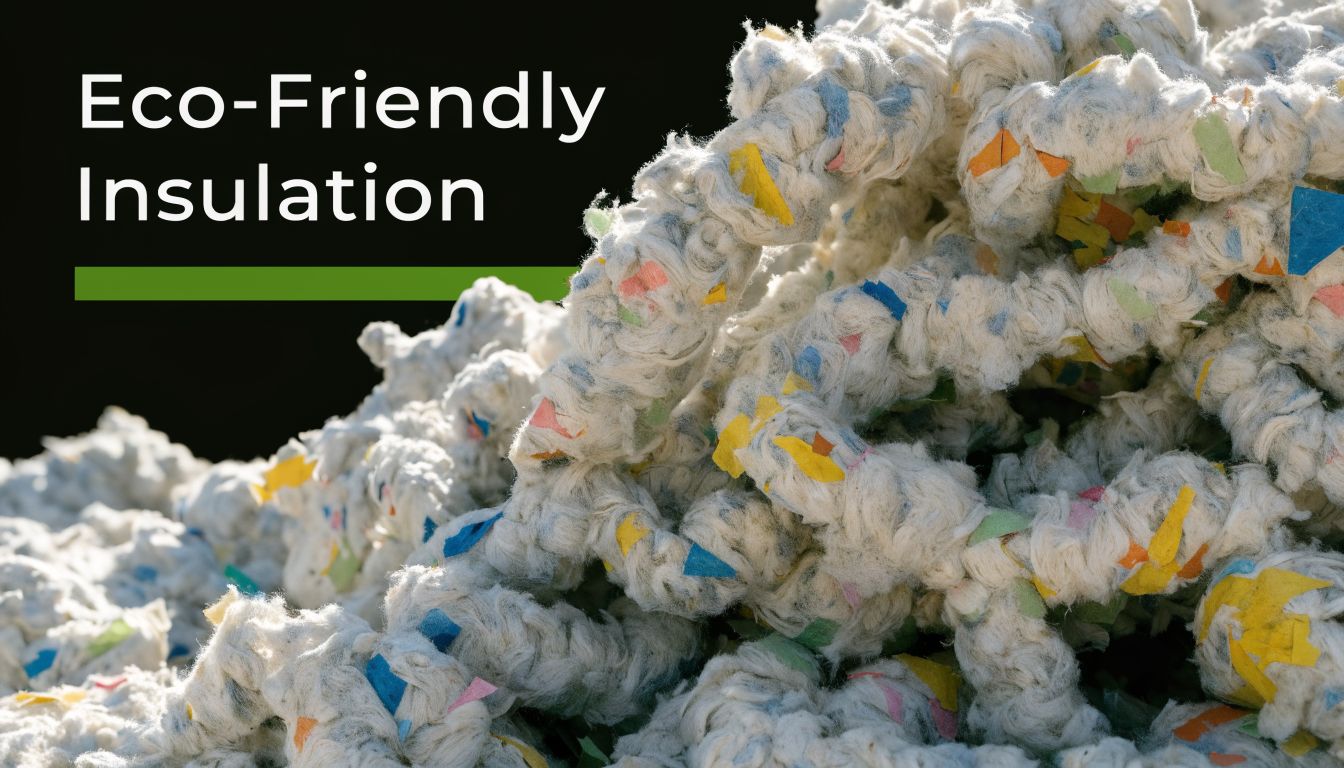
The phrase dense pack matters because it describes how the material is installed, not just what it is made of. Loose-fill cellulose in an attic sits lightly, like a blanket spread across the floor. Dense-packed cellulose is compressed into a closed cavity so the fibers knit together and stay in place. That tighter fill helps the material resist settling and slows air movement better than a fluffy, low-density application.
A wall filled this way works more like a packed snowbank than loose powder. Air has a harder time weaving through compact material, and the installer can fill around wires, plumbing, and uneven framing that would leave gaps with rigid batt products.
That distinction is easy to miss.
A homeowner may hear "cellulose" and assume every version performs the same way. In reality, the category includes several different applications, and they do different jobs:
Dense-pack cellulose can be a useful retrofit option because crews can often add it to existing walls without opening the entire house. It also appeals to homeowners who want a material with recycled content. Its thermal performance is respectable, and if you want a clearer breakdown of dense-pack cellulose R-value and what it means in real assemblies, that part deserves a closer look than the bag label usually gets.
For South Florida homeowners, though, material identity is only half the question. The practical question is how that fiber-filled cavity behaves when the house is exposed to long cooling seasons, high outdoor humidity, wind-driven rain, and the occasional storm-related leak. Cellulose can perform well in the right enclosed assembly, especially in walls where a retrofit approach makes sense. But it is still a moisture-sensitive fiber insulation. If water gets in, the material can hold that moisture longer than insulation that does not absorb water the same way.
So the right mental model is this: dense-pack cellulose is a carefully installed cavity insulation with real strengths, especially for retrofit walls and sound control. It is not just recycled paper blown into a hole, and it is not automatically the best fit for every Florida assembly. In homes around Jupiter, Wellington, and Palm Beach Gardens, those moisture and durability questions often push homeowners to compare it closely with spray foam before they commit.
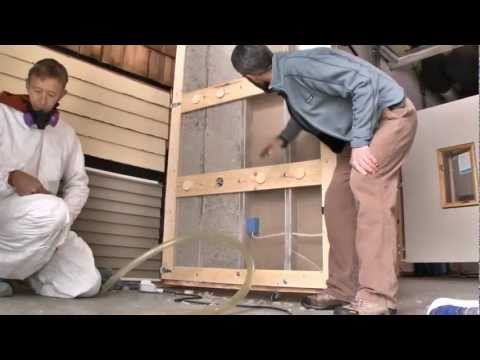
Dense-pack installation is often called drill-and-fill. In an existing wall, crews create access holes, then use a blowing hose to force cellulose into each stud bay until the cavity is tightly packed. In some homes they work from the interior. In others they work from the exterior, depending on finishes, access, and repair strategy.

That sounds straightforward, but the details determine the result. The crew has to avoid bridging at the hose opening, make sure the material reaches corners and obstructions, and confirm the cavity is dense enough. If they miss a section behind wiring or around blocking, the wall can end up with hidden low-density pockets.
A proper install usually includes a clear plan for patching access holes and checking consistency from bay to bay. Good installers also understand that dense-pack insulation does more than slow heat transfer. It also limits air movement inside the cavity.
That second part matters a lot in Florida. If warm, humid air can move through or around insulation, actual performance drops. That's one reason some homeowners researching thermal performance also look at how dense-pack cellulose R-value compares in real assemblies, not just the number printed on a product sheet.
Many homeowners focus on insulation thickness because it feels tangible. Air leakage is less visible, but often more disruptive. A wall that leaks air can pull in heat and humidity continuously, even when the insulation itself has a respectable rated R-value.
Blower door testing makes that effect easier to understand. According to Johns Manville data on dense-pack performance, dense-pack cellulose can reduce a home's overall air infiltration by 24-65%. In one retrofit example, leakage dropped from 1450 to 870 cfm@50Pa, a 40% reduction.
That doesn't mean every house will see the same result. Houses differ. Leakage paths differ. Installation quality differs. But the testing does confirm the basic building-science point: when cellulose is packed to proper density, it can tighten the enclosure meaningfully.
A short visual helps if you've never watched the process in the field.
The common misunderstanding is thinking dense-pack equals air barrier in every sense. It doesn't. It can significantly reduce airflow, but it isn't the same as a fully adhered foam product that seals to framing and sheathing. That distinction becomes important when you're deciding between cellulose and spray foam for walls, attics, or rooflines in a humid coastal climate.
Moisture is where the cellulose conversation gets more complicated. Cellulose is hygroscopic, which means it can absorb and release moisture. In the right assembly, that can be useful. The material can buffer some humidity changes instead of behaving like a completely closed surface.
That sounds appealing, and in some climates it is. But South Florida asks harder questions. Homes here don't face occasional humidity. They face persistent humidity, wind-driven rain, prolonged cooling loads, and the possibility that a small flashing defect or storm-related water entry can keep materials damp far longer than expected.

Cellulose is more vapor open than closed-cell spray foam, and that can help a wall dry under some conditions. It also tends to reduce air movement better than fiberglass batts when it's installed properly, which can help limit moisture transport driven by air leakage.
For homeowners dealing with comfort issues inside the living space, better humidity control from HVAC can also reduce stress on wall assemblies. If you're trying to get indoor moisture under control, this guide to humidifiers and dehumidifiers is useful because it explains how indoor humidity management affects comfort and building performance together.
The problem is that a material's ability to absorb moisture is only an advantage when the assembly can also dry reliably. In South Florida, drying potential can be limited by exterior finishes, solar exposure, interior cooling, and long periods of humid outdoor air. When assemblies stay damp, cellulose can lose some of the practical advantages it has when dry.
An 18-month CCHRC study on cellulose wall performance found that wall assemblies with exterior cellulose insulation hovered around 80% relative humidity during winter, which the study flagged as a moisture-management concern if conditions aren't handled carefully. That study was not performed in South Florida, so it shouldn't be treated as a direct Florida forecast. But it does reinforce the core point that cellulose is sensitive to moisture conditions and assembly design.
High humidity doesn't automatically make cellulose fail. It does narrow the margin for design mistakes, installation errors, and hidden water entry.
Generic advice often falls apart in such situations. A homeowner reads that cellulose "manages moisture" and assumes that means "safe in any humid climate." Those aren't the same thing. Managing vapor and surviving bulk water exposure are different challenges.
In many South Florida homes, the more conservative approach is to choose an insulation that also acts as a stronger air seal and is less likely to hold moisture if the assembly is stressed. That's one reason many professionals spend time comparing insulation with a proper vapour barrier and insulation strategy instead of selecting by R-value alone.
If a wall has excellent rain control, careful flashing, and a sound retrofit plan, dense-pack cellulose may still be appropriate. But if the house has a history of leaks, storm exposure, inconsistent exterior detailing, or you are insulating a roofline where moisture risk is harder to forgive, spray foam usually offers a sturdier long-term margin.
Dense-pack cellulose and spray foam both aim to improve comfort and reduce energy loss, but they do it in different ways. Cellulose relies on a tightly packed fiber matrix. Spray foam expands in place and adheres to surrounding surfaces. In South Florida, that difference affects moisture resilience, storm-related durability, and the ability to control humid air.
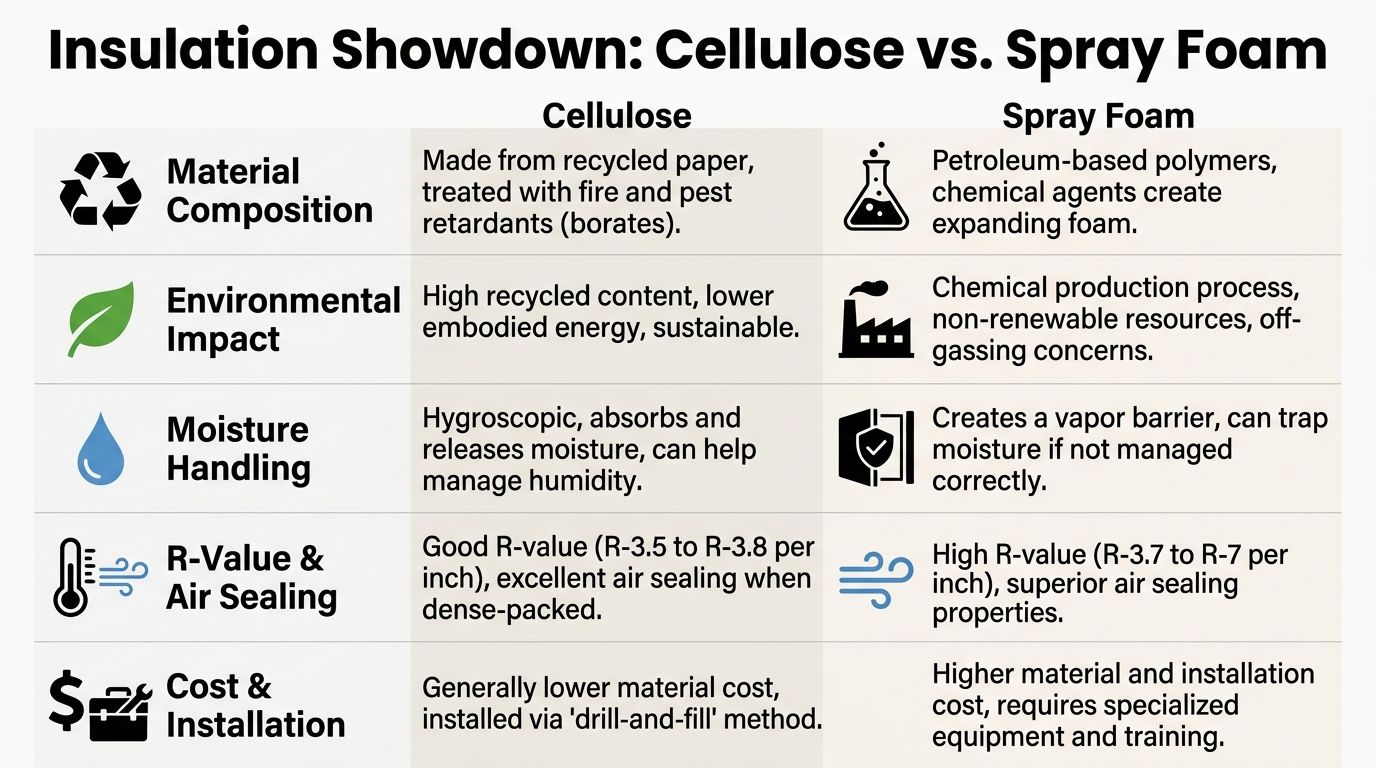
Dense-pack cellulose has clear strengths. It uses recycled content, can fit irregular cavities well, and often performs nicely in enclosed wall retrofits where you don't want to remove large sections of drywall or siding. It also has a reputation for good sound control because dense fiber tends to dampen vibration and airborne noise.
Open-cell spray foam is often chosen when homeowners want strong air sealing and sound reduction inside assemblies where vapor openness is still acceptable. Closed-cell spray foam goes further. It offers stronger moisture resistance, greater rigidity, and a more effective barrier against humid air movement, which is why it often stands out in coastal Florida applications.
| Feature | Dense-Pack Cellulose | Open-Cell Spray Foam | Closed-Cell Spray Foam |
|---|---|---|---|
| Material makeup | Recycled paper fiber treated for fire resistance | Expanding foam | Expanding foam with denser structure |
| Air sealing | Good when properly dense-packed | Very good | Excellent |
| Moisture behavior | Hygroscopic, can absorb and release moisture | Air seals well but is not the strongest moisture block | Stronger moisture resistance and air seal |
| Retrofit wall use | Strong option for drill-and-fill enclosed cavities | Usually needs open access | Usually needs open access |
| Sound control | Strong | Strong | Good |
| Storm-prone durability | Depends heavily on assembly dryness and water control | Better air seal than fibrous insulation | Often the most robust option where moisture resilience matters |
| Sustainability appeal | High recycled content | Less often chosen for recycled-content goals | Less often chosen for recycled-content goals |
For many Florida homeowners, the practical questions are these:
A broader side-by-side review of cellulose vs spray foam can help if you're weighing options for a specific area of the house.
If your priority is upgrading existing enclosed walls with limited disruption, cellulose deserves consideration. If your priority is the strongest long-term defense against humid air and moisture intrusion, spray foam usually has the edge.
For interior partitions, selective retrofits, and some existing wall cavities, cellulose dense pack insulation can be a reasonable and even smart choice. For unvented roof assemblies, highly exposed exterior assemblies, and homes where moisture risk is the dominant concern, closed-cell spray foam is often the more resilient solution.
That's not because cellulose is bad. It's because South Florida is demanding.
Dense-pack cellulose works best when you use it where its strengths are obvious and its weaknesses are controlled. In Florida homes, that usually means enclosed wall cavities, interior sound-control applications, and carefully chosen retrofit situations.
A common example is an older home in Stuart or Wellington with little or no wall insulation, but with walls you don't want to fully open. Dense-pack cellulose can often be blown into those cavities through small access holes. That makes it attractive when the homeowner wants a meaningful upgrade without a full interior renovation.
This use case plays to cellulose's retrofit advantage. The material can move around wiring and plumbing and fill irregular spaces better than a batt inserted after partial demolition.
Some of the best cellulose projects have little to do with outdoor heat. A home office next to a living room, a bedroom near a laundry area, or a media room sharing a wall with a hallway can all benefit from dense fiber insulation. In those spaces, sound dampening may be the main value.
That is a useful reminder: not every insulation choice is about the exterior envelope. Sometimes the right material is the one that makes the house calmer and more livable day to day.
There are also places where I'd be much more cautious in Florida.
A final point on attics: homeowners sometimes mix up dense-pack cellulose in a closed cavity with loose-fill cellulose on an attic floor. Those are different applications. Loose-fill attic cellulose can be effective on an attic floor, while dense-packing a sloped roof assembly in a hot-humid climate raises a different set of moisture questions.
With dense-pack cellulose, installation quality isn't just important. It determines whether the product performs as intended. Two homes can use the same material and get very different outcomes based on density, cavity coverage, patch quality, and moisture awareness.
Because this article can't cite verified project pricing, the fairest way to describe cost is qualitative. Dense-pack cellulose is often viewed as a middle-ground option. It usually sits above simple batt upgrades in complexity and below more specialized foam assemblies in overall system intensity. But the cheapest bid can become the most expensive if voids, settling, or moisture issues show up later.
When you interview an insulation contractor, ask specific questions. General promises aren't enough.
Cellulose is treated to improve fire performance, and that treatment is one reason the material is used in code-compliant assemblies. It is also commonly selected in weatherization work, which speaks to its established place in residential insulation practice.
But don't turn that into a blanket assumption that every cellulose application is safe anywhere. Fire safety, moisture control, ignition barriers, clearances, and assembly approvals still have to be handled correctly. The insulation material is one part of the assembly, not the entire safety plan.
A good contractor doesn't just promise that cellulose works. They explain where it works, where it doesn't, and how they'll verify the installation.
Properly installed dense-pack cellulose is intended to resist settling because it is packed tightly enough to be self-supporting. The concern in Florida isn't just gravity. It's whether long-term moisture exposure or repeated wetting could affect performance. If the wall stays dry and the installation is done correctly, the risk is lower. If the wall has persistent moisture problems, I'd be cautious.
It can help with comfort by reducing heat flow and limiting some air movement when properly installed in framed cavities. But hurricane resilience isn't only about insulation. Wind-driven rain, roof integrity, window protection, and drainage details matter more. If your concern is how the enclosure performs after severe weather, moisture tolerance becomes a major decision point, which often pushes the conversation toward closed-cell foam.
Cellulose is treated for fire resistance, and those treatments are also part of why homeowners often ask about pest resistance. Still, no insulation should be viewed as a stand-alone pest-control plan. Pest entry usually comes back to gaps, cracks, roof details, and maintenance.
Metal buildings can be unforgiving because condensation and air leakage become serious issues quickly. In those structures, moisture control and condensation management usually dominate the insulation choice. Dense-pack cellulose may have niche uses in certain framed sections, but spray foam is often favored where direct air sealing and moisture control are the priority.
It makes sense when you have an enclosed wall cavity, a dry assembly, a retrofit goal, and a contractor who understands dense-pack technique. If you're insulating a roofline, solving chronic humidity issues, or trying to create the most moisture-resilient envelope possible, spray foam is often the better fit for South Florida.
If you're weighing insulation options for a home or building in Jupiter, Palm Beach Gardens, Wellington, West Palm Beach, or Stuart, Airtight Spray Foam Insulation can help you sort through the tradeoffs and choose the right system for your climate, assembly, and long-term goals. Their team focuses on South Florida conditions first, with recommendations specific to humidity control, air sealing, storm resilience, and durable performance.