If your search for "air sealing contractors near me" landed you here, you're already halfway to solving one of South Florida's biggest homeowner headaches. For those of us in Jupiter and West Palm Beach, high energy bills and that constant, sticky humidity aren't just annoyances—they're a year-round battle for comfort.
This isn't just about saving a few bucks; it's about taking back your home from our relentless climate.
Here in South Florida, your air conditioner is the undisputed MVP, running almost constantly and driving the single biggest part of your electric bill. What most people don't realize is how much of that precious, cool air is vanishing into thin air through countless tiny gaps and cracks all over their house.
It's like trying to keep a leaky bucket full. You can pour more and more water in (or in this case, pump more cold air), but you're just fighting a losing battle. Professional air sealing finds and plugs those leaks for good, creating a true barrier that keeps the cool, dry air in and the hot, muggy air out.
Sure, you can grab a tube of caulk and seal a drafty window. That's a start. But a real professional goes after the whole building envelope. We’re trained to find the major air leakage points that a DIY job will almost always miss because they’re hidden in the most unassuming places.
We consistently find the worst offenders in spots homeowners rarely think to check:
Tackling these areas isn't a job for hardware store supplies. It demands specialized materials like spray foam and the experience to apply it correctly. To get a better sense of what this involves, see our guide on how to properly seal attic air leaks.
With over 25 years of experience in South Florida, we’ve seen it all. The most common mistake homeowners make is underestimating how much air they're losing through the attic. It’s often the single most effective place to start for immediate comfort and savings.
Getting this done by a true professional pays off immediately and for years to come. It’s no surprise that air sealing is now a cornerstone of modern energy efficiency. Studies have shown that the average U.S. home can lose up to 30% of its cooled air through these small leaks.
According to the U.S. Department of Energy, a proper air sealing job can slash annual energy use by 10-20%. Now, translate that to South Florida, where your A/C can easily account for 50-70% of your total electric bill. The savings become impossible to ignore. You can explore more about these energy-saving statistics on Aeroseal.com.
Choosing the right contractor isn't just about buying a service—you're investing in your home's overall health and comfort. A professionally sealed home is noticeably quieter, has cleaner indoor air because it blocks outdoor allergens and pollutants, and maintains a consistent temperature from one room to the next. It’s the definitive fix for the unique climate challenges we face every day.
When you’re ready to air seal your home, a quick "air sealing contractors near me" search is just the starting line. The real challenge is sifting through the results to find a true professional who won't cut corners.
Finding a great contractor is about more than just reading online reviews. It’s about knowing where the real pros hang out and how to verify they have their act together. After years in this business, I’ve learned that the best referrals come from other tradespeople who see the work—and the results—up close.
Sure, start with a Google search, but don't end there. To find the cream of the crop, you need to tap into the local industry network.
Once you’ve got a few names, it's time to put on your detective hat. This is the vetting process, and it’s where you separate the legitimate businesses from the liabilities.
Any professional contractor will have this information ready to go. If they hesitate or make excuses, walk away. It’s that simple.
In Florida, a license isn't optional. Insulation contractors are required to be licensed, and you should always verify their status on the Florida Department of Business and Professional Regulation (DBPR) website. This is a quick, easy check that confirms they're legally allowed to work in your home.
This is your single most important protection. A contractor needs two kinds of insurance, and you need to see proof of both.
Think about it: an uninsured worker falls from a ladder in your attic. Who pays for the medical bills? Without workers' comp, their lawyer will be coming after you, the homeowner. It’s a nightmare scenario that can be financially devastating. It's why knowing what every home contractor needs to know about insurance is just as important for you as it is for them.
Pro Tip: Never just take their word for it. Ask for their Certificate of Insurance (COI). Call the insurance agent listed on the certificate to confirm the policies are active and that the coverage limits are sufficient for your project.
References are your best look into what it's really like to work with a company. Don't just ask if they were "happy." You need the unvarnished truth about their experience from start to finish. For more tips on this, our guide on selecting spray foam insulation contractors has some great insights.
Questions to Ask Previous Customers:
The answers you get will tell you everything you need to know about their professionalism, reliability, and the quality of their work. A little due diligence upfront is the best way to guarantee your air sealing project is a success.
Alright, you've done your homework, narrowed down the list, and now you have a few contractors coming to your home. This is where the rubber meets the road.
Think of this consultation as a job interview—and you’re the one doing the hiring. A real professional won't just tolerate your questions; they'll welcome them. They should be eager to show you they know their stuff. If they get defensive or vague, that’s a huge red flag.
Your first line of questioning should dig into the what and the why of their plan. In South Florida, a cookie-cutter approach just doesn't work.
Kick things off with a direct, open-ended question: "Based on what you're seeing in my home, where are the biggest air leaks, and how exactly are you going to fix them?"
A pro won't just say, "Oh, it's your attic." They'll get specific. They’ll point out the plumbing vents, the can lights, the gaps around your AC ducts, and the top plates of the walls. They'll explain how these seemingly small gaps are letting in that thick, humid air we all know too well.
Next, pivot to the materials. The quality of the foam and the skill of the installer are everything.
If a contractor struggles to explain why they're recommending a specific product or process, it might mean they don't truly understand the building science behind it. You're not just looking for a technician; you're looking for an expert.
I’ve seen plenty of projects where the choice between open-cell and closed-cell foam was the difference between a comfortable, dry home and a moisture-related headache. To help you understand the key differences, here’s a quick breakdown.
| Feature | Open-Cell Foam | Closed-Cell Foam |
|---|---|---|
| Structure | Soft, flexible, sponge-like texture with "open" cells. | Rigid, dense structure with "closed" cells. |
| R-Value | Around R-3.5 to R-3.8 per inch. | Around R-6.5 to R-7.0 per inch. |
| Air Barrier | Excellent air barrier. | Excellent air barrier. |
| Moisture Permeability | Permeable to moisture vapor (lets it pass through). | Resists moisture vapor, acting as a vapor barrier. |
| Structural Rigidity | Adds minimal structural strength. | Significantly adds to the structural integrity of the building. |
| Cost | Generally less expensive. | Generally more expensive. |
For most South Florida applications, the moisture resistance and higher R-value of closed-cell foam make it the superior choice, especially in our humid climate. But every home is different, and your contractor should be able to justify their recommendation based on your specific needs.
Applying spray foam is a chemical process, and it needs to be handled with absolute care. The safety of the crew and your family should be a contractor's number one priority.
Ask them point-blank: "What are your safety protocols during and after application, especially concerning chemical off-gassing?"
A responsible contractor will state that the home must be vacated during the application and for a specified curing period, typically 24 hours. They should also explain their ventilation strategy to ensure the home's air is safe upon your return. Any contractor who downplays these safety steps is a major risk.
Once the job is done and the walls are closed up, the air seal is invisible. So how do you know you got what you paid for?
This brings us to a crucial quality control question: "How do you test the effectiveness of the air seal after the job is complete?"
The only right answer here is a blower door test. The best contractors perform a "test-in, test-out" protocol. They measure your home's air leakage rate before they start, then run the test again when they're finished. This gives you hard data—measurable proof—of exactly how much tighter and more efficient your home is. It’s what separates the true professionals from the rest.
Finally, make sure you're crystal clear on the business side of things to avoid any headaches later.
Essential Logistical Questions:
Asking these targeted questions elevates the conversation beyond just a price tag. You'll get a complete picture of each contractor's expertise, professionalism, and commitment to doing the job right. It’s the best way to ensure you find the right "air sealing contractors near me" and a lasting solution for your home.
Let's talk about the numbers. Every homeowner wants to know the bottom line, and when it comes to air sealing, it’s not just about the upfront cost. It’s about making a smart investment in your home’s future comfort and efficiency.
The final price for a professional air sealing project in South Florida depends on a few things: the total area we’re treating, the type of foam you choose, and the overall complexity of your home's structure. For our climate, closed-cell spray foam is usually the best bet—it costs a bit more, but its performance in handling our humidity is unmatched.
We see professional air sealing as an upgrade that starts paying you back the day it's done. It’s not just another line item on a home improvement budget. For most of our clients, the project pays for itself in just 3 to 5 years.
Here's how that breaks down in the real world:
This isn't just a local trend. There's a big push for more efficient homes, and valuable incentives are making it easier for homeowners to make the switch. The federal Inflation Reduction Act, for instance, offers a 30% tax credit for air sealing work, up to $1,200. You can find more great info on energy-saving strategies and contractor insights at DrEnergySaverCentralVA.com.
We get this question all the time from homeowners in Jupiter, Stuart, and all over the area: "Do I need a permit for this?" The answer depends on how extensive the work is, but don't worry—a good contractor handles all of it.
In most cities here in South Florida, any significant insulation work, especially a project that changes your home's building envelope, will require a permit. This isn't just a bureaucratic hoop to jump through; it’s a safeguard to make sure the job is done right and meets critical safety codes.
A professional contractor will know the exact requirements for your city. They will manage the entire permitting process—from the application to the final inspection. It's our job to handle the paperwork so you don't have to.
Trying to manage permits on your own can be a real headache. An experienced contractor's familiarity with the building departments in Palm Beach County or Martin County is worth its weight in gold. We know the process, the people, and the paperwork needed to keep your project on track. This is one more reason why hiring a vetted, licensed pro is always the right call.
Hiring a contractor shouldn't be a black box. You deserve to know exactly what’s going to happen in your home, from the first hello to the final handshake. A true professional crew makes the entire project feel smooth and predictable, and frankly, we believe the process itself is a major sign of a contractor's quality.
It all starts with a thorough property assessment. This isn’t a quick peek into your attic. A real pro will evaluate your entire home’s envelope, pointing out the exact spots where air is leaking and explaining why it matters. This leads to a detailed, written estimate breaking down every cost—labor, materials, and prep—so there are no surprises down the road.
This chart breaks down the financial side of an air sealing project, showing how the upfront cost pays for itself over time.
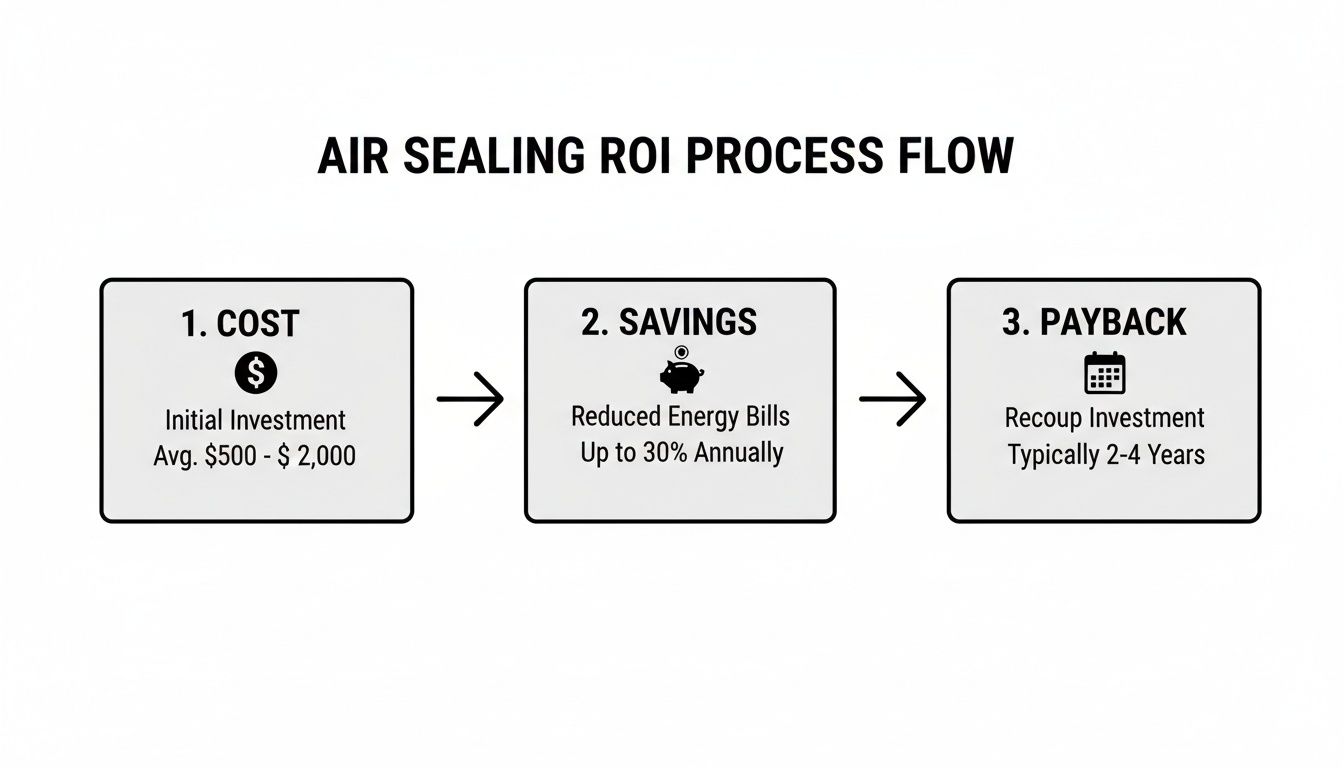
The path is clear: an initial investment directly fuels ongoing energy savings, leading to a tangible payback.
Before any foam is sprayed, the crew's first job is to protect your home. I can't stress this enough: how a team prepares the workspace tells you everything you need to know about their level of professionalism.
A meticulous crew will:
Rushing this stage is a huge red flag. A team that respects your property takes the time to do this right.
Once your home is prepped and protected, the certified technicians get to work. This is where skill and training really come into play. Applying spray foam correctly is a science—it demands precise control over temperature, pressure, and thickness to create that perfect, unbroken air barrier.
You’ll see the techs in full personal protective equipment (PPE), including respirators and suits, as they methodically apply foam to all the gaps and cracks we identified earlier.
According to ENERGY STAR, air sealing combined with proper insulation can cut heating and cooling costs by an average of 15%. In South Florida, we often see that number climb even higher, making this phase absolutely critical for your ROI.
After the application, the foam needs time to cure. We insist that the home remains vacant for a minimum of 24 hours. This allows the foam to harden completely and for any fumes to dissipate, ensuring your home’s air is safe and clean when you return.
The job isn't done just because the spraying has stopped. After the 24-hour cure time, our crew returns to perform a detailed cleanup. All the plastic and tape come down, and the area is left just as clean as we found it.
Then comes the most important part: the quality inspection. The project manager will walk you through the finished work, answering any questions you have. For ultimate proof, we perform a post-installation blower door test. This isn't just an estimate—it's hard data showing you exactly how much tighter and more efficient your home is now.
To see how this verification works, take a look at our guide on what is a blower door test. This final test is how a contractor proves they stand behind their work.
Alright, you've done the research and narrowed it down to a few potential contractors. This is where the rubber meets the road—making that final, crucial decision.
Think of this as your last gut check. It’s not about finding the cheapest price tag. It’s about hiring a true professional who understands South Florida’s unique challenges and will deliver a solution that actually lasts, protecting your home from our relentless humidity and sky-high energy bills.
Before you even think about signing a contract, make sure your top choice can answer "yes" to every single one of these. This is non-negotiable.
Licensed & Insured? Have you looked them up on the Florida DBPR website yourself? Don't just take their word for it. Ask to see their Certificate of Insurance, and make sure it covers both general liability and workers' comp.
Real, Local References? A good contractor will have a list of recent, local clients ready to go. You need to call at least two of them. Ask about everything—the crew's attitude, how well they cleaned up, and if they're happy with the results.
Clear Explanations? Did they take the time to explain why they recommend open-cell or closed-cell foam for your attic or walls? Could they walk you through their process for prep, safety, and cleanup in a way that made you feel confident, not confused?
A Detailed, Written Proposal? Their estimate should be more than a number on a napkin. Look for an itemized breakdown of labor, materials, and any prep work. It needs to clearly define the scope, timeline, and payment schedule so there are no surprises later.
Paperwork is one thing, but true professionalism shows up in the details. The numbers don't lie. Homes with air leaks can have 20-40% higher indoor humidity. With 25% of Florida residences dealing with mold at some point, getting this right is critical.
A professional air sealing job can slash your home’s relative humidity by 25-35% and drastically reduce air leakage, often taking it from a leaky 8-12 ACH50 (Air Changes per Hour at 50 Pascals) down to a tight 2 ACH50 or less. You can learn more about these performance metrics and our approach at Air Resolutions.
A top-tier contractor isn't just selling you foam; they're providing a data-backed solution. If they mentioned performing a blower door test before and after the job, that’s the sign of a real pro. They're confident enough in their work to prove it works.
This is your moment to step back and look at the whole picture. The right contractor will do more than just make your home comfortable and efficient—they’ll give you peace of mind for years.
Ready to see what a professional, no-pressure consultation looks like? Let us show you how we do things. Request a free, detailed estimate from our team, and we'll walk you through how the Airtight Comfort System can transform your home.
Even with all the details covered, a few questions always come up. As someone who's talked with hundreds of homeowners across South Florida, I've heard them all. Here are the answers to the most common concerns I hear on the job.
The biggest worry for most people is the disruption. I get it—you have a life to live. The reality is, a professional crew can be surprisingly fast.
For a standard attic in a home you’d see in Jupiter or Wellington, we can typically have the entire job done—from prep and spray to final cleanup—in just one to two days. Of course, larger homes or more complex layouts might add a day, but we always lay out a firm, realistic timeline in our written estimate. No surprises.
This is non-negotiable, and the answer is a firm yes, but with a critical condition: it must be installed correctly by certified professionals. We’re dealing with a chemical reaction, and safety is our top priority. The most crucial part of this process is allowing the foam to cure properly.
A reputable contractor will always require the home to be vacant during the application and for a minimum of 24 hours afterward. This is essential for the foam to fully cure and for any off-gassing to completely dissipate, ensuring the air is perfectly safe when your family returns.
Yes, and you absolutely should. These programs exist to reward you for making smart energy upgrades, and they can significantly offset the initial cost. It’s a question you should ask every contractor you speak with.
A good local contractor stays on top of these programs. They’ll know exactly what’s available from the federal government down to our local utilities and can help you navigate the paperwork to make sure you get every dollar you’re entitled to.
Ready to see how the Airtight Comfort System can transform your South Florida home? Airtight Spray Foam Insulation offers a no-pressure, free estimate to show you exactly how we can make your space quieter, healthier, and more energy efficient. Request your free quote today.