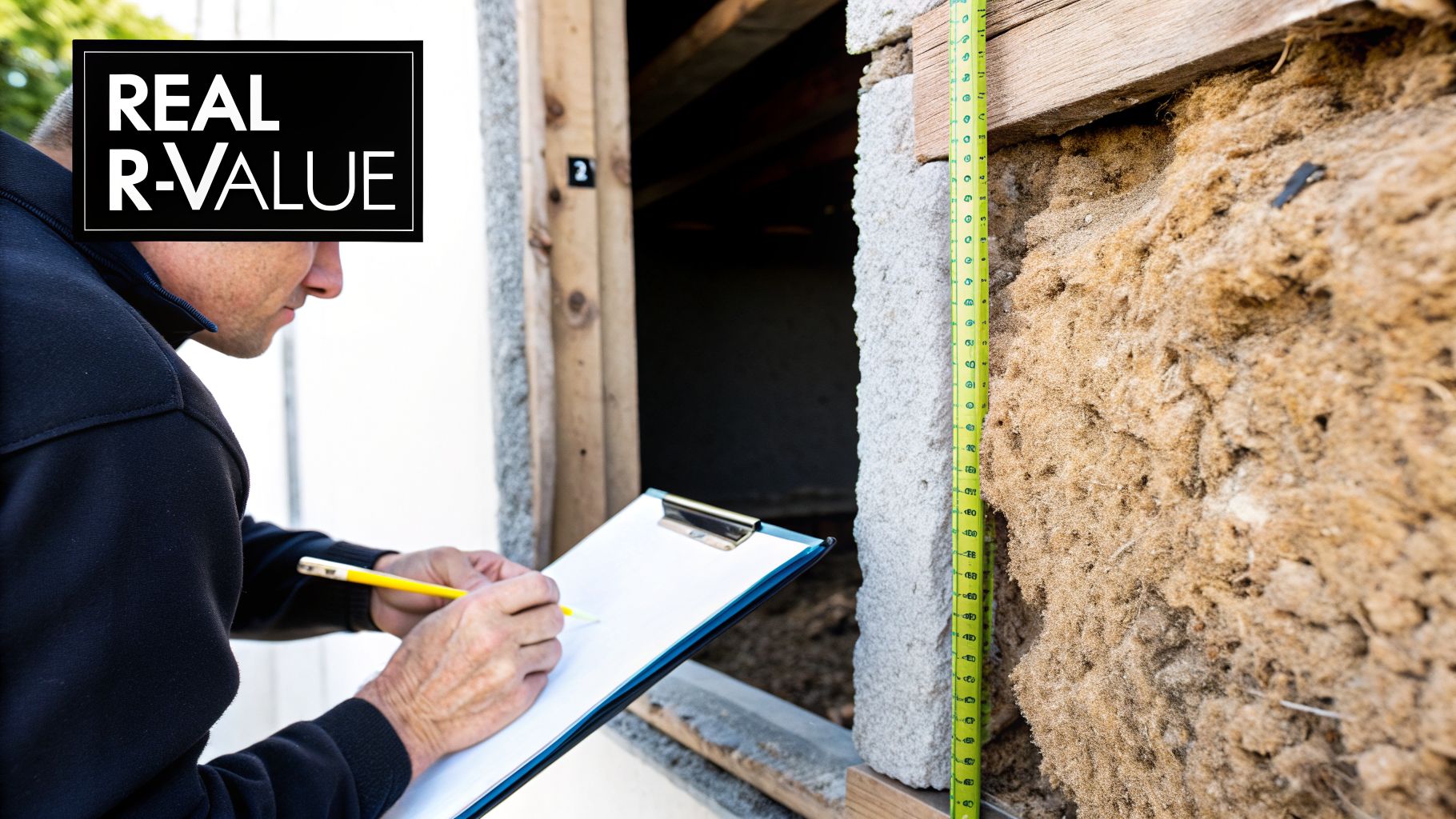
On paper, dense pack cellulose is typically rated between R-3.6 and R-3.8 per inch. That's the number you'll see on the bag, but in a real-world wall cavity—especially here in South Florida—it's a whole different story.
The lab rating is just a starting point. The thermal performance you actually get comes down to the quality of the installation, how well it stops air, and how it handles our relentless humidity.
It's a bit like a wool sweater. The tag tells you the material is warm, but its real effectiveness depends on the fit. If it's loose and full of holes, it won't do much to block a cold wind.
Dense pack cellulose is the same way. The R-value printed on the bag is a material rating, but the installed R-value is what actually determines your comfort and your FPL bill. The final performance hinges on how that material stands up to the conditions inside your walls.
Before we get into the nitty-gritty details, here's a quick look at the key numbers and what they mean for a home in our climate.
| Metric | Typical Value | Key Consideration for Florida Homes |
|---|---|---|
| R-Value Per Inch | R-3.6 – R-3.8 | This is a lab value; actual performance is lower due to air and moisture. |
| Required Density | ~3.5 lbs/ft³ | Must be achieved to prevent settling and maximize thermal resistance. |
| Air Sealing | Poor | It's air-permeable, allowing hot, humid air to pass through. |
| Moisture Handling | Hygroscopic | Absorbs moisture, which drastically reduces its R-value and risks mold. |
This table shows why looking past that simple "R-value per inch" is so critical. Now, let's break down why these other factors matter so much more.
That advertised R-3.7 per inch is only possible under perfect lab conditions. To even get close to that, the cellulose has to be packed into the wall cavity at a very specific density. If the installer goes too light, the material will be fluffy, won't stop airflow, and will eventually settle, leaving a big uninsulated gap at the top of your walls.
The real takeaway is this: the dense pack cellulose R value isn't a fixed number. It's a direct result of hitting the right installation density—around 3.5 pounds per cubic foot (lbs/ft³).
This density is what gives the insulation its structure and ability to resist heat flow. Anything less, and you're not getting what you paid for.
In our hot, humid climate, obsessing over the R-value per inch is a rookie mistake. It misses the two things that will actually make or break your home's performance: air sealing and moisture management.
Air Leakage: Dense pack cellulose is air-permeable. It slows air down, but it doesn't stop it. Hot, moisture-laden air can still push right through it, bringing heat and humidity into your home. It’s simply not an air barrier.
Moisture Handling: Cellulose is also hygroscopic, a technical term meaning it naturally soaks up moisture from the air. In a place like South Florida, this is a huge liability. Wet insulation doesn't insulate well, and worse, it can become a breeding ground for mold and rot inside your walls.
This guide is about moving past the sales pitch and focusing on what you'll actually experience. To see how different insulation materials and thicknesses add up, you can check out our insulation R-value calculator. Now, let's unpack how these real-world factors dictate the true, effective R-value of dense pack cellulose in your home.
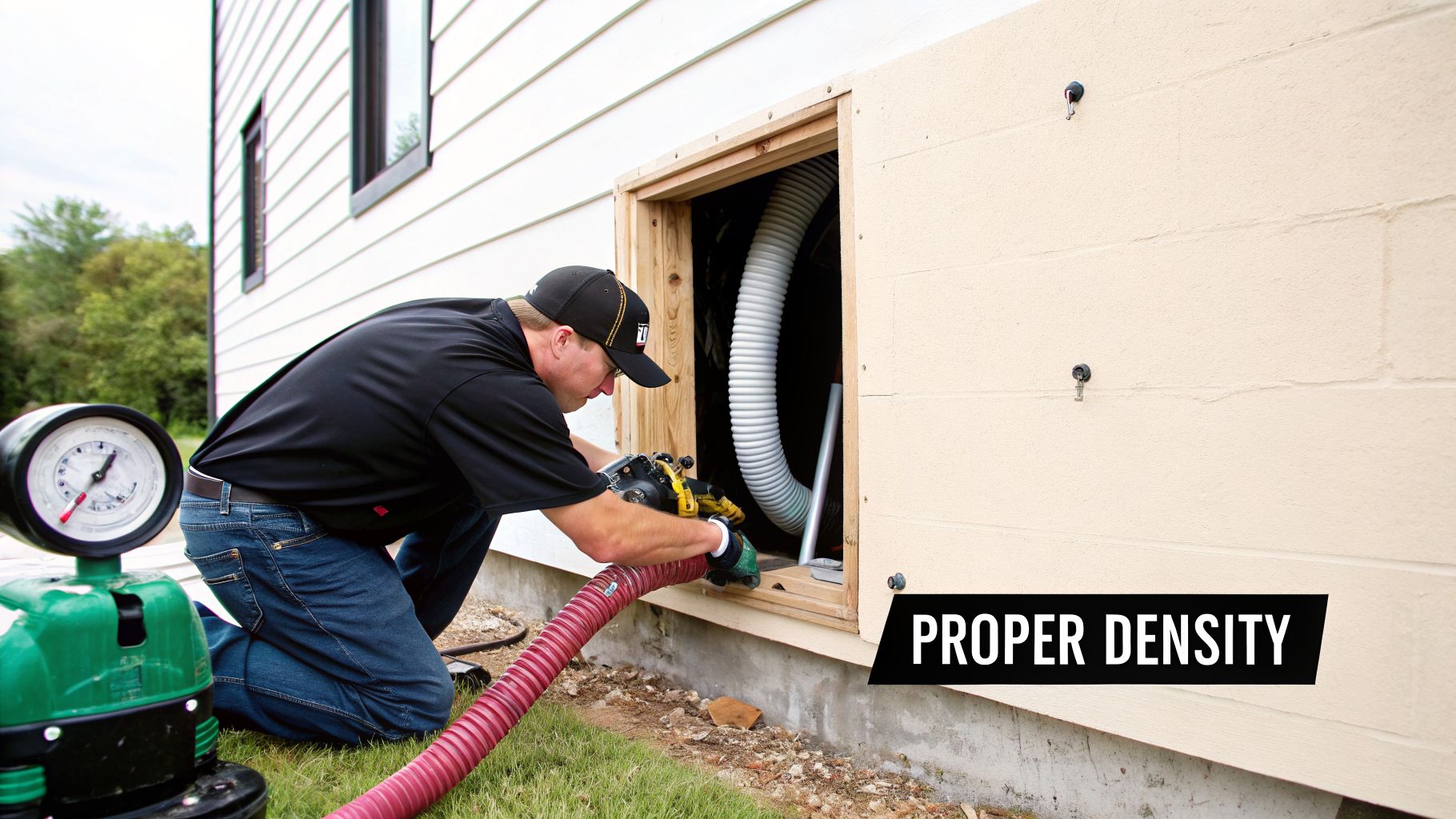
When we talk about “dense-pack,” we’re not using a catchy sales term. It’s a technical specification, and it’s the single most important factor that determines whether the job succeeds or fails. Getting the right dense pack cellulose R‑value comes down to hitting a very specific installation density.
Think of it this way: if you don’t get the density right, the insulation simply won’t work as promised. The magic number in our industry is 3.5 pounds per cubic foot (lbs/ft³). A true professional installation isn’t just about filling a wall cavity—it’s about pressurizing it until that critical density is met.
So, why all the fuss about density? Imagine a handful of loose cotton balls. Air and light pass right through them. Now, picture those same cotton balls compressed into a tight, solid bale. Suddenly, it’s a formidable barrier that stops air in its tracks.
That’s exactly how dense-pack cellulose is supposed to work in your walls.
Settling is the biggest threat to long-term R-value. A gap of just an inch or two at the top of a wall creates a thermal superhighway for heat to pour into your home, making the insulation below it almost useless.
Proper density is the only thing that prevents settling and ensures your dense pack cellulose R‑value stays put for the life of the home. Anything less is a failed installation waiting to happen.
Getting the density perfect is a balancing act that takes powerful, specialized equipment and a whole lot of skill. This is absolutely not a DIY project. The rental machines from big-box stores just don't have the horsepower to get the job done right.
You need a pro for two big reasons.
First, under-packing is what we see most often from inexperienced crews. The wall might look full from the outside, but if it doesn’t hit that 3.5 lbs/ft³ mark, it will settle. A few years down the road, you’re left with huge uninsulated gaps at the top of your walls and energy bills that are going right back up.
Second, over-packing creates a completely different—and much more immediate—disaster. The pressure needed to dense-pack a wall is immense. An unskilled operator can easily blow out drywall, bow the studs, or pop sheetrock screws right out of the wall. A real pro knows how to feel the back-pressure from the hose and listen to the machine, filling the cavity perfectly without causing any damage. It’s this combination of powerful gear and skilled hands that guarantees performance and protects the integrity of your home.
When it comes to insulation in South Florida, R-value isn't the whole story. Not even close. We have to talk about the one thing that defines our climate and wreaks havoc on building materials: humidity.
Cellulose insulation is hygroscopic, a technical term that means it actively absorbs and releases moisture from the air around it. Some try to spin this as a feature, but for us down here, it’s a massive liability.
Think of it this way: you’re essentially lining your walls with paper. In a dry climate, no problem. But in South Florida, with our relentless humidity, that paper is constantly soaking up moisture like a sponge. It never gets a real chance to dry out completely.
This is where the advertised dense pack cellulose R value starts to mean very little in the real world. Insulation works by trapping air. But when water fills those tiny air pockets, the material’s ability to resist heat transfer plummets. Water conducts heat, it doesn't insulate. A damp wall becomes an easy pathway for heat to enter your home, making your AC work overtime.
When cellulose takes on more water than it can let go of, you’re looking at problems far more serious than a high power bill. This perpetually damp material, hidden away in your wall cavities, becomes the perfect breeding ground for disaster.
These aren't just hypotheticals. I’ve seen them firsthand in homes all over our area.
In a humid climate like ours, the ability of cellulose to absorb moisture is not a feature—it's a fundamental flaw. Without the constant, consistent drying potential that South Florida’s air simply doesn’t provide, the insulation becomes a moisture reservoir that threatens both its performance and your home.
So, is there any way to make cellulose work here? The only shot you have is with an absolutely perfect air barrier. I don’t mean a "pretty good" job; I mean a flawless, completely sealed building envelope. This isn't an upgrade; it’s a non-negotiable requirement.
An effective air barrier is the only thing standing between the cellulose and the hot, humid air trying to get in. You have to stop that moisture-laden air from ever reaching the insulation in the first place. This is why properly solving crawl space moisture problems is so critical—moisture from one area will absolutely find its way to others, undermining your entire system.
Without an airtight seal, the cellulose is fighting a losing battle, constantly wicking up new moisture with no real chance to dry. To see why stopping moisture movement is so crucial, you can learn more about how a dedicated moisture barrier for insulation functions in our unique climate.
When you’re looking at insulation for a home here in South Florida, the conversation almost always lands on a classic matchup: dense pack cellulose vs. spray foam. On paper, their R-values can look pretty close, but that's where the similarities end.
In the real world—our world of oppressive heat and humidity—how they actually perform couldn't be more different. It really boils down to a fight between a material that just slows air down and one that stops it cold. This isn't just about resisting heat; it's about defending your home from air leakage and the moisture it carries.
The dense pack cellulose R‑value is only one piece of the puzzle. The full picture comes into focus when you see how each product truly handles the unique challenges of our climate.
Here’s the hard truth about dense pack cellulose: it’s air-permeable. Even with a perfect installation at the target 3.5 lbs/ft³ density, it can only slow down airflow. It can't actually stop it.
That means hot, moisture-heavy air can still worm its way through the insulation, bringing all that heat and humidity right into your walls and living space.
Spray foam, on the other hand, is an air barrier by its very nature. As it expands, it finds and seals every last crack, gap, and pinhole. You get a solid, continuous, airtight layer. This completely stops air leakage, which, frankly, is far more important than R-value alone in a place like South Florida.
You could say spray foam fixes the root of the problem—air leakage—while cellulose just puts a band-aid on a symptom.
If you're exploring different insulation strategies, some homeowners look into smaller-scale applications first. You can learn more about various approaches in articles like Common Insulation Foam Spray DIY Uses for Home Projects.
This chart puts the R-value-per-inch numbers side-by-side for cellulose and the two types of spray foam.
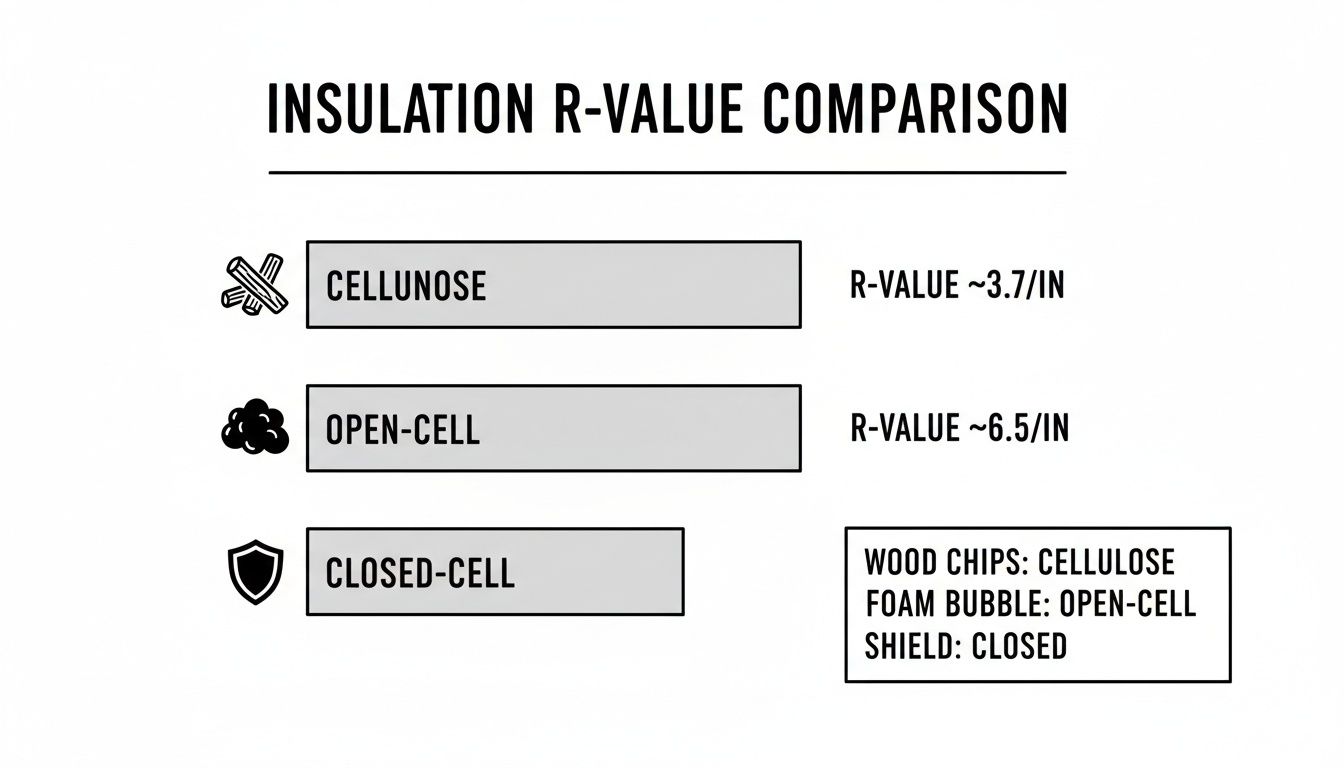
As you can see, while open-cell foam's R-value is neck-and-neck with cellulose, closed-cell spray foam provides almost double the thermal resistance per inch. That’s a massive performance difference right out of the gate.
In South Florida, moisture is the enemy we’re always fighting. As we've covered, cellulose is hygroscopic—it naturally absorbs moisture right out of the air. If it can't dry out, which is a constant struggle here, its R-value tanks, and it becomes a breeding ground for mold and rot.
This is where spray foam insulation really proves its worth.
Open-Cell Spray Foam: This foam is vapor-permeable, which is a good thing. It lets moisture pass through and dry out. While it’s not a water barrier, its structure prevents it from acting like a sponge the way cellulose does. It gives you a great air seal but still allows the wall assembly to breathe.
Closed-Cell Spray Foam: For our climate, this is the total package. It’s an insulator, an air barrier, and a vapor barrier all in one. Closed-cell foam is impermeable to water, period. It stops moisture from ever getting into your wall cavity. As a bonus, it adds significant structural strength to your walls—a nice little perk during hurricane season.
For a deeper dive into how these materials stack up in different scenarios, check out our full guide on cellulose vs. spray foam insulation.
To help homeowners in humid climates like ours, we put together this table comparing the essential performance metrics of dense pack cellulose, open-cell spray foam, and closed-cell spray foam. It cuts through the noise and shows you what really matters.
| Feature | Dense Pack Cellulose | Open-Cell Spray Foam | Closed-Cell Spray Foam |
|---|---|---|---|
| R-Value Per Inch | R-3.7 | R-3.8 | R-7.0 |
| Air Barrier | No (Air Permeable) | Yes (Effective Air Seal) | Yes (Impermeable) |
| Vapor Barrier | No (Permeable) | No (Permeable) | Yes (at >1.5 inches) |
| Moisture Handling | Absorbs and Holds Water (High Risk) | Allows Drying (Low Risk) | Blocks Water (No Risk) |
| Best Fit for South Florida | Fair (Requires Flawless Air Sealing) | Good (Great Air Seal, Needs Vapor Control) | Excellent (All-in-One Protection) |
While dense pack cellulose might be a fine choice in a dry, northern climate, it introduces serious risks down here. For any homeowner looking for real energy savings, long-term performance, and genuine peace of mind, spray foam is simply the smarter, more reliable choice for our demanding environment.
So, how can you be sure your insulation job was done right? Just blowing cellulose into a wall cavity doesn't cut it. A proper, professional installation is a precise process, and holding your contractor accountable is the only way to get the thermal performance you’re paying for.
The final dense pack cellulose R value hinges entirely on hitting the right density—that non-negotiable 3.5 lbs/ft³ target. This isn't just a "best practice" recommendation. It's a code-level requirement that guarantees the insulation won't settle and will perform as advertised. A low-bid installer might be tempted to cut corners here, but a true professional knows their reputation is on the line with every job.
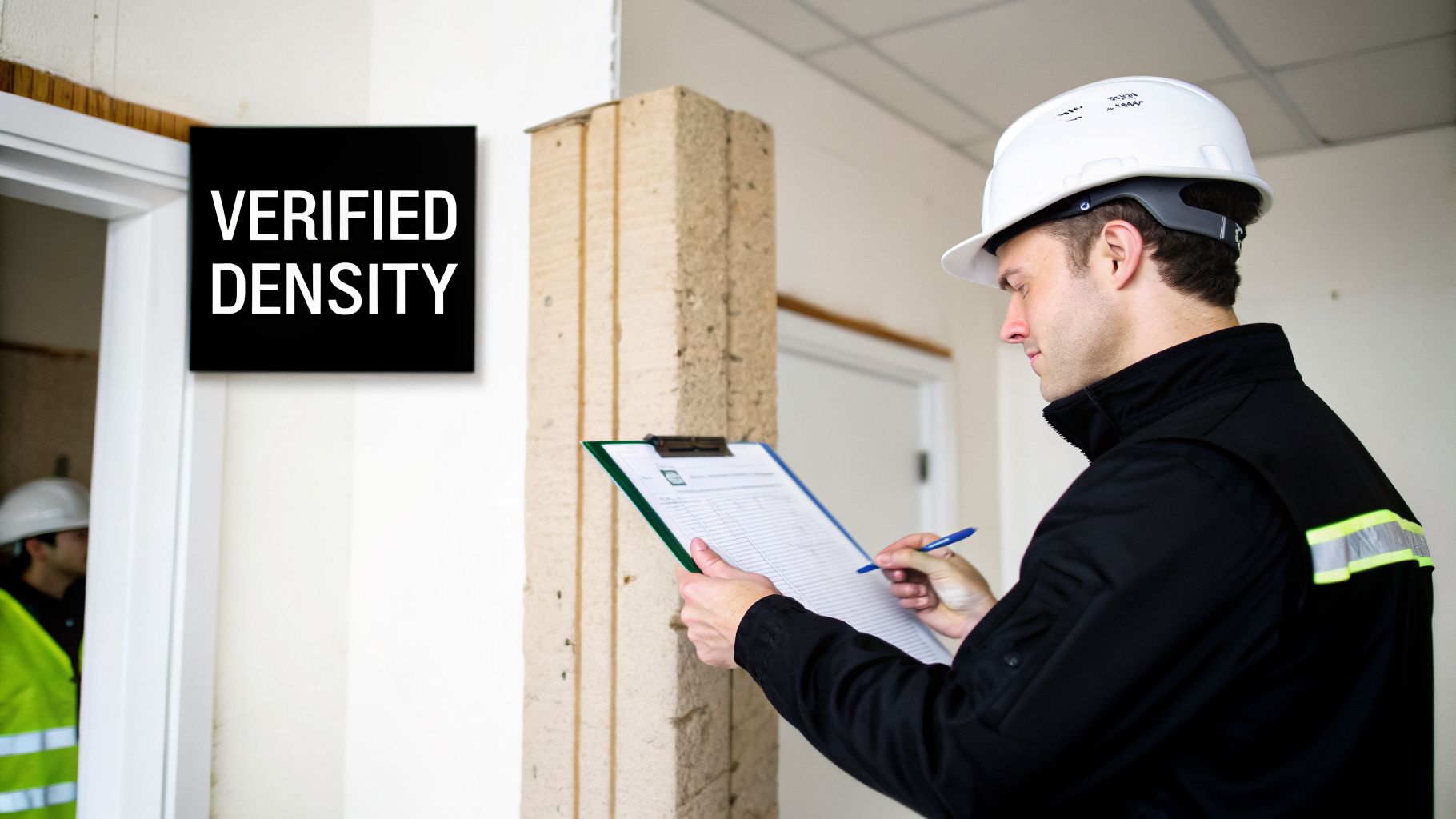
After the job is done, a building inspector has to sign off on the work. They aren’t just peeking into the wall to see if it’s full; they are there to confirm the installation meets the manufacturer's specs and, more importantly, local building codes. This all comes down to one critical test: the density check.
An inspector's job is to protect you. They've seen what happens when cellulose is under-packed—it inevitably settles, leaving huge uninsulated voids at the tops of your walls. Here in Florida, that’s a recipe for disaster. It doesn't just kill your energy efficiency; it creates the perfect cold spots for condensation and moisture problems.
To prevent this, they have to validate the installation density. This isn't something you can eyeball. It requires a physical test to measure the pounds per cubic foot.
The only reliable way to prove proper density is through a procedure called core sampling. It’s a simple but absolutely essential quality control step that any reputable contractor should perform without you even having to ask.
Here’s a breakdown of the process:
This simple test is your proof of performance. If that number comes in below 3.5 lbs/ft³, the job wasn’t done right. The contractor needs to get their machine back out and add more material to bring the wall up to the correct pressure and density.
Asking for a density test isn't being difficult—it's being a smart homeowner. It’s the only real way to prove you got the lasting dense pack cellulose R value you invested in and to protect your home from the long-term headaches of a shoddy installation.
When you're looking at insulation, especially here in South Florida, you're bound to have questions. Let's cut through the noise and get straight to what you really need to know about dense-pack cellulose and its R-value in our climate.
Yes, and it’s not a small drop—it's a complete collapse in performance. All insulation works by trapping dry, still air. Once water gets into cellulose, it displaces that air, and since water is a fantastic conductor of heat, your insulation stops insulating. It's that simple.
A wet wall might as well not be insulated at all. Its effective R-value plummets. In a place as humid as our corner of the world, cellulose that can't dry out fast becomes a permanent weak spot in your home. Worse, it becomes a breeding ground for mold and can lead to wood rot inside your walls, which is a problem I’ve seen firsthand far too many times.
Not even close. In Florida, your biggest fight isn't just against heat conduction (what R-value measures), but against air leakage. Hot, humid air sneaking into your house through tiny gaps forces your AC to work overtime, and that’s where your energy bills really skyrocket.
This is why an insulation that creates a perfect air seal, like spray foam, will flat-out outperform a product with a high R-value that still lets air pass through it.
The winning strategy for our climate isn't about chasing the highest R-value on paper. It's about creating a complete thermal and air barrier to stop both heat transfer and air intrusion.
I understand the temptation, but this is one of those jobs you absolutely have to leave to the pros. Getting the proper 3.5 lbs/ft³ density isn't just a matter of technique; it's physically impossible without specialized, high-pressure blowing equipment.
Those rental machines from the big-box stores just don't have the power. I've seen the results: under-packed walls that inevitably settle in a few years, leaving huge uninsulated gaps at the top of the wall cavities. If you want the actual performance and dense pack cellulose R-value you're paying for, professional installation is non-negotiable.
Let's look at the numbers for a standard 3.5-inch deep 2×4 wall. This is where you see the real-world difference.
The R-value difference is obviously huge, but that's only half the picture. The closed-cell spray foam also forms a rigid, airtight, and vapor-proof barrier. Cellulose can’t do that. That all-in-one protection from heat, air, and moisture makes spray foam a far more resilient and effective solution for South Florida homes.
Are you tired of high energy bills and uncomfortable indoor temperatures? The team at Airtight Spray Foam Insulation has the expertise to create a truly sealed and comfortable home. Learn how our solutions provide superior performance and lasting peace of mind. Request a free estimate today!