Discover how our spray foam insulation solutions in Jupiter, FL help improve comfort, efficiency, and moisture control in South Florida homes.
For anyone living in South Florida, the war against heat is a year-round battle. Your attic is ground zero—the main entry point where that oppressive heat invades your home. Getting the right insulation in the attic ceiling, especially with a modern solution like spray foam, is one of the single most powerful upgrades you can make. It creates a legitimate barrier that completely changes your home’s comfort and slashes your energy bills.
On any given sunny day here in South Florida, a poorly insulated attic can easily soar to 150°F or even higher. That intense heat doesn’t just stay up there; it radiates straight down through your ceiling, forcing your air conditioner into overdrive just to keep pace.
It’s a vicious and expensive cycle. Your AC runs constantly, your energy bills are through the roof, and your house still feels uncomfortably warm and humid. The only way to win is to create a thermal boundary that stops the heat transfer cold.
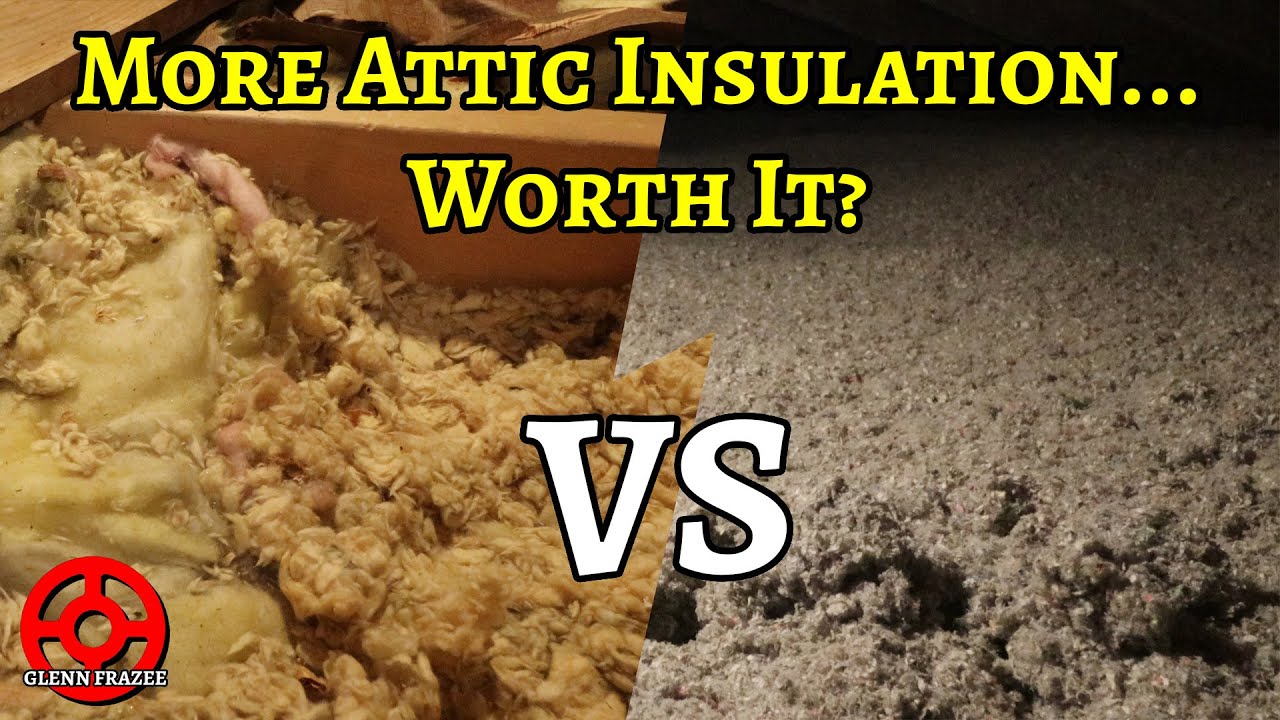
Traditional insulation like fiberglass batts or blown-in cellulose just isn’t cut out for our humid climate. Sure, it has an R-value, but it does absolutely nothing to stop air from leaking. Hot, humid air still pushes its way through countless gaps and cracks, bringing both heat and moisture along for the ride. This is where spray foam completely changes the game.
Spray foam insulation expands on contact, filling every single crack, crevice, and gap to create a solid, monolithic air seal. This airtight barrier is a game-changer for several reasons:
When we treat the attic as part of the home’s conditioned envelope, we’re essentially creating a buffer zone. This not only protects your living area but also shields any HVAC equipment and ductwork in the attic from those brutal temperature swings, helping them run more efficiently and last longer.
Investing in high-performance insulation in your attic ceiling pays for itself, and fast. It’s not uncommon for homeowners to see their monthly cooling bills drop by a staggering 30-50%. Think about that. Your HVAC system is no longer fighting a losing battle against a superheated attic.
The difference in comfort is just as dramatic and happens almost immediately. Rooms stay consistently cool, hot spots disappear, and the whole house feels less damp and more comfortable. To really dig into how different materials stack up, check out this complete guide to R-value roofing and smart insulation.
When you pair the right insulation with a holistic strategy, like our https://airtightsprayfoaminsulation.com/airtight-comfort-system/, the results are truly remarkable.
When you’re thinking about insulating your attic, the first—and most important—decision isn’t what material to use. It’s where you put it. Are you going to insulate the attic floor, creating a barrier right above your living space? Or will you apply insulation in the attic ceiling, directly to the underside of the roof?
This single choice changes everything. It completely redefines how your attic functions and is the most critical decision you’ll make for long-term comfort and energy savings here in South Florida. One method is the way it’s always been done; the other is a modern approach that’s purpose-built for our hot, humid climate.
The old-school way is to roll out fiberglass batts or blow in cellulose insulation across the attic floor. This creates a thermal boundary between your cooled home and the hot attic above it. The attic itself is left unconditioned, essentially treated like the outdoors.
This setup creates what’s called a “vented attic.” Soffit vents and ridge vents are installed to let outside air flow through, which is supposed to carry heat and moisture away. This works okay in cooler, drier parts of the country, but for South Florida, it’s a deeply flawed strategy.
Why does it fail so badly here? Simple. The air it’s pulling in is already blazing hot and loaded with humidity. On a summer day, a vented attic in our area can easily hit 150°F. You’ve basically created a giant radiator that sits on top of your house, baking everything inside it. If your HVAC ducts or air handler are up there, they’re fighting a losing battle, trying to cool air while surrounded by extreme heat.
This quick decision-making guide cuts right to the chase for South Florida homeowners.
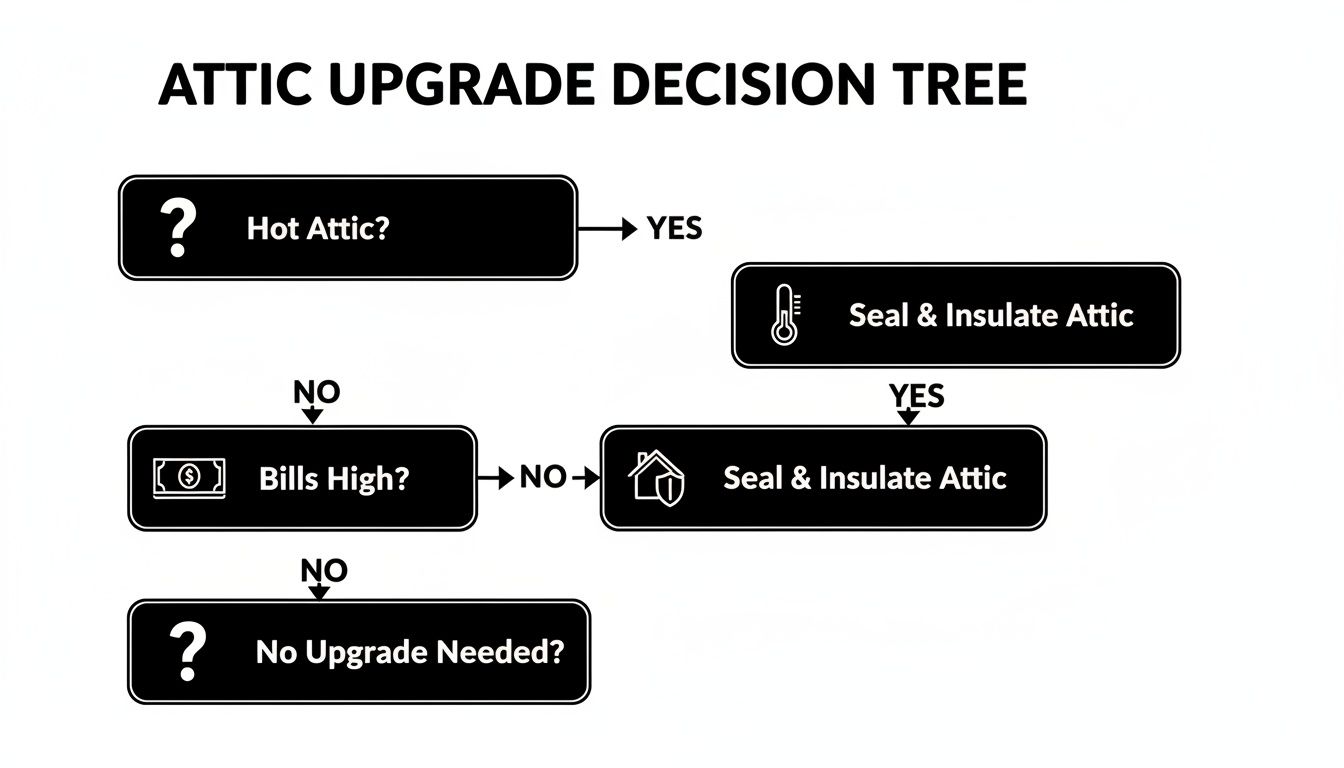
As you can see, the main drivers for attic upgrades—high energy bills and uncomfortable rooms—are solved by sealing the attic, not just piling more insulation on the floor.
A much smarter strategy for our climate is applying insulation in the attic ceiling, right under the roof deck. When you do this, you create an “unvented” or “conditioned” attic. The attic is no longer a scorching no-man’s-land; it becomes part of your home’s air-sealed, insulated envelope.
By sealing the roof deck, you move the thermal boundary from your ceiling to the roof itself. This transforms your attic from a scorching, moisture-laden liability into a temperate, semi-conditioned buffer zone.
This approach brings some serious advantages to the table:
To make the choice crystal clear, let’s break down the two approaches side-by-side.
| Factor | Attic Floor Insulation (Vented Attic) | Roof Deck Insulation (Unvented Attic) |
|---|---|---|
| Attic Temperature | Extremely Hot (often 130-150°F) | Mild (just 10-15°F warmer than your home) |
| HVAC Efficiency | Poor. Ducts lose massive amounts of energy. | Excellent. Ducts operate in a semi-conditioned space. |
| Humidity Control | Poor. Actively pulls humid air into the attic. | Excellent. Creates an air barrier, blocking humidity. |
| Air Quality | Poor. Can draw in dust, allergens, and pollutants. | Good. Prevents outside contaminants from entering. |
| Upfront Cost | Lower | Higher |
| Long-Term ROI | Limited. A band-aid solution for our climate. | High. Significant energy savings and equipment protection. |
While insulating the attic floor is cheaper upfront, it’s a classic case of being penny-wise and pound-foolish in South Florida. It fails to address the two biggest enemies we face: relentless radiant heat and invasive humidity.
Applying insulation directly to the roof deck is a comprehensive solution that attacks these problems at their source. It’s the smarter, more durable strategy for any home in our region.
Once you’ve committed to sealing the roof deck, the conversation shifts from where to what. When it comes to a high-performance insulation in the attic ceiling project here in South Florida, the choice is pretty clear: spray polyurethane foam (SPF). It’s the only game in town that insulates and air-seals in a single shot—something that’s non-negotiable for fighting our region’s intense heat and humidity.
But not all spray foam is created equal. The two main players, open-cell and closed-cell, have completely different personalities. Getting a handle on these differences is the key to making sure you get the performance, protection, and value you expect from your investment.
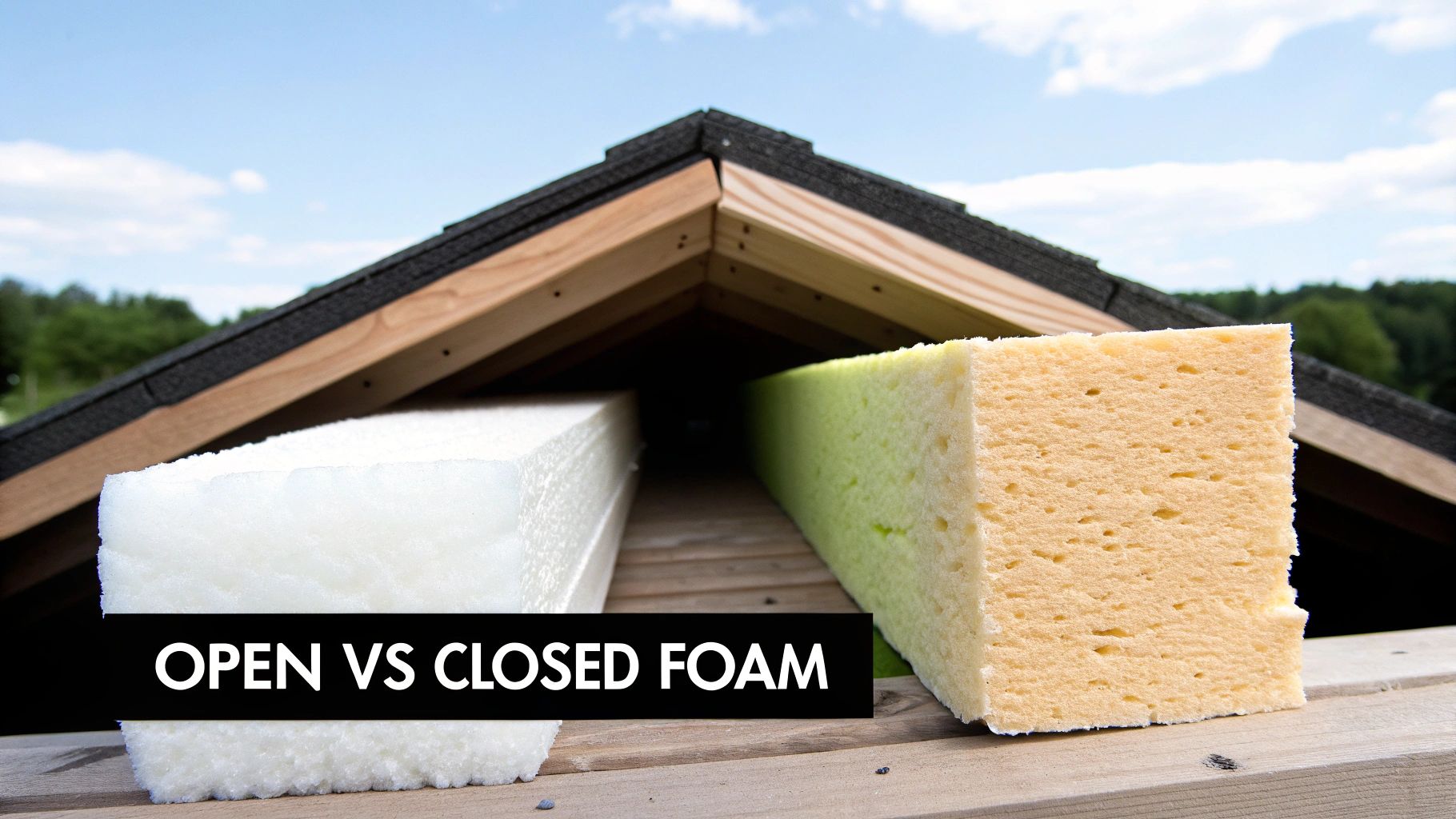
Think of open-cell foam as a dense, rigid sponge. Its chemical structure is made of tiny cells that aren’t fully sealed off, or “open.” When it’s sprayed, it expands like crazy—up to 100 times its liquid volume—filling every last nook, cranny, and gap with incredible precision.
This massive expansion is what makes it a phenomenal air sealer. It’s also much lighter and more flexible than closed-cell.
Here’s the rundown:
But that open-cell structure has a big catch: it’s vapor-permeable. It will let water vapor pass right through it, which is a major factor to consider in our climate.
Closed-cell foam is a whole different beast. Its cells are fully encapsulated and packed together tightly, which creates a dense, rigid, and incredibly strong material. This structure gives it a unique set of high-performance properties that are a perfect match for the demands of South Florida.
The biggest game-changer is its R-value. Building science shows that higher R-values, paired with proper air-sealing, deliver the biggest energy savings in hot climates. For our warm-humid zone, codes often call for R-30 to R-60 in the attic. Closed-cell foam delivers an impressive R-6 to R-7 per inch, while open-cell comes in around R-3.5 to R-4 per inch.
The dense structure of closed-cell foam doesn’t just provide superior thermal resistance—it also acts as a robust vapor barrier. This is a game-changer for humidity control in our climate, as it completely blocks moisture from seeping through the roof deck.
Let’s put them head-to-head on the things that matter most for an attic ceiling. While any spray foam is a massive upgrade over old-school insulation, the choice between open-cell and closed-cell comes down to the specific benefits each brings to the table. And if you’re curious how spray foam stacks up against other common materials, check out our detailed comparison of spray foam vs. blown-in insulation.
| Feature | Open-Cell Spray Foam | Closed-Cell Spray Foam |
|---|---|---|
| R-Value per Inch | ~ R-3.7 | ~ R-6.5 |
| Moisture Barrier | No (vapor permeable) | Yes (vapor barrier) |
| Air Sealing | Excellent | Excellent |
| Structural Strength | Minimal | Adds significant rigidity |
| Sound Dampening | Excellent | Good |
| Cost | Lower | Higher |
For most South Florida homes, closed-cell foam is the superior choice for insulating the roof deck. Its high R-value gives you more insulating power in less space. Crucially, its ability to block moisture is vital for preventing humidity issues and the potential for mold growth.
On top of that, its rigidity adds structural strength to your roof assembly, which increases its resistance to wind uplift during hurricanes—a benefit that you just can’t overstate around here. While it does come with a higher upfront cost, the long-term performance, durability, and moisture protection make it the smarter investment for protecting your home.
Deciding to upgrade your insulation in your attic ceiling is a smart move, but it helps to know what the process actually looks like. A professional spray foam job isn’t just about pointing a hose and spraying; it’s a careful, multi-step operation that puts safety, quality, and your home’s cleanliness first. Seeing how a skilled team operates really shows why this isn’t a weekend DIY project.
When our crew shows up, the first thing they do isn’t spray foam—it’s prep. This is arguably the most critical phase, where we make sure your home is completely protected.
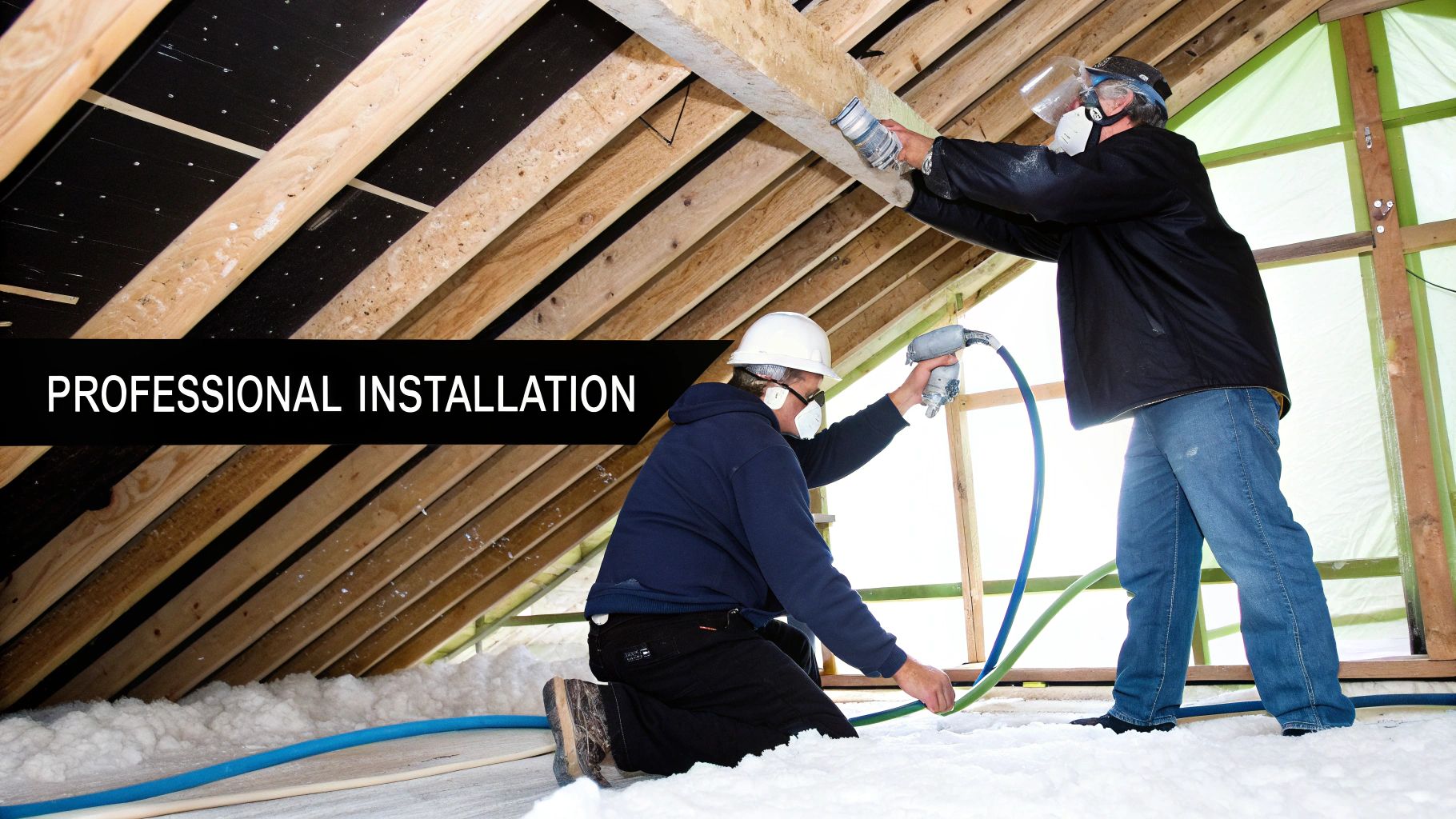
Once the prep work is buttoned up, our certified technicians get into their full personal protective equipment (PPE), including respirators and coveralls. This is non-negotiable for safety. The foam is then applied methodically, with the applicator moving steadily across the roof deck to build up a consistent, even layer.
We’re not just guessing on thickness. Our technicians constantly monitor the depth to make sure it meets the R-value specified for your project. You’ll see the foam expand in seconds, filling every single crack and crevice to create that airtight seal we’re after.
After the last bit of foam is sprayed, the area needs to be ventilated. This is a crucial step that lets the foam cure properly and allows any off-gassing to dissipate safely. For this reason, we require homeowners and pets to be out of the house for up to 24 hours.
The mark of a true professional is leaving your home looking like we were never there—or even cleaner. After the foam has had time to cure, our team comes back to handle the final phase.
We’ll carefully pull down all the protective plastic and tape, making sure no debris is left behind. The entire work area is swept and vacuumed before we pack up all our equipment.
Before we call it a day, our project manager or lead tech will do a final walkthrough with you. This is your chance to look over the work, ask any questions, and make sure everything meets your expectations. We’ll check for uniform coverage, proper depth, and a clean finish, guaranteeing the job delivers the performance and quality you paid for.
This commitment to the entire process is what ensures you get the lasting benefits of a professional insulation job. It’s no surprise the demand for high-performance materials is growing as building codes get stricter and homeowners look for real energy solutions. In fact, the global insulation market is booming, partly because of the huge opportunity to fix older, under-insulated homes. You can learn more about the trends driving the insulation market to see why this is such a hot topic.
Think of upgrading your insulation in the attic ceiling as a direct investment in your home’s performance and, frankly, your own comfort. While the upfront cost for spray foam is higher than old-school materials, the financial payback starts the moment our crew leaves, especially down here in South Florida.
A few key variables will shape the final price. The main driver is the total square footage of your attic’s roof deck—bigger attics simply need more material and time. Your choice between open-cell and closed-cell spray foam also plays a big role, with closed-cell being the more premium, high-performance option. Finally, the job’s complexity, like navigating tight spaces or working around a maze of ductwork, can influence the total investment.
The real story here isn’t the initial cost, but the powerful return on that investment (ROI). This is where spray foam insulation truly leaves everything else behind. By creating a superior air seal, it drastically cuts the workload on your HVAC system, leading to immediate and serious savings on your monthly cooling bills.
Think of it this way: every dollar you spend on cooling a leaky, superheated attic is money thrown straight out the window. A properly sealed attic stops that waste cold, allowing your AC to run less often and more efficiently.
This efficiency translates directly to your wallet. For South Florida homeowners, it’s not uncommon to see cooling costs drop by 30% or more. This upgrade is widely recognized as one of the single most effective energy improvements you can make.
Based on U.S. Department of Energy estimates, properly insulating an attic can slash annual cooling bills by 10% to 50%. For a typical home spending around $2,400 a year on energy, even a 20% reduction means $480 back in your pocket each year. Most of our customers see a payback period between three to eight years. You can find more details about these insulation market trends to see where the industry is heading.
The financial upside goes beyond your FPL statement. By keeping your attic cooler and drier, you take a massive strain off your expensive HVAC equipment. An air conditioner that isn’t constantly fighting 150°F attic temperatures is going to last longer and need fewer repairs, saving you thousands in potential replacement costs down the road.
It’s a smart move that protects one of your home’s most critical systems while making your house a far more comfortable place to live.
Even after you’ve settled on a plan for your attic, it’s completely normal to have a few more questions pop up. Getting clear, straightforward answers is key to feeling confident about your investment. Let’s walk through some of the most common things South Florida homeowners ask us.
Most residential attic jobs are wrapped up in just one to two days. The exact timing really depends on the size of your attic, how much prep is needed, and which type of foam we’re using.
Typically, day one is all about preparation—clearing out the space, cleaning surfaces, and carefully masking off anything that needs protection. Day two is for the actual spray application, followed by a final walkthrough to make sure everything is perfect. We’ll always give you a clear timeline with our estimate so there are no surprises.
Absolutely. When installed by certified professionals like our team, spray foam is completely safe.
During the application itself, there are some off-gassing fumes. For that reason, we require the home to be vacant for about 24 hours. This gives the foam plenty of time to fully cure and lets us thoroughly ventilate the space. Once it’s cured, spray foam is inert and stable. It doesn’t release any harmful fibers or particles, which actually helps improve your home’s indoor air quality in the long run.
A great side benefit of spray foam is how well it dampens sound. By creating a solid, seamless barrier, it also helps quiet your home by reducing noise from outside. To dig deeper into this, you can learn more about how insulation acts as an effective sound barrier in our detailed guide.
Not at all. In fact, applying closed-cell spray foam directly to the roof deck can actually make your roof stronger. It adds structural integrity and significantly increases its resistance to wind uplift—a huge advantage here in hurricane-prone Florida.
When it’s eventually time for a new roof, the roofing pros will simply remove the old shingles and sheathing from the outside, just like they normally would. The spray foam stays right where it is, attached to the rafters, and the new roof deck is installed over it. Your insulation investment remains intact and continues working for years to come.
Ready to transform your home’s comfort and slash your energy bills? The expert team at Airtight Spray Foam Insulation is here to provide a professional, seamless installation experience. Request your free, no-obligation quote today!