Blog
A Homeowner’s Guide to Insulating an Attic Knee Wall

If you have a bonus room over the garage or a finished attic space that’s always too hot in the summer and freezing in the winter, there’s a good chance your knee walls are the problem. Tackling an attic knee wall is one of the highest-impact DIY projects you can do, directly targeting a major source of energy loss in many homes.
These short, vertical walls separate your comfortable living space from the harsh, unconditioned attic. All too often, they are poorly sealed and insulated, creating a constant drain on your HVAC system and a major source of discomfort. Properly sealing and insulating them creates a solid thermal boundary, making your home more comfortable and energy-efficient almost immediately.
Why Your Attic Knee Wall is an Energy Hog
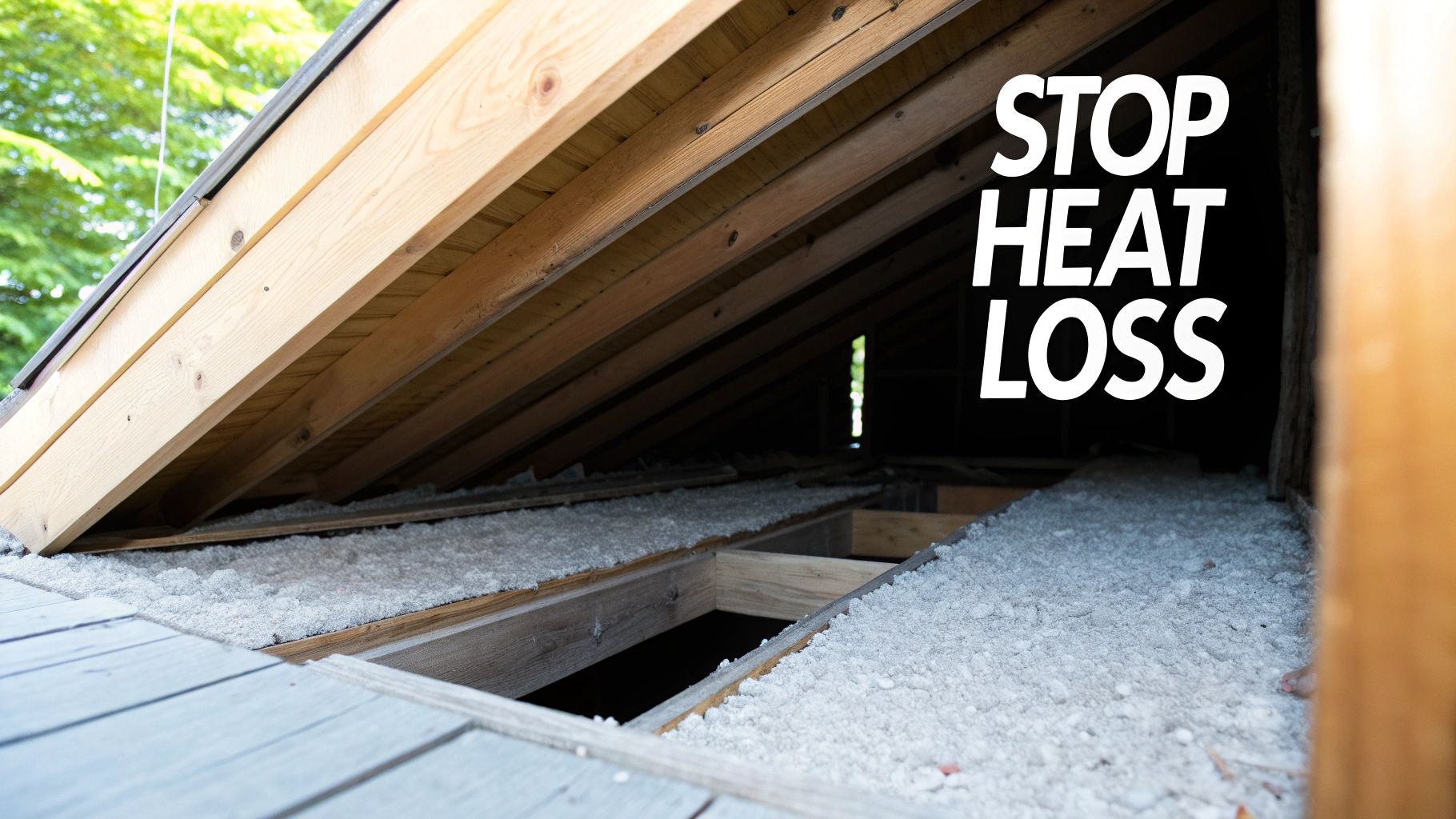
Think about what that little wall is up against. On one side, you have your air-conditioned living room. On the other, you have an attic that can easily soar past 130°F during a South Florida summer. Without proper insulation, that intense heat radiates right through the wall studs and drywall, a process known as thermal bridging. It’s why that wall often feels warm to the touch.
This weak point forces a constant battle between your HVAC system and the outside elements, making it nearly impossible to keep those adjacent rooms comfortable.
The Hidden Costs of an Underperforming Knee Wall
That energy transfer isn’t just about comfort; it hits you directly in the wallet. Your air conditioner has to run longer and harder just to keep up, leading to a cascade of problems:
- Higher Energy Bills: Your HVAC system is constantly trying to compensate for the air you’re losing to the attic.
- Uneven Home Temperatures: It’s the reason for those frustrating hot and cold spots that make certain rooms unusable during peak seasons.
- Increased HVAC Wear and Tear: The extra strain can shorten the lifespan of your system and lead to more frequent, costly repairs.
A quick look at the major improvements you’ll see after properly insulating this critical area.
| Benefit | Impact on Your Home |
|---|---|
| Lower Utility Bills | Reduced HVAC runtime directly translates to lower monthly energy costs. |
| Consistent Comfort | Eliminates the hot and cold spots that make rooms uncomfortable. |
| Improved Air Quality | Sealing air leaks prevents dusty, unconditioned attic air from entering your living space. |
| Longer HVAC Lifespan | Less strain on your system means fewer breakdowns and a longer operational life. |
Ultimately, a poorly sealed knee wall is like leaving a window to your attic wide open. It doesn’t matter how new or efficient your air conditioner is if you’re constantly losing the cool air you’re paying for.
Sealing this weak point is one of the most effective ways to reclaim comfort and control energy costs. No matter how efficient your HVAC system is, you’re constantly losing the conditioned air you’re paying for.
It’s a Problem of Both Air Leaks and Heat Transfer
The problem works in two ways. First, you have heat conducting through the building materials. But the bigger issue, in many cases, is air leakage. Tiny gaps along the bottom plate (where the wall meets the attic floor), around electrical outlets, and where the wall meets the roof rafters create little highways for your conditioned air to escape.
This uncontrolled air movement completely undermines whatever insulation might already be there. Research from the U.S. Department of Energy shows that combining thorough air sealing with effective insulation can cut heating and cooling needs by 15-30% in a typical home. You can dig into the full findings on energy performance from the Oak Ridge National Laboratory if you want to see the data for yourself.
By tackling these hidden leaks, you stop hemorrhaging energy and start creating a home that’s truly stable and comfortable.
Choosing the Right Insulation for Your Knee Wall
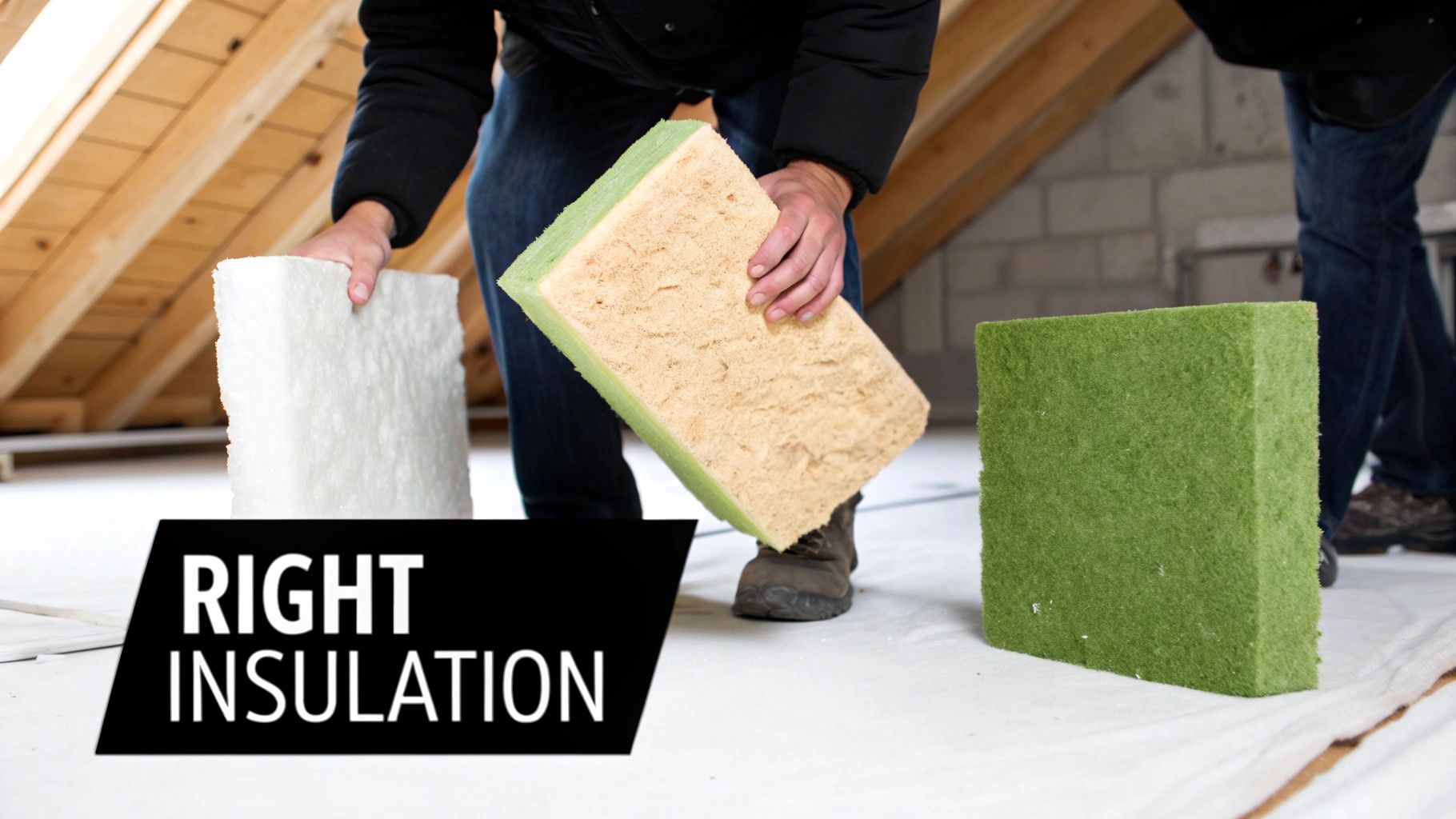
Picking the right insulation for your knee wall isn’t just about grabbing whatever has the highest R-value off the shelf. It’s a real-world decision that has to factor in your budget, our relentless South Florida humidity, and how much work you’re willing to put in.
What works great in a dry, cold climate can be a complete disaster here. Let’s look past the marketing hype and compare the materials you’re most likely to encounter, focusing on what actually performs best in our unique environment.
Fiberglass Batts: The Familiar DIY Choice
You know the stuff. Pink, fluffy fiberglass batts are everywhere, from big-box stores to older attics. They’re cheap and easy for a homeowner to handle (with the right safety gear, of course—mask, gloves, and long sleeves are non-negotiable).
But here’s the catch: fiberglass is only as good as its installation. Its job is to trap still air, but it does absolutely nothing to stop air from moving through it. The second you leave a gap, compress a batt, or forget to properly seal it, the performance tanks.
Key Takeaway: The single biggest mistake we see is the “stuff and forget” approach. Without a rigid air barrier like foam board on the attic side, wind-washing can slash the effective R-value of fiberglass by more than 50%. All that hard work for nothing.
Rigid Foam Board: The Air-Sealing Champion
Now we’re talking. Rigid foam board—whether it’s Expanded Polystyrene (EPS), Extruded Polystyrene (XPS), or Polyisocyanurate (Polyiso)—is a game-changer for knee walls. Why? It’s both insulation and an air barrier in one solid sheet.
We install it right on the attic-facing side of the knee wall studs, creating a tough, continuous shield that stops air leakage cold. It’s the “windbreaker” your fluffy insulation needs to do its job. In fact, a “flash-and-batt” system, where foam board covers cavities filled with fiberglass or mineral wool, is a fantastic, high-performance approach.
- Polyiso (Foil-Faced): Delivers the highest R-value at around R-6.5 per inch and adds a radiant barrier.
- XPS (Usually Pink or Blue): A great middle-ground with good moisture resistance and an R-value of R-5 per inch.
- EPS (White): The most budget-friendly foam board, offering a solid R-4 per inch.
This method directly tackles the main reason most traditional knee wall insulation jobs fail.
Mineral Wool: The Durable Performer
Think of mineral wool (often called rockwool) as fiberglass’s tougher, more capable cousin. It’s denser, far more fire-resistant, and does a much better job at dampening sound.
For us here in South Florida, its best feature is that it’s hydrophobic—it literally repels water and won’t host mold growth. It costs a bit more than fiberglass, but it’s firmer, making it easier to cut for a snug, sag-free fit between studs. Just like fiberglass, though, it absolutely needs an air barrier on the attic side to work effectively.
Spray Foam: The Premium All-in-One Solution
If you’re looking for the best possible performance, Spray Polyurethane Foam (SPF) is it. Nothing else comes close. It expands to fill every single gap, crack, and imperfection, creating a truly seamless air, moisture, and thermal barrier all in one shot. For a tricky area like a knee wall, it’s the most effective way to guarantee an airtight seal.
This isn’t just our opinion; the entire industry is moving this way. Homeowners want high-performance materials, and building codes are increasingly mandating the kind of air-sealing that only spray foam can reliably deliver.
You’ve got two main options here:
- Closed-Cell Spray Foam: This is the dense, rigid stuff. It adds structural integrity to the wall and boasts a massive R-value of R-6 to R-7 per inch. Critically, it’s a vapor barrier, which is exactly what you want in our humid climate to stop moisture in its tracks.
- Open-Cell Spray Foam: A softer, spongier foam with a lower R-value (around R-3.7 per inch). While it’s a phenomenal air and sound barrier, it is vapor-permeable, meaning it lets moisture pass through it, which requires careful management in our climate.
Spray foam is a professional job—it requires specialized equipment and serious safety protocols. If you’re weighing your options, getting a handle on how it stacks up against older methods is a smart move. Our guide on spray foam vs blown-in insulation breaks down the pros and cons for different attic scenarios. Ultimately, choosing spray foam is an investment in a complete, permanent solution.
Comparing Your Knee Wall Insulation Options
This table gives you a quick, side-by-side look at the most common materials. Use it to help decide which option best fits your home’s needs and your project goals.
| Material Type | Average R-Value/Inch | Air Sealing | Moisture Resistance | Best For |
|---|---|---|---|---|
| Fiberglass Batts | R-3.1 to R-4.3 | Poor (Requires separate air barrier) | Poor (Can hold moisture & support mold) | Budget-conscious DIY projects where air sealing is addressed separately. |
| Mineral Wool | R-3.0 to R-3.3 | Poor (Requires separate air barrier) | Excellent (Hydrophobic; resists mold) | Projects needing better fire/sound resistance and moisture management. |
| Rigid Foam Board | R-4.0 to R-6.5 | Excellent (Acts as an air barrier) | Good to Excellent (Varies by type) | Creating a durable air barrier on the attic side of the knee wall. |
| Open-Cell Spray Foam | ~R-3.7 | Unbeatable (Monolithic air barrier) | Fair (Vapor permeable) | Air sealing and soundproofing in climate-controlled assemblies. |
| Closed-Cell Spray Foam | R-6.0 to R-7.0 | Unbeatable (Air, vapor, thermal barrier) | Excellent (Acts as a vapor barrier) | High-performance applications in humid climates like South Florida. |
Remember, the “best” material isn’t just about the highest R-value. In South Florida, air sealing and moisture control are just as important—if not more so. A perfectly installed system using mid-range materials will always outperform a sloppy job with the most expensive product.
How to Properly Install Knee Wall Insulation
Alright, let’s get our hands dirty. Insulating an attic knee wall isn’t rocket science, but the devil is in the details—specifically, the order you do things. We’re going to walk through the most common and effective DIY approach: using fiberglass batts inside the stud cavities and finishing with rigid foam sheathing on the outside to create a bulletproof air barrier.
This isn’t just about cramming insulation into a wall cavity and calling it a day. It’s about building a complete, sealed thermal assembly that can actually stand up to the brutal heat and humidity we get here in South Florida. When you get this right, you transform one of your home’s biggest energy weak spots into a solid part of your conditioned envelope.
The Most Overlooked Step: Air Sealing
Before you even think about touching a piece of insulation, you have to meticulously air-seal every single gap. This is the single most critical step, and it’s the one most guides gloss over. It’s also the reason most DIY insulation jobs fail.
Remember, insulation’s job is to slow down heat transfer, not to stop air from moving.
Think of it like wearing a thick wool sweater on a windy day. The sweater itself is warm, but a cold breeze will cut right through it. It’s the thin windbreaker jacket you wear over it (the air barrier) that actually makes the sweater effective. For your knee wall, that “windbreaker” is a combination of caulk, canned spray foam, and rigid foam board.
Here are your primary targets:
- The Bottom Plate: That gap where the knee wall’s 2×4 frame sits on the attic floor? That’s an absolute superhighway for air leakage. Seal this entire seam with a good acoustic sealant or high-quality caulk.
- Around Penetrations: Anywhere electrical wires, plumbing pipes, or ducts punch through the wall’s top or bottom plates needs to be sealed. Use canned spray foam for the bigger gaps and caulk for the smaller ones.
- Vertical Seams: Don’t forget to seal the gaps where the end studs of your knee wall meet the roof rafters. These are often overlooked but can let a surprising amount of air move through.
This prep work is completely non-negotiable. If you skip it, you’re just putting expensive insulation into a leaky box, and its real-world performance will be a fraction of its rated R-value.
Cutting and Fitting the Cavity Insulation
With all the air leaks buttoned up, you can finally install your cavity insulation. For this example, we’ll use unfaced fiberglass or mineral wool batts since they’re affordable and easy for a DIYer to handle. The goal here is a perfect, snug fit—no compression and absolutely no gaps.
Measure the height and width of each stud bay before you cut. A batt that’s too small leaves an air gap. One that’s too big gets compressed, which crushes the tiny air pockets that give it its R-value, making it far less effective.
- Length: Cut the batts about 1 inch longer than the cavity’s height. This gives them enough friction to stay put against the top and bottom plates without compressing.
- Width: Standard batts are made for 16-inch or 24-inch on-center framing. If you have non-standard spacing, you’ll need to carefully cut the batts to width.
- Obstacles: When you hit an electrical wire, don’t just shove the insulation behind it. That compresses it. Instead, carefully split the batt into two thinner layers and sandwich the wire right in the middle. This keeps the insulation at its full thickness and R-value.
Pro Tip: Use a long, straight edge (like a spare 2×4) and a sharp utility knife to make your cuts on a piece of plywood. This gives you clean, straight edges for a much tighter fit than just tearing it by hand.
Installing the Rigid Foam Air Barrier
This is where the magic really happens. The rigid foam board you install on the attic-facing side of the knee wall is what makes the whole system work. This layer does three critical jobs: it stops air movement (also called wind-washing), it adds continuous R-value, and it breaks the thermal bridge created by the wood studs.
Choose a foam board that fits your budget and goals. Polyiso has the highest R-value per inch, but even standard EPS foam board will work exceptionally well as your air barrier.
The process is pretty straightforward:
- Measure and Cut: Measure the entire face of the knee wall and cut your foam panels to fit. It’s always better to work with larger sheets to minimize the number of seams you have to seal later.
- Attach the Foam: Secure the foam board directly to the face of the studs. Use cap nails or special insulation fasteners—they have wide plastic washers that prevent the nail head from pulling right through the foam.
- Seal Every Seam: This part is critical. Every single seam between foam panels and around the entire perimeter (where the foam meets the attic floor and the roof rafters) must be sealed. Use a high-quality flashing tape or canned spray foam to create a continuous, airtight barrier.
Once this is done, you’ve created what building scientists call a “6-sided” insulated cavity. The insulation is now completely sealed on all sides: by the drywall on the inside, the studs on the sides, the plates on the top and bottom, and now, your rigid foam air barrier on the attic side. This is the gold standard.
Of course, exploring different methods and materials, like those detailed in our comprehensive guide to spray foam insulation applications, can offer even more robust solutions for creating a truly sealed and high-performance attic space.
Don’t Forget the Attic Floor
You’re not done just yet. The attic floor area behind the knee wall is still part of your home’s thermal boundary—it’s the ceiling for the room below. This area has to be insulated to the exact same level as the rest of your attic.
Make sure the insulation on that attic floor is installed snugly against the bottom edge of your new foam board. There should be absolutely no gap between the wall insulation and the floor insulation. This final connection creates a continuous, unbroken line of defense against heat gain and air leaks, locking in your hard work and energy savings.
Managing Airflow to Prevent Moisture Problems
Simply shoving insulation into a knee wall without a strategy for airflow is a classic rookie mistake. An insulated wall that can’t breathe or dry out is a ticking time bomb for mold, mildew, and even structural rot. This is non-negotiable here in South Florida, where the air is practically dripping with humidity half the year.
To do this right, you have to think about the entire attic as a system. The goal is to make sure your new insulation doesn’t accidentally trap moisture or choke off the ventilation paths that keep your attic from turning into a swamp. Getting this balance right is everything.
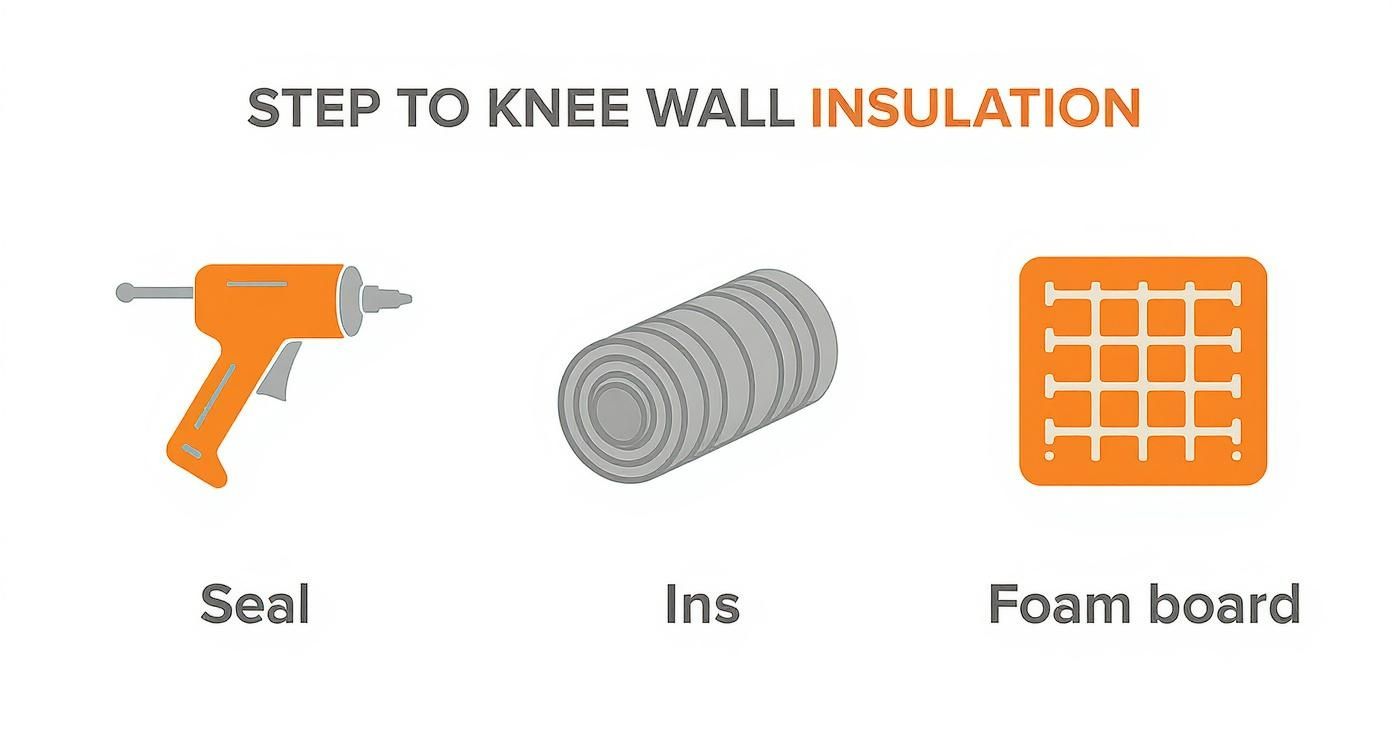
Insulation is just one piece of the puzzle. Sealing air leaks and directing airflow are just as critical.
Keep Your Attic Breathing with Rafter Vents
Your attic is designed to breathe. Air is supposed to flow in through vents in your soffits (under the roof eaves), wash up along the underside of the roof deck, and then exit out the ridge vent at the top. This constant movement pushes out super-heated air and, more importantly, any moisture that gets in.
When you insulate that knee wall and the floor behind it, you have to protect that ventilation channel. That’s what rafter vents (or insulation baffles) are for. These are just simple plastic or foam channels you staple between the rafters, right up against the roof sheathing.
- They create a dedicated air gap—usually 1 to 2 inches deep—between the insulation and the roof deck.
- This guarantees that air can still flow freely from the soffit all the way to the ridge.
- Without them, insulation gets pushed right up against the soffits, effectively suffocating your attic and trapping hot, humid air.
Installing baffles is a quick but absolutely essential step. It ensures your insulation works with your home’s ventilation system, not against it.
The Truth About Vapor Barriers in South Florida
The vapor barrier conversation gets confusing fast, but for our hot, humid climate, the rule is simple and absolute. You need to stop humid air from the attic from getting into your wall, hitting your cool air-conditioned drywall, and turning into water.
In South Florida (that’s Climate Zone 1A), the vapor barrier always, always goes on the exterior, attic-facing side of the insulation. Getting this wrong is a catastrophic mistake that I’ve seen countless times. Put a vapor barrier on the interior side like they do up north, and you’re literally building a mold terrarium inside your walls.
This is where closed-cell spray foam really shines in our climate. It acts as insulation, an air barrier, and a vapor barrier all in one shot. It creates a seamless layer that completely stops moisture from ever getting into the wall cavity to begin with.
The physics are totally different here compared to cold climates. Our enemy is vapor drive pushing inward from the humid outside.
Conditioned vs. Unconditioned Attics
When you insulate the knee walls and the attic floor behind them, you’re creating a standard vented, unconditioned attic. This means the attic space itself stays outside your home’s thermal envelope—it gets hot and humid, but it’s separated from your living space by a solid barrier of insulation.
The other option is to create a sealed, conditioned attic. This is a bigger job where you remove all the old ventilation and apply insulation directly to the underside of the roof deck. This approach brings the entire attic inside your home’s conditioned bubble, which is great for protecting HVAC equipment and ducts from extreme heat.
It’s a major decision. For homeowners wanting the ultimate solution, sealing the whole attic is the way to go. You can see how this works by looking into a complete thermal and air barrier package like the Airtight Comfort System, which turns the whole attic into a conditioned space. For a standard knee wall project, though, the goal is simply to maintain a properly vented, unconditioned attic.
Budgeting Your Project: DIY vs. Hiring a Pro
When it comes to insulating your attic knee walls, the first question everyone asks is: what’s it going to cost? Deciding whether to tackle it yourself or call in a professional really boils down to that number. Both paths have their own financial logic, but the right choice for you depends on how you value your time, your comfort level wriggling into tight spaces, and whether you want a guaranteed result.
https://www.youtube.com/embed/QvIlRM4oQCE
Going the DIY route is, without a doubt, the cheaper option on paper. You’re trading your own sweat and weekend hours for some serious savings on labor. But don’t just look at the price of the insulation—you have to budget for all the materials needed to do the job right.
The DIY Cost Breakdown
If you’re ready to get your hands dirty, your shopping list is going to look something like this. Keep in mind that prices will shift based on how big your knee wall is and the quality of the products you choose.
- Insulation: This will be your biggest line item. Fiberglass or mineral wool batts typically run between $1.00 and $2.00 per square foot.
- Rigid Foam Board: You need this to create that critical air barrier. Expect to pay $1.50 to $3.00 per square foot for a solid board like Polyiso.
- Air Sealing Supplies: Set aside $50 to $100 for canned spray foam, good quality caulk, and flashing tape. This stuff is what seals every last seam and gap.
- Safety Gear: Don’t even think about skipping this. A good respirator, gloves, and safety glasses are non-negotiable and will probably cost you $50 to $75.
For a pretty standard 50-foot-long knee wall, a full DIY project will likely land you in the $400 to $800 range. The biggest factor influencing that number is the quality of the foam board and insulation you buy. It’s always tempting to go for the cheaper option, but investing in better materials pays you back big time in energy savings.
The Professional Installation Cost
Bringing in a professional crew like Airtight Spray Foam Insulation means you’re paying for expertise, speed, and a warranty. It comes at a higher price, but it takes all the guesswork out of the equation. Professional installation for an attic knee wall usually ranges from $5 to $10+ per square foot.
So, why the big range? It really comes down to a few key things:
- Insulation Type: A “flash-and-batt” system, which combines a thin layer of spray foam with traditional batt insulation, is more budget-friendly than a full, thick application of closed-cell spray foam.
- Attic Accessibility: If your attic is a maze of tight corners and low clearance, it’s going to take more time and labor, and that will be reflected in the cost.
- Project Scope: The final quote will depend on the total square footage of the knee walls and the current condition of the space.
For that same 50-foot knee wall, you can expect a professional bid to fall somewhere between $1,200 and $3,000+, with a full spray foam job landing at the higher end. That price isn’t just for insulation—it covers labor, all materials, cleanup, and the peace of mind that the job was done right according to modern building science.
Homeowners are getting serious about these kinds of upgrades. The global market for building thermal insulation recently topped USD 29.9 billion, and residential projects account for over 40% of that. This isn’t just a trend; it’s a clear signal that people understand how powerful proper insulation is for fighting back against sky-high energy bills. You can dig into the numbers yourself and check out the full building thermal insulation market report.
In the end, the decision is a classic trade-off between upfront cost and long-term performance. A DIY job saves you money now but comes with the risk of small installation mistakes that can seriously hurt your results. Hiring a pro ensures the system works perfectly from day one, maximizing your energy savings and home comfort for years to come.
Common Questions About Insulating an Attic Knee Wall
Even after you’ve got the basics down, a few tricky questions always seem to pop up when homeowners get into the details of insulating an attic knee wall. Getting these details right is what separates a job that works from one that fails completely. Let’s tackle the questions we hear most often.
What R-Value Do I Need for My Knee Wall?
For the insulation inside the wall cavity itself, you’re aiming for an R-13 to R-21. But here’s the thing: stopping there is a huge mistake.
The real game-changer is adding a continuous layer of rigid foam insulation on the attic-facing side of the studs. This simple step does two critical things: it dramatically boosts the total effective R-value and, more importantly, it stops “thermal bridging”—that’s when heat bypasses your insulation by traveling right through the wood studs.
Should I Insulate the Attic Floor Behind the Knee Wall?
Yes, one hundred percent. This is the single most common step people miss on a DIY job. That small attic floor behind the knee wall is part of your home’s thermal boundary, and it absolutely must be insulated and air-sealed.
Think of it as the ceiling for the room below. The insulation here needs to connect tightly with the bottom of your knee wall insulation. You’re trying to create a continuous, unbroken barrier against both heat and air movement.
A knee wall is only as strong as its weakest connection. A gap between the wall and floor insulation is like leaving a window open—it completely undermines all your hard work.
Can I Just Stuff Insulation in the Wall and Call It Done?
Please don’t. That’s probably the worst thing you can do. Without a rigid air barrier (like foam board, OSB, or even drywall) on the attic side, air will move straight through fiberglass batts. We call this “wind-washing,” and it can slash the effective R-value of your insulation by over 50%.
An air barrier is non-negotiable. It protects the insulation from the harsh, moving air in the attic, ensuring it can actually do its job.
What Is the Difference Between Insulating the Knee Wall vs. the Roof?
When you insulate the knee wall and the attic floor behind it, you’re creating an unconditioned, vented attic space. This means the attic itself is technically outside your home’s thermal envelope.
The other option is to insulate the roof deck itself (along the rafters). This brings the entire attic area inside the home’s conditioned envelope. This approach is usually much better if you have any HVAC equipment or ductwork in the attic, as it protects them from extreme temperatures and makes your whole system run more efficiently.
At Airtight Spray Foam Insulation, we specialize in creating high-performance insulation systems that are built to handle South Florida’s unique climate. If you’re ready to solve your home’s comfort and energy issues for good, request a free quote today.
Homeowners in Palm Beach Gardens, FL often deal with temperature swings in bonus rooms and upper-level spaces due to poorly insulated attic knee walls. Airtight Spray Foam Insulation helps PBG homeowners seal hidden gaps, stabilize temperatures, and improve year-round comfort.
👉 Learn more about our services in Palm Beach Gardens:
https://yourwebsite.com/spray-foam-insulation-palm-beach-gardens/