Blog
A Guide to Insulating a Garage Attic in Florida

When you open your garage door and that wall of oppressive heat hits you, it’s not just uncomfortable—it’s a direct assault on your home’s energy efficiency. Here in South Florida, an uninsulated garage attic acts like a massive radiator. It soaks up solar energy all day long and pumps that heat right into your living spaces.
This forces your air conditioning system to work overtime, driving up your utility bills and creating frustratingly inconsistent temperatures throughout your house.
Insulating your garage attic isn’t just about making the garage itself more bearable. It’s one of the most effective upgrades you can make to fortify your entire home’s building envelope. By creating a solid thermal barrier, you dramatically reduce the workload on your HVAC system, which translates directly into real, tangible savings.
The Impact on Your Home and Wallet
An uninsulated attic doesn’t just make the garage unusable for a workshop, gym, or even simple storage. That trapped heat bleeds into any adjacent rooms, making them significantly harder and more expensive to keep cool. Over time, this extreme heat can also ruin things you store out there, from holiday decorations to expensive tools.
Think about the real-world benefits you get from tackling this problem:
- Lower Energy Bills: When you stop radiant heat from penetrating your home, your AC unit finally gets a break. It runs less often, and many homeowners see their cooling costs drop by up to 20%.
- Improved Home Comfort: No more hot spots. The rooms next to or above the garage will hold a stable, comfortable temperature all year.
- More Usable Space: A cooler garage suddenly becomes a functional part of your home. It’s a viable spot for a home gym, a workshop, or just storage without the fear of everything melting.
- A Quieter Home: This is a secondary benefit, but one our customers always appreciate. A well-insulated space is a quieter space, muffling noise from the street and making your home more peaceful. We’ve seen how the right material can act as an excellent insulation as a sound barrier.
Ultimately, insulating a garage attic in a hot, humid climate like South Florida isn’t a luxury. It’s a practical investment that pays for itself through energy savings and a much more livable home.
Choosing the Right Insulation for Your Garage Attic
When it comes to insulating a garage attic in South Florida, picking the right material isn’t just a small detail—it’s the most important decision you’ll make. Sure, you’ve seen the pink fiberglass batts at the home improvement store, but in our swampy, high-humidity climate, those traditional options often don’t cut it. For a solution that actually creates a thermal and moisture barrier that can withstand our environment, spray polyurethane foam (SPF) is really the only way to go.
But “spray foam” isn’t a one-size-fits-all product. It comes in two main flavors: open-cell and closed-cell. Which one you choose depends entirely on what you want to achieve with your garage, your budget, and how you see yourself using that space down the road. It’s a choice more and more homeowners are taking seriously.
The proof is in the numbers. The global insulation market was already valued at around USD 55 billion back in 2018 and is expected to hit nearly USD 79 billion by 2026. This isn’t just about keeping homes comfortable; it’s a huge shift toward making them smarter and more energy-efficient. You can see a breakdown of what’s driving this trend in this detailed insulation market analysis.
This decision process is pretty straightforward for most people once they understand the problem.
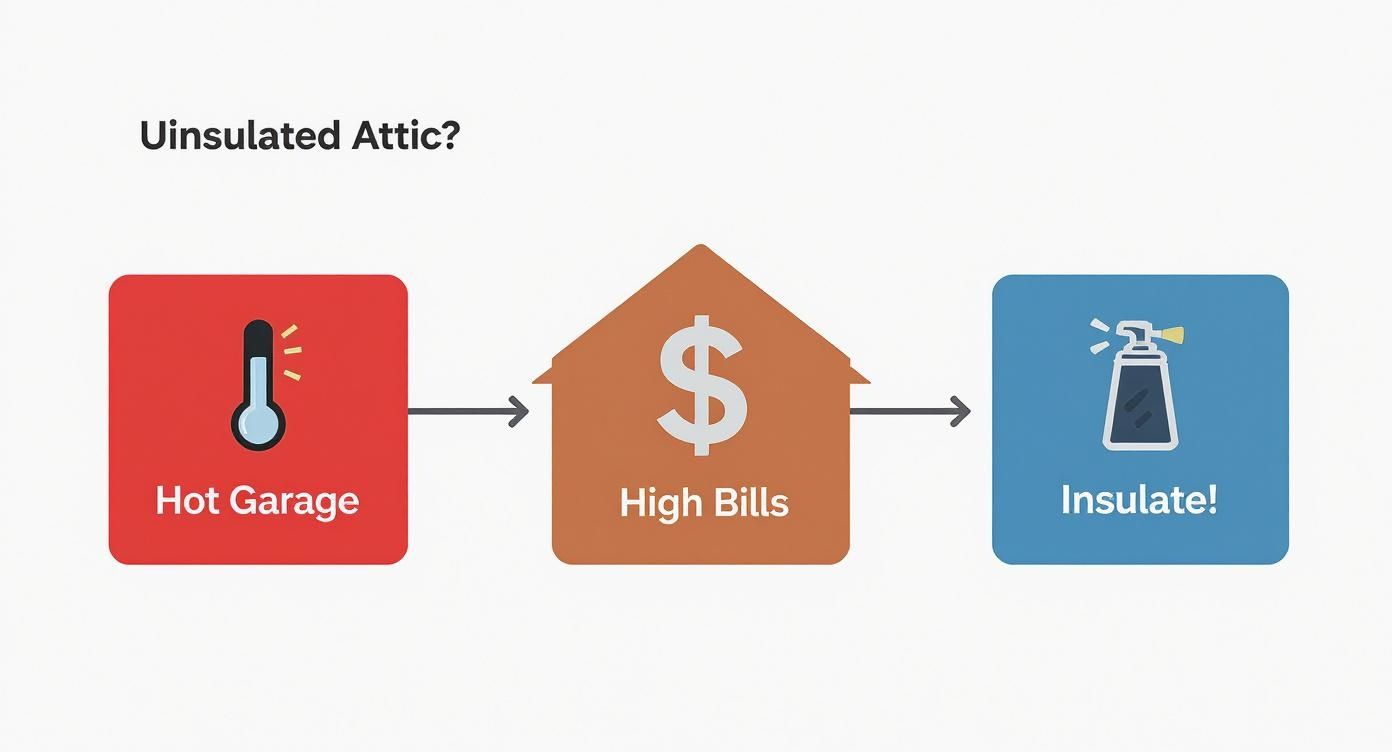
As you can see, a hot garage and high bills are symptoms of the same problem—and insulation is the cure.
Open-Cell vs. Closed-Cell Spray Foam
To make the right call for your garage here in South Florida, you need to know the real-world differences between these two types of foam. They have completely different properties and are suited for different jobs.
Open-cell spray foam is the lighter, spongier of the two. It has a soft, flexible texture because its cells aren’t completely sealed. This makes it an incredible sound dampener—perfect for reducing noise. The downside? That open structure is vapor-permeable, meaning it can absorb and hold onto moisture like a sponge.
Closed-cell spray foam, on the other hand, is dense, hard, and incredibly strong. Its cells are completely sealed off from each other, which makes it an outstanding air and vapor barrier. In South Florida, that’s a game-changer for stopping moisture in its tracks. It also packs a much higher R-value per inch and even adds structural strength to your roof deck.
For the vast majority of garage attics in South Florida, closed-cell spray foam is the hands-down winner. Its ability to block moisture vapor is your best defense against the humidity, condensation, and mold that thrive in our climate.
Making the Right Decision for Your Garage
So, let’s put them head-to-head on the factors that matter most for a garage attic project. While we often compare spray foam to other materials, like in our guide on spray foam vs. blown-in insulation, understanding the differences within the spray foam family is critical.
Here’s a quick comparison table to make it simple.
Open-Cell vs. Closed-Cell Spray Foam for a Florida Garage
| Feature | Open-Cell Spray Foam | Closed-Cell Spray Foam |
|---|---|---|
| Moisture Barrier | Poor (Vapor Permeable) | Excellent (Vapor Impermeable) |
| R-Value (per inch) | R-3.5 to R-4.0 | R-6.0 to R-7.0 |
| Structural Strength | No additional strength | Adds significant rigidity |
| Cost | Less expensive | More expensive |
| Air Sealing | Excellent | Excellent |
So what’s the takeaway? If your only goal is to knock down some radiant heat and your attic has fantastic ventilation with zero signs of moisture, open-cell could be a budget-friendly choice.
However, if you ever plan to condition the garage (put in an A/C unit), need a bulletproof moisture barrier, or want to add some serious strength to your roof, closed-cell foam is the smarter investment every single time.
Getting Your Attic Ready for a Flawless Installation
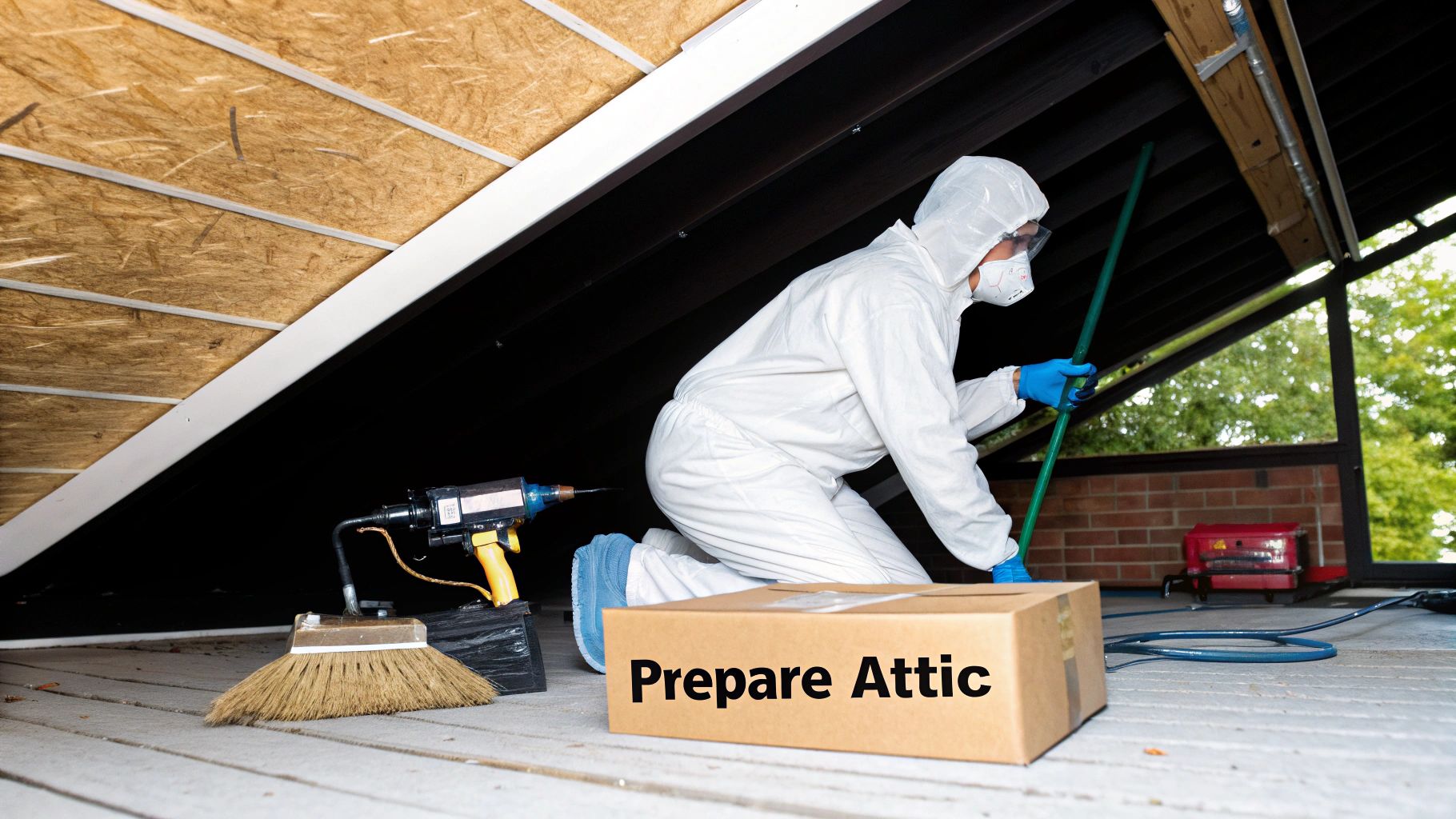
Here’s a little industry secret: proper preparation is the single biggest factor in a successful spray foam insulation project. It’s the difference between a good job and a great one. While our crew handles the heavy lifting, taking care of some initial prep work can really streamline the process and even trim a bit off your labor costs.
Before we spray a single drop of foam, the attic space needs to be a clean, safe, and accessible canvas for our team.
First things first, completely clear out the attic. That means everything—holiday decorations, old boxes, forgotten treasures. This isn’t just about protecting your stuff; it gives our installers the unobstructed access they need to work safely and efficiently in what’s usually a tight space.
Once it’s empty, a thorough cleaning is a must. Grab a shop vac with a decent filter and go to town on the dust, dirt, cobwebs, and any loose debris on the rafters and the underside of the roof deck. The foam needs to stick directly to the wood sheathing, and a clean surface is absolutely non-negotiable for a strong, permanent bond.
Air Sealing: Your Secret Weapon Against Energy Loss
Before we apply the foam and create that monolithic air barrier, you have a golden opportunity to plug the small, sneaky air leaks that have been robbing your home of energy for years. We often find these little gaps around anything that pokes through the roof deck. Sealing them beforehand is key to creating a truly airtight envelope.
Keep an eye out for these common culprits:
- Wiring Penetrations: Tiny holes drilled for electrical wires are notorious for letting air sneak through.
- Plumbing Vents: The gaps around PVC vent pipes where they exit the roof can be significant sources of air leakage.
- Exhaust Fan Housings: Vents for bathrooms or kitchens that terminate in the attic often have unsealed gaps around the main housing.
For these smaller gaps, a can of quality low-expansion spray foam sealant is your best friend. It fills the voids perfectly without putting too much pressure on the surrounding materials. A pro tip: only fill the gaps about 50% full—the foam will expand and take care of the rest.
Safety First When Prepping
Working in an attic, especially a South Florida one in the middle of the day, demands that you put safety first. The dust, debris, and potential for old fiberglass particles make personal protective equipment (PPE) essential.
Always wear a high-quality N95 respirator or dust mask, safety goggles to protect your eyes, and a good pair of durable gloves. We also recommend long sleeves and pants to keep your skin from getting irritated.
Make sure you have stable footing and plenty of light. A powerful headlamp is a game-changer, since it keeps your hands free. If you feel the least bit uneasy walking on the rafters or the job just seems too much, it’s always best to leave the prep work to the professionals. Your safety is the top priority when preparing for a garage attic insulation project.
What to Expect on Installation Day
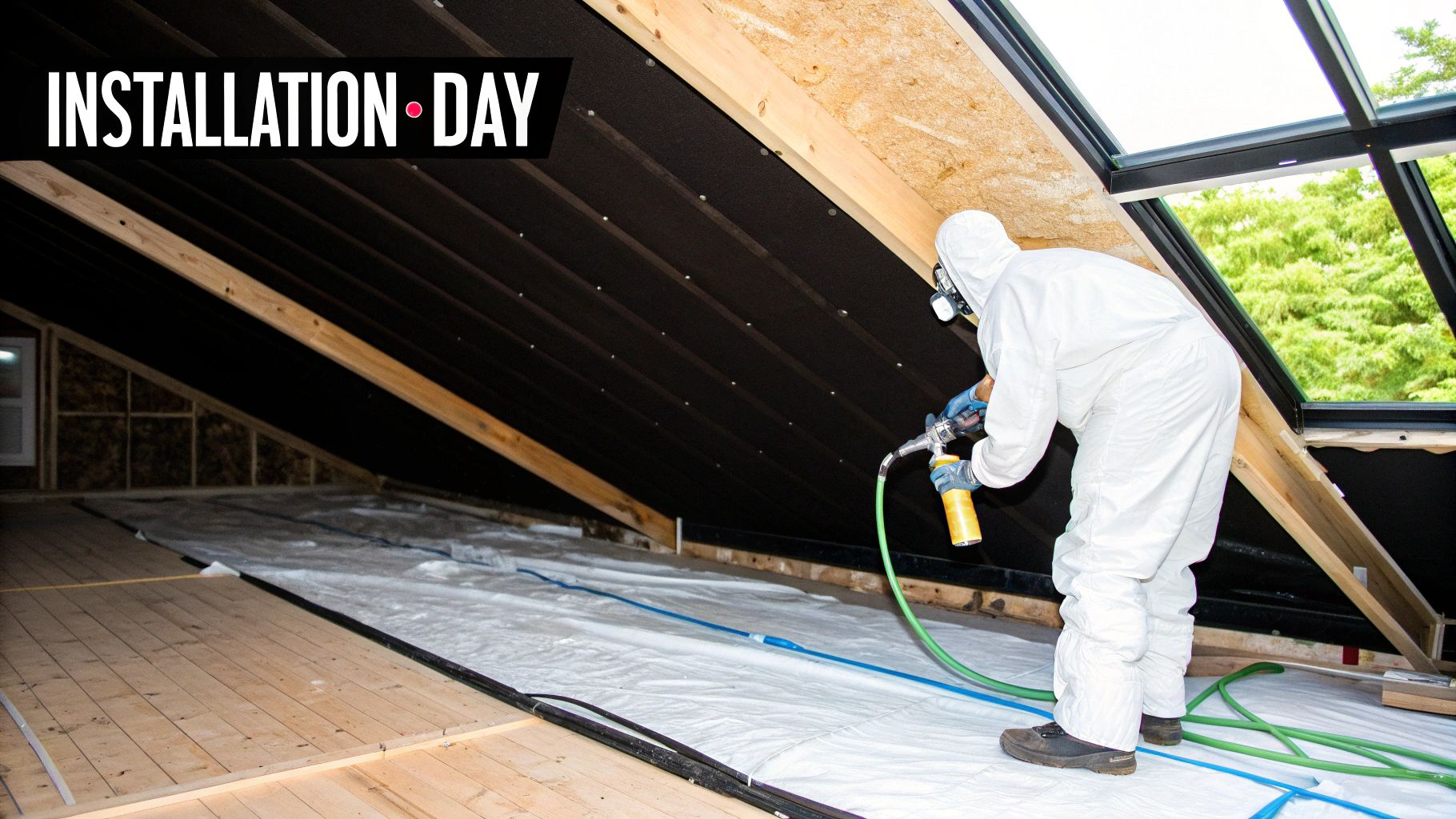
Watching a professional spray foam crew in action is pretty impressive, but knowing what’s going on helps you understand the quality of the job you’re getting. Applying spray foam is a precise chemical process, not just a simple spray-and-pray task. It demands specialized equipment, serious training, and a real understanding of how the material behaves.
On installation day, the first thing our crew does is prep your property. This is a non-negotiable step for a clean, professional job. They’ll lay down heavy plastic sheeting over any items in the garage, the floor, and the walls to protect everything from overspray. We’re meticulous about this because once spray foam cures, it’s there for good.
They’ll also set up a powerful ventilation system to manage fumes. You’ll see large fans and flexible ducting used to create strong airflow, pulling air from the garage straight outside. This keeps the crew safe and ensures no odors sneak into your home.
The Application Process Up Close
With all the prep work done, the real work begins. Our technicians will be in full personal protective equipment (PPE), including respirators and full-body suits. They use a heated, high-pressure hose to apply the two-part liquid polyurethane foam directly to the underside of your garage roof deck.
As the foam hits the surface, it triggers an immediate chemical reaction, expanding 30 to 100 times its original liquid volume in seconds. This incredible expansion is what lets it fill every single crack, seam, and gap, creating a seamless, monolithic air and thermal barrier. That’s the magic of spray foam when it comes to insulating a garage attic.
Demand for high-performance solutions like this is soaring. The global attic insulation market is on track to hit around USD 6.4 billion by 2028, growing at a compound annual rate of about 4.2%. This boom is driven by homeowners just like you who are fed up with high energy bills. You can read more about this expanding market on datainsightsmarket.com.
Why Thickness and Technique Are Everything
Achieving the correct thickness, or depth, of the foam is absolutely critical for hitting the target R-value you need. Experienced installers apply the foam in controlled “lifts”—or layers—usually about one to two inches at a time. This layering method ensures the foam cures correctly and prevents it from overheating, which could compromise its integrity.
An experienced installer uses a depth gauge constantly throughout the process. This isn’t just a quick check; it’s a guarantee that you’re getting the full R-value you paid for across the entire roof deck, with no weak spots or thin patches.
This level of precision is exactly why insulating a garage attic with spray foam isn’t a weekend DIY project. The equipment is expensive and complex, and mishandling the chemicals can lead to a failed job or even safety hazards. Trusting a professional team ensures the job is done right the first time, giving you a high-performance barrier that will protect your home for decades.
Managing Moisture and Ventilation in a Sealed Attic
When we apply spray foam directly to the underside of your roof deck, it does more than just stop heat. It completely changes how your attic functions. Building science pros call this an unvented attic assembly, or more casually, a “hot roof.” For any South Florida homeowner, understanding this is key.
Traditional attics are vented to let hot air and moisture out. That sounds good on paper, but in our humid climate, those vents often create more problems than they solve. They basically become superhighways for hot, soggy air to pour into your attic, condense on cool surfaces, and create a perfect home for mold.
By sealing the roof deck with spray foam, we move the home’s entire thermal and air boundary from the attic floor right up to the roofline. Your attic essentially becomes part of the conditioned space, which stops that sticky outdoor humidity from ever getting a foothold.
Creating a Controlled Environment
Once your attic is sealed off from the outside world, it becomes a much more stable and controlled space. Those wild temperature swings are a thing of the past. Instead, the space will stay within 5-10 degrees of the rest of your home. It’s a game-changer for moisture management when done the right way.
This is especially huge if your HVAC equipment or ductwork is up in the garage attic. In a classic vented attic, your ducts are getting baked by blistering heat all day long, forcing your AC to work overtime just to deliver cool air.
With a sealed and insulated attic, your ductwork is now running through a semi-conditioned space. This slashes energy loss and shields your HVAC system from extreme temperatures, which can seriously extend its lifespan.
Post-Installation Checks and Humidity Control
After we’ve insulated a garage attic, it’s smart to keep an eye on the new environment. The goal is to keep the relative humidity below 60% to completely shut down any chance of mold growth. A simple digital hygrometer placed in the attic gives you all the data you need.
For most garages here in South Florida, the powerful air-sealing properties of closed-cell spray foam are more than enough to keep humidity locked out. But in certain cases—like if the garage door is open a lot or there are other moisture sources inside—adding a small dehumidifier can be a smart move.
This bigger-picture approach of creating a sealed, manageable space is a cornerstone of high-performance building. You can see how this strategy fits into the complete Airtight Comfort System that protects your entire home. By tackling heat and moisture right at the roofline, you create a healthier, more efficient home from the top down.
Crunching the Numbers: Costs, Permits, and Your ROI
Let’s talk money. Any home improvement is an investment, but insulating your garage attic is one where you can actually see the payback. The upfront cost really comes down to the size of your roof deck and which spray foam you go with. Closed-cell is usually the higher-ticket option.
Here in South Florida, you can expect a professional spray foam job to run you anywhere from $2.00 to $5.00 per square foot. What nudges the price up or down? Things like how complex your attic is, the R-value (thickness) you need to hit, and how much prep work is involved. A simple, wide-open attic will be on the lower end. One with tricky roof lines or a bunch of obstacles will naturally cost more.
Don’t Skip the Permits and Codes
Just about every city in South Florida is going to require a permit for a spray foam job. This isn’t just red tape—it’s your guarantee that the work is done safely and meets local building codes. Fire safety and proper ventilation are huge, and the permit process keeps everyone honest.
A good insulation contractor handles all of this for you. They know the local rules inside and out, so the paperwork gets filed right and the final inspection is a breeze. Trying to sidestep permits can come back to bite you with fines or create major headaches when you go to sell your house.
The Real Payback on Your Investment
This is where that initial cost starts looking like a smart move. The biggest win from insulating your garage attic is the serious drop in your energy use. When you stop that brutal Florida sun from baking your attic, you take a massive load off your air conditioner.
It’s not uncommon to see energy bills drop by 10% to 50% after properly insulating an attic, especially depending on what you started with. Those are real, month-after-month savings that add up fast, paying back your initial investment over time. You can get a wider view of the industry impact by checking out these building thermal insulation market findings.
And it’s not just about the monthly bills. A properly insulated garage adds real value to your home. When potential buyers see an energy-efficient home that’s more comfortable to live in, it becomes a major selling point. From every angle, it’s a solid financial decision.
A Few Final Questions You Might Have
Even after you’ve done the research, a few questions always pop up before starting a big project. Here are the answers to some of the most common ones we get from homeowners in South Florida.
Will Insulating My Garage Attic Actually Increase My Home’s Value?
It absolutely does. In South Florida, an insulated garage isn’t just a bonus—it’s a smart, tangible upgrade that buyers look for.
A properly insulated garage signals a well-maintained, energy-efficient home. When potential buyers see it, they don’t just see a comfortable workspace; they see lower energy bills and a proactive homeowner. It’s a feature that definitely stands out in our market.
Can I Just DIY My Garage Attic Insulation?
While you can technically install fiberglass batts on your own, spray foam insulation is a completely different ballgame. This is one of those jobs where hiring a certified pro is the only way to go.
The application requires highly specialized equipment and a deep understanding of the chemical process. Precise temperature and pressure controls are critical for the foam to expand and cure correctly. Without them, you risk a poor seal, off-gassing, or a failed application.
To get the permanent, high-performance air and moisture barrier you’re paying for, professional installation is non-negotiable. It’s the only way to guarantee you get the full R-value and the airtight seal that makes spray foam so effective. A DIY job just can’t compete.
What R-Value Do I Really Need for a Garage Attic in Florida?
Down here, our main battle is against radiant heat pouring down from the roof deck. The goal isn’t just to insulate, it’s to create a real thermal barrier.
For spray foam applied directly to the underside of the roof deck, an R-value between R-20 and R-30 is the sweet spot. This provides excellent performance against our intense summer heat without going overboard on cost.
Ready to turn your hot, stuffy garage into a comfortable and energy-saving part of your home? The team at Airtight Spray Foam Insulation has the local expertise to do the job right. Get your free, no-obligation estimate by visiting us at https://airtightsprayfoaminsulation.com today.
Garage attics in Palm Beach Gardens, FL often struggle with extreme heat and poor airflow. Our team helps PBG homeowners insulate these spaces properly, improving comfort and reducing energy loss from rooms connected to the garage.
👉 Learn more about our services in Palm Beach Gardens:
https://yourwebsite.com/spray-foam-insulation-palm-beach-gardens/