You're probably looking at a wall that looked fine in January and feels wrong by July. Maybe the AC runs all day, one room stays clammy, and a corner of stucco or interior drywall keeps coming back with that dull, musty smell that never quite goes away. In South Florida, that usually isn't just an equipment problem. It's often a wall assembly problem, and external wall insulation contractors should be judged on how well they manage moisture before they talk about finish color or board thickness.
The trap is treating exterior insulation like a product purchase. That's how homeowners end up comparing quotes on price alone while the core issue, trapped moisture and uncontrolled air movement, stays untouched. A contractor who understands the envelope will start with the wall, the reveals, the penetrations, and the way the home sheds water, not with a sales pitch.
A stucco house in Jupiter can look solid from the street and still be sweating inside the cavity every humid afternoon. The owner usually blames the air conditioner because the bills are high and the rooms feel sticky, but the actual problem is often that the wall is pulling heat and moisture through an assembly that was never detailed to resist both. That's why external wall insulation is best understood as a building-envelope moisture strategy first, and an insulation upgrade second.
Exterior insulation wraps the outside of the wall with a thermal layer. When properly installed, it slows heat gain, reduces temperature swings across the wall, and helps keep the interior surface warmer and less prone to condensation. If installed incorrectly, it can trap water at penetrations, leave seams unsealed, or hide drainage failures until the damage appears as staining, swelling, or mould.
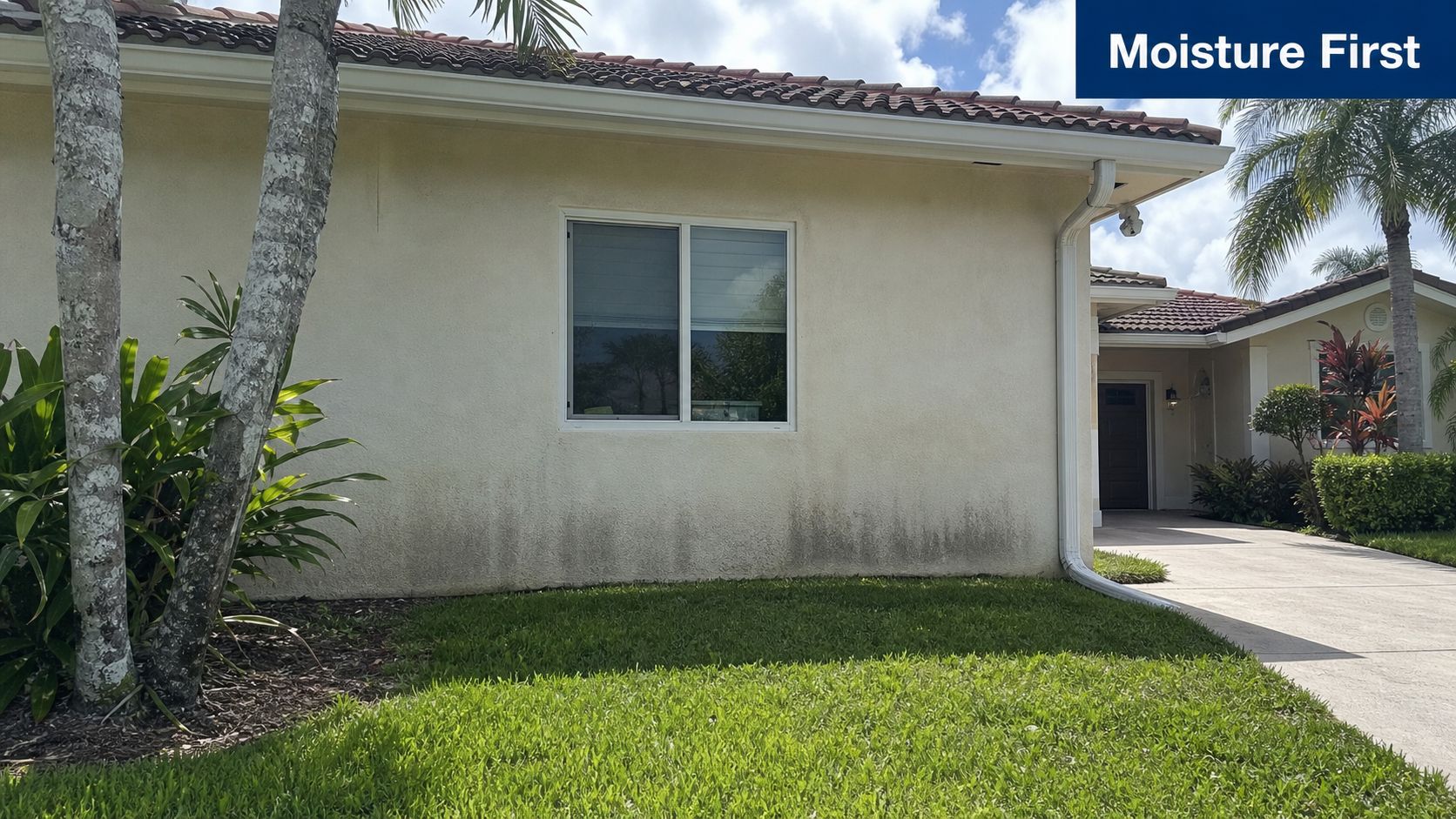
A trustworthy contractor thinks about water control, air control, and thermal control as one system. That matters because the weak point is rarely the insulation board itself. It's the unsealed window, the missing drainage detail, the transition at the slab edge, or the junction where old wall materials meet new work.
If you want the practical version of that mindset, this is a useful primer on the relationship between insulation and condensation, especially at dew point conditions: understanding dew point.
Practical rule: If a contractor talks about insulation first and moisture second, keep shopping.
The broader market also tells you this is not a small-ticket niche. In the U.S. insulation-contracting industry, IBISWorld reports 28,814 businesses in 2025 and projects a market size of $13.6 billion in 2026, with business count growth at 1.6% CAGR from 2020 to 2025 and revenue growth at 2.1% CAGR over the same period (IBISWorld). That scale matters because exterior insulation work sits inside a large, active construction-services market, not a corner repair trade.
The cheapest quote is rarely the safest one in a coastal climate. The question isn't, “Who can cover the wall fastest?” It's, “Who can keep that wall dry, continuous, and serviceable after the crew leaves?”
Start outside, then work inside. Look for cracking in stucco, bulging around windows, brittle sealant, rust at fasteners, and any sign that water has already found a path behind the finish. Inside, pay attention to one room that always feels damp, any musty odor that shows up after rain, and AC cycles that seem unusually long for the same setpoint. Those are not perfect diagnostics, but they're the kind of clues serious external wall insulation contractors use before they ever price a job.
Take photos of the wall type, the trim conditions, soffits, eaves, sill areas, and every penetration that passes through the envelope. If you've had leaks, note where they happened, when they happened, and whether they were tied to wind-driven rain, heavy afternoon storms, or persistent humidity. You're not trying to diagnose the whole house yourself, you're trying to give the contractor enough evidence to tell whether the wall is a straightforward retrofit or a moisture-management project.
A good home review also includes the roof-void and attic as part of the same system. That's where the diagnostic mindset matters. If the roof space is under-insulated, leaky, or showing signs of damp movement, a wall upgrade alone may not solve the comfort problem. thermal imaging inspection can help reveal surface temperature differences and weak spots, but the key value is in pairing those findings with an understanding of where the building is already stressed.
| South Florida Housing Types and Insulation Fit | |||
|---|---|---|---|
| Wall Assembly | Common Locations | Best-Fit Approach | Watch-Out |
| CBS block | Newer subdivisions, many single-family homes | Exterior insulation where the wall needs thermal continuity and the finish can be detailed cleanly | Penetrations and transitions still need moisture control |
| Frame stucco | Mixed-age neighborhoods, additions, remodels | Exterior systems that account for substrate movement and junction detailing | Hidden leak paths can show up behind the cladding |
| Older solid-wall | Older masonry homes, durable but often under-insulated walls | Careful envelope review before choosing exterior or interior work | Don't assume the wall is dry just because it looks intact |
Homeowner checkpoint: If the wall, roof-void, and attic aren't being discussed together, the quote is probably too shallow.
Before the estimate, keep your ask simple. Show the contractor what's happening, where it happens, and how long it's been happening. The best bidders don't need a script, they need a clear picture.
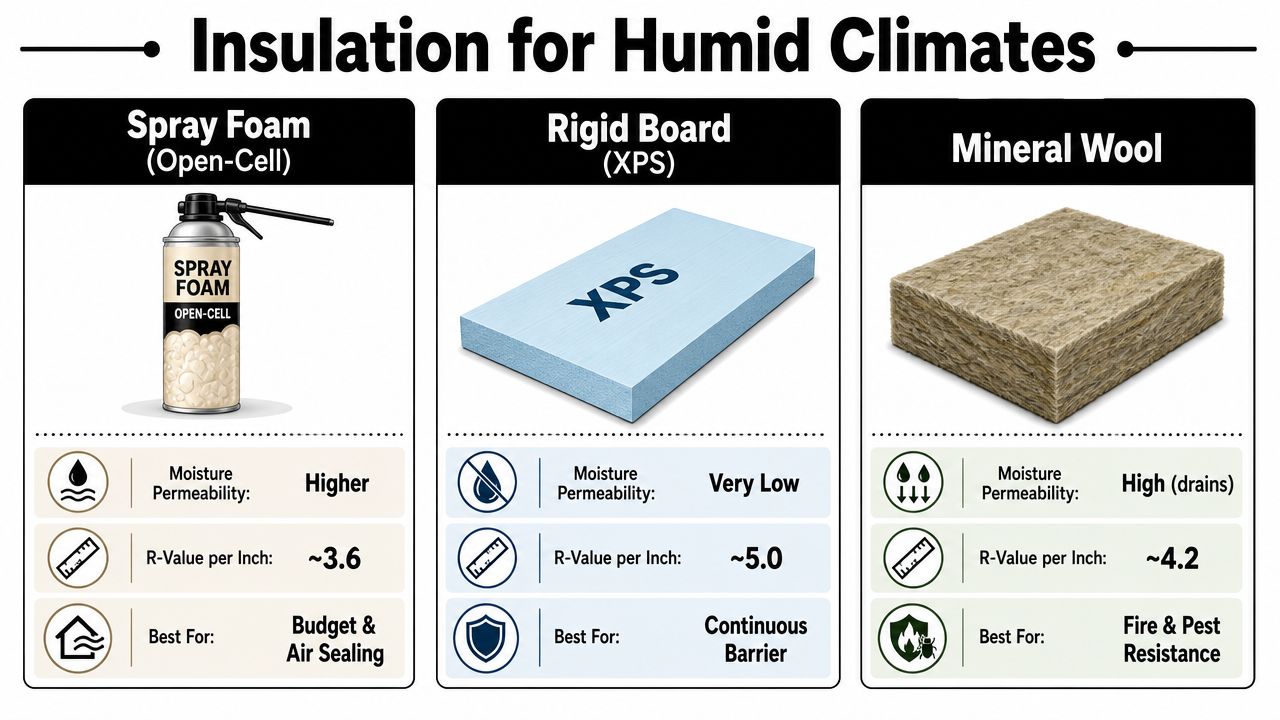
In a humid climate, material choice isn't about picking the “best” insulation in the abstract. It's about choosing the material that fits the wall you already have, the finish you want to keep, and the moisture behavior that wall can tolerate. Open-cell spray foam, closed-cell spray foam, rigid board, and mineral wool all have a place, but they don't behave the same way once heat, rain exposure, and substrate movement show up.
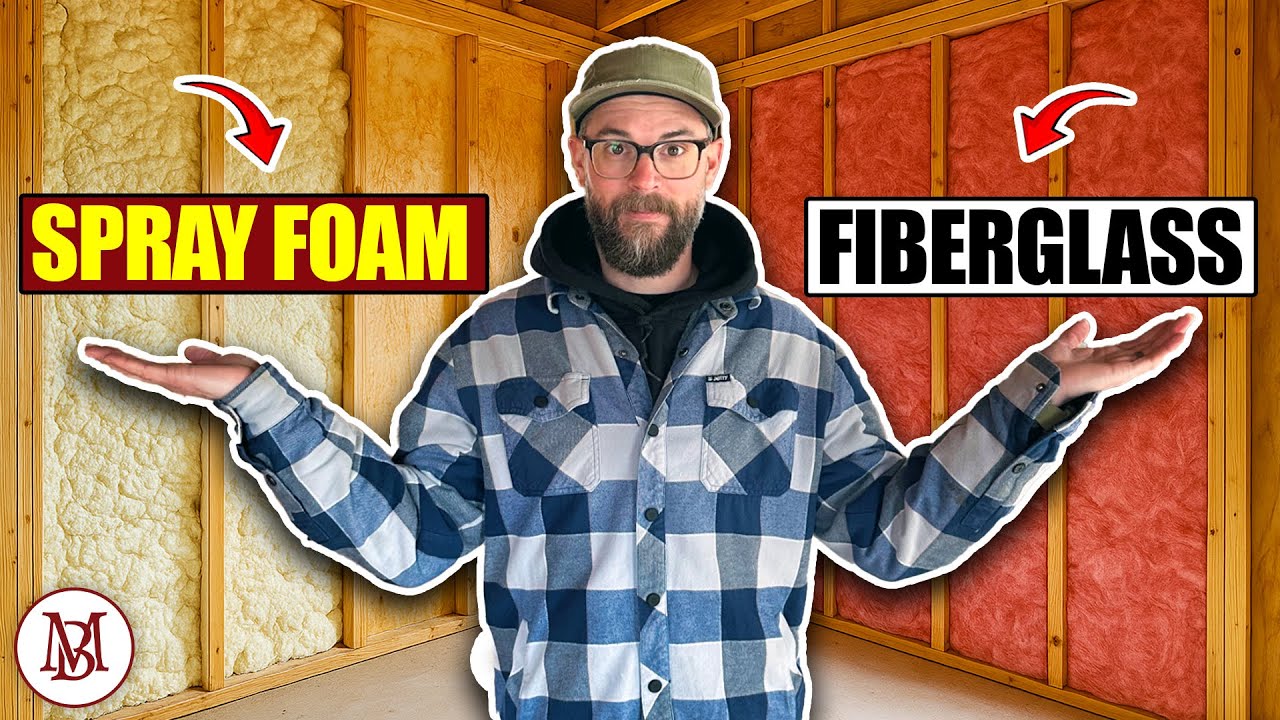
Open-cell spray foam is forgiving in some assemblies because it expands into irregular spaces and helps with air sealing. It's often chosen where budget and sealing matter, but it's not the same thing as a rigid exterior thermal layer, and it doesn't turn a bad wall into a good one. Closed-cell spray foam is denser and more resistant to moisture, which can make sense in some exposures, but that doesn't mean it should be used to cover up a wall that still leaks.
Rigid board systems are the usual choice when continuity matters. They're better suited to building a more uniform thermal layer over the outside of the wall, especially where you want to reduce thermal bridging at framing or masonry transitions. Mineral wool is attractive when drainage and vapor openness matter, especially in assemblies that need a more forgiving moisture profile, but the detailing still has to be right or it won't save the job.
The mistake I see most often is buyers chasing thickness. A thicker wall package doesn't help if the insulation layer is interrupted at windows, soffits, or slab edges. The system works only when the water-resistive barrier, drainage path, and insulation continuity are all coordinated.
Material rule: Choose the assembly that matches the wall's moisture behavior, not the one with the flashiest brochure.
The best contractors separate themselves from board installers by asking how the home breathes, where the wall gets hit by wind-driven rain, and how the finish will be supported over time. If they can't explain those trade-offs in plain language, they probably don't have a real envelope strategy.
A written brief does more filtering than a phone call ever will. Vague requests attract vague quotes, and vague quotes usually leave out the exact details that create failure later. A homeowner who wants serious external wall insulation contractors should hand every bidder the same basic brief and see who responds with a real scope instead of generic optimism.
Include the wall type, the known moisture history, the outcome you want, the approximate area, and a request for a written scope. Keep it factual, not emotional. If the wall has had leaks, mention where they were and what was already repaired. If you care about interior disruption, say so. If the home is occupied, that matters too.
Then ask every contractor to answer the same questions in writing.
That's the kind of brief that reveals whether someone understands the job or just wants to win it on price. If they won't put these answers in writing, they're not ready to work on a wall that has to stay dry for years.
For contractors who claim they're set up for this kind of work, a good benchmark is the kind of scope discipline explained in spray foam insulation contractors. The point isn't to compare products. It's to compare how clearly a company thinks about the wall before the crew shows up.

Ask for the scope in writing before you ask for the number. That one habit saves a lot of arguments later.
A short, disciplined brief usually brings you two or three serious bidders, not five noisy estimates. That's the right size shortlist.
A contractor's quote for external wall insulation starts looking reasonable the moment you stop treating price as the main filter. In South Florida, the cheapest bid is often the one that skips the part that keeps the wall dry, and that mistake shows up fast when the humidity climbs.
The market also stays busy enough that a neat-looking number on paper does not prove the crew understands the job. The broader insulation field still has plenty of operators, and that leaves room for sloppy scope writing, loose assumptions, and bids that leave out the labor needed for real moisture control.
Substrate prep drives a lot of the spread. So does access, window and eave detailing, cladding finish, and any carpentry needed for trims or soffits. If a wall is flat, dry, and easy to reach, pricing stays simpler. If the existing finish is damaged, the reveals are deep, the fascia details are awkward, or the crew has to work around old penetrations, the labor changes quickly.
You should look at the full assembly, not just the board price. A rigid exterior system with a proper drainage layer and finish is a different job from a quick spray application on a controlled substrate. The system, not the material by itself, drives the cost.
For broader market context, the global exterior insulation market was valued at USD 99.31 billion in 2024 and is projected to reach USD 209.64 billion by 2032, according to Data Bridge Market Research, with a 9.79% CAGR projected from 2025 to 2032 (Data Bridge Market Research). That growth points to strong demand, but it does not make every quote fair or every crew qualified.
If you want contractor-marketing context, Netco Design LLC's contractor strategy is useful because it shows how strong local visibility can still sit next to weak field execution. A company can be easy to find online and still be careless about moisture control.
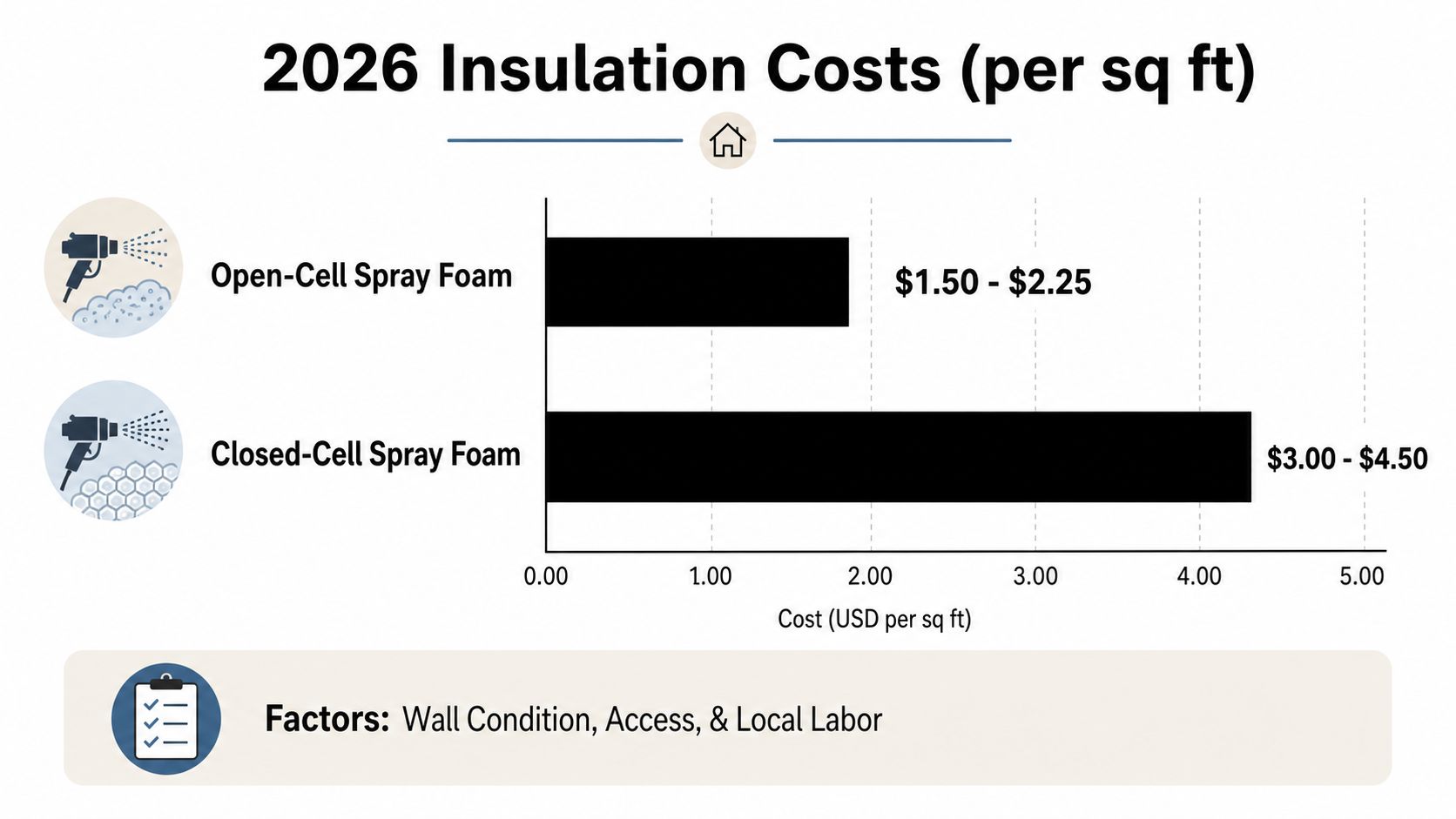
A payment schedule should follow progress, not optimism. If someone asks for a large upfront payment before the scope, prep, and sequencing are clear, treat that as a warning sign. The job should be documented well enough that both sides know what is being built and when.
The week before install, clear the perimeter. Move planters, furniture, hoses, grills, and anything that blocks the wall line. If landscaping is close to the house, ask how the crew will protect it, and make sure exterior outlets, light fixtures, downspouts, and delicate trim are covered or removed in a controlled way.
On spray or adhesive days, coordinate around AC use if the work affects openings or interior comfort. A good crew should explain the shutdown windows, the re-entry time, and any ventilation needs tied to the products being used. If weather changes, that matters too. A rain interruption isn't a minor inconvenience when the wall sequence depends on a dry substrate and a verified moisture-control layer.
The crew should inspect the substrate first, then deal with moisture and air sealing at penetrations, then apply the insulation, then detail the openings, then finish with rainscreen or cladding as specified. If the crew tries to bury bad flashing or skip the sealing at windows and eaves, stop them. That's where many failures start, and once the finish is on, the mistake is much harder to correct.
If the wall can't be inspected cleanly before it gets covered, the project isn't ready to proceed.
Ask to see how the WRB sequence is being verified before cladding hides it. A smart contractor won't bristle at that question. They'll show you the overlap, the flashing continuity, and the way the drainage path is preserved.
If thermal imaging is available, it can help confirm continuity and spot obvious weak points. A blower-door-style sanity test can also reveal whether the envelope is behaving the way the crew claimed it would. Neither one replaces good detailing, but both can catch surprises before you sign off.
The handoff should include the product data, warranty terms, maintenance guidance, and a clear record of what was installed where. If a contractor can't hand over that documentation, the job wasn't managed tightly enough.
Choose on three filters. First, does the contractor understand moisture diagnosis and ask about the whole envelope, not just the wall face? Second, does the material fit South Florida conditions and the existing wall assembly? Third, can they document the strategy in writing so you know what was built?
Skip the roof-void and attic review, and you're guessing. Treat the wall as an isolated surface, and you'll miss the path that caused the problem. Accept a quote without a written scope, and you've already given away negotiating power.
The best move is simple. Get two or three written proposals, compare the moisture plan, the material choice, the scope, and the warranty, then pick the one that explains the building like a builder, not a salesman.
If you want a straight answer on how your wall should be handled, Airtight Spray Foam Insulation can help you sort out the moisture side before you spend money on the wrong assembly. Visit Airtight Spray Foam Insulation to request a quote that's built around your wall, your climate, and the way the home performs.