
If you're in South Florida, you probably already know the sound of a house working hard. The AC handler kicks on. Traffic hums through the windows. A metal garage door rattles. In open living rooms with tile floors and high ceilings, every conversation can bounce around like you're inside a clubhouse instead of your own home.
That's usually when people start looking at sound absorbing insulation panels. And that's a smart place to start, as long as the goal is clear.
A lot of homeowners mix up sound absorption and soundproofing. They're not the same job. Sound-absorbing panels reduce echo and reverberation inside the room. They don't primarily block sound moving through walls or floors. As Acoustical Surfaces explains in its overview of acoustical panels, these panels improve the sound quality within a space by lowering internal sound energy intensity, rather than acting as a true sound barrier.
In South Florida, that distinction matters even more because noise problems often overlap with moisture, air leakage, and heat gain. The right solution depends on whether you want a room that sounds better, a room that feels quieter from outside noise, or both.
The most common complaint isn't always outside noise. A lot of the time, the problem is what the room is doing with the sound already inside it. Hard finishes like tile, drywall, glass, concrete block, and big uncovered ceilings throw sound back into the space. That creates slap echo, muddied speech, and rooms that feel louder than they should.
Sound absorbing insulation panels fix that specific problem. They take reflected sound energy and reduce how much of it keeps bouncing around. In plain terms, they make a room feel tighter, calmer, and easier to talk in.
Practical rule: If the room sounds harsh when you clap, talk on the phone, or watch TV, you likely need absorption first.
They work best in spaces where speech clarity matters and surfaces are reflective. Typical examples include:
If your main problem is the neighbor's music, road noise through a wall, or a mechanical room bleeding sound into a bedroom, panels alone won't solve it. That kind of problem needs isolation. Isolation comes from assembly design, air sealing, and dense materials.
That's where a lot of people waste money. They buy decorative panels expecting them to stop exterior noise, then get frustrated because the room still hears the same traffic or pool equipment. The echo may improve, but the transmission path is still there.
In South Florida homes, I'd also look at the room's moisture exposure before choosing any panel system. A panel can help the sound and still be the wrong choice if the wall or ceiling regularly deals with humidity, condensation, or air leakage.
A lot of bad panel decisions start with reading the wrong number on the spec sheet. Homeowners see one rating, assume it covers every kind of noise problem, and end up disappointed when the room still feels loud or the next room still hears everything.
For sound absorbing insulation panels, the first metric to read is NRC.
Noise Reduction Coefficient, or NRC, rates how much sound a material absorbs instead of reflecting back into the space, as explained in Arturel's acoustic panel science overview. A higher NRC usually means less echo, less slap off hard surfaces, and better speech clarity.
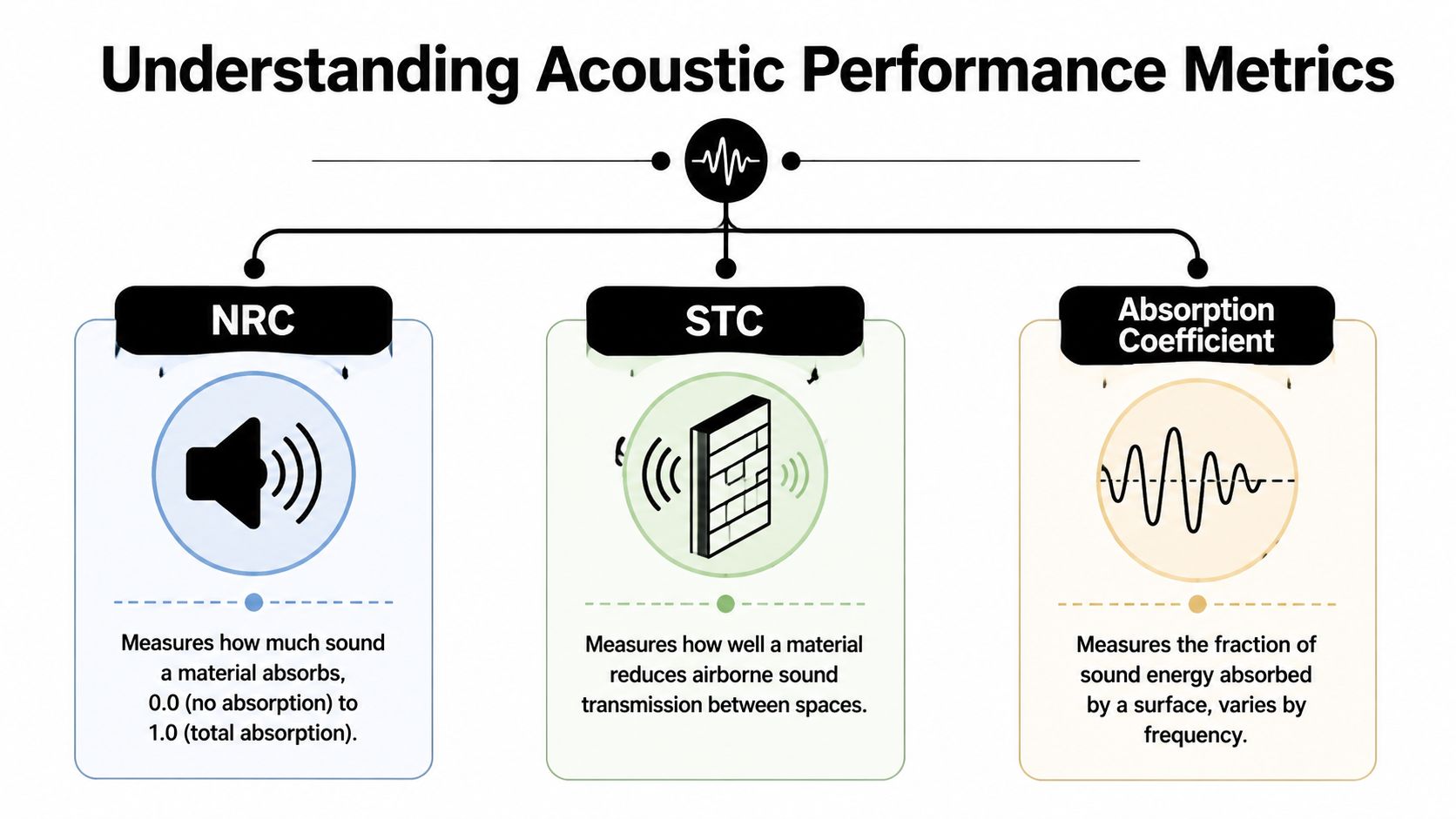
In practical terms, NRC matters most in rooms where the problem is reflected sound. That includes a home office with tile floors, a living room with high ceilings, or a conference room with a lot of glass. In South Florida, those are common conditions. Hard finishes hold up well in humidity, but they also make rooms sound sharper and more echoey.
A panel with a high NRC helps fix that specific problem. It does not tell you how much sound stays out of the room.
STC measures how well a wall, floor, or ceiling assembly reduces airborne sound moving from one space to another. That is the rating tied to privacy, TV bleed-through, bedroom-to-bathroom noise, or mechanical noise crossing a partition.
R-value measures resistance to heat flow. That matters in South Florida for comfort, HVAC load, and energy bills, but it is not an acoustic rating.
Here's the clean way to read a spec sheet:
| Metric | What it measures | Why it matters |
|---|---|---|
| NRC | Sound absorption inside a room | Reduces echo and reverberation |
| STC | Airborne sound reduction through an assembly | Helps with privacy and noise transfer |
| R-value | Resistance to heat flow | Helps with comfort and energy efficiency |
This distinction matters on real jobs. I've seen clients buy attractive acoustic panels for a bedroom wall facing pool equipment or traffic, then wonder why the noise problem barely changed. The panels improved the room sound. The wall assembly still leaked noise.
If the goal is a calmer sounding room, start with NRC. If the goal is blocking sound between spaces, review the full assembly, including framing, drywall layers, gaps, penetrations, and air sealing. This guide on how insulation works as a sound barrier is a good reference for separating absorption products from true sound-control assemblies.
South Florida adds another layer to that decision. A product might post a solid acoustic number and still be a poor fit if it traps moisture, sags in humid conditions, or creates a maintenance issue near an exterior wall or ceiling line. Good acoustic performance on paper is only part of the job. The material also has to hold up in heat and humidity.
A strong NRC rating helps with echo. It does not replace air sealing, mass, or a properly built wall.
That's the number-reading mistake I see most often. People focus on one metric and miss the actual source of the noise.
Material choice matters more in South Florida than in milder climates. You're not just choosing by sound performance. You're also choosing by moisture tolerance, handling, finish options, and where the material will live for years.
Some products work fine in a dry interior office and become a headache in a humid garage, bonus room, or metal building. Others cost more up front but hold up better and give you fewer callbacks.
Fiberglass is common because it's widely available and usually straightforward to source. Mineral wool is the product many contractors prefer when the project needs stronger overall acoustic performance and better resilience. Polyester fiber panels get attention from clients who want a cleaner-looking decorative option and easier handling.
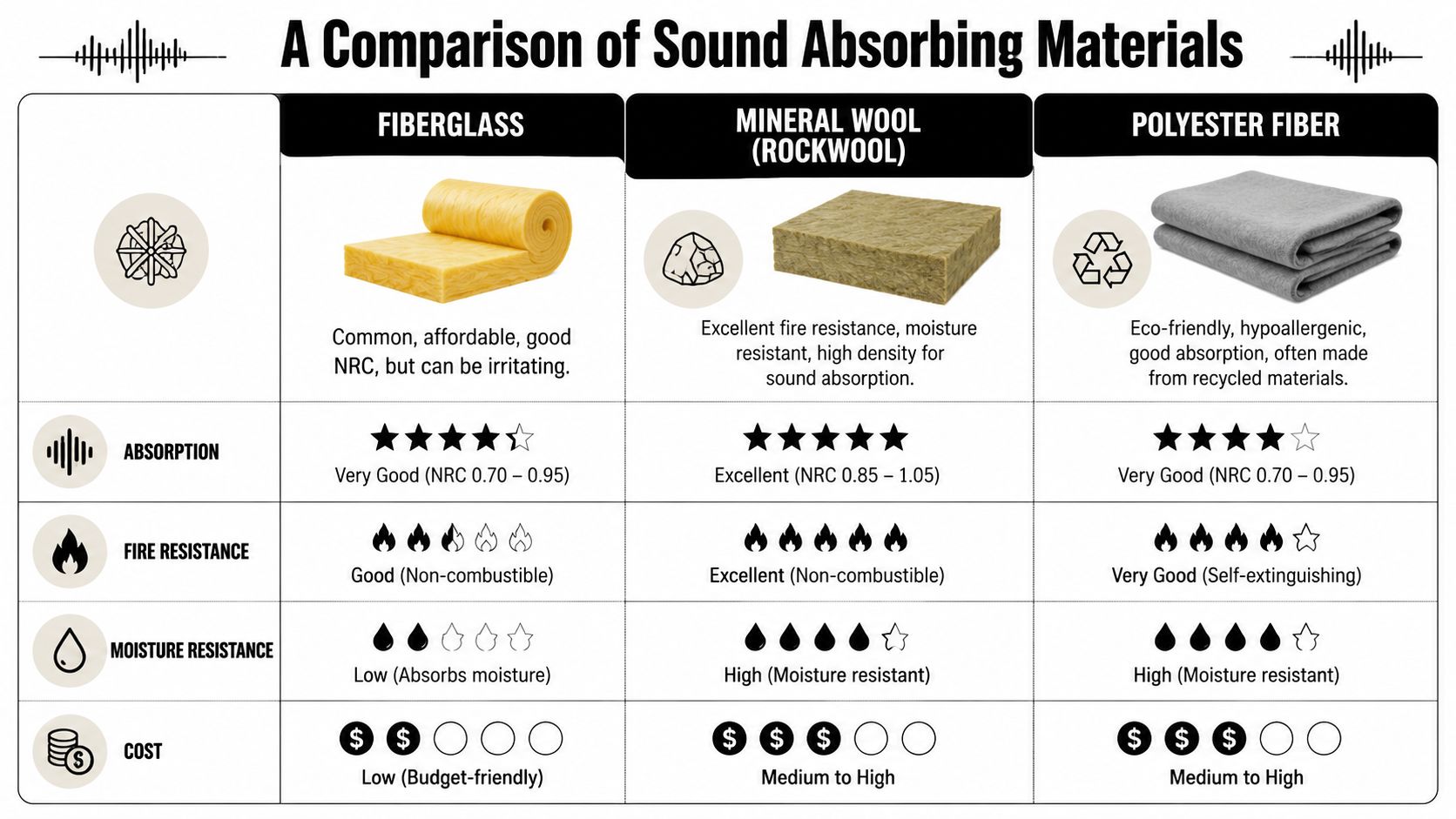
Here's the practical comparison:
| Material | Sound absorption | Moisture behavior | Fire and durability considerations | Typical fit |
|---|---|---|---|---|
| Fiberglass | Good acoustic absorption when properly built into a panel | Needs careful detailing in humid spaces | Can irritate during handling, usually fabric-wrapped for finish | Offices, media rooms, interior spaces |
| Mineral wool | Strong performer for acoustic treatment | Better fit where humidity resistance matters | Known for fire-rated and moisture-resistant applications | Commercial spaces, garages, mixed-use rooms |
| Polyester fiber | Useful for light acoustic treatment and decorative finishes | Often easier for occupied interior spaces | Cleaner handling and design flexibility | Home offices, decorative wall panels, light-duty acoustic upgrades |
When clients want the strongest all-around answer for panel cores, mineral wool is hard to ignore. ROCKWOOL's acoustic insulation information states that high-quality mineral wool panels typically achieve NRC values of 0.85 to 0.95, while cellulose-based panels are typically in the 0.70 to 0.80 range.
That doesn't mean cellulose or polyester products are bad. It means they serve a different balance of priorities. Some clients want recycled content, softer finishes, or lower irritation during installation. Those are valid reasons to choose them.
Core material matters, but panel depth matters too. A thin decorative panel may help tame flutter echo and brighten speech a little less. A thicker panel handles a broader slice of the problem.
That's one reason “cheap online acoustic panels” disappoint people. Many look good on the wall and barely move the room acoustically where it counts.
A few trade-offs to keep in mind:
For a deeper look at assemblies and product choices, this guide on the best insulation for noise reduction is worth reading before you buy materials just based on appearance.
The best panel on paper can still be the wrong panel if the room is damp, leaky, or unfinished.
For a climate-controlled home office, you have more flexibility. For a garage, utility room, metal structure, or any room with uneven humidity, I'd be much more selective.
My general contractor view is simple. In South Florida, I'd rather install a material that gives up a little style but survives the environment than install a pretty panel that becomes a maintenance issue later.
Humidity changes the conversation. In South Florida, any acoustic product that ignores moisture is only solving half the job.
A porous panel can perform well acoustically and still become a bad fit if it sits against a surface that gets damp, pulls humid air, or sees condensation. That's especially true in garages, block homes, bonus rooms, under-insulated additions, and metal buildings. The sound issue is visible fast. The moisture issue usually shows up later.
The weak points are familiar:
If you're trying to quiet a room that already has a moisture pattern, don't cover the symptom and hope for the best. Fix the moisture path first. For homeowners dealing with damp lower spaces, Eagle Restoration's crawlspace moisture guide is a useful primer on how hidden moisture can affect the rest of the structure.
Generic online advice often proves inadequate. A panel recommendation from a dry climate doesn't always hold up here.
Mineral wool tends to stay in the conversation because it's commonly used where fire-rated and moisture-resistant performance matters, as noted in GM Insights' acoustic panel market analysis. Closed-cell foam also enters the discussion in Florida because it doesn't just address acoustics. It also helps control moisture movement and air leakage when installed as part of the assembly.
That doesn't mean every room needs foam or every panel is risky. It means the material choice should follow the building condition.
If a room has a humidity problem, decorative acoustic treatment comes second. The assembly has to stay dry first.
Homeowners often ask for “the quietest option,” but the better question is, “What solves the noise problem without creating a moisture problem?” In South Florida, those two questions are tied together.
A quieter room isn't worth much if the wall cavity behind it stays wet. Good acoustic work here has to respect the climate.
Most rooms don't need every wall covered. That's good for your budget and good for the look of the space.
Primacoustic's acoustic treatment guidance says 15% to 25% of the total wall surface area is typically enough to achieve a noticeable reduction in reverberation and echo, with more demanding spaces needing 25%+ coverage. That same guidance also points to practical placement strategies, including ear-level positioning and a 60/40 wall-to-ceiling ratio in commercial applications.
The first panels should go where sound bounces directly back at the listener. In a home office, that often means the wall behind the desk view, the side reflection points, or part of the ceiling if the room is hard and boxy.
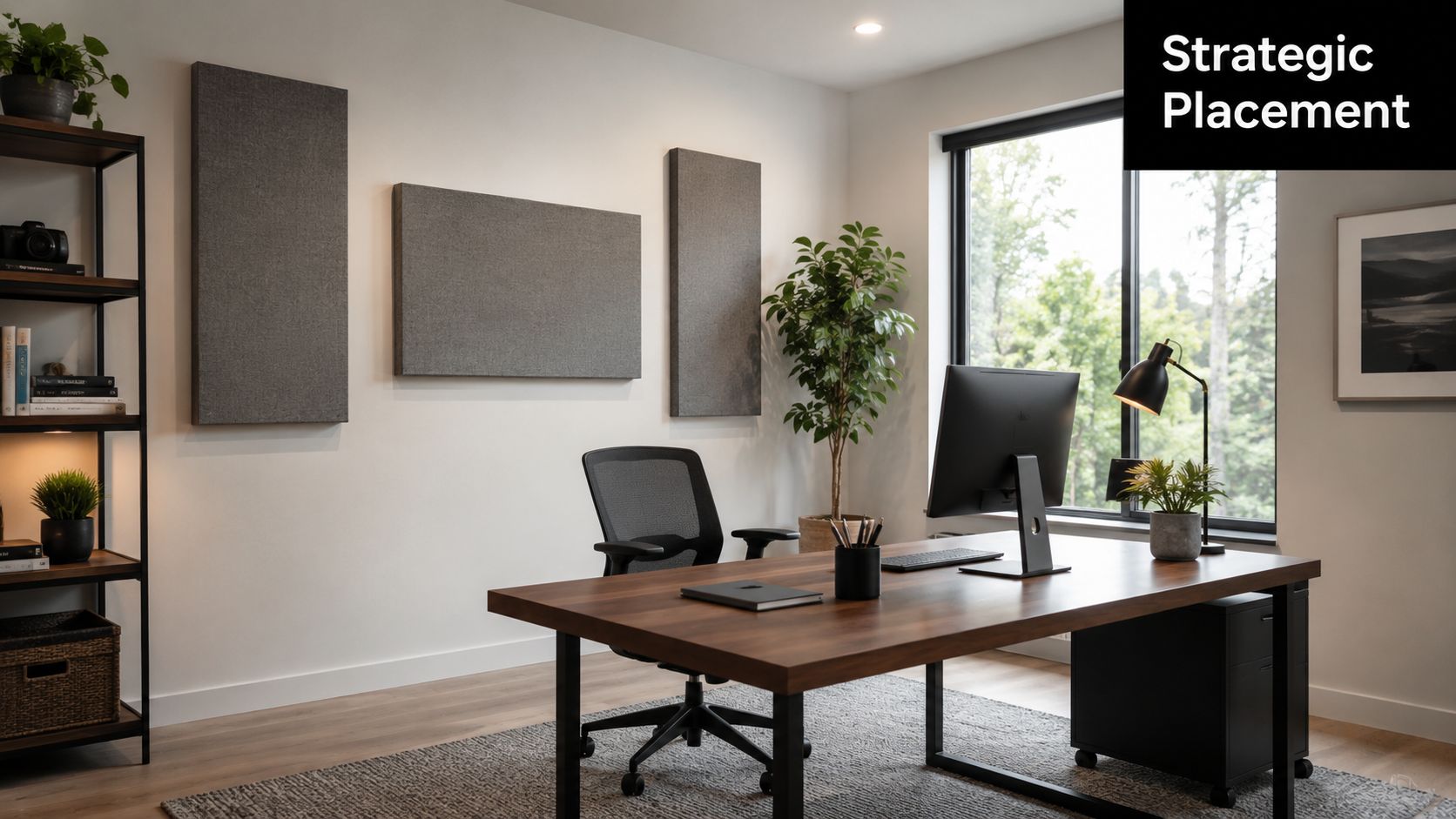
For speech-focused rooms, ear-level placement usually gives the fastest audible improvement. You don't need a perfect studio map to get results. You just need to stop the strongest early reflections.
Home office
Mount panels on the wall you face or the wall behind the camera position. If the room has glass, tile, or a bare ceiling, treat at least one of those hard reflective surfaces.
Garage workshop
Don't chase perfect acoustics. Focus on reducing harsh reflections from concrete, drywall, and the garage door surface. Use durable materials and think hard about humidity before you glue up anything decorative.
Metal building or warehouse office
These spaces get loud fast because metal and exposed hard surfaces keep throwing sound around. Wall panels help, but ceiling treatment often carries a lot of the load. If the shell also sweats or leaks air, acoustics alone won't fix the room.
A few placement rules make a big difference:
If your goal is more than echo control, this guide on how to soundproof interior walls helps clarify when panel placement needs to be paired with a better wall assembly.
Good acoustic treatment is usually targeted, not oversized.
That's the part many homeowners appreciate once they hear the difference. Strategic coverage often gets the room where it needs to be without turning it into a padded box.
Some South Florida rooms have two problems at once. They sound harsh, and they never quite feel dry or stable because outside air keeps finding its way in.
In that situation, sound absorbing insulation panels only address part of the job. They can calm echo inside the room, but they do nothing for the humid air leaking through wall cavities, rooflines, and small gaps around framing.

Panels work on the finished side of the room. They reduce reflections and help speech clarity, but they do not air-seal the assembly, stop humid infiltration, or fix a wall or ceiling that is underperforming.
They also get harder to live with as performance demands go up. A discussion in the audio community often referenced for practical acoustic behavior notes that thicker panels absorb a broader range of sound, including more low-frequency energy, as described in this thickness discussion on acoustic panels. That lines up with what we see in the field. Better absorption usually means more thickness, more projection off the wall, and more compromise on space and appearance.
That trade-off matters in finished homes. A client may be fine with a few well-placed panels in an office or media room, but not with deep treatments across every wall.
Spray foam solves a different problem. It goes inside the assembly, fills irregular cavities, and cuts down uncontrolled air movement. In South Florida, that matters because air leakage is not just a comfort issue. It is often the start of moisture trouble.
If a room sounds bad because of echo alone, foam is not a replacement for acoustic treatment. If the room is noisy, muggy, and harder to cool than the rest of the house, spray foam often gives you more value because it improves the shell first.
Open-cell foam is usually the better fit when the priority is sound dampening within interior framed walls. Closed-cell foam makes more sense when the assembly also needs stronger moisture resistance and added rigidity. The right choice depends on location, drying potential, and how the space is being used.
| Situation | Panels help | Spray foam helps |
|---|---|---|
| Echo inside a finished room | Yes | Sometimes, indirectly |
| Air leakage through walls or roof | No | Yes |
| Moisture control in the assembly | No | Yes, depending on foam type |
| Interior finish upgrade without major renovation | Yes | Usually requires more project scope |
| New construction or major remodel | Sometimes | Often a stronger whole-system option |
A quick visual helps if you're comparing approaches in real-world buildings.

Installation quality matters a lot more with foam than with panels. A homeowner can often hang panels successfully if the goal is basic echo control in a dry room. Foam is less forgiving. Missed cavities, poor substrate prep, or uneven application can leave hidden gaps that still move air and moisture.
I tell clients to separate the question clearly. Do you need less echo, a tighter building envelope, or both? Once that is clear, the material choice usually gets simpler. In South Florida, spray foam is often the better choice when sound control needs to happen alongside moisture control and energy efficiency, not as a decorative add-on after the fact.
Usually, that's not a good idea. Paint can seal the face of a porous panel and reduce how well it absorbs sound. If appearance matters, it's better to choose a panel finish or fabric you already like rather than trying to coat it afterward.
No. Panels improve the acoustics inside the room by reducing echo and reverberation. If you need to reduce sound transfer between rooms, you'll need to look at the wall, ceiling, or floor assembly itself, not just the finish surface.
Some are a much better fit than others. In South Florida, the right answer depends on where the panel is installed and whether the surrounding assembly is dry and well-sealed. A good acoustic product can still be the wrong building product if the room has a moisture problem.
That depends on the face material. Most finished panels are best cleaned gently, usually with light dust removal rather than aggressive scrubbing or soaking. If the panel is fabric-faced, harsh cleaning can damage the finish or affect performance. Check the manufacturer's care instructions before doing more than basic surface cleaning.
For many rooms, strategic placement matters more than blanket coverage. A moderate amount in the right locations often outperforms a larger amount installed randomly. Reflection points, listening height, and the mix of hard surfaces in the room matter more than guesswork.
If the room feels noisy, humid, drafty, and hard to cool, that usually points to a bigger assembly issue. In that case, treating only the room surface may improve echo but won't solve the root cause. That's where a more complete insulation and air-sealing approach often makes more sense.
If you're dealing with noise, humidity, or comfort issues in South Florida, Airtight Spray Foam Insulation can help you sort out whether you need acoustic panels, better insulation, or a full air-sealing strategy. Their team serves homeowners, builders, and property managers across Jupiter, Palm Beach Gardens, West Palm Beach, Wellington, and Stuart with practical recommendations for quieter, healthier, more energy-efficient spaces.