Choosing the right spray foam insulation contractors isn’t just another item on your home improvement checklist—it’s a major decision that directly impacts your home’s health, comfort, and energy bills for years to come. Here in South Florida, with our relentless humidity, getting this right is non-negotiable.
This guide is built from years of on-the-ground experience in Jupiter, West Palm Beach, and across the region. It’s your playbook for hiring a true professional, not just a company with a truck and a sprayer.
Let's be clear: a top-notch spray foam installation is an investment that pays you back. It can dramatically lower your FPL bill, give you cleaner indoor air, and even add structural strength to your home. But a botched job? That's a fast track to moisture problems, lingering chemical smells, and insulation that just doesn't perform.
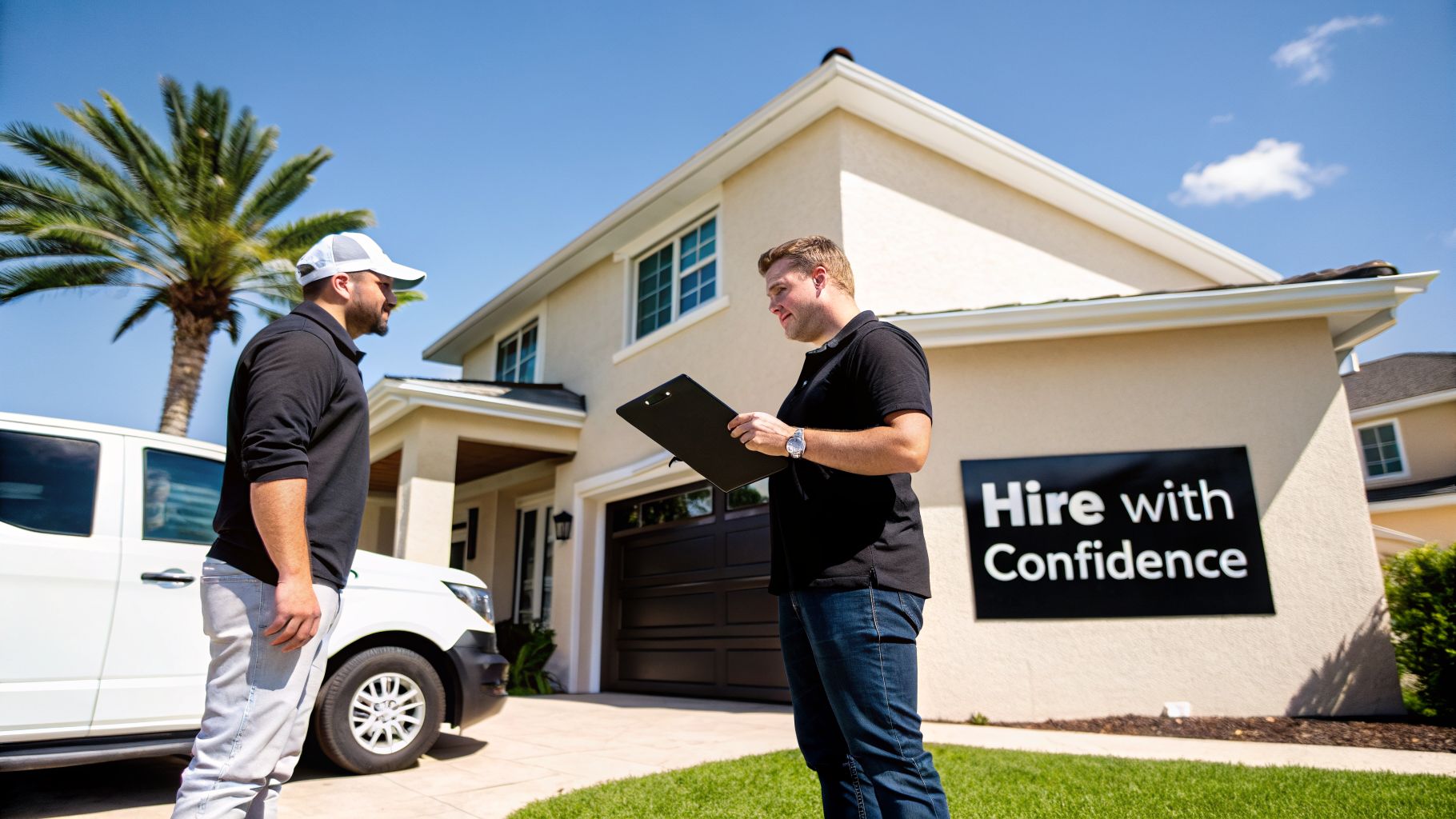
Spray foam has exploded in popularity, and for good reason. The market is projected to surge from $2.09 billion in 2025 to $2.88 billion by 2033. For homeowners, this boom means you have more choices than ever. But it also means the market is flooded with new, less-experienced crews alongside the seasoned pros.
You can dive deeper into the data on this industry growth and see for yourself why careful vetting is critical.
Your goal is to find a contractor who not only knows how to apply the product but deeply understands South Florida's building science. They must be experts in managing our unique humidity and heat challenges.
Finding a qualified contractor who truly gets the science behind insulating a home in our climate is everything. That’s what separates a standard job from a high-performance one that protects your investment.
To help you cut through the noise, we've put together this quick-reference checklist. Think of it as your field guide to spotting a pro.
| Vetting Criteria | Why It Matters for South Florida | Red Flag to Watch For |
|---|---|---|
| Local Experience | Understands local codes, humidity challenges, and hurricane-rated building practices. | Vague answers about projects in Palm Beach or Martin County; no local references. |
| Proper Licensing & Insurance | Protects you from liability for accidents or property damage during the job. | Hesitation to provide a Certificate of Insurance (COI) or a valid license number. |
| Building Science Knowledge | Knows how to prevent moisture entrapment—a major risk in our humid climate. | Focuses only on R-value and price, without mentioning air sealing or moisture control. |
| Material Transparency | Explains the specific brand and type of foam (open vs. closed cell) they plan to use and why. | "All foam is the same." They won't provide a Safety Data Sheet (SDS) for the product. |
| Detailed Bids | The quote breaks down costs for labor, materials, and prep work, specifying foam thickness. | A single-line-item quote with a low price but no details. It's often too good to be true. |
This checklist is your first line of defense. A contractor who checks all these boxes is already miles ahead of the competition.
We're going to walk you through the entire hiring process, sharing practical advice to help you avoid common pitfalls. We'll cover everything from building your initial list of contractors in Jupiter or Wellington to what you should be asking during the consultation.
You'll learn how to read between the lines of a quote and compare bids based on value, not just the bottom-line price. We'll also break down what happens on installation day so you know exactly what to expect. By the end, you’ll have the confidence to choose an expert who will get the job done right the first time.
Finding a great spray foam contractor in South Florida isn't just about a quick Google search. The best crews are often booked solid, relying on their reputation and word-of-mouth, not flashy ads. You have to know where to look and, more importantly, what to look for.
This is where you need to be strategic. It starts with building a solid list of professionals who actually know the unique demands of our climate.

To find the top-tier installers working in places like Wellington, Jupiter, and Stuart, you need to dig a little deeper than the first page of search results.
It also helps to understand how reputable companies present themselves online. Knowing the fundamentals of Local SEO strategies for contractors can show you which businesses are investing in their local presence—a good sign they're in it for the long haul.
Once you have a list of three to five companies, it’s time to do some initial homework before you even think about scheduling an estimate. This is the screening phase, designed to weed out the unqualified operators right away.
Your goal here isn't to talk about price yet. It's to confirm they are a legitimate, professional business.
A contractor’s hesitation to provide a license number or proof of insurance is the biggest red flag you can encounter. It’s an immediate disqualification—no exceptions.
Don't just take their word for it. You absolutely have to verify these things yourself.
For every single contractor on your shortlist, do this before they set foot on your property:
Finally, read their online reviews—and I mean read them, don't just look at the star rating. Are the comments specific? Do they talk about the crew being on time, professional, and clean? A pattern of detailed, positive experiences is what you're looking for.
This groundwork ensures you're only spending your time meeting with qualified pros. A truly thorough contractor, for example, understands the importance of creating a complete air seal, which is often verified with a diagnostic test. If that’s a new concept for you, take a moment to understand what a blower door test is and why it's a sign of a contractor who doesn't cut corners.
Alright, you've narrowed it down to a few licensed and insured contractors. This is where the real vetting starts. The initial meeting isn't just about getting a quote—it's your chance to grill them and see who really knows their stuff.
The answers you get will tell you everything you need to know about their experience, their commitment to safety, and whether they truly understand the unique challenges we face here in South Florida. A pro will have confident, clear answers. Someone just trying to close a deal will stumble.
The single most important decision is the type of foam they recommend. Their reasoning says a lot. In our humid climate, choosing between open-cell and closed-cell foam isn't just a preference; it's a strategic decision based on your home, your goals, and where the foam is being applied.
Here’s what you need to ask:
These questions shift the focus from price to quality. A contractor who takes the time to educate you is a contractor who cares about the final result.
The people actually holding the spray gun are just as critical as the foam itself. Installing spray foam is a chemical process that demands proper training and strict safety measures. An untrained crew is not only a danger to themselves but can leave you with a botched job and a hazardous home.
The safety of your family and the crew is non-negotiable. A professional contractor won’t just have a safety plan—they’ll live by it. No shortcuts.
Get direct with these questions:
Finally, you need to know how they stand behind their work. A proper spray foam installation should last for the life of your home, and the warranty should reflect that confidence.
Make sure you ask about two different warranties. The foam manufacturer should offer a limited lifetime warranty on the product itself, covering any defects. Just as important is the workmanship warranty from the contractor. This is their promise that the installation was done right. A company that’s confident in its work will put that promise in writing without you even having to ask.
Once the quotes for your spray foam job start rolling in, it’s tempting to just glance at the bottom-line price. But I can tell you from decades of experience, that’s one of the biggest mistakes a homeowner can make, especially here in South Florida. The lowest bid is almost never the best value.
More often than not, a surprisingly cheap quote is a flashing red light. It usually means corners are about to be cut—less material, sloppy prep work, or a crew that isn't properly trained. This leads to a weak thermal barrier, lingering moisture problems, and an FPL bill that doesn’t drop like you expected. You have to learn to read between the lines to see what you're really getting for your money.
A professional quote is more than just a price; it’s a project roadmap. It should be detailed enough that you understand every single phase of the job. A contractor who hands you a clear, transparent proposal is showing you they’re confident in their process. Many of us use simplified estimating and invoicing tools to make sure nothing gets missed.
Here’s what you should be looking for in any bid you seriously consider:
If you get a vague, one-page quote with a single number on it, be wary. That’s an amateur move. A pro builds your confidence with a detailed breakdown.
Let’s say you’re insulating a 1,500 sq. ft. attic in your Jupiter home and you get two different quotes.
Quote A comes in at $4,500. It simply lists "spray foam insulation" for the job.
Quote B is $6,200. It specifies "5.5 inches of open-cell foam," and includes line items for air sealing all attic penetrations, extensive prep work, and a 5-year workmanship warranty.
Your first instinct might be to jump on Quote A and save $1,700. But that lack of detail is exactly where the risk is. The contractor could show up and spray only 3 inches of a cheap, off-brand foam, completely skipping the crucial step of air sealing gaps around pipes and vents. You’ll end up with a home that’s still drafty, and you might even find yourself dealing with condensation in the attic.
Quote B, while costing more upfront, outlines a complete project. It’s designed to create a true air and thermal barrier that delivers the comfort and energy savings you’re paying for. This is what choosing long-term value over short-term price looks like.
The most expensive insulation job is the one you have to pay for twice. A low bid that results in poor performance isn't a bargain; it's a down payment on a future problem.
This decision-making process is about more than just numbers on a page.
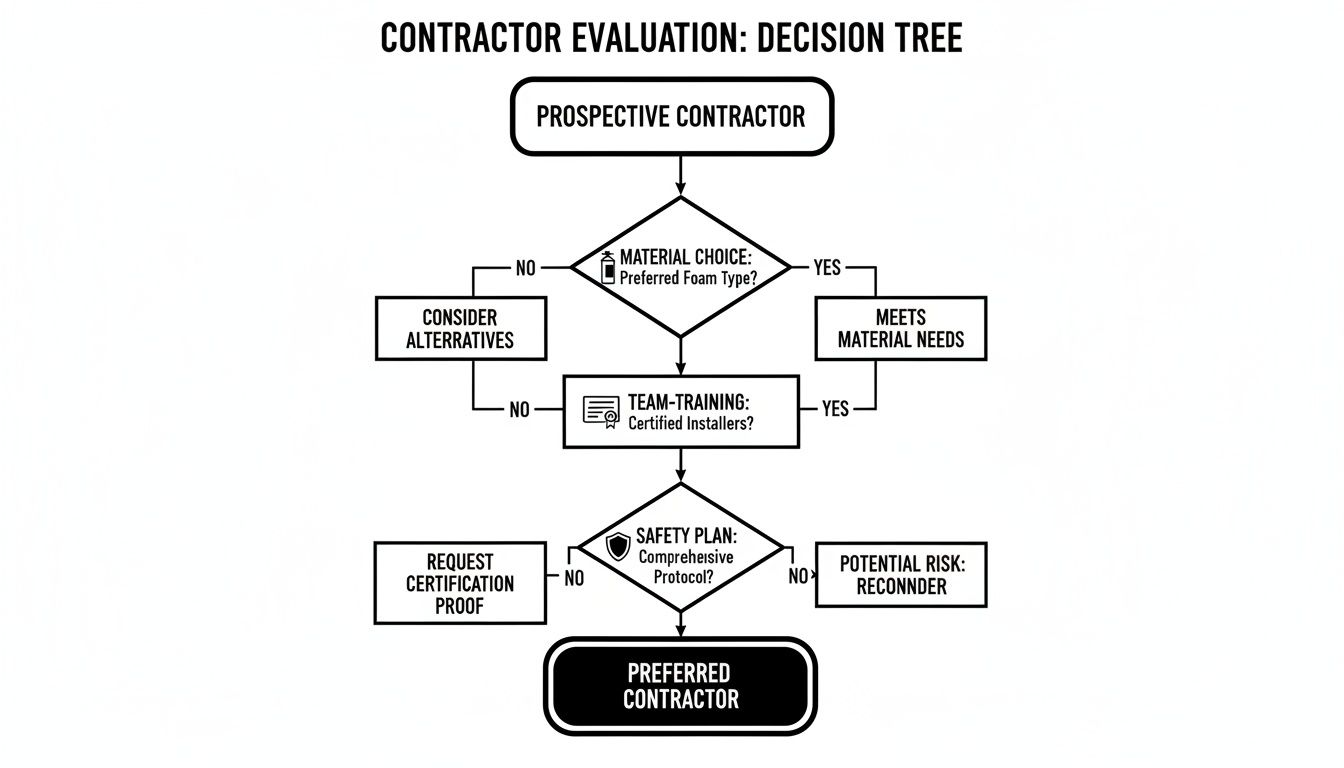
As you can see, vetting the contractor's expertise with materials, their team's training, and their safety protocols is just as critical as the final price.
The type of foam specified in the bid—open-cell or closed-cell—is one of the biggest factors driving the total cost. Closed-cell foam is significantly more expensive, but for good reason. It's denser, provides a higher R-value per inch, and, most importantly for our climate, it forms a vapor barrier. This makes it a superior choice for many South Florida applications, particularly on roof decks where moisture control is critical.
To help you understand the differences, here’s a quick comparison of how each foam type performs in our specific environment.
| Feature | Open-Cell Spray Foam | Closed-Cell Spray Foam | Best for South Florida Use Case |
|---|---|---|---|
| Density & Structure | Soft, spongy, and light. Cells are left open. | Rigid, dense, and strong. Cells are closed and packed tight. | Closed-cell offers structural rigidity, which can help strengthen a roof deck against high winds. |
| R-Value per Inch | ~R-3.5 to R-3.8 | ~R-6.5 to R-7.0 | Closed-cell provides much higher insulation value in less space, ideal for meeting modern energy codes. |
| Air Barrier | Excellent. Effectively stops air movement. | Excellent. Effectively stops air movement. | Both are effective air barriers, which is crucial for lowering cooling costs in our hot climate. |
| Vapor Permeability | Permeable. Allows water vapor to pass through. | Impermeable. Acts as a vapor barrier, blocking moisture. | Closed-cell is the clear winner for preventing humidity and condensation issues in attics and walls. |
| Sound Dampening | Excellent. The soft structure is great at absorbing sound. | Good. Offers some sound reduction but less than open-cell. | Open-cell is a better choice for interior walls if soundproofing is a primary goal. |
| Cost | Lower cost per board foot. | Higher cost per board foot. | For budget-sensitive interior projects without moisture risk, open-cell can work. Otherwise, closed-cell is the investment. |
Ultimately, while open-cell has its place, the superior moisture resistance and higher R-value of closed-cell foam make it the premium, more resilient choice for protecting homes in Jupiter, Wellington, and across our humid region.
The demand for high-performance materials like closed-cell foam is growing fast. The U.S. spray foam market was valued at $750.02 million in 2024 and is on track to hit $1.01 billion by 2030, with closed-cell foam leading the charge. A contractor who recommends it for your roof deck isn’t trying to upsell you; they’re specifying the right product for our demanding environment.
Always question a bid that seems too good to be true. It almost always is.
You’ve vetted your options and picked a contractor. Now comes the most critical part: the installation. Knowing what a truly professional spray foam job looks like on installation day will give you major peace of mind.
More importantly, it helps you tell the difference between a seasoned pro and a rookie crew. A top-tier team operates with precision from the moment they pull up, and it shows.
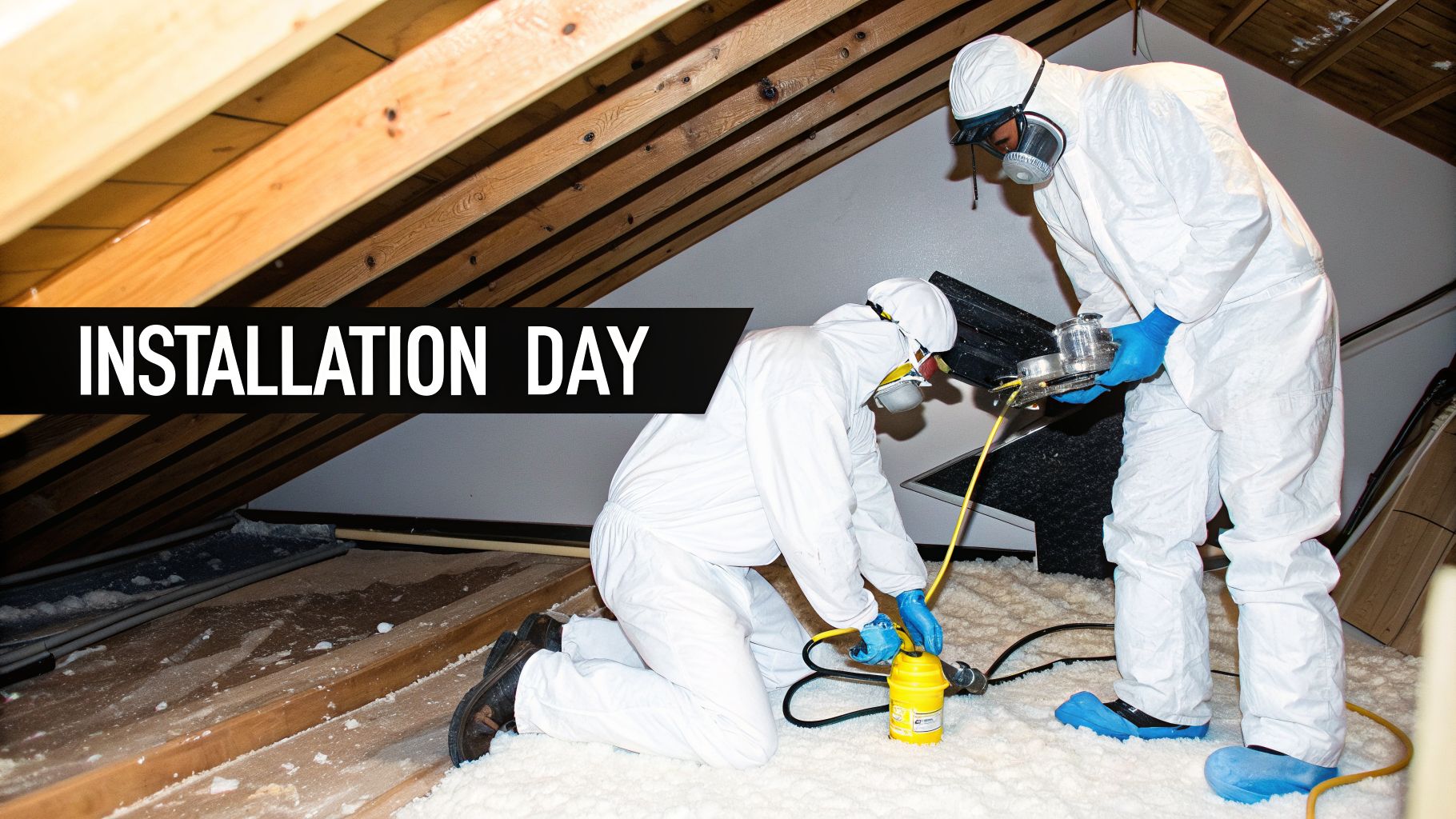
The first thing a real professional crew does is protect your home. This isn't just about throwing down a few drop cloths; it's about meticulously isolating the work area to prevent overspray. That fine, sticky mist can travel farther than you think and adhere to anything it touches.
This is a non-negotiable step. Here’s what you should see them doing:
This detailed prep work is the hallmark of spray foam insulation contractors who respect your property. A team that skimps on prep is a major red flag.
Once the prep is done, the crew suits up. Applying spray foam is a chemical process, and there is no room for cutting corners on safety. Your installers absolutely must be in full Personal Protective Equipment (PPE). This means full-body suits, gloves, and—most importantly—full-face, fresh-air-supplied respirators.
Proper ventilation is just as critical. The team will set up powerful fans to create negative air pressure, pulling fumes and odors directly outside and away from the living space.
For your own safety, you, your family, and your pets need to be out of the house before spraying starts. Plan on staying away for a minimum of 24 hours. This allows the foam to fully cure and off-gas. If a contractor tells you a few hours is fine, they are ignoring established industry safety standards.
The application itself is a skill honed over thousands of hours. The installer applies the foam in thin, even passes, or "lifts." They allow each layer to rise and begin to set before applying the next. This controlled technique is essential for the foam to cure properly and deliver its full R-value and structural benefits.
For a closer look at what this involves in an attic, you can find helpful information on our insulation installation in attic guide.
After the final layer of foam is sprayed, the curing process takes over as the foam hardens and becomes inert. While the foam might feel hard to the touch in a few minutes, the 24-hour minimum re-entry time is the gold standard for your safety.
A professional crew will then return to finish the job right. This involves a few key steps:
This commitment to a clean finish and quality control is what separates the pros from the rest. It’s part of a bigger trend toward high-performance homes, which is why the global spray foam market is projected to hit $3.32 billion by 2030. You can explore the full market analysis on spray foam growth to see just how much demand is rising for this kind of quality work.
You’ve done the research, narrowed down your list, and you're close to a decision. But making a big investment in your home naturally comes with a few final questions. It's smart to have them.
We get these questions all the time from homeowners across West Palm Beach, Jupiter, and the surrounding areas. Getting clear answers is the last step to feeling 100% confident in the contractor you choose.
This is always the first question, but the truth is, there’s no single, one-size-fits-all answer. The final price depends on the project's complexity, whether we’re using open-cell or closed-cell foam, and the required thickness to meet Florida's specific building codes.
However, to give you a solid baseline for planning in 2026, homeowners in areas like West Palm Beach and Jupiter can generally expect costs in these ranges:
For a typical attic job, you're often looking at a total cost between $2,500 and $6,000. But let me be clear: a cheap bid is rarely a good deal. An unusually low price often means corners are being cut, which can lead to poor performance, moisture problems, and costly repairs down the road.
Always insist on a written, itemized estimate. That transparency is one of the clearest signs you're dealing with a contractor who respects you and their own work.
In most situations in our area, yes. Municipalities like Wellington and Palm Beach Gardens, along with the rest of Palm Beach County, typically require a building permit for new insulation. This is especially true if it’s part of a re-roofing project or a significant remodel.
The permit isn’t just red tape—it’s your assurance that the job meets the strict energy efficiency and wind-resistance standards of the Florida Building Code. A legitimate, licensed contractor will know precisely when a permit is needed and will manage the entire process for you.
If a contractor ever suggests skipping the permit to "save money," that's a massive red flag. Working without a permit can result in fines, stop-work orders, and serious complications when it’s time to sell your home.
When installed by skilled spray foam insulation contractors, the foam itself is a lifetime product. It’s an inert plastic that won't sag, settle, or break down. It will perform for as long as your house is standing, period.
Because of this, you should always receive two separate warranties:
A reputable contractor will proudly offer a clear, written workmanship warranty. It’s their way of standing behind their team's training and the long-term performance of their work. Make sure you have these warranty details in writing before any work starts.
I've seen what happens when homeowners hire the wrong crew, and it's not pretty. Spotting the warning signs early is key. Beyond an obvious low-ball price, here are the things that should make you pause:
Ultimately, you have to trust your gut. A professional team makes you feel confident through their expertise, transparency, and straightforward process. If something feels off, it probably is.
At Airtight Spray Foam Insulation, we believe an educated customer is our best partner. If you're ready to see how a professional installation can transform your home's comfort and energy efficiency, we invite you to get in touch. Learn more and request your free, no-obligation estimate today at https://airtightsprayfoaminsulation.com.