An energy audit is a professional checkup for your home that shows you exactly where you’re using, wasting, and losing energy. Think of it as a comprehensive report card that uncovers the hidden issues—like air leaks, weak insulation, and inefficient equipment—that push up your utility bills and make your home less comfortable.
Let’s be honest, just looking at a high utility bill doesn’t tell you why it’s so high. An energy audit is like a doctor’s physical for your house—it moves past the symptom (the high bill) to diagnose the root cause. It swaps guesswork for a clear, data-driven story of your home's actual performance.
This process is all about finding the invisible problems that are quietly costing you money. An auditor doesn’t just eyeball your windows; they use specialized tools to measure exactly how much air is leaking around the frames. They don’t just poke their head in the attic; they use infrared cameras to see precisely where your insulation is failing.
Getting a handle on your home’s energy use has never been more important. With global energy demand on the rise, governments are pushing for greater efficiency. The U.S. government, for instance, has set aside roughly $161 billion in clean electricity tax credits through the Inflation Reduction Act to help homeowners make these kinds of improvements. You can dig deeper into global energy trends with the Energy Institute's Statistical Review.
An energy audit gives you a personalized roadmap to lower bills and a more comfortable home. It pinpoints the specific fixes that will give you the biggest bang for your buck, making sure your investment is a smart one.
Here in South Florida, the insights from an audit are especially critical. The relentless heat and high humidity put a massive strain on our cooling systems and building materials. An audit is your best tool for fighting back against these unique challenges.
A professional audit is designed to arm you with clear, actionable information. It isn't just about pointing out flaws; it’s about creating a prioritized list of solutions that will genuinely improve your home and your budget. The table below breaks down the main objectives.
| Objective | What It Means for You |
|---|---|
| Pinpoint Energy Waste | Find the exact spots where your expensive conditioned air is escaping and hot, humid air is getting in. |
| Measure System Efficiency | Get a real-world assessment of your HVAC system, water heater, and other major appliances to see if they're pulling their weight. |
| Prioritize Key Improvements | Get a clear plan that ranks fixes by their return on investment, from simple DIY tasks to larger professional projects. |
| Boost Comfort & Health | Solve the root causes of drafty rooms, hot spots, and poor indoor air quality that can affect your family's well-being. |
Ultimately, a quality audit moves you from wondering where your money is going to knowing exactly what to do about it. It gives you the power to make informed decisions that create a more efficient, comfortable, and healthy home.
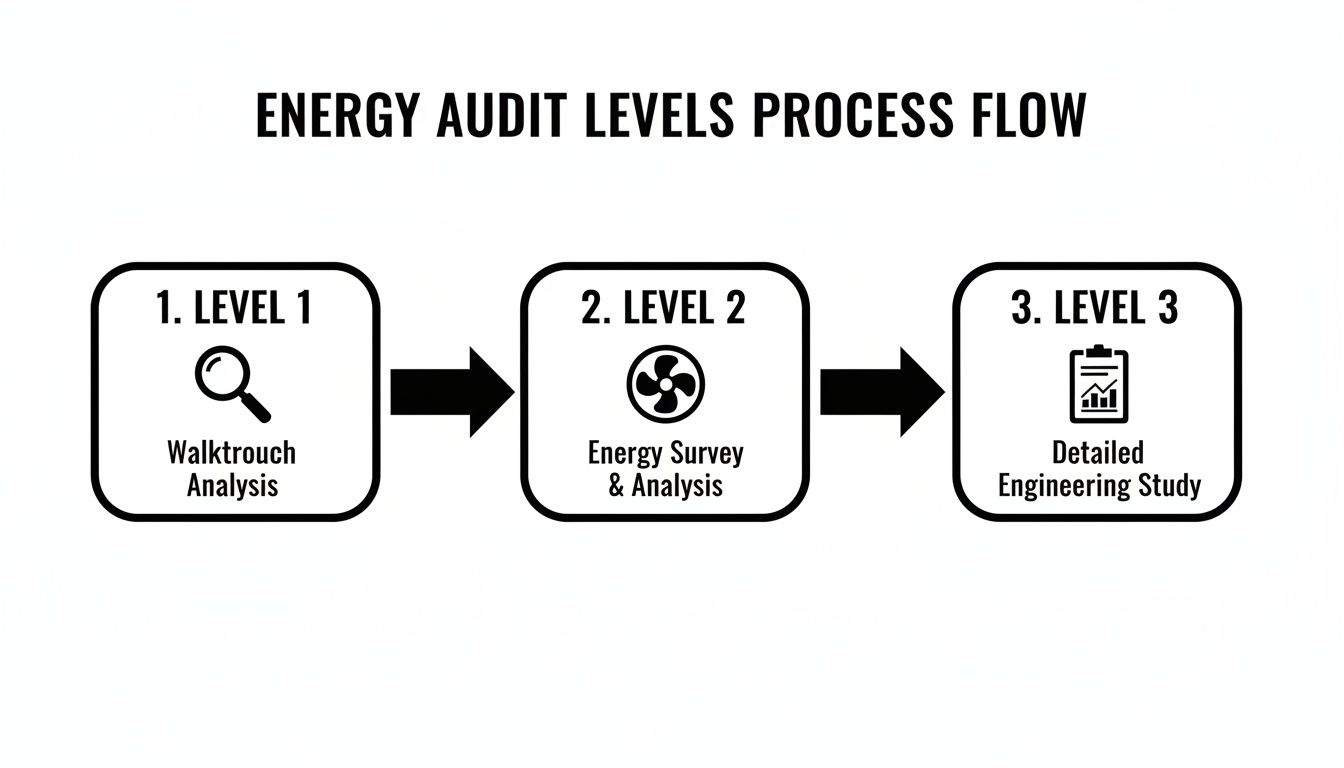
Not all energy audits are the same. It’s a lot like the difference between a quick look under the hood and a full engine diagnostic. You have to know what you’re looking for to pick the right one for your home or business, otherwise you might pay for more than you need or, worse, not get the answers you’re after.
Think of it as a series of levels, each one digging deeper than the last. For most folks here in South Florida, the first two levels are what really matter.
A Level 1 audit is the starting point. It’s pretty much a visual once-over. An auditor will walk through your property, take a look at the obvious stuff—gaps around windows, a poorly insulated attic hatch, old lightbulbs—and chat with you about your energy bills and any hot or cold spots you’ve noticed.
This gives you a quick snapshot. You’ll get a basic report with some straightforward, low-cost recommendations. But it’s surface-level. It doesn’t use any special equipment, so it can't find hidden problems like air leaks that are costing you a fortune on your FPL bill every summer.
This is the real deal. When most people talk about getting a home energy audit, they’re talking about a Level 2 audit. This is the standard for homeowners for a reason. It includes everything from the Level 1 walk-through but adds the critical diagnostic tests that give you hard data on your home's performance.
This is where we break out the serious equipment to see what’s really going on. The two main tests are:
A Level 2 audit isn't about guessing. It gives us measurable, actionable data. We won’t just tell you that you have air leaks—we’ll show you exactly how much air you’re losing and pinpoint where it’s coming from.
Finally, there’s the Level 3 audit. You can think of this as the most intensive, in-depth analysis available. It’s typically reserved for big commercial or industrial buildings where major capital investments are on the line. This audit involves collecting detailed data over weeks or months to build out complex energy models.
For a homeowner in Jupiter or West Palm Beach, it’s almost always overkill. A proper Level 2 audit gives you all the information you need to make smart, effective improvements to your home.
So, you’ve scheduled an energy audit. What actually happens when the auditor shows up? It's much more than a quick glance around. A real professional audit is a deep dive, using specialized diagnostic tools to uncover exactly where your home is losing energy.
Think of it like a full medical workup for your house. We're not just looking at the symptoms—like a high FPL bill or a stuffy bedroom—we're using advanced equipment to find the root cause of the problem. This is where the real savings begin.
The graphic below shows how audits progress from a simple visual check to the kind of in-depth diagnostic assessment we perform.
We focus on a comprehensive, diagnostic approach because simple observation just doesn't cut it. You need hard data to make smart decisions.
To get that hard data, we run a series of specific tests. Each one is designed to measure a different aspect of your home's performance, giving us a complete picture of its health.
| Diagnostic Test | Primary Purpose | Common Findings in South Florida |
|---|---|---|
| Blower Door Test | Measures overall air leakage in the entire house. | Gaps around windows, unsealed attic hatches, leaky recessed lights pulling in hot, humid air. |
| Infrared Thermography | Visually identifies temperature differences on surfaces. | Missing or settled insulation in walls and ceilings, air leaks around outlets, moisture hidden in drywall. |
| Duct Blaster Test | Measures air leakage specifically in your HVAC ductwork. | Leaky duct seams in the attic losing cold air, disconnected returns pulling in dusty attic air. |
These aren't just guesses. They're precise measurements that tell us exactly where to focus our efforts for the biggest impact on your comfort and energy bills.
The first thing we'll do is run a blower door test. This is the cornerstone of any serious audit. We fit a powerful fan into an exterior door frame and pull air out of the house, creating a slight negative pressure inside.
This simple action makes all the hidden leaks whistle. All those tiny cracks and gaps around windows, outlets, and light fixtures start pulling air in from the outside. We can then walk through the house with a smoke pencil and literally see where the drafts are coming from.
The test gives us a precise number—Cubic Feet per Minute (CFM)—that tells us the total size of all the air leaks combined. It’s the definitive way to know just how "leaky" your home is. You can learn more about how this crucial test works in our detailed guide.
Next, we pull out the thermal camera for an infrared thermography inspection. This tool lets us see what the naked eye can't: temperature. It creates a color-coded map of your walls, ceilings, and floors, instantly showing where heat is getting in or your expensive A/C is getting out.
It's like having X-ray vision for your home's insulation. The camera immediately reveals dark blue splotches where hot, humid air is infiltrating or bright yellow and red streaks showing where conditioned air is escaping right through the ceiling.
With this, we can pinpoint:
Finally, especially here in South Florida, we test your ductwork with a duct blaster test. Think of it as a smaller, targeted blower door test just for your HVAC system. We seal off all your vents, connect a small fan to the ductwork, and pressurize the whole system.
Why is this so critical? Most ducts run through brutally hot attics. If those ducts have leaks—and most do—you're basically paying to air condition your attic.
The duct blaster measures exactly how much of that precious, conditioned air is lost to leaks before it ever reaches your living space. It's not uncommon to find systems losing 20-30% of their air into the attic. That's a huge waste of money and a major reason why some rooms never seem to get cool.
An energy audit in a place like South Florida is a whole different ballgame compared to one up north. Here, our biggest enemy isn’t just the heat—it’s the brutal combination of intense sun and thick, relentless humidity. This duo creates unique and expensive problems that a professional energy audit is built to sniff out.
Think of an audit's findings as a diagnostic report for your home. It shows you exactly how our local climate is winning the war against your house. And while every home has its quirks, our auditors see the same few culprits causing high FPL bills and that stuffy, uncomfortable feeling from Jupiter all the way down to Wellington.
Most homes around here are fighting a losing battle against a few core issues. An audit brings these problems into the light, showing you precisely why your air conditioner is working itself to death and costing you a small fortune.
Here’s what we find time and time again:
An energy audit moves beyond guesswork. It measures the cumulative impact of these leaks and insulation gaps, showing you exactly how much energy—and money—is escaping your home every single day.
Tackling these issues has never been more important, especially with reports showing that power sector emissions reached a new record high in 2023. For us in South Florida, making these smart improvements isn’t just about a lower power bill; it’s one of the most effective ways to reduce our personal environmental footprint.
These problems go way beyond your wallet. In our climate, they create a much bigger threat: uncontrolled moisture. When hot, humid air from outside sneaks into your cooler, conditioned home, that moisture has to go somewhere. It condenses on walls, behind cabinets, and inside your attic.
This creates the perfect breeding ground for mold and mildew.
An audit isn't just looking for wasted energy; it's identifying the weak points that impact your family's health and your home's structural integrity. Sealing air leaks and upgrading your insulation is about more than bills. It's one of the most critical steps you can take to control indoor humidity and protect your property from moisture damage. We dive deeper into this in our guide covering insulation for energy-efficient homes and how it’s designed to fight these exact challenges.
So, you've got the energy audit report in your hands. It’s packed with data, thermal images, and professional notes. But it’s not just a piece of paper—it’s your battle plan for taking on South Florida’s brutal heat and humidity. Now comes the important part: turning those findings into fixes that actually lower your bills and make your home comfortable.
After years of doing this, I can tell you that most reports point to the same two culprits: air leakage and poor insulation. They’re a one-two punch. Air leaks let hot, humid air invade your home, while bad insulation lets the sun’s heat radiate right through your roof and walls. Your report might show dozens of leaks and huge gaps in insulation, and trying to fix them one by one can feel impossible.
Luckily, you don't have to. The best modern solutions tackle both problems at the same time. This is where the audit truly proves its worth—by pointing you directly to the most effective, high-impact upgrades for your home.
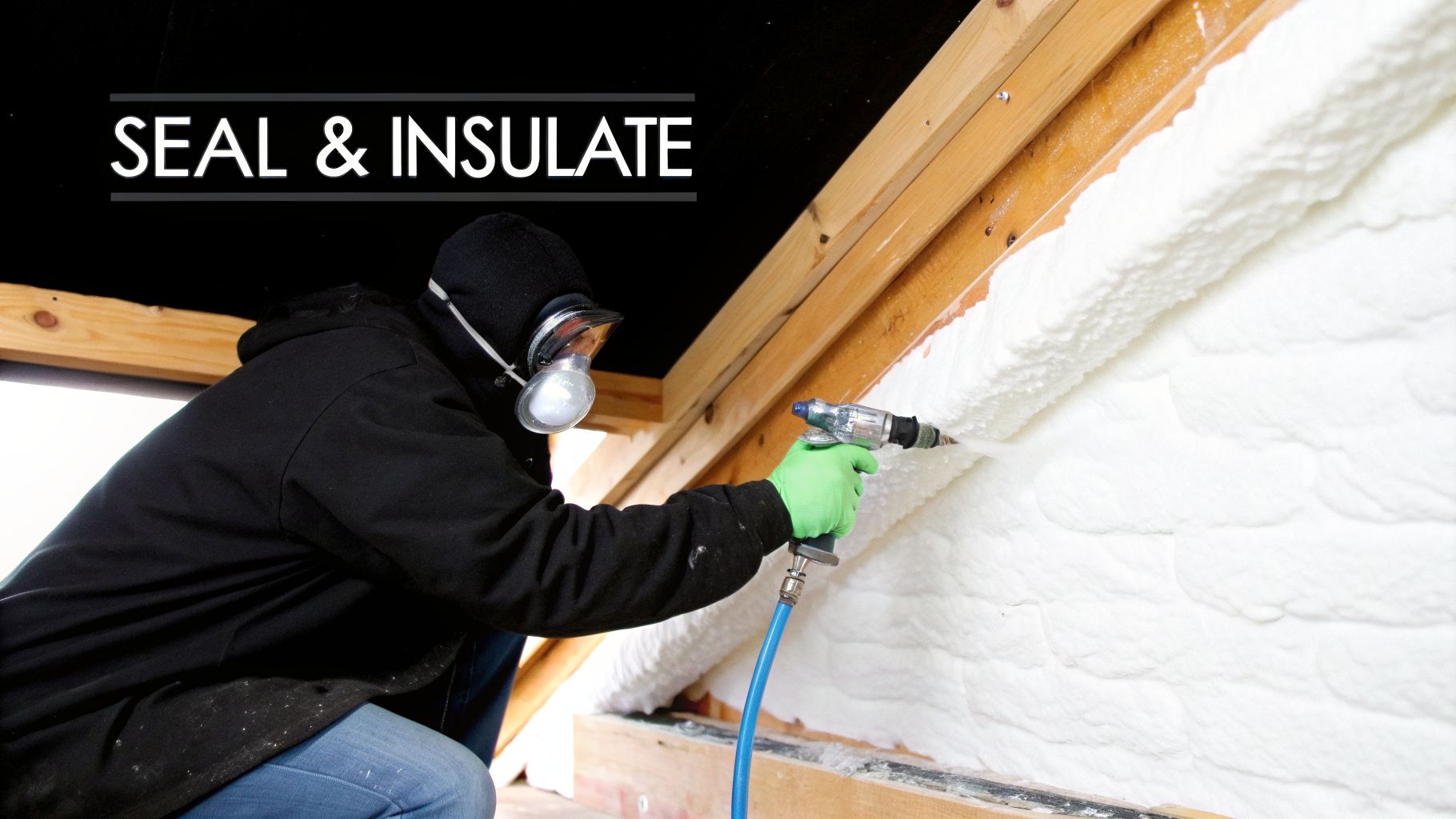
When your audit comes back showing significant air leaks and failing insulation, spray foam is in a class of its own. Traditional insulation like fiberglass batts just sits there, slowing down heat. Spray foam is different. It’s applied as a liquid that expands, creating a powerful thermal barrier and a complete air seal in one shot.
I like to explain it like this: old-school insulation is like throwing a wool blanket over your house. It helps a little, but the wind still blows right through. Spray foam is like a high-tech windbreaker jacket—it completely stops the air from getting in.
By expanding to fill every last crack, gap, and crevice, spray foam insulation doesn't just insulate—it air-seals your building envelope. This single step directly stops hot, humid air from sneaking into your cool, conditioned space, which is the #1 problem we find in nearly every South Florida energy audit.
This dual-action approach is what makes it so powerful for solving the core issues your audit uncovered. If you’re constantly wondering why your electric bill is so high, there's a good chance air leakage is the reason.
When you use the audit's findings to make the right upgrade, the benefits ripple throughout your entire home.
While spray foam is the knockout solution for attics and walls, your audit might spot other weak points. For instance, if your report flags significant heat gain from windows, adding quality cellular shades can offer another layer of insulation. Combining these smart fixes is the key to unlocking a truly efficient and comfortable home.
So, you have your energy audit report in hand. Think of it less as a final grade and more as a detailed roadmap. It’s the critical first step, shifting you from guessing what’s wrong to knowing exactly where your home is losing the battle against high energy bills and discomfort.
For most homeowners we talk to, that report points a finger directly at two major culprits: countless tiny air leaks and failing, inadequate insulation. Now it's time to put that data to work and find a professional who can deliver a real, lasting solution.
When you’re looking for someone to perform an audit in South Florida, make sure they’re certified and, more importantly, that they use diagnostic tools like blower doors and infrared cameras. A simple walk-through just won’t cut it. For the actual repair work—especially insulation or HVAC upgrades—always, always go with licensed and insured contractors who have a long track record right here in our local climate.
Your audit report might also suggest improvements to your air conditioning system. This makes sense; good insulation and a well-maintained AC go hand-in-hand. Understanding some basic HVAC maintenance strategies is smart for any homeowner, as it ensures your biggest energy-using appliance isn't fighting against a leaky house.
Remember, the whole point of an energy audit is to move from guessing to knowing. It pinpoints the fixes that offer the biggest return on your investment, ensuring you spend money where it truly counts.
If your audit showed significant air leakage and poor insulation—and it almost certainly did, as that's the story in most Florida homes—your path forward is clear. These aren't small issues; they are the root cause of sky-high FPL bills and rooms that are impossible to keep cool. They demand a specialized fix that solves both problems at the same time.
This is where we come in. At Airtight Spray Foam, we specialize in solving the exact problems your energy audit uncovered. Our system creates a seamless, monolithic air barrier and a high-performance insulation layer in one step. It directly stops the heat gain and humidity infiltration that are making your home uncomfortable and expensive to run.
Ready to see how our Airtight Comfort System can permanently fix the issues in your report? Request a free, no-obligation quote today and take the definitive next step toward a more comfortable and affordable home.
Even with a clear understanding of the process, it's natural to have a few more questions. We get it. Here are the straightforward answers to the questions we hear most often from homeowners here in South Florida.
You can expect a professional Level 2 energy audit—the kind with diagnostic tools like a blower door test and infrared imaging—to run between $300 and $700. The final price tag really depends on the size and complexity of your home.
Think of it less as a cost and more as an investment. This audit gives you a detailed roadmap for energy savings that will pay you back many times over.
Sure, you can definitely do a basic walk-through yourself to spot the obvious stuff, like feeling for drafts or looking for gaps in your attic insulation. But that’s where a DIY check ends.
A professional audit uses specialized diagnostic equipment, like a blower door and an infrared camera, which a homeowner just doesn't have. These tools are absolutely essential for measuring air leakage precisely and finding hidden voids in your insulation—the exact problems that let South Florida's humidity wreak havoc on your home.
The real power of a professional audit is in the data. It takes the guesswork out of the equation. An auditor can turn a vague feeling like, "I think my living room is drafty," into a hard number: "You're losing 1,200 cubic feet of conditioned air per minute through leaks in this wall."
A thorough residential energy audit usually takes somewhere between 2 and 4 hours to finish. The auditor will need access to pretty much every part of your home to get the job done right.
This includes the attic, any crawl spaces you have, and of course, all the main living areas where they'll conduct tests and gather the data they need on your home's performance.
Lower energy bills are great, but for most folks down here, the biggest win is a huge improvement in comfort and serious moisture control. An audit is like a treasure map that leads directly to the hidden entry points for hot, humid air that make your home feel sticky and damp.
Once you find and fix those sources with air sealing and the right insulation, your home becomes a healthier, more comfortable place to live. Your AC doesn't have to work nearly as hard, and that's where the real savings kick in.
At Airtight Spray Foam Insulation, we don't just identify problems; we provide the permanent fix. When your energy audit report points to major air leakage and insulation failures, that's our specialty.
Ready to turn those audit results into real-world comfort and savings? Contact us for a free estimate today.