Blog
Metal Building Insulation: metal building insulation Tips to Stop Condensation

Picking the right metal building insulation isn't just another item on a checklist; it's the single most critical decision you'll make to protect your building from Florida’s punishing climate. Here, options like closed-cell spray foam aren't just a good idea—they're a necessity. They create a powerful thermal and moisture shield, tackling the two biggest enemies of any steel structure in our area: condensation and brutal radiant heat.
Why Your Metal Building Needs the Right Insulation
Think about it: an uninsulated metal building is just a big tin box. When the South Florida sun beats down, that box becomes an oven, pushing unbearable heat inside. Then, when a cool, humid night rolls in, those metal walls and ceilings start to sweat, dripping water everywhere. That condensation leads to rust, ruined inventory, and a damp, miserable environment.
This is why insulation is non-negotiable. It's the building's climate control system. It doesn't just block heat; it creates a stable, predictable interior. You're turning a structure that's practically useless for half the year into a comfortable workshop, a secure storage facility, or a functional commercial space.
The Financial Case for Insulation
Beyond pure comfort, the numbers just make sense. Without proper insulation, your HVAC unit is fighting a battle it can't win, running nonstop to combat the heat gain. The result? Sky-high energy bills and an air conditioner that's going to burn out years before its time.
We're seeing a huge spike in demand for quality insulation, and it's no wonder why. Heating and cooling can easily eat up 30–50% of a building's total energy use. For a metal structure in a place like South Florida, a modern insulation system can slash those energy bills by a whopping 20–40%. You can read more about these market trends and insulation performance.
Key Benefits of a Well-Insulated Structure
When you invest in a quality insulation system, you're not just buying a product; you're making a long-term investment that protects your building and your wallet. The payoff comes in several key ways:
- Drastic Energy Savings: A solid thermal barrier means your AC doesn't have to work nearly as hard. That translates directly into lower monthly utility bills.
- Complete Moisture and Condensation Control: The right insulation—especially closed-cell spray foam—doubles as a vapor barrier. It stops warm, humid air from ever touching the cool metal, completely preventing "building sweat."
- Enhanced Structural Integrity: This is a benefit most people overlook. Closed-cell spray foam actually adheres to the metal panels and adds a surprising amount of rigidity, making the whole building stronger against wind and storms.
- Improved Comfort and Usability: A stable indoor temperature finally lets you use the space how you intended, all year long, maximizing the return on your investment.
Ultimately, better insulation leads to better building performance. You can learn more about wider industrial strategies for energy efficiency to see how it all fits together. Choosing the right insulation is what unlocks the true potential of your metal building.
Comparing the Most Common Insulation Types
Choosing the right insulation for a metal building feels a lot like picking the right tool for a job. What works perfectly in one situation might be a complete disaster in another, especially down here in South Florida. It’s not about finding the single “best” option, but about matching the material to the unique demands of a metal structure in our high-heat, high-humidity world.
To make the right call, you have to understand the personality of each material.
Let’s think of it this way. Closed-cell spray foam is like a custom-molded, waterproof shell for your building. It’s sprayed on as a liquid and expands to fill every single crack, seam, and crevice, creating one seamless barrier that locks out both air and moisture. It literally becomes part of the building's structure.
Now, consider fiberglass batts. They’re like a thick wool blanket. Sure, they’re decent at trapping air, but the moment they get wet, they become a heavy, soggy mess. They lose their insulating power, start to sag, and create huge gaps where heat and moisture can pour right through.
Finally, you have rigid foam boards. These are like perfectly cut puzzle pieces. When they’re installed flawlessly—with every single seam meticulously taped and sealed—they can create a solid thermal break. But even one small mistake in cutting a piece or sealing a seam creates a weak point, an open invitation for air and condensation to sneak in.
This chart really drives home how the right insulation tackles the core challenges of a metal building head-on: heat, moisture, and cost.
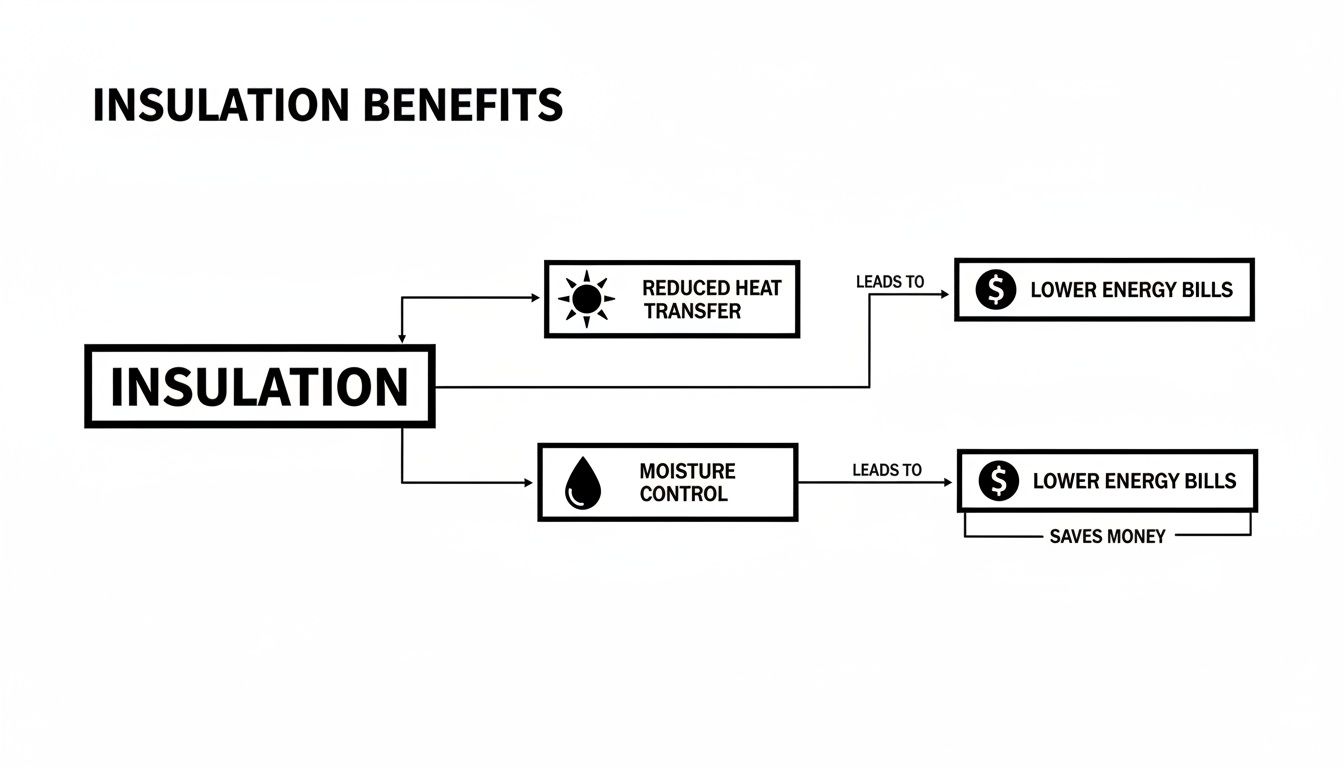
As you can see, getting heat and moisture under control isn't just about feeling comfortable. It's the most direct path to slashing your energy bills and protecting your investment for the long haul.
The Airtight Champion: Spray Foam Insulation
Spray polyurethane foam (SPF) is widely considered the gold standard for metal buildings, and for very good reasons. It’s applied as a liquid that expands instantly, bonding directly to the metal panels, purlins, and framing.
- Closed-Cell Spray Foam: This is the heavyweight champion for metal structures. Its dense, rigid structure creates an impermeable barrier to both air and water vapor. It stops condensation dead in its tracks by preventing our warm, humid air from ever touching the cooler metal surface. As a bonus, it adds significant structural strength to the entire building.
- Open-Cell Spray Foam: While it's a fantastic sound dampener, open-cell foam is like a sponge—it’s vapor-permeable and can absorb water. For that reason, we never recommend it for exterior walls or roofs on metal buildings in a climate like ours.
For a metal building, the ability to form a perfect, gap-free seal is everything. Unlike other methods that are full of seams and potential failure points, spray foam insulation creates a truly monolithic, airtight envelope. It solves the problems of heat, air leaks, and moisture all in one shot. We dive deeper into this in our article comparing spray foam vs. blown-in insulation.
The Old Standby: Fiberglass Batts and Rolls
Fiberglass is one of the most common and affordable insulation materials out there. It comes in those familiar pink or yellow rolls and is designed to be fitted between the framing members of a building.
The problem is, its performance in a metal building is almost always a letdown. Steel buildings are full of ribs, purlins, and girts that make it impossible to install fiberglass batts without squishing them or leaving gaps. Every single compressed spot and unsealed gap becomes a superhighway for heat transfer and condensation.
Worse yet, over time, gravity and moisture cause the batts to sag, leaving huge sections of your wall or roof completely exposed and uninsulated.
The Precision Player: Rigid Board Insulation
Rigid foam boards, made from materials like polystyrene (EPS) or polyisocyanurate (polyiso), pack a high R-value into a relatively thin profile. They’re lightweight, easy to handle, and do a good job resisting moisture.
The biggest challenge with foam boards is the installation. To work correctly, every single board has to be perfectly cut to fit around every obstruction, and every seam between them must be meticulously taped and sealed. If that process isn't flawless, you’re left with hundreds of tiny pathways for air and moisture to leak in, completely undermining the whole system.
The Heat Reflector: Radiant Barriers
A radiant barrier is basically a sheet of highly reflective material, like aluminum foil. Think of it like the sunshade you put in your car's windshield—it's designed to reflect the sun's radiant heat before it has a chance to heat up the interior.
Radiant barriers work best in hot, sunny climates and are usually installed on the underside of a roof deck. However, they do absolutely nothing to stop conductive or convective heat flow and have almost no R-value. Because of this, they should only be used to supplement another primary insulation, never as a standalone solution for a metal building.
Historically, many steel buildings got by with minimal insulation, but that performance gap has become too large to ignore. Just increasing roof insulation from a basic R-10 to an R-25 can cut cooling costs by 15–30% in warm climates—a jump that traditional fiberglass just can't make efficiently. This reality is what's driven the shift to materials like closed-cell spray foam, which delivers a much higher R-value per inch and a far more reliable seal.
Insulation Performance in High-Humidity Metal Buildings
Here's a quick side-by-side comparison to help you see how these options stack up specifically for metal buildings in a climate like South Florida's.
| Insulation Type | Moisture & Air Seal | R-Value Per Inch | Best Use Case | High-Humidity Suitability |
|---|---|---|---|---|
| Closed-Cell Spray Foam | Excellent (Monolithic) | R-6 to R-7 | Complete building envelope | Excellent |
| Fiberglass Batts | Poor (Gaps & Seams) | R-3.1 to R-3.7 | Budget interior walls (wood frame) | Poor |
| Rigid Foam Board | Good (If perfectly sealed) | R-4 to R-6.5 | Continuous exterior sheathing | Good |
| Radiant Barrier | None | Negligible | Supplemental roof application | Fair (As a supplement only) |
This table makes it clear: when you're dealing with the dual threats of intense heat and relentless humidity, an insulation's ability to create a perfect air and moisture seal is just as important as its R-value.
How to Stop Condensation in Metal Buildings
Condensation is the sworn enemy of any metal building. It’s that maddening drip from the ceiling on a cool morning or the persistent dampness that seems to creep in from nowhere. Left unchecked, it leads to rust, mold, and serious damage to whatever you're storing inside.
So, what's really going on here?
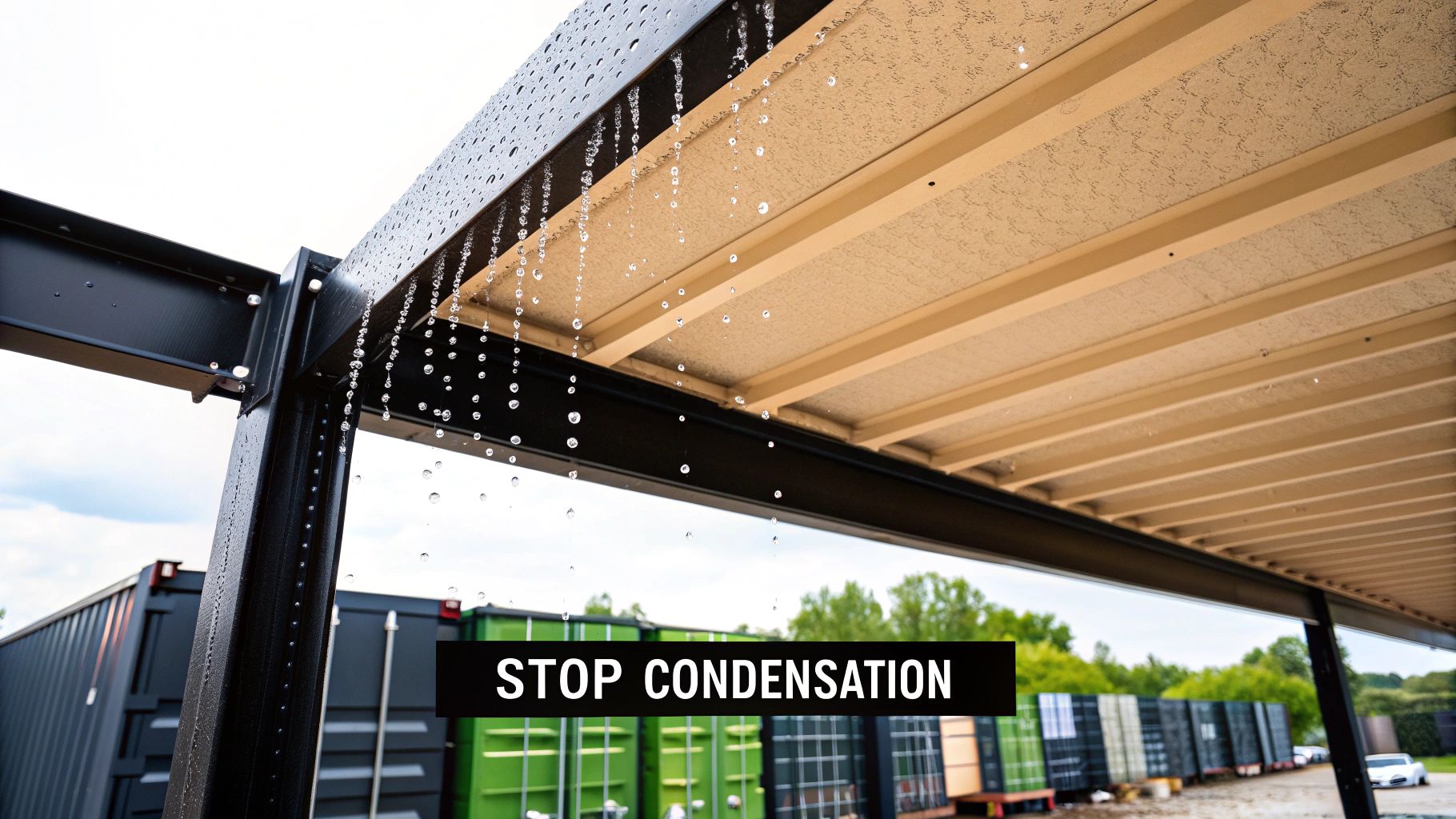
Picture a cold glass of sweet tea on a hot, humid South Florida afternoon. The second you take it outside, droplets form all over the glass. Your metal building is doing the exact same thing on a much larger scale—it’s "sweating."
This happens anytime warm, moisture-heavy air hits a colder surface. The metal panels on your building shed heat and cool down fast, especially overnight, much quicker than the air inside. When that warm, humid interior air makes contact with the cold panels, it can no longer hold all its moisture. The water vapor instantly converts back into liquid.
The True Cause of Metal Building Sweat
A lot of people mistake condensation for a leak, but the real culprit is a constant battle between air temperature and surface temperature. The only way to win this fight is to stop the warm, humid air from ever touching the cold metal. That’s the entire game right there.
Unfortunately, some common insulation methods can actually pour fuel on the fire. Fiberglass batts, for instance, soak up moisture like a sponge. Once they get damp, they lose all their insulating power and just trap that wetness right against your metal panels, fast-tracking rust and corrosion.
The goal isn't just to slow down heat transfer; it's to create a complete, unbroken separation between the interior air and the exterior metal shell. Any material that doesn't also act as a vapor barrier is an incomplete fix that sets you up for long-term structural failure.
To fix this for good, you need a solution that is both an insulator and a true vapor retarder, applied seamlessly without any gaps.
Why Closed-Cell Spray Foam Is the Ultimate Solution
This is exactly where closed-cell spray foam insulation proves its worth. When we apply it, the foam expands and hardens into a single, solid, continuous barrier. It bonds directly to everything—the flat panels, the curved ribs, the structural purlins—leaving zero space for moist air to sneak through and make contact with the metal.
Because of its dense, closed-cell structure, this type of foam is completely impermeable to moisture. It’s an all-in-one insulation, air barrier, and vapor retarder.
- It stops air movement: By forming a perfect, airtight seal, it physically prevents humid interior air from ever reaching the cool metal surface.
- It is waterproof: The material itself doesn't absorb water or let it pass through, a huge difference from open-cell foam or fiberglass.
- It adds structural integrity: The rigid foam actually glues itself to the metal panels, adding strength and cutting down on noise and vibrations from wind and rain.
In short, closed-cell spray foam doesn't just manage condensation; it completely eliminates the conditions that cause it in the first place. For buildings in our humid climate, this is a non-negotiable advantage. You can see how effective it is in our projects featuring closed-cell spray foam insulation in Palm Beach.
Creating a Condensation-Proof Envelope
To make sure your metal building stays bone-dry and protected, the strategy has to be comprehensive. The insulation must form a complete, unbroken envelope that covers every single surface facing the exterior.
- Walls: We insulate from the floor slab all the way up to the roofline, ensuring a continuous seal.
- Roof Deck: The underside of the roof is the prime offender for condensation, so it needs thorough, complete coverage.
- Gable Ends: Don't overlook the triangular wall sections at the ends of the building. These are hotspots for moisture problems.
When you take this approach, you transform your building from a "sweating" metal box into a stable, dry, and protected asset. It's the only way to permanently solve the root cause of condensation and protect your investment for decades to come.
R-Value, Metal Buildings, and The Hidden Energy Thief
When you start looking into metal building insulation, the term R-value is going to come up a lot. It’s pretty straightforward: think of it like the SPF rating on sunscreen. The bigger the number, the better it is at blocking heat.
An insulation product rated at R-13 puts up less of a fight against heat than one rated at R-21. Down here in South Florida, where the sun is relentless, a higher R-value is your first line of defense for keeping a building comfortable without breaking the bank on air conditioning. But that number on the package only tells part of the story.
The R-value you see advertised is based on performance in a perfect lab setting. Your building isn't a lab. It’s a real-world structure, and when it's made of metal, you've got a specific problem that can sabotage even the best insulation rating.
The Problem With Metal: Thermal Bridging
This brings us to a concept I see trip people up all the time: thermal bridging.
Imagine you have a really warm winter coat, but it's held together with solid metal buttons and zippers. On a cold day, what happens? Those metal parts get icy and transfer the chill right through the fabric to your skin. The coat's warm material is being completely bypassed.
In a metal building, your steel frame—the studs, purlins, and girts—acts just like those cold metal zippers. Steel is a fantastic conductor, which is great for many things, but terrible for energy efficiency. Heat and cold travel along it with ease. When you just place insulation between the metal studs, the studs themselves create a "bridge" for heat to sneak right around it.
This process absolutely tanks the effective R-value of your entire wall or roof.
We see it constantly. A builder installs R-19 fiberglass batts between the steel studs, thinking they've done the job right. But because of thermal bridging, the real-world performance of that wall system can plummet to as low as R-7 or R-8. You’re paying for a high R-value but getting less than half the benefit.
How You Actually Defeat Thermal Bridging
The only way to win this fight is to completely stop the bridge. You need a continuous, unbroken blanket of insulation that covers everything, including the metal frame itself. We call this continuous insulation, and it's non-negotiable for getting real performance out of a steel building.
Here’s how different insulation types stack up:
- Traditional Batt Insulation: This is the biggest loser here. It’s installed between the studs, leaving the framing completely exposed to transfer heat. It’s a built-in thermal bridge.
- Rigid Foam Boards: These can get the job done if they're installed as a continuous layer over the framing. But every single seam and joint has to be meticulously taped and sealed. Any gap becomes a new, smaller thermal bridge.
- Spray Foam Insulation: This is where spray foam really shines. It's applied as a liquid that expands on contact, covering the metal panels and the framing in a single, seamless layer. It completely wraps the steel studs, cutting off the thermal bridge at its source.
This monolithic barrier is what ensures you get the full R-value you paid for across every square foot of your building. By creating a truly seamless thermal envelope, you get predictable, high-level performance. It's the core principle behind systems designed to tackle these hidden energy drains, like the Airtight Comfort System. Getting this one concept right is fundamental to making a metal building efficient and comfortable for the long haul.
What to Expect During a Professional Installation
When you bring in a professional team to insulate your metal building, you're not just paying for spray foam. You're investing in a process that guarantees the job is done right, ensuring quality and performance for years to come. It’s a world away from a weekend DIY project.
Knowing what a real professional installation looks like helps you understand where the value is. It's about a lot more than just pointing a sprayer.
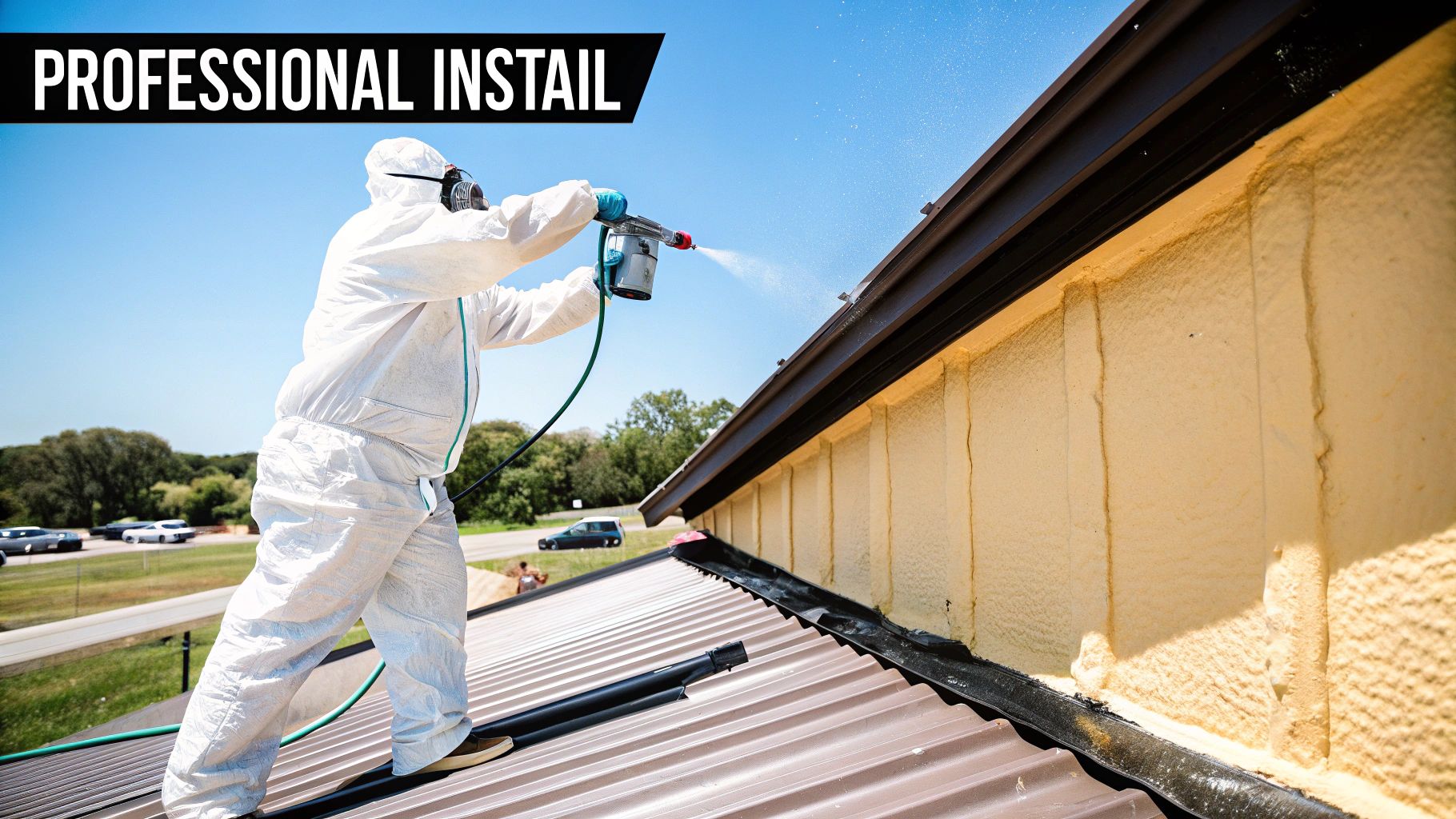
From the first walk-through to the moment they pack up the truck, every step has a purpose. The goal is simple: to make sure the insulation sticks, works perfectly, and is installed safely, transforming your metal shed or workshop into a comfortable, efficient space.
Step 1: The Initial Assessment and Game Plan
Before a single piece of equipment shows up, a good project manager will come out for a thorough on-site evaluation. This isn't just about grabbing measurements for a quick quote. We're talking about a deep dive into your building's specific quirks.
The team will be looking for potential roadblocks—things like hidden moisture spots, oily residue on the panels, or tricky structural beams. They'll also want to know exactly what you're trying to fix. Is condensation your main enemy, or is it the brutal South Florida heat? This assessment creates the blueprint for the entire job, locking in the right material thickness and application strategy from the get-go.
Step 2: Meticulous Surface Prep
Honestly, this is where the magic happens and what separates the pros from the amateurs. For spray foam to last a lifetime, it needs a perfectly clean, dry, and grease-free surface to grab onto. A professional crew will spend a significant amount of time getting every inch of that metal ready.
This usually means:
- Power Washing: Blasting away all the dirt, dust, and grime that’s collected on the panels.
- Degreasing: Using special cleaners to strip off any oils or factory residues that would kill adhesion.
- Drying: Making absolutely sure the surface is bone-dry before the first ounce of foam is sprayed.
Getting this step wrong is the number one reason amateur jobs fail. A seasoned team knows that 90% of a successful application happens before the spraying even starts. Think of it as the foundation—if it’s weak, the whole thing will eventually crumble.
Step 3: Safety and Containment
Professional installers don't mess around when it comes to safety and protecting your property. Before they start spraying, the crew will lock down the work area.
They'll mask off everything that isn't getting insulated—doors, windows, concrete floors, and any equipment you have stored inside. They’ll also set up heavy-duty ventilation systems to keep the air clear while the foam cures. And, of course, every technician will be geared up in full personal protective equipment (PPE), including respirators and protective suits.
Step 4: The Art of Application and Quality Control
With all the prep work done, the certified technicians finally get to work. Using highly specialized equipment, they'll apply the insulation to the exact thickness planned, moving methodically to create even coverage. This includes getting into all the tough spots, like around purlins and trusses.
An experienced applicator is constantly watching how the foam is reacting, making sure it cures correctly right before their eyes. They build the foam up in even layers to create a single, seamless air and moisture barrier with no gaps or weak points.
Once the spraying is done, a manager will do a final inspection, checking for consistent depth and a perfect seal. Only then does the cleanup begin. They'll pull up all the masking and protective coverings, leaving your space clean, tidy, and a whole lot more comfortable.
Let's be real—when you're pricing out a project, insulation can feel like just another line item on a long list of expenses. But looking at it that way is a mistake. Think of it as a capital improvement, an investment that starts paying you back from day one.
Of course, the final price tag is going to move around based on a few key things. The size of your building is the big one; more square footage means more material and more time. The type of insulation you choose matters a lot, too. A high-performance material like closed-cell spray foam will have a higher upfront cost than, say, traditional fiberglass batts, but the long-term benefits are in a different league. Then there are the little things that add up, like a complicated job site with hard-to-reach spots that might require more prep work.
What Drives the Upfront Cost?
To get a handle on your budget, you need to know what goes into the final quote. It's not just one thing, but a combination of factors.
- Total Square Footage: This is the foundation of the estimate. It dictates how much material we'll need and how long the job will take.
- Insulation Type: Closed-cell spray foam costs more per square foot, but you're paying for unmatched moisture control and a higher R-value in a thinner application.
- Required Thickness (R-Value): If you need to hit a higher R-value for code or for a climate-controlled space, that means more material, which bumps up the price.
- Job Site Accessibility: A simple, wide-open building is straightforward. One with lots of interior walls, machinery, or other obstacles can add time and complexity to the installation.
For a clearer picture of how this fits into your overall project, a good metal building construction cost guide can help you see where insulation fits in the grand scheme of things.
Shifting Focus from Cost to Investment Return
Here’s where we need to change our thinking. Seeing insulation purely as a cost is missing the whole point. A well-insulated metal building is an asset that works for you, turning that initial expense into a smart financial move. The return on investment (ROI) starts rolling in immediately, and it comes from a few different places.
The payback you'll feel first is in your wallet. We consistently hear from building owners who see a 20-40% drop in their monthly heating and cooling bills after we're done. That’s not pocket change; it’s a significant, reliable dividend that boosts your bottom line every single month.
But the savings don't stop with your power bill. Your HVAC system will thank you, too. It won't have to work nearly as hard, which means fewer breakdowns and a much longer lifespan for that expensive equipment. You're also buying peace of mind by preventing costly headaches like rust and mold, protecting not just the steel structure but everything you keep inside it.
When you add it all up, the combined savings often blow past the initial cost of the insulation, delivering a powerful and predictable return on your investment.
Still Have Questions? Let's Clear Them Up.
Even after you’ve explored all the options, a few specific questions always seem to pop up when you're getting serious about insulating a metal building. That's perfectly normal. Getting straight answers is the best way to feel confident you're making the right call for your property.
Here are a few of the most common questions we get from folks just like you.
Can I Insulate My Existing Metal Building?
Absolutely. In fact, adding insulation to an existing metal building is one of the single best upgrades you can make. A professional crew knows exactly how to prep the interior of an older structure, making sure the insulation bonds perfectly to create a single, unbroken barrier against heat and moisture.
For this kind of retrofit, closed-cell spray foam is the hands-down winner. It sticks directly to those aged metal panels, sealing up the tiny gaps and leaks that develop over time. As a bonus, it actually adds a surprising amount of structural strength to the building itself.
Will Insulation Really Make My Building Quieter?
Yes, and the difference is night and day. If you’ve ever been inside a metal building during a downpour, you know that deafening "ping, ping, ping" sound. Insulation dampens that noise dramatically, turning a chaotic racket into a much more peaceful environment.
- Open-cell spray foam is a fantastic sound absorber because of its soft, almost spongy texture. This makes it a great pick for workshops, offices, or any space where you need to keep the noise down.
- Closed-cell spray foam, while chosen mostly for its thermal and moisture-blocking power, still does a solid job of cutting down on outside noise.
Is Spray Foam Insulation Safe?
When it’s installed by certified professionals who follow the book on safety, spray foam is completely safe. The process involves a chemical reaction that happens right on site, and the foam itself is usually fully cured within 24 hours.
Once it's cured, spray foam becomes a solid, inert plastic. It doesn't "off-gas" or release anything harmful into the air. A reputable installer will always use powerful ventilation, containment barriers, and full personal protective equipment (PPE) to make sure the application is safe for everyone.
Which Type of Spray Foam Is Best for a Metal Building?
For just about every metal building project here in South Florida, closed-cell spray foam is the one you want.
Its dense, rigid structure creates a true air and vapor barrier—it’s impermeable. This is critical because it stops condensation before it can even start. It also packs a bigger punch with a higher R-value per inch and, as we mentioned, even helps reinforce the building.
While open-cell foam is great for soundproofing, it can’t stop vapor and can actually hold onto moisture. In our humid climate, that makes it the wrong choice for the roof and walls of a metal structure.
Ready to transform your metal building into a comfortable, dry, and energy-efficient space? The experts at Airtight Spray Foam Insulation have the experience and high-performance materials to solve your heat and condensation problems for good. Request your free, no-obligation quote today!