Blog
Is expanding foam watertight: A practical guide for home insulation

Here's the simple answer: Yes, expanding foam can be watertight, but only if you’re talking about closed-cell spray foam. The other kind, open-cell foam, is a completely different story. It acts more like a sponge, soaking up water and making it a terrible choice for anywhere that might get wet.
Your Guide to Watertight Foam Insulation
When you’re trying to protect your South Florida home from our relentless humidity and hurricane season, you have to get the details right. The question of whether expanding foam is watertight opens up a critical conversation about two very different products that both get called "spray foam."
It’s easier to understand with a quick analogy:
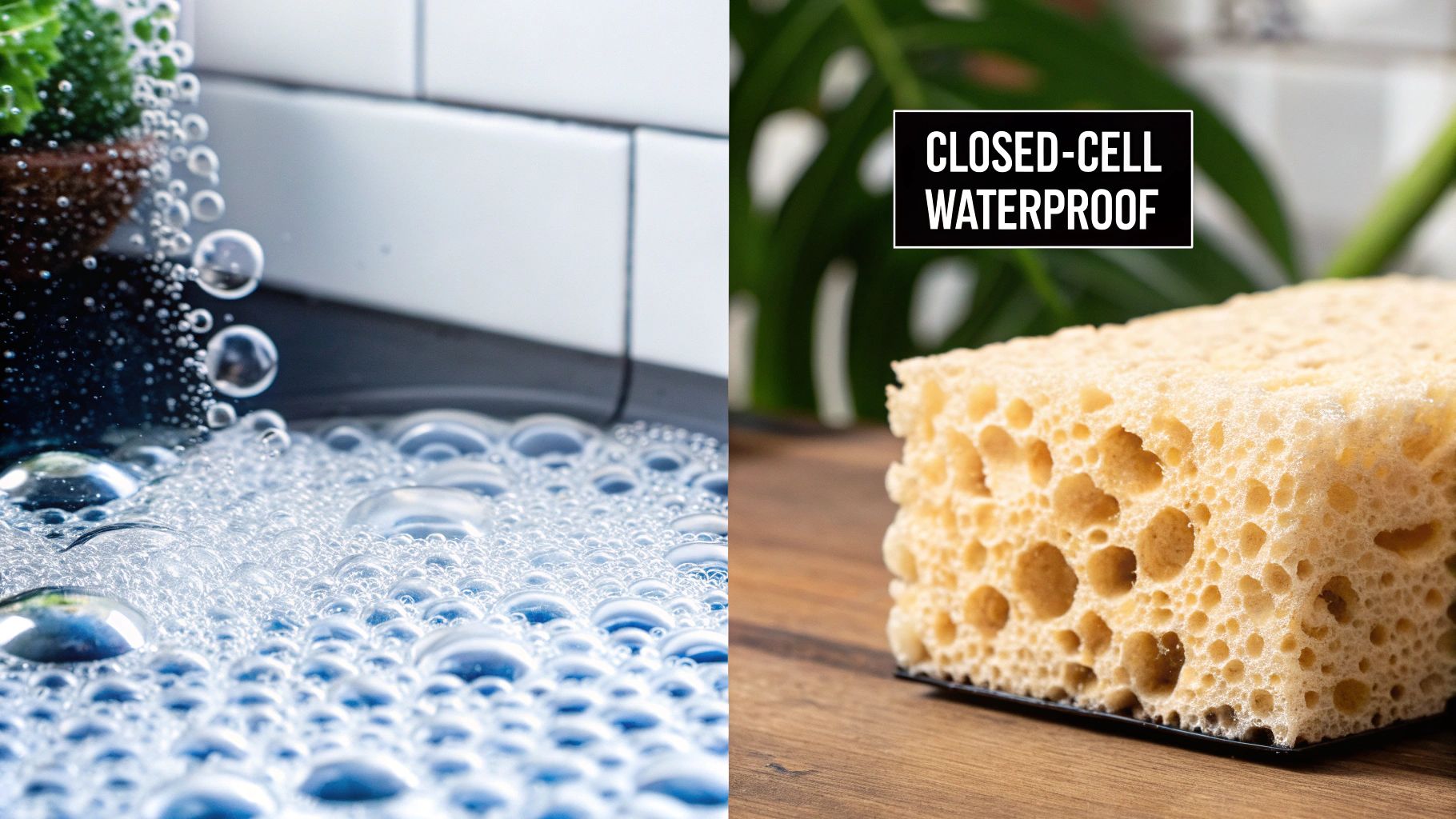
- Closed-Cell Foam: Picture a wall of microscopic, individual plastic bubbles, all sealed up and packed tightly together. Water just can't get through this dense, rigid structure. It creates a solid barrier that stops both liquid water and water vapor in its tracks.
- Open-Cell Foam: Now, think about a regular kitchen sponge. Its cells are all interconnected, which is exactly why it’s so good at soaking up and holding liquid. While it's great for dampening sound, it offers zero real defense against moisture.
This one fundamental difference is why building codes often recognize closed-cell foam as a legitimate water and vapor barrier. The same kind of careful consideration comes up with other building materials, like when homeowners ask if is cork flooring actually waterproof.
For those of us in places like Jupiter and Palm Beach Gardens, picking the right material is the first and most important line of defense against the mold, rot, and structural headaches caused by our climate.
The core takeaway is simple: not all expanding foams are created equal. For any job that needs a true watertight seal—from your attic and roof deck to the inside of your concrete block walls—closed-cell foam is the only way to go.
Waterproof vs. Water-Resistant: What It Really Means for Your Home
When we talk about protecting our homes, the words waterproof and water-resistant get tossed around a lot, often as if they mean the same thing. They don't. Getting this difference right is the first step in genuinely protecting your home from moisture, especially here in the humidity of South Florida. It helps you cut through the marketing noise and choose an insulation that actually does the job it’s supposed to.
Think about it like picking out a coat for a storm. A water-resistant windbreaker is fine for a light sprinkle; it’ll shed water for a bit, but it’s going to soak through in a real downpour. On the other hand, a truly waterproof diver’s dry suit is built to keep you bone dry even when you’re completely underwater for a long time. It’s an impermeable barrier, and that’s a world of difference.
It's Not Just About Rain—It's About the Air
When we ask if expanding foam is watertight, we can't just think about liquid water like rain or a plumbing leak. We have to talk about water vapor—that invisible moisture that’s always in the air. In a place like Palm Beach Gardens, the air is heavy with it, and that vapor can cause more silent damage than a visible leak ever could.
Lots of building materials can stop liquid water just fine but let this damaging water vapor sneak right through. This is called vapor permeance, and it’s a recipe for disaster. It can lead to condensation building up inside your walls, which feeds mold and rots wood, all without you ever seeing a single drop of water.
A truly effective moisture barrier has to stop both bulk water and sneaky water vapor. This is where the specific type of spray foam becomes critical, because only one kind is engineered to block both.
Putting It All Together
Let's ground these ideas in what they mean for your house:
- Water-Resistant: This is for materials that can handle a little bit of moisture now and then. Think of a painted wall in your living room—you can wipe it down if it gets splashed, but you wouldn't want it constantly wet. It's temporary protection, not a long-term shield.
- Waterproof: This is a material that creates a complete, unbroken shield against liquid water, even if that water pools or sits against it. This is non-negotiable for anything below ground or on a flat roof where water doesn't drain immediately.
- Vapor Barrier: This is a material specifically made to stop water vapor from passing through. In our climate, a material that is both waterproof and a strong vapor barrier offers the absolute best protection against moisture in all its forms.
This is the lens you need to use when evaluating any material for your home, from your floors to your insulation. The goal is always to match the material’s real-world capabilities to the specific moisture threat it will face. For attics and exterior walls in South Florida, controlling both liquid water and water vapor isn't a luxury—it’s absolutely essential for a healthy, long-lasting home.
A Tale of Two Foams: Closed-Cell vs. Open-Cell
To get to the bottom of whether expanding foam is watertight, you have to understand it’s not all the same stuff. Spray foam has two very different family members: closed-cell and open-cell. The difference isn't just some technical jargon—it's everything. It's the reason one can create a truly waterproof barrier while the other acts more like a sponge.
Think of closed-cell foam on a microscopic level. It's made up of countless tiny, individual plastic bubbles, and each one is completely sealed off from its neighbors. When the foam cures, these bubbles are packed together so tightly that they form a dense, rigid material. Water simply can't find a path through this locked-down structure. It hits a wall.
Open-cell foam, on the other hand, is the total opposite. Its microscopic bubbles are intentionally left interconnected, creating a web of tiny pathways. This structure makes the foam feel soft, light, and flexible, but it also means water and air can move right through it. Get it wet, and it will soak up moisture and hold onto it, making it completely wrong for any job where you need to stop water.
How Structure Dictates Performance
This basic difference in structure is what determines how each foam will perform in your home, especially here in the humid climate of South Florida. The dense, sealed nature of closed-cell foam gives it a few critical advantages for controlling moisture.
First, its rigidity actually adds structural strength. When we spray it on a roof deck, it essentially glues the sheathing to the rafters. This dramatically increases its resistance to wind uplift during a hurricane—a huge benefit in our area. Open-cell foam is far too soft to provide that kind of reinforcement.
Second, and this is the big one, is its vapor permeability. Closed-cell foam has a very low perm rating. That means it doesn't just block liquid water; it also blocks invisible water vapor. This is absolutely critical for stopping humid air from creeping into your wall cavities, condensing, and causing the mold and rot we see all the time. You can get a much deeper look into this in our complete Florida guide to open-cell vs closed-cell spray foam.
For a side-by-side look at how these two materials stack up, here’s a quick breakdown of their key characteristics when it comes to moisture and performance.
Performance Showdown: Open-Cell vs. Closed-Cell Foam
| Characteristic | Closed-Cell Spray Foam | Open-Cell Spray Foam |
|---|---|---|
| Cell Structure | Dense, individual, and sealed cells. | Interconnected cells forming a sponge-like structure. |
| Water Permeability | Very Low (<1.0 perm). Acts as a true water barrier. | High. Readily absorbs and holds water. |
| Vapor Permeability | Very Low (<1.0 perm). Blocks water vapor effectively. | High. Allows water vapor to pass through easily. |
| Density | High (typically 1.75 – 2.25 lbs/ft³). Rigid and strong. | Low (typically 0.4 – 0.75 lbs/ft³). Soft and flexible. |
| Structural Strength | Adds significant racking strength and wind uplift resistance. | Does not add structural strength. |
| Best Use Case | Exterior walls, roofs, below-grade, any area needing a moisture barrier. | Interior walls for sound dampening where moisture is not a concern. |
As you can see, when it comes to keeping water and moisture out, it's not even a fair fight.
The Clear Winner for Watertight Applications
This superior moisture resistance is exactly why closed-cell foam has taken over the market. Its effectiveness in controlling humidity has made it a go-to in modern home building, and it now holds the largest market share in the United States. Its ability to be both an insulator and a robust moisture barrier makes it the only smart choice for demanding climates like ours.
When you break it all down, the choice is pretty simple. Each foam has its place:
- Closed-Cell Foam: The right choice for any area where moisture is a concern. Its dense, waterproof structure makes it perfect for attics, exterior walls, and crawl spaces.
- Open-Cell Foam: Best used for interior jobs where sound dampening is the main goal and there’s zero risk of moisture exposure.
The bottom line is that only closed-cell spray foam has the right physical properties to be considered watertight. Its sealed-cell structure creates an impenetrable barrier to both liquid water and vapor, making it the only reliable choice for protecting your home.
Where Waterproof Foam Is Your Home's Best Defense
Let's move from theory to the real world and look at how waterproof expanding foam acts as a silent guardian in scenarios every South Florida homeowner knows all too well. These aren't just abstract concepts; they're practical situations where choosing the right foam makes the difference between a secure home and a costly, water-logged disaster.
When a professional applies it correctly, closed-cell spray foam becomes more than just insulation. It creates a seamless, monolithic barrier that’s fused directly to your home's structure. It doesn't just sit in a wall cavity—it becomes part of the wall, giving you serious protection against our unique climate challenges.
This visual gives you a clear, at-a-glance breakdown of the two foam types.
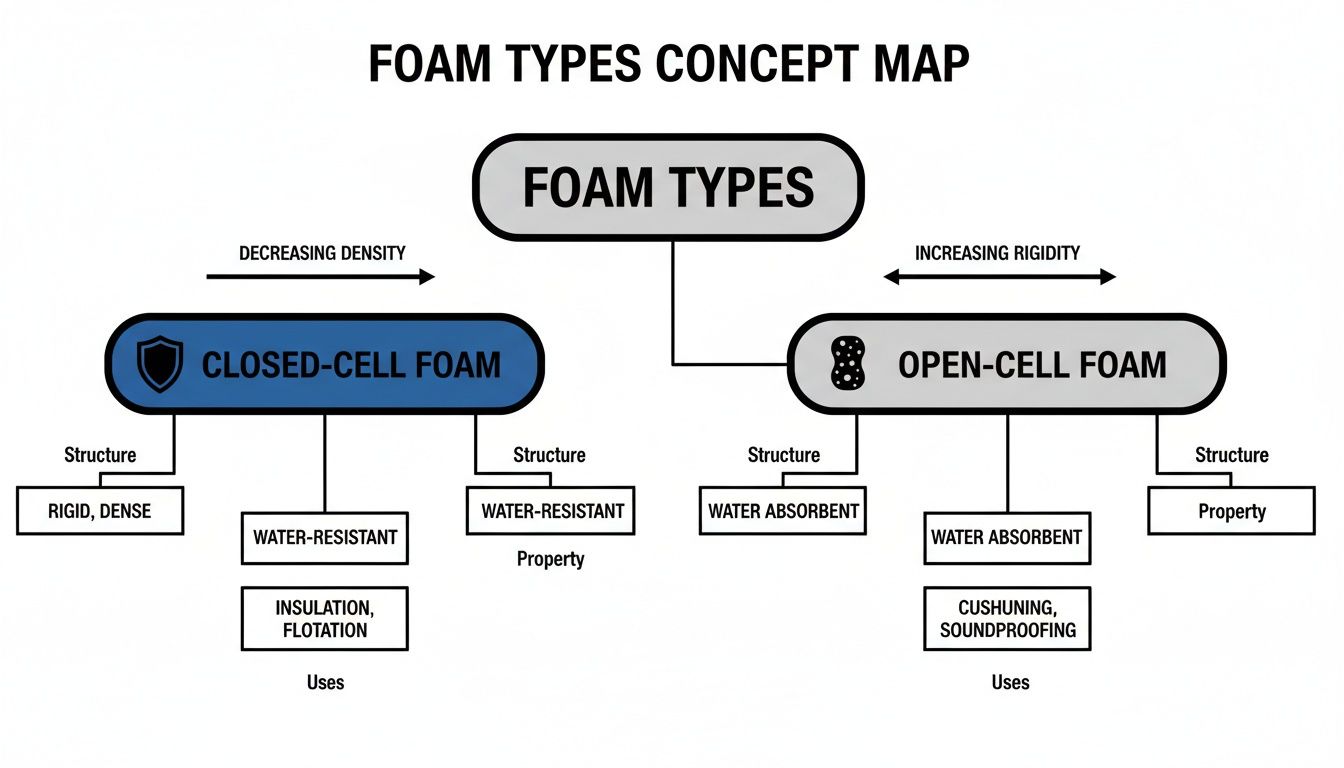
The image drives home a simple but critical idea: closed-cell foam acts like a shield, while open-cell foam behaves like a sponge.
Under Your Roof Deck
During a hurricane, losing shingles is one of the most common and dangerous things that can happen. Once they’re gone, your roof's wooden sheathing is left completely exposed to torrential, wind-driven rain, which can lead to massive water damage inside. This is where closed-cell foam provides a game-changing second line of defense.
When sprayed directly onto the underside of the roof deck, it creates a completely watertight membrane. Even if shingles get ripped off, this powerful barrier stops water from pouring into your attic and home. As a bonus, it essentially "glues" the roof deck to the rafters, adding significant structural strength to resist wind uplift.
Beyond its watertight properties, foam is also crucial for thermal performance. Understanding effective skylight insulation is a key piece of the puzzle for total home comfort and energy savings.
Think of it as a built-in, hurricane-proof tarp that’s permanently bonded to your home's most vulnerable surface. It’s an investment in resilience that truly pays for itself when the storm hits.
Sealing Concrete Block Walls
Concrete block (CBS) construction is everywhere you look in South Florida, but it's not naturally waterproof. Unsealed block is porous and will absolutely absorb moisture from our humid air and sideways rain. That leads directly to that damp, musty smell inside your home.
When closed-cell foam is sprayed on the interior of your exterior block walls, it pulls triple duty:
- It creates a true vapor barrier, preventing humid outdoor air from condensing on the cooler interior surfaces of the block—a primary cause of mold.
- It forms a perfect air seal, stopping drafts and energy loss through the countless tiny mortar joints and imperfections you can't even see.
- It provides superior insulation, which helps stabilize your indoor temperature and can drastically cut down your cooling costs.
This single application transforms a standard block wall into a high-performance, moisture-proof assembly that’s perfectly suited for our demanding climate.
Protecting Your Crawl Space
That dark, humid environment under your house? It's a breeding ground for mold, mildew, and wood rot. Moisture from the damp earth is constantly rising, creating a perpetual problem that can compromise your entire home's air quality and structural health.
Applying closed-cell spray foam to the walls and rim joists of a crawl space is the definitive solution. Its watertight and vapor-blocking properties completely isolate the space from ground moisture. This process, known as encapsulation, turns a damp, problematic area into a clean, dry, and conditioned part of your home, eliminating musty odors and protecting the floor joists above from decay.
When Spray Foam Alone Isn't the Answer
While closed-cell spray foam is a phenomenal watertight barrier, it's crucial to understand where it fits in the big picture. Think of it as a high-tech shield, not a magic wand for existing water damage. Its incredible strength and protective power are only unlocked when it's part of a complete building system, not just a standalone fix.
Let's be clear: spray foam is not a substitute for fundamental home repairs. If you have a leaky roof or a crack in your foundation, spraying foam over the problem area will only trap the water that's getting in. This creates a hidden disaster, letting moisture accelerate rot, rust, and mold growth completely out of sight until the damage becomes severe.
The golden rule is simple: fix the source of the water intrusion first. Spray foam should only be applied to a structure that's already sound, stable, and dry. It's an elite preventative measure, designed to create a powerful secondary barrier—not a primary repair patch.
A System of Defense, Not a Single Product
A truly protected home relies on multiple layers of defense working in concert. Expanding foam is at its best when it complements the other critical components of your home's exterior envelope. It’s a key player on the team, but it can't win the game by itself.
A comprehensive moisture management strategy always includes:
- Proper Flashing: This is your first line of defense. Around windows, doors, and anything that pokes through your roof, properly installed metal or membrane flashing is designed to direct bulk water away from the most vulnerable spots.
- Drainage Systems: You can't ignore gravity. Functional gutters, downspouts, and foundation drains are non-negotiable for managing rainwater and preventing hydrostatic pressure from pushing moisture right through your walls.
- Waterproofing Membranes: Especially for below-grade applications like basements, spray foam is often paired with exterior waterproofing membranes to create a robust, multi-layered shield that water simply can't penetrate.
Understanding how a vapour barrier and insulation work together is fundamental to appreciating this system-based approach to building science.
The Critical Role of Surface Preparation
Finally, the performance of even the best closed-cell foam is entirely dependent on what it’s sprayed onto. The substrate—the surface being insulated—must be meticulously prepared. We're talking clean, dry, and completely free of dust, oils, or any loose debris.
Poor prep leads to poor adhesion, creating tiny gaps and voids that completely compromise the watertight seal. This is precisely why professional installation is so non-negotiable. An expert installer ensures the substrate is perfectly ready, guaranteeing the foam creates a permanent, monolithic bond with your home's structure. Without that perfect seal, you’re left with weak spots that water will inevitably find and exploit.
Why a Perfect Seal Depends on Professional Installation
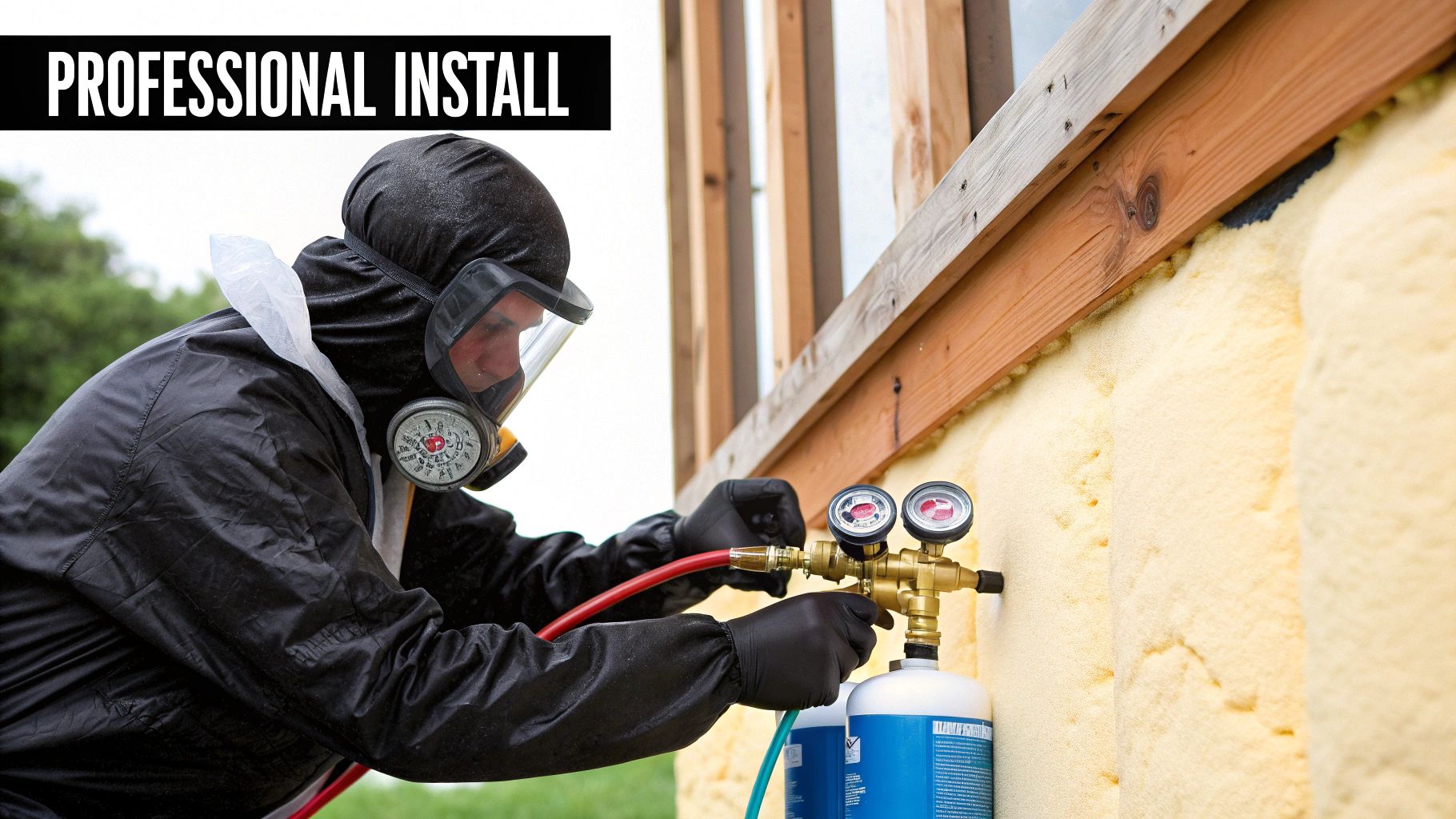
The difference between a truly watertight barrier and a costly, moisture-ridden failure isn’t in the can of foam—it’s in the hands of the person spraying it. Achieving that perfect, monolithic seal with closed-cell foam is a precise science, not a weekend DIY job. You're not just buying a product; you're investing in the expertise required to make it perform.
Here’s why: the foam’s dense, waterproof structure only forms under very specific conditions. Pros use sophisticated, high-pressure equipment to manage a complex chemical reaction in real-time. This involves dialing in exact temperatures and pressures to ensure the two liquid components mix at a perfect 1:1 ratio the second they leave the nozzle.
Any deviation, even a small one, can compromise the entire job. It's no surprise that the market for professional spray foam insulation machines is growing, as more builders recognize that the equipment and the operator are non-negotiable for a successful outcome.
The Risks of a Flawed Application
When that chemical reaction isn't perfect, the consequences can be severe, completely undermining your goal of a watertight home.
- Improper Mix Ratio: If the mix is off, the foam might not cure correctly. It can end up sticky and soft or become brittle, shrinking away from studs and leaving gaps.
- Incorrect Temperature: If the chemicals or the surface they're hitting are too cold, the foam won’t expand properly. The result is a dense, thin layer that doesn't insulate well and won't stick.
- Insufficient Thickness: A pro knows the exact thickness needed to create a true vapor barrier. Apply it too thin, and it simply won’t stop moisture from passing through.
A bad installation can lead to foam that cracks, pulls away from surfaces, or contains hidden voids. These flaws create invisible highways for water and humid air to get in, negating all the benefits and potentially trapping moisture inside your walls where it can't escape.
This is exactly why hiring a certified expert is the only way to go. They understand the science behind the application and have the equipment to get it right. To get a better picture of what goes into a professional project, it's helpful to understand the factors that determine spray foam insulation installation cost. Ultimately, a professional installer ensures the foam performs exactly as it should for the life of your home.
Your Top Spray Foam Questions, Answered
When it comes to protecting your home, especially here in South Florida, you need straight answers. We get a lot of questions from homeowners in Jupiter, Palm Beach Gardens, and all over the area about what spray foam can and can't do. Let's clear a few things up.
Can I Use Expanding Foam to Fix an Active Roof Leak?
Absolutely not. Think of spray foam as a shield, not a patch. Using it to plug an active leak is a recipe for disaster.
The foam will trap moisture against your roof decking, which can lead to serious rot and structural damage that you won't see until it's too late. The first step is always to have a professional roofer find and fix the source of the leak.
Once the roof is properly repaired and completely dry, then we can talk. Applying closed-cell spray foam to the underside of the roof deck creates an incredible secondary water barrier. It's a fantastic protective layer against future water intrusion, but it is never a primary repair for an existing leak.
Is Closed-Cell Foam a Good Choice for Concrete Block Walls?
It’s not just a good choice; it's an outstanding one for the CBS (concrete block structure) walls we see all over Florida. The dense, waterproof nature of closed-cell foam is perfectly suited to handle our relentless humidity.
Applying it to your block walls does three critical things:
- It stops condensation dead in its tracks. No more warm, moist air hitting your cooler interior block and sweating.
- It creates an unbeatable air seal, which dramatically improves your home's energy efficiency and comfort.
- It actually adds structural strength, helping to reinforce the wall and make it more resilient against high winds.
Does Spray Foam Lose Its Watertight Properties Over Time?
When it's installed by a professional who knows what they're doing, closed-cell spray foam is a "once and done" solution. It's engineered to maintain its watertight and insulating properties for the entire life of your house.
Unlike fiberglass that can sag or cellulose that can settle, spray foam cures into a solid, rigid plastic. It doesn't break down, shrink, or degrade over time. You get the same high level of performance on day one as you do on day 10,001.
This long-term stability is a huge advantage. Once installed, it becomes a permanent part of your home’s structure—no maintenance, no replacements, just continuous protection.
How Does Spray Foam Help During a Hurricane?
This is where closed-cell foam really shines. It offers two powerful lines of defense when a storm hits.
First, it acts like a super-strong glue, bonding your roof deck sheathing directly to the rafters. This dramatically increases the roof’s ability to resist the incredible uplift forces of hurricane winds.
Second, its watertight seal becomes a life-saving secondary barrier. If wind rips off shingles or tiles, that layer of foam underneath is often the only thing standing between the wind-driven rain and catastrophic water damage inside your attic and home.
At Airtight Spray Foam Insulation, we live and breathe this stuff. We specialize in giving South Florida homes the highest quality closed-cell foam applications for a truly watertight and energy-efficient shield. Request a free, no-obligation quote today to see how our expert team can protect your home.