Blog
What Is the Best Way to Insulate a Metal Building?

For a metal building in a humid climate like South Florida, there’s really only one answer if you want to do it right: closed-cell spray foam. It’s the only method that creates a single, seamless barrier against both air and moisture, something traditional options like fiberglass or rigid board just can’t deliver. This isn’t just about temperature control; it’s about stopping condensation, killing thermal bridging, and securing real, long-term energy savings.
Understanding the Top Insulation Choices
Choosing the right insulation is what turns a metal building from a sweltering “hot box” into a space that’s actually comfortable and efficient. There are a few ways to go about it, but they perform very differently, especially when you throw South Florida’s high humidity and relentless sun into the mix. The goal here is simple: control the temperature, stop condensation in its tracks, and create a truly airtight building envelope.
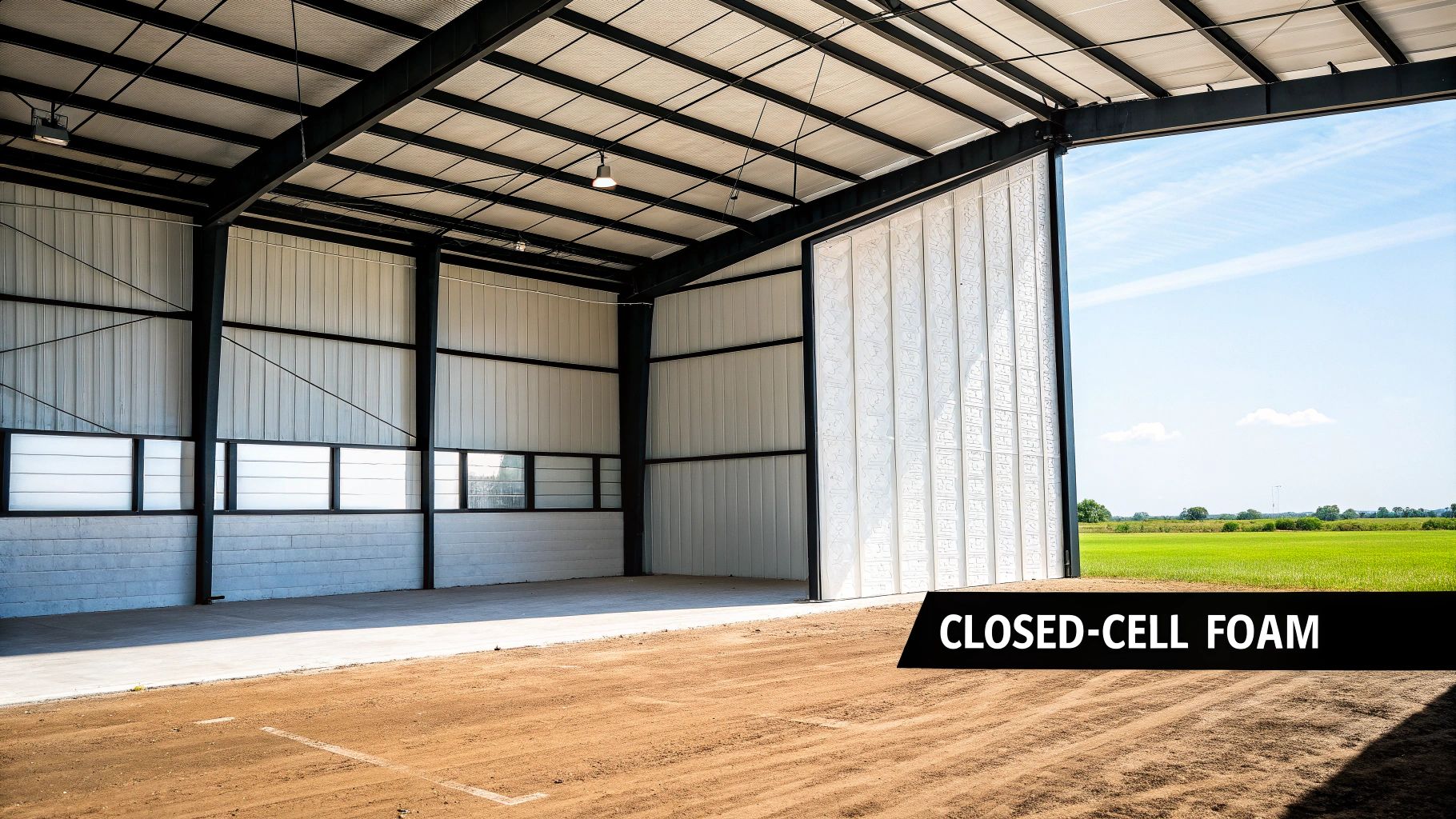
A Quick Comparison of Insulation Types
Getting a handle on the core differences makes it clear why one method stands out for our climate. Classic options like fiberglass batts are cheap upfront, but they act like a sponge for moisture, which leads to mold and a complete loss of effectiveness over time. Rigid foam boards are a step up in R-value, but every single seam is a potential failure point for air and moisture to sneak through unless they’re sealed perfectly.
Spray foam, on the other hand, is a different beast entirely. It expands on contact, filling every tiny crack, gap, and crevice.
I’ve seen it a hundred times. The biggest failure point for insulation in a metal building isn’t the material itself—it’s the installation. Gaps, seams, and compressed spots destroy performance. Spray foam’s monolithic application completely sidesteps that problem.
A well-insulated building is an efficient one, and that has a direct impact on your comfort and your monthly power bill. It also means you can size your AC system correctly. For a deep dive into that, a great resource is understanding your HVAC load calculations. Getting this right ensures you’re not overworking your equipment, which saves you money and adds years to its life.
Here’s a quick rundown of how the common choices stack up:
| Insulation Type | Air & Moisture Seal | R-Value per Inch | Condensation Control | Best For |
|---|---|---|---|---|
| Spray Foam | Excellent | 6.5 – 7.0 | Superior | Airtight, moisture-proof structures. |
| Rigid Board | Good | 4.0 – 6.5 | Good (if sealed) | DIY projects; moderate needs. |
| Fiberglass | Poor | 3.0 – 4.0 | Poor | Basic, low-humidity environments. |
| Reflective Foil | Good | Varies | Good | Hot, dry climates; supplemental use. |
Here’s the rewritten section, crafted to sound like an experienced human expert in the field.
Why Standard Insulation Fails in Metal Structures
Let’s get one thing straight: insulating a metal building is a completely different ballgame than insulating a typical wood-framed house. Metal is a unique material, and if you treat it like wood, you’re setting yourself up for some expensive problems. We’re talking about turning your building into a sweatbox in the summer and a rust-bucket in the winter.
The core issue comes down to two big challenges inherent in steel construction: thermal bridging and condensation. These aren’t just minor quirks; they can wreck your building’s integrity, send your FPL bill through the roof, and ruin whatever you’re storing inside. If you don’t get these two things right, nothing else matters.
The Problem of Thermal Bridging
Ever grab the metal handle of a hot frying pan? That’s thermal bridging in action. Heat loves to travel through metal, and in your building, the steel skeleton—all those purlins and girts—is a superhighway for heat transfer.
You can stuff the thickest fiberglass batts you can find between the steel framing, but it won’t solve the problem. Heat will just bypass the insulation and zip right through the steel, creating hot and cold spots all over your walls and roof. Here in Jupiter or West Palm Beach, that means your air conditioner is constantly running a race it can’t win against the building itself.
“A metal building without a continuous insulation barrier is like a cooler with metal rods running through it. No matter how thick the walls are, the rods will always transfer heat, rendering the insulation far less effective.”
And this isn’t a small amount of energy loss. We’re talking about a massive difference. According to historical data from the U.S. Department of Energy, an uninsulated steel building can lose heat 300-400 times faster than a wood-framed one. To get a better sense of how far insulation technology has come to combat this, it’s worth reading up on the evolution of metal structural insulation.
The Menace of Condensation
The second enemy is condensation, what a lot of people call “building sweat.” In South Florida, we live and breathe humidity. When that warm, moist air hits a cooler metal surface inside your building, the water vapor turns into liquid droplets.
This happens all the time, especially on cool mornings or when the AC is cranking. The metal roof and wall panels become the perfect surface for dew to form, and suddenly, it’s raining inside your building.
This isn’t just a little dampness; it’s a destructive cycle with serious consequences:
- Rust and Corrosion: Water is the enemy of steel. Constant moisture eats away at the panels and fasteners, causing rust that compromises the entire structure over time.
- Mold and Mildew: When traditional insulation like fiberglass gets damp, it becomes a breeding ground for mold. This not only stinks but can ruin your inventory and create an unhealthy environment.
- Damaged Goods: I’ve seen it all—dripping condensation ruining boxes of inventory, shorting out expensive equipment, and staining interior finishes. The financial loss can be huge.
This is where traditional insulation methods really fall short. Fiberglass batts act like a sponge, soaking up moisture until they sag, fall apart, and lose all their insulating value. Rigid foam boards might seem better because they don’t absorb water, but the seams between the boards can trap moisture right against the metal panels, hiding rust until it’s a major problem.
To beat condensation, you need a seamless, airtight barrier that completely separates the humid outside air from the cool interior metal. Anything less is just a temporary fix.
Comparing The Top Metal Building Insulation Options
When you’re trying to figure out the best way to insulate a metal building, you have to look past the R-value on the package and think about how the material will actually perform in the real world. A solution that works perfectly fine in a dry, cool climate can fail spectacularly in South Florida’s oppressive humidity. Let’s break down the top five insulation options—spray foam, rigid board, fiberglass, reflective barriers, and insulated metal panels (IMPs)—from the perspective of what really matters for a metal structure down here.
This diagram hits on the two biggest enemies of any metal building: runaway heat transfer and destructive condensation. Your insulation choice has to beat both.
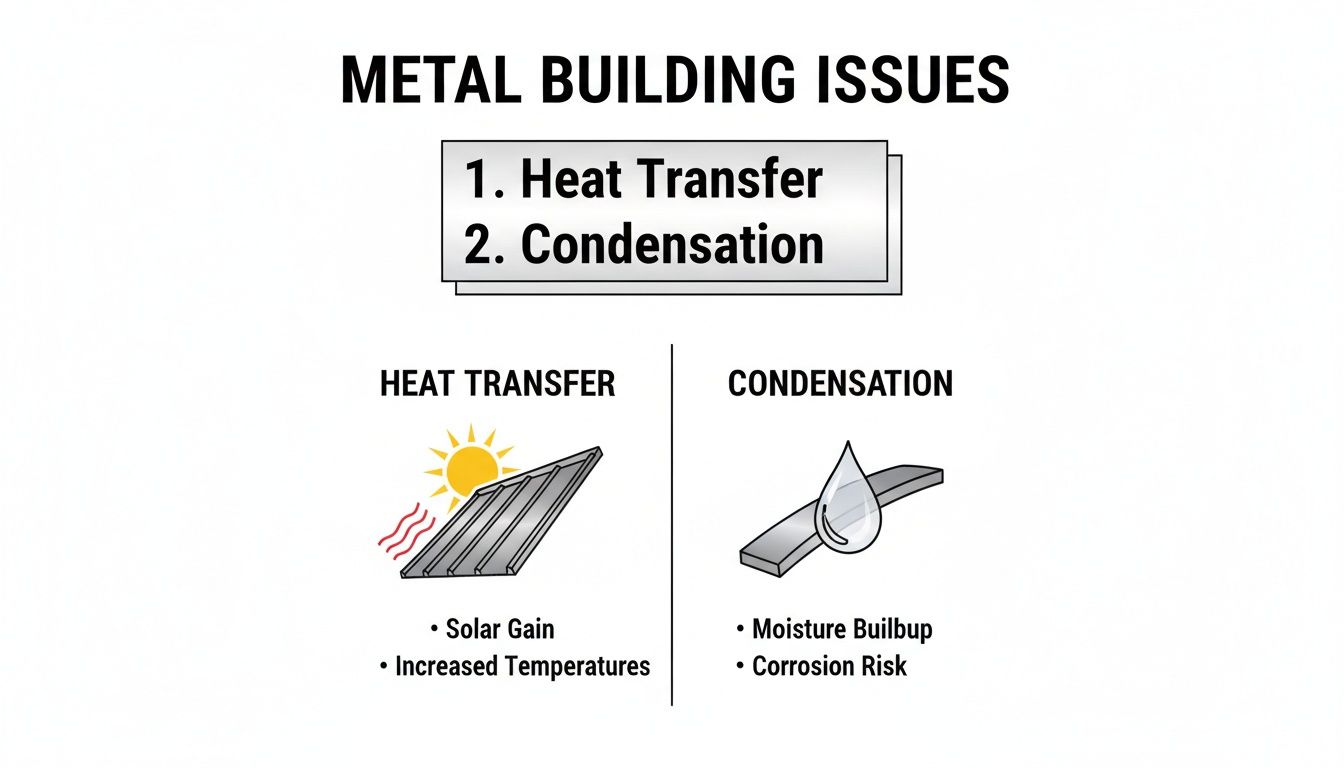
You can see how the sun bakes the metal skin while temperature differences inside create moisture. It’s a combination that demands an insulation system capable of handling both problems at once.
Fiberglass Blanket Insulation: A Common But Flawed Choice
Fiberglass batts or blanket insulation is what most people think of first. It’s cheap, it’s everywhere, and it usually comes with a vinyl facing that’s supposed to act as a vapor barrier.
The problem is, its performance in a metal building is notoriously poor over the long haul. Fiberglass sags, tears, and gets compressed easily, creating huge gaps where air and moisture sneak right past. Even worse, the moment it gets damp from condensation—which is a given in Florida—it loses most of its insulating power and becomes a perfect home for mold and mildew.
Rigid Foam Board: An Improvement With A Weakness
Rigid foam boards, like XPS or polyiso, are a definite step up from fiberglass. They deliver a higher R-value for their thickness, they don’t sag, and they won’t soak up moisture. That makes them a much more durable option for walls.
But their Achilles’ heel is the installation. Every single seam between the boards is a potential leak for air and moisture. Unless every joint is painstakingly taped and sealed, which is a massive headache on a large metal structure, the whole system is compromised from day one. Those tiny gaps become highways for thermal bridging and condensation.
Reflective Insulation: A Situational Player
Reflective insulation, or what most people call a radiant barrier, works differently. Instead of absorbing heat, it reflects it. It’s basically a high-tech layer of foil that’s fantastic at blocking radiant heat from the sun.
This stuff is really best for hot, dry climates and is almost always used with another type of insulation. By itself, it has almost no R-value and doesn’t do much to stop heat transfer through conduction or convection. It can help cut down on condensation under a roof, but it’s not a complete thermal solution for a building you plan to spend time in.
Insulated Metal Panels (IMPs): A High-End Integrated System
Insulated Metal Panels are a premium, all-in-one product. They’re made in a factory by sandwiching a core of foam insulation between two sheets of metal. The result is an incredibly efficient wall or roof system that looks clean and performs beautifully.
The big downsides here are cost and inflexibility. IMPs are one of the most expensive routes you can take, and they really only make sense for brand-new construction projects. Trying to retrofit an existing building with IMPs is usually impractical and costs a fortune.
For a new build where the budget allows, IMPs are a fantastic, high-performance product. But for the vast majority of existing metal buildings, they simply aren’t a practical option. You need a solution that can be applied to the structure you already have.
Spray Foam Insulation: The Superior Monolithic Seal
That brings us to spray polyurethane foam (SPF), which is in a class of its own. Unlike other materials that have to be cut and pieced together, spray foam is applied as a liquid. It expands on contact, creating a solid, seamless, and completely monolithic barrier.
This application method is its greatest strength. It sticks directly to the metal panels and framing, filling every last crack, gap, and weird angle. The process eliminates air leaks by its very nature, creating a perfect air seal that other systems can only dream of. For those considering which product to use, a helpful expert review of top spray foam insulation brands like Tiger Foam, Froth Pak, and Handifoam can offer deeper insights.
As our founder Christian Cates often points out, spray foam expands to fill every void, unlike vinyl-backed fiberglass that shifts and sags over time, leading to a 20-30% efficiency loss within five years. We see it in the field all the time. Real-world data from a 2022 DOE report backs this up, showing that properly insulated metal buildings maintain 15-20°F better temperature stability—a game-changer for a small business in Stuart storing sensitive goods.
Closed-cell spray foam, in particular, delivers a massive R-value of 6.5 to 7.0 per inch and acts as its own vapor barrier. It completely stops moisture from ever touching the cold metal surfaces. This solves both thermal bridging and condensation in a single application. To see how it stacks up against other applied types, check out our comparison of spray foam vs. blown-in insulation. This total performance package is why it’s consistently the best way to insulate a metal building, especially in a tough climate like South Florida’s.
Here’s a quick-glance table to help visualize how these options stack up in the areas that matter most for a metal building in our climate.
Insulation Performance Comparison For Metal Buildings
| Insulation Type | R-Value per Inch | Air Seal | Moisture Barrier | Best Use Case for Metal Buildings | Longevity & Durability |
|---|---|---|---|---|---|
| Spray Foam | 6.5 – 7.0 | Excellent | Excellent | The all-around best solution for new or existing buildings; stops condensation and air leaks. | Excellent (Rigid, permanent) |
| Rigid Board | 4.0 – 6.5 | Good | Good | A decent DIY option for walls, but seams must be perfectly sealed to be effective. | Good (Structurally stable) |
| Blanket/Fiberglass | 3.0 – 3.7 | Poor | Poor | Low-cost initial option, but prone to moisture damage, sagging, and mold. Not recommended. | Poor (Degrades with moisture) |
| Insulated Panels | 5.0 – 7.0 | Excellent | Excellent | Premium choice for new construction projects with a large budget. | Excellent (Integrated system) |
| Reflective/Barrier | 1.0 (Alone) | Poor | Fair | Best used with other insulation to reduce radiant heat, primarily in attics or roofs. | Good (Durable foil) |
As the table shows, while other options have their niche uses, spray foam consistently delivers the highest performance across the board—from R-value to the critical air and moisture seals needed to protect a metal structure for the long term.
When Spray Foam Is the Only Sensible Choice
Looking at different insulation types is a great exercise, but some situations just demand a no-compromise solution. For those of us with metal buildings here in South Florida, there are high-stakes scenarios where closed-cell spray foam isn’t just the best option—it’s the only one that truly gets the job done. This is where we stop talking about general performance and start talking about a guaranteed, permanent fix.
Think about a couple of real-world situations we see all the time. You’ve got a classic car enthusiast in Wellington trying to shield his collection from the brutal humidity that causes rust and fries delicate electronics. Or maybe a warehouse owner in Palm Beach who needs absolute climate control to protect sensitive inventory like pharmaceuticals or fine art.
In both of these cases, even a tiny failure in the insulation—a small air leak or a single spot of condensation—can lead to thousands of dollars in damage. This is exactly where spray foam’s unique abilities make it the only logical choice.
Protecting High-Value Assets and Equipment
When what’s inside your metal building is valuable or simply irreplaceable, you can’t afford to take chances with conventional insulation. Fiberglass eventually sags and soaks up moisture like a sponge, and rigid board panels will always have seams that create weak points for air and moisture to exploit.
Spray foam, on the other hand, creates a single, solid barrier. It gets sprayed directly onto the metal, expanding to fill every single crack, crevice, and corner. The result is a genuinely airtight seal that’s simply impossible to get with materials you have to cut and fit.
- For Workshops: If you’re running a CNC machine or storing high-end tools, the unwavering humidity control from spray foam is a game-changer. It prevents flash rust from forming on precision metal surfaces and shields sensitive electrical parts from moisture damage.
- For Storage Facilities: A business storing documents, electronics, or textiles can be financially wiped out by a mold outbreak. Spray foam’s moisture-blocking power eliminates the damp conditions where mold loves to grow, protecting the inventory inside.
This level of protection is why we see it used so often in specialized applications. You can dig deeper into its uses in our detailed guides on spray foam insulation.
Creating Healthy and Comfortable Living Spaces
The “barndominium” trend and other metal building homes bring a unique set of challenges. You aren’t just storing things anymore; you’re creating a home for your family. In that context, things like air quality, comfort, and the building’s durability become non-negotiable.
This is another area where closed-cell spray foam shines, tackling three critical jobs in one single application:
- Superior Thermal Resistance: It delivers a high R-value, which keeps the inside cool and stable even when the Florida sun is blazing down on that metal roof.
- An Impenetrable Vapor Barrier: It stops our thick, humid air from ever touching the cooler metal surfaces, completely shutting down the condensation that causes mold and rot.
- Enhanced Structural Strength: By bonding to the building’s frame and panels, it can actually add significant racking strength to the whole structure—a huge plus during hurricane season.
As Christian Cates, with over 25 years of hands-on experience at Airtight Spray Foam Insulation, puts it, closed-cell spray foam provides a superior R-value of 6.5 per inch, which is two to three times higher than traditional panels. This delivers not only exceptional thermal resistance but also crucial structural rigidity against Florida’s hurricane-force winds. You can discover more insights about the performance of modern metal structural insulation to see just how far the technology has come.
When Extreme Weather Is a Factor
Here in South Florida, insulation has to do a lot more than just manage the temperature. It has to stand up to hurricane-force winds and driving rain. Closed-cell spray foam acts like a powerful adhesive, basically “gluing” the roof deck and wall panels to the building’s frame.
That extra rigidity can be the difference between a building that weathers a storm and one that suffers catastrophic failure. Water getting in is the other big worry. Since spray foam creates a seamless, watertight barrier, it helps stop wind-driven rain from forcing its way through tiny gaps in the metal panels. No other insulation gives you this one-two punch of thermal performance and structural reinforcement. For any structure in our region, that resilience makes it the clear winner.
Navigating the Installation Process and Investment
So, what does it really take to get spray foam in your metal building, and what’s the real cost? This isn’t a weekend DIY job. It’s a technical process that demands precision, specialized gear, and a solid grasp of building science to get the results you’re paying for. Thinking of it as a strategic investment in your building’s long-term health, rather than just another line-item expense, is the right way to approach it.
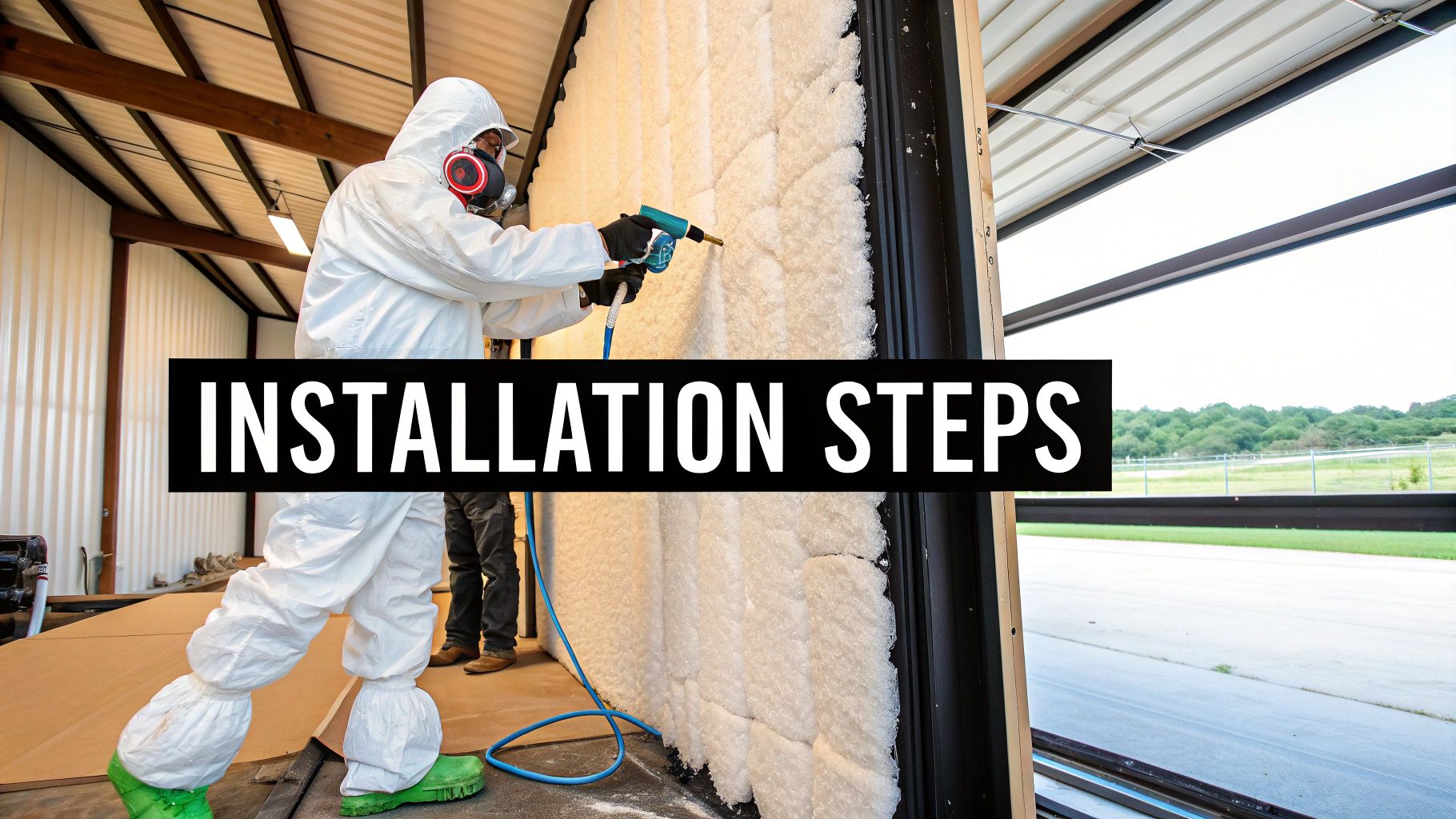
The Professional Installation Method
A quality spray foam job is methodical, with a huge emphasis on safety and getting it right the first time. Every building has its quirks, but the pros follow a proven game plan to create that perfect, seamless seal.
- Initial Consultation and Assessment: An expert will walk your site to understand its size, condition, and how you plan to use it. This is where we figure out the right tool for the job—open-cell or closed-cell—and how thick it needs to be to hit your performance targets and meet local codes.
- Meticulous Site Preparation: Honestly, this is where a good job becomes a great one. The crew preps everything, covering doors, windows, and floors. They also make sure the metal surfaces are perfectly clean and dry, with no oil or grime that could mess with adhesion.
- Controlled Application: Certified technicians, geared up in full personal protective equipment (PPE), use high-pressure equipment to apply the foam. They move methodically, ensuring an even thickness across every surface and paying extra attention to tricky spots like corners and framing to leave zero air gaps.
- Quality Assurance and Cleanup: Once the foam cures, they do a final walkthrough to check for uniform coverage and depth. After that, they clean up the site, leaving you with a building that’s fully sealed and ready to perform.
Breaking Down the Investment
Looking at the price of spray foam is about understanding its long-term value, not just the upfront cost. Several factors influence the final number, and they all tie back to performance.
While the initial cost is higher than fiberglass, spray foam’s real value comes from its durability and performance. It’s a one-and-done investment that stops costly moisture damage, slashes energy bills, and even adds to the building’s structural strength for decades.
The total project cost really comes down to a few things:
- Type of Foam: Closed-cell foam is the heavy-hitter—it’s denser, gives you a higher R-value, and acts as a vapor barrier. That makes it more expensive than open-cell foam.
- Required Thickness: The R-value you need dictates how deep we spray. A thicker application means more material and labor, which bumps up the cost.
- Building Complexity: A simple, wide-open warehouse is a straightforward job. A building with intricate framing, lots of obstacles, or hard-to-reach nooks and crannies will take more time and skill.
- Surface Preparation: If your metal surfaces need a deep clean or special priming before we can spray, that will add to the labor cost.
But this investment pays you back. The insulation market is set to hit USD 128.11 billion by 2034, with a huge chunk of that coming from retrofitting existing buildings like yours. Modern spray foam is the go-to for metal buildings, delivering 3-4 times the insulation value of older panel systems. In fact, studies by Oak Ridge National Lab have shown it can cut energy use by up to 50%.
You can read more about the growing metal insulation panel market to see where the industry is heading. When you choose the best way to insulate a metal building, you’re not just buying a product—you’re investing in decades of efficiency and protection.
Choosing the Right Insulation Contractor in Florida
Even the best insulation money can buy will underperform if it’s installed poorly. Choosing the right contractor is every bit as critical as selecting the right material, particularly when you’re trying to insulate a metal building from Florida’s relentless heat and humidity. A top-tier installer doesn’t just show up with equipment; they bring a deep, practical understanding of our regional building science.
An expert knows exactly how to prepare metal surfaces for a perfect, lasting bond. They understand the precise thickness needed to create a seamless air and vapor barrier that performs for decades. This hands-on expertise is what turns a good product into a permanent solution—one that stops energy loss cold, prevents condensation, and protects your building’s integrity.
Look for Proven Metal Building Experience
When you start vetting contractors, put the ones with extensive, direct experience with metal buildings in our climate at the very top of your list. This is no job for a generalist. A true specialist gets the unique challenges posed by thermal bridging through steel framing and the constant battle against moisture intrusion.
A contractor’s commitment to quality shines through in their process. They should be obsessive about site prep, strict with their safety protocols, and completely transparent about every step. That’s how you know the final result will deliver guaranteed performance for years to come.
This kind of specialized knowledge ensures the job is done right the first time, saving you headaches and money down the road. Professionals who offer spray foam insulation in West Palm Beach, FL, and the surrounding areas have a home-field advantage—they understand our local codes and climate demands better than anyone.
Ultimately, partnering with a proven specialist is your best guarantee for creating a metal building that’s comfortable, efficient, and built to last. The next move is to schedule a professional consultation and get a solution designed specifically to solve your building’s insulation challenges for good.
Common Questions About Insulating a Metal Building
Even after laying out the options, you probably still have a few questions. That’s completely normal. Making the right call for your metal building is a big investment, and getting straight answers is the only way to feel confident.
Here are a few of the most common questions we hear from building owners across South Florida.
Is Spray Foam Insulation Safe for My Metal Building?
Yes, it is, but only when it’s installed by a certified professional. Once modern spray foam has fully cured, it’s a completely inert and stable material. It doesn’t off-gas or release anything harmful into the air.
That’s why professional installers are so strict about safety protocols. We use proper ventilation and wear personal protective equipment (PPE) during the application to guarantee a safe environment, both for our technicians and for anyone who uses the building afterward.
How Long Will Spray Foam Actually Last in a Metal Structure?
Spray foam is pretty much a permanent solution. This isn’t like other materials that can sag, settle, or break down over time. Spray foam actually bonds directly to the metal panels and framing, becoming a rigid, structural part of the building itself.
It’s engineered to last for the entire lifespan of your building. You can expect consistent thermal performance and moisture control year after year without ever thinking about replacing it. It’s truly a one-and-done investment.
The real advantage here is longevity. Spray foam won’t compact or get waterlogged like fiberglass, so its R-value and air seal stay put for decades. That’s what protects your building from the rust and rot we see so often down here.
Do I Still Need to Install a Vapor Barrier with Spray Foam?
No, and this is one of its biggest advantages in a humid climate like ours. When you use closed-cell spray foam, you do not need an additional vapor barrier.
Closed-cell is unique because it’s an all-in-one system: it’s your insulation, your air barrier, and your vapor barrier. Its dense, non-permeable structure stops moisture dead in its tracks, so there’s no need for that separate plastic sheeting. That means less complexity and lower installation costs.
Can Spray Foam Be Applied to an Existing Metal Building?
Absolutely. In fact, retrofitting existing metal buildings is one of our most common jobs. Professionals can apply spray foam directly to the interior walls and the underside of the roof deck.
Because it’s applied as a liquid, it flows into every nook and cranny—around existing wiring, plumbing, and framing—to create a perfect, seamless seal. This process completely eliminates old air leaks and dramatically boosts the building’s efficiency and comfort.
Ready to make your metal building a comfortable, energy-efficient space that can stand up to South Florida’s climate? The experts at Airtight Spray Foam Insulation have the hands-on experience to deliver a permanent solution. Request a free quote today and find out what a true airtight seal can do for your property.
Homeowners in Jupiter, FL can learn more about our spray foam insulation services designed to improve comfort, control moisture, and increase energy efficiency in South Florida homes.