If you’ve ever typed "sound proof insulation spray" into a search bar, you know exactly what you’re after: a little more peace and quiet in your own home. While there’s no magic bullet that can make a room completely soundproof, acoustic spray foam insulation gets you remarkably close by being incredibly effective at sound dampening. It’s all about creating an airtight seal that dramatically cuts down on the noise that makes its way into your living space.
Most of the noise that drives us crazy—the traffic from busy South Florida streets, the planes overhead, or even just a loud TV in the next room—is airborne. Think of sound waves like water; they’ll find any path they can to get in. They sneak through thousands of tiny, invisible gaps and cracks in your home's walls, attic, and ceilings.
Traditional insulation like fiberglass batts can help, but they often leave small gaps around outlets, pipes, and wood framing. These little voids become superhighways for sound. This is where spray foam changes the game. We apply it as a liquid, and it expands to fill every single nook and cranny, creating one solid, seamless barrier. It doesn't just block those sound highways; it eliminates them entirely. The result isn't dead silence, but you’ll absolutely notice a massive drop in background noise.
The secret to spray foam's acoustic muscle is its ability to create a perfect air seal. When you stop air from moving through your walls, you stop the sound traveling with it. It’s that simple. It’s the reason a properly sealed wall or attic just feels quieter and more solid.
A complete air seal is the absolute foundation of good sound control. By cutting off the main path for airborne noise, you're not just muffling sound—you're stopping it before it even gets started. This is what brings real peace and quiet back into your home.
This gives you a powerful two-for-one punch. That same airtight seal that quiets your home also keeps your conditioned air inside and the hot, humid Florida air outside. This means you also get:
It's really important to know the difference between "sound dampening" and "soundproofing." Spray foam is a champion of sound dampening—it absorbs and deadens sound waves, making a room significantly quieter. It’s fantastic for dealing with common frustrations like traffic, barking dogs, and neighborhood noise.
True soundproofing is a whole different level of construction. It’s what you’d find in a recording studio or a high-end home theater. That involves complex, expensive techniques like adding incredible mass (think multiple layers of drywall) and decoupling walls so they don't touch.
For the vast majority of homeowners in places like Palm Beach Gardens or Wellington who just want relief from everyday noise, a professional sound proof insulation spray application is the perfect solution. It delivers the best balance of performance and value, turning a noisy, frustrating house into a peaceful retreat.
To really get why spray foam insulation is so good at quieting a home, you first have to understand how sound actually gets around. Noise isn't just one thing; it moves in two different ways, and spray foam has a unique strategy for handling each one.
The most common culprit is what we call airborne noise. Think of conversations in the next room, the TV blasting, traffic from a busy street, or planes flying overhead. These are sound waves traveling through the air, and they will find any little crack or gap—around windows, under doors, through outlets—to sneak into your space.
Then there's structure-borne noise, which you might know as impact noise. This is the thud of footsteps from the floor above, a door slamming shut, or the deep rumble from a home theater system. This kind of sound doesn't travel through the air; it vibrates directly through the solid materials of your house, like the wood studs and drywall.
Not all spray foam is the same. The two main types, open-cell and closed-cell, play very different roles in sound control. It's a bit like how a car's suspension uses both springs and shock absorbers to give you a smooth ride—each component has a specific job.
Open-cell spray foam is the master of absorbing airborne noise. It has a soft, almost spongy texture because its cellular structure is, as the name suggests, "open."
When sound waves from your neighbor's music hit a wall filled with open-cell foam, they enter a complex maze of tiny air pockets. Instead of passing through, the sound energy gets trapped, bouncing around inside these cells until it fizzles out into a tiny, unnoticeable amount of heat. The sound essentially gets lost and runs out of steam.
Closed-cell spray foam, on the other hand, is completely different. It’s dense, rigid, and incredibly strong because its cells are sealed tight. This density is the key to fighting structure-borne noise. By adding mass and rigidity to a wall, it dampens vibrations before they can travel through the framing of your home. Those annoying thuds and rumbles get stopped in their tracks.
You can dive deeper into how different insulation types work in our detailed guide on insulation as a sound barrier.
This visual helps show how spray foam works to create a quieter, more peaceful home by sealing up all those little pathways noise loves to use.
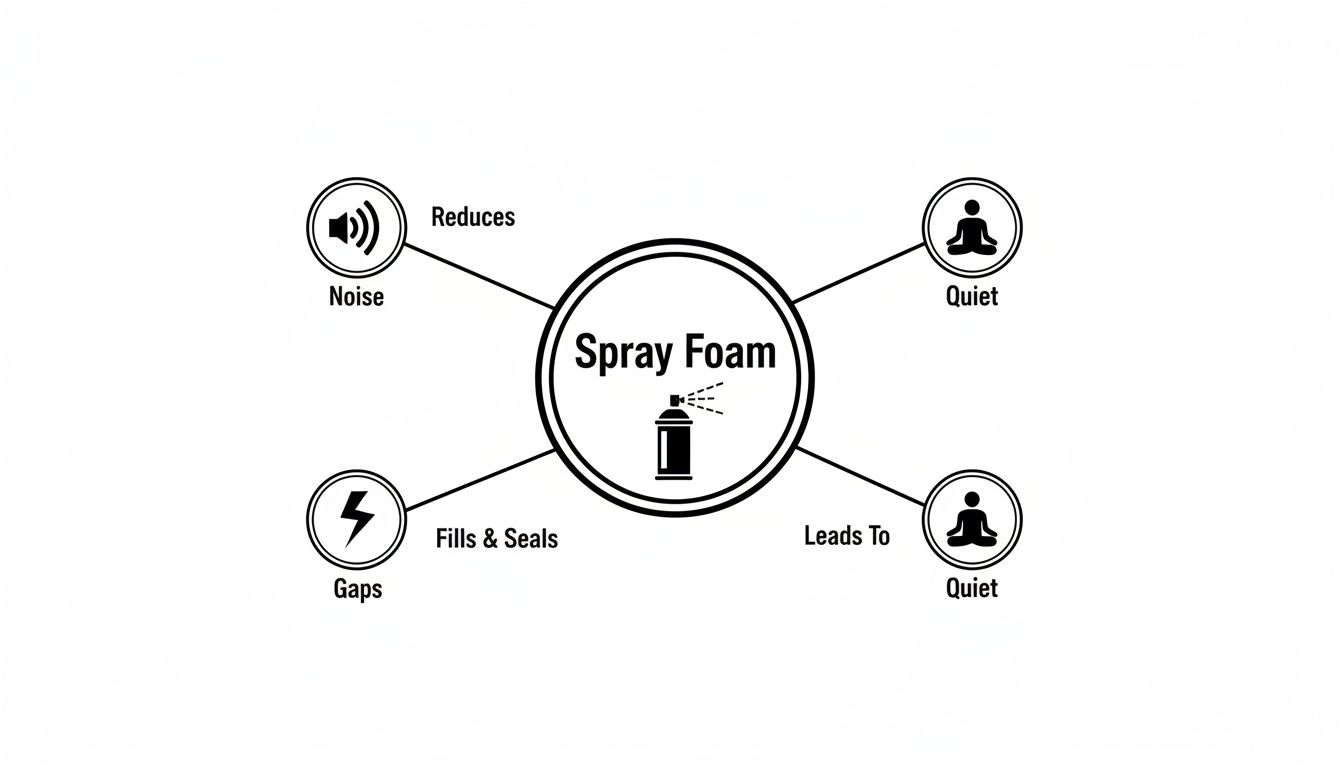
As you can see, it's all about creating an airtight seal. When you eliminate the air gaps, you eliminate the primary routes for noise to travel.
Here’s a quick breakdown to help you see the difference at a glance:
| Feature | Open-Cell Spray Foam | Closed-Cell Spray Foam |
|---|---|---|
| Primary Sound Target | Airborne Noise (voices, music) | Structure-Borne Noise (impacts, vibrations) |
| How It Works | Sound Absorption (traps sound waves) | Sound Blocking (adds mass & dampens vibrations) |
| Density | Low-density, soft, and flexible | High-density, rigid, and strong |
| Best For | Interior walls, home theaters, ceilings | Exterior walls, floors, areas needing structural support |
| NRC Rating (Absorption) | Excellent (0.70 or higher) | Fair to Poor |
| STC Rating (Blocking) | Good (improves assembly) | Very Good (adds significant mass) |
Choosing the right foam for the job is crucial. For a home theater, open-cell is king. For reducing noise from a busy road through an exterior wall, closed-cell provides the mass needed to make a real difference.
In the building industry, we don't just guess if something is "quiet." We use two specific ratings to measure acoustic performance. Understanding these will help you know exactly what you're getting.
Sound Transmission Class (STC): This number tells you how well a wall, floor, or ceiling assembly blocks airborne sound from passing right through it. A higher STC rating is better. For example, a standard interior wall might have an STC of 35. Adding the right insulation and materials can easily boost that to an STC of 50 or more, which would make loud speech on the other side barely audible.
Noise Reduction Coefficient (NRC): This measures how well a material absorbs sound within a room, cutting down on echo and reverb. The scale runs from 0 (like a mirror for sound) to 1 (like a black hole for sound). Open-cell foam is a true champion here, with an NRC often at 0.70 or higher. That means it absorbs 70% of the sound that hits its surface, which is fantastic for places like media rooms, offices, or open-concept living areas.
By using the right foam in the right places, we can strategically improve both STC and NRC ratings. This gives you a home that not only keeps outside noise out but also sounds better on the inside.
Knowing the science behind acoustic spray foam is great, but the real magic happens when you know exactly where to put it for the biggest impact. It’s not about blanketing your whole house; it’s about a targeted approach, using sound proof insulation spray to create peaceful zones and solve specific noise headaches.

Let's walk through the most common problem areas and see how we can transform them into quiet, functional spaces.
Let’s be honest, some of the most annoying noises come from inside our own homes. The TV blaring from the living room, loud conversations, or kids playing can bleed right through standard drywall, making it impossible to find a quiet spot to think.
This is a perfect job for open-cell spray foam. Its soft, sponge-like structure is brilliant at absorbing those airborne sound waves. When we apply it between the studs in your interior walls, we can effectively create room-to-room sound isolation.
Think about these high-impact spots:
Treating these key walls means you can create dedicated quiet zones without making everyone else tiptoe around. You can dig deeper by exploring our overview of the best insulation for noise reduction to see how different materials stack up.
Your roof is the single largest surface of your home exposed to the outside world. That makes it a massive gateway for outdoor noise—especially here in South Florida, with the constant hum of traffic, lawn crews, and planes from nearby airports.
By applying spray foam directly to the underside of your roof deck, you create an unbroken barrier against both air and sound, right at the source.
Think of an uninsulated attic as a giant drum. Every sound that hits your roof—rain, wind, a passing plane—is amplified. Spray foam essentially mutes that drum. It forms a seamless layer that absorbs the sound energy, stopping it dead before it can travel down into your home.
This is incredibly effective against:
Garages and workshops are often the source of some serious noise. Power tools, air compressors, and weekend projects can generate sounds that easily vibrate through shared walls and drive the rest of the house (and the neighbors) crazy. The goal here is containment—keeping the loud inside.
Applying spray foam to the garage walls and ceiling, especially any wall connected to your living space, acts as a powerful sound buffer. Open-cell foam is great for absorbing the high-pitched whine of saws, while closed-cell foam adds mass to help dampen the low-frequency rumble of heavy equipment. Your garage becomes a truly usable workspace that doesn't disrupt the peace.
Anyone who has been inside a metal building during a rainstorm knows how loud they are. These structures, popular for workshops and storage in South Florida, are basically noise amplifiers. Their thin metal panels offer zero resistance to sound.
For these buildings, sound proof insulation spray is less of a luxury and more of a necessity. Closed-cell spray foam is the clear winner here. It bonds directly to the metal panels, adding mass and making them more rigid. This does two critical things at once: it dampens the vibrations from wind and rain, and its airtight seal absorbs airborne sound. The difference is night and day—transforming a loud, echoing shell into a comfortable, functional space.
Whenever you're thinking about investing in your home, the bottom line is always part of the conversation. But with soundproofing spray foam, it’s not just about what you spend—it’s about what you get back. Think of it less as a one-time expense and more as a long-term upgrade that delivers value in ways you might not expect.
Of course, every project is unique, so the final price tag will depend on a few key things. But the return on that investment? That shows up in your peace of mind and your wallet. The same powerful thermal properties that make spray foam a soundproofing champ also make it an energy-saving powerhouse.
So, what goes into the final quote for a professional spray foam job? It really comes down to a few core variables. Understanding these helps you see exactly where your money is going.
The main factors are:
For a deeper dive into the numbers for your specific project, take a look at our guide on the cost of spray foam insulation. It'll give you a much clearer picture of what to budget for.
A quiet, peaceful home is a fantastic immediate reward, but the financial return on investment (ROI) is where things get really interesting. Spray foam’s superpower is its ability to create a truly airtight seal, and that has a direct impact on your energy bills.
In South Florida, your air conditioner is one of the biggest energy hogs in your house. Spray foam seals up all those tiny cracks and gaps, stopping that precious cool air from leaking out and preventing hot, humid air from sneaking in. Your HVAC system doesn't have to work nearly as hard, which can lead to savings of up to 40% on your annual heating and cooling costs.
The investment in acoustic spray foam is one that works for you 24/7. It dampens noise when you need quiet and saves you money on energy bills every single month, delivering a dual return that few other home improvements can match.
The benefits don't stop with sound and savings. In a climate like ours—humid and prone to storms—spray foam offers some serious secondary advantages that protect your home and add to its long-term value.
Closed-cell spray foam, in particular, adds a remarkable amount of structural strength to walls and roof decks, helping brace your home against high winds. Better yet, its dense, non-porous structure is a formidable barrier against water intrusion and mold growth, which is an absolute must-have defense here in South Florida.
This isn't just a niche benefit, either. The global spray foam industry was valued at around USD 2.4 billion in 2023 and is on a major growth trajectory, a trend powered by homeowners who want exactly these benefits. You can see more on this from global industry analysts. It all adds up to a smart upgrade—for your comfort, your wallet, and your property’s future.
Spray foam is a fantastic tool for cutting down noise, but let's be real—for those projects where you need true silence, it’s just the starting point. Think of a home theater, a recording space, or a bedroom you want to be an absolute sanctuary. In these cases, spray foam is the foundation of a much bigger, multi-layered system.
Think of it like building a fortress. Your sound proof insulation spray is that first critical line of defense. It seals every single crack and gap, stopping airborne sound from sneaking through. But to stop the really stubborn noises, you need more layers.
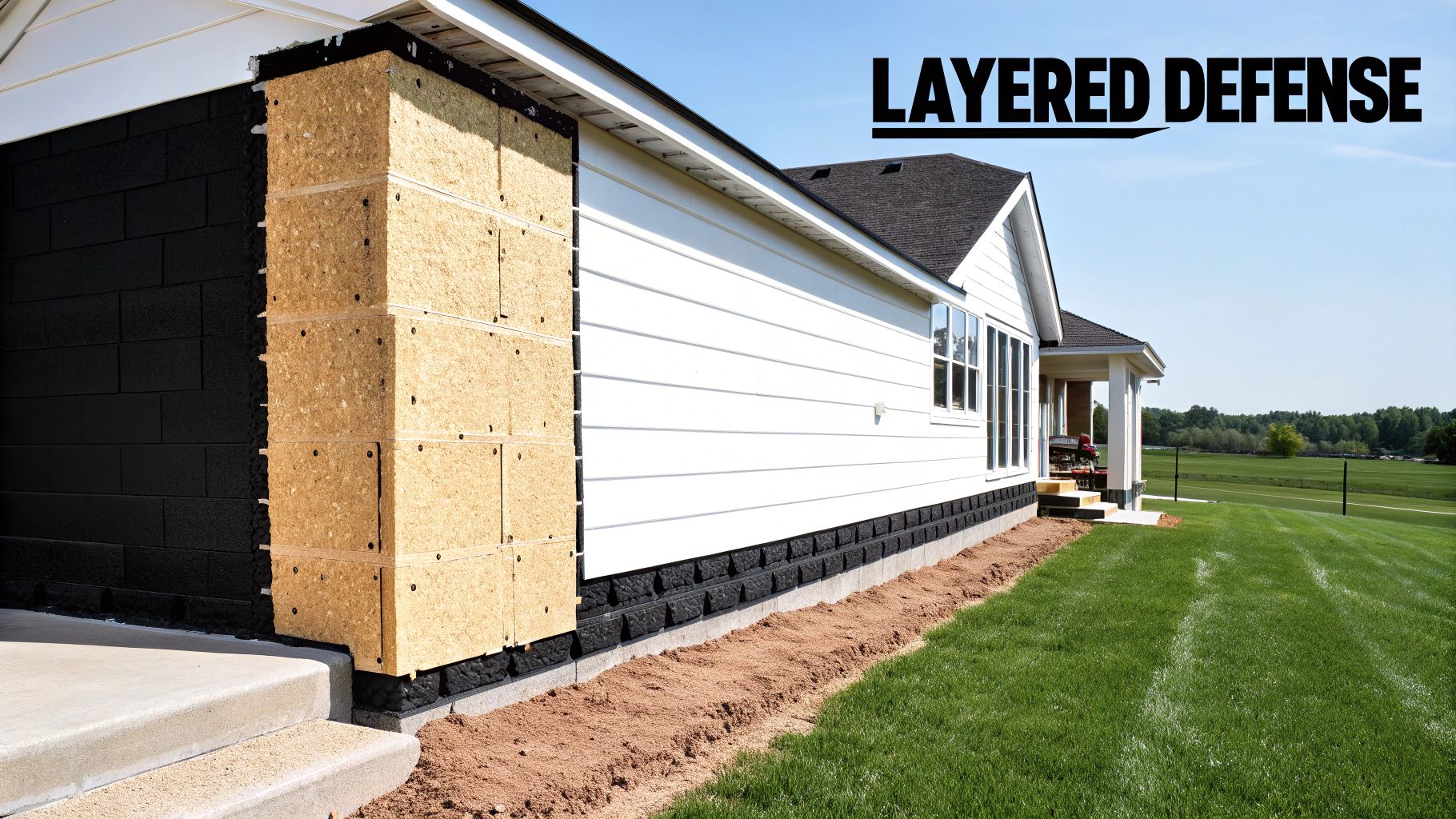
This is where we go from simply dampening sound to engineering a full-on soundproofing strategy. By pairing spray foam's incredible air-sealing power with other proven acoustic tricks, we can build a wall assembly that blocks a massive spectrum of sound, from high-pitched chatter all the way down to those low, rumbling frequencies.
One of the oldest rules in soundproofing is simple: mass blocks sound. The heavier and denser a wall is, the more energy it takes for sound waves to make it vibrate and pass through. While spray foam adds a bit of mass, we can dramatically improve performance by adding materials specifically designed to be heavy.
It’s a straightforward concept that delivers powerful results. Here are a few of the most effective ways to do it:
Adding mass is like upgrading your shield from wood to steel—it just stops more of the attack.
Mass is great for blocking airborne sound, but what about vibrations? Low-frequency sounds from a subwoofer or heavy footsteps can travel right through the solid structure of your home—the studs, joists, and floors. This is where decoupling comes in.
The goal is to create a physical break in the wall assembly so vibrations have no direct path from one side to the other.
Decoupling is like cutting the string on a tin can telephone. No matter how loudly you shout into one can, the sound can't reach the other because the physical connection is gone.
This technique is a cornerstone of any professional soundproofing job. Here’s how we do it:
So, what happens when you combine all these elements? You get a truly formidable soundproof barrier.
Picture this: we start by filling the stud cavities with open-cell spray foam to absorb airborne sound. Then, we attach sound isolation clips to the studs and hang a layer of Mass Loaded Vinyl. To finish it off, we install two layers of 5/8-inch acoustic drywall.
This multi-layered approach attacks sound from every angle: the foam absorbs it, the mass blocks it, and the decoupling stops the vibrations. It’s a comprehensive system.
And this focus on high-performance building isn't just local; it's a global trend. The demand for materials that create quieter, more comfortable spaces is skyrocketing. In fact, the Asia-Pacific region, with its boom in modern construction, held 36.85% of the global spray foam market share in 2025. You can dig into the numbers yourself and read more about these global market trends in spray foam insulation. It just goes to show that people everywhere are investing in creating better, more peaceful homes.
The incredible sound-dampening power of spray foam only comes to life with a perfect application. It might be tempting to think about a DIY kit, but getting that flawless, airtight seal needed for real sound control is a science. This isn't a weekend warrior project; it's a technical job where experience is everything.
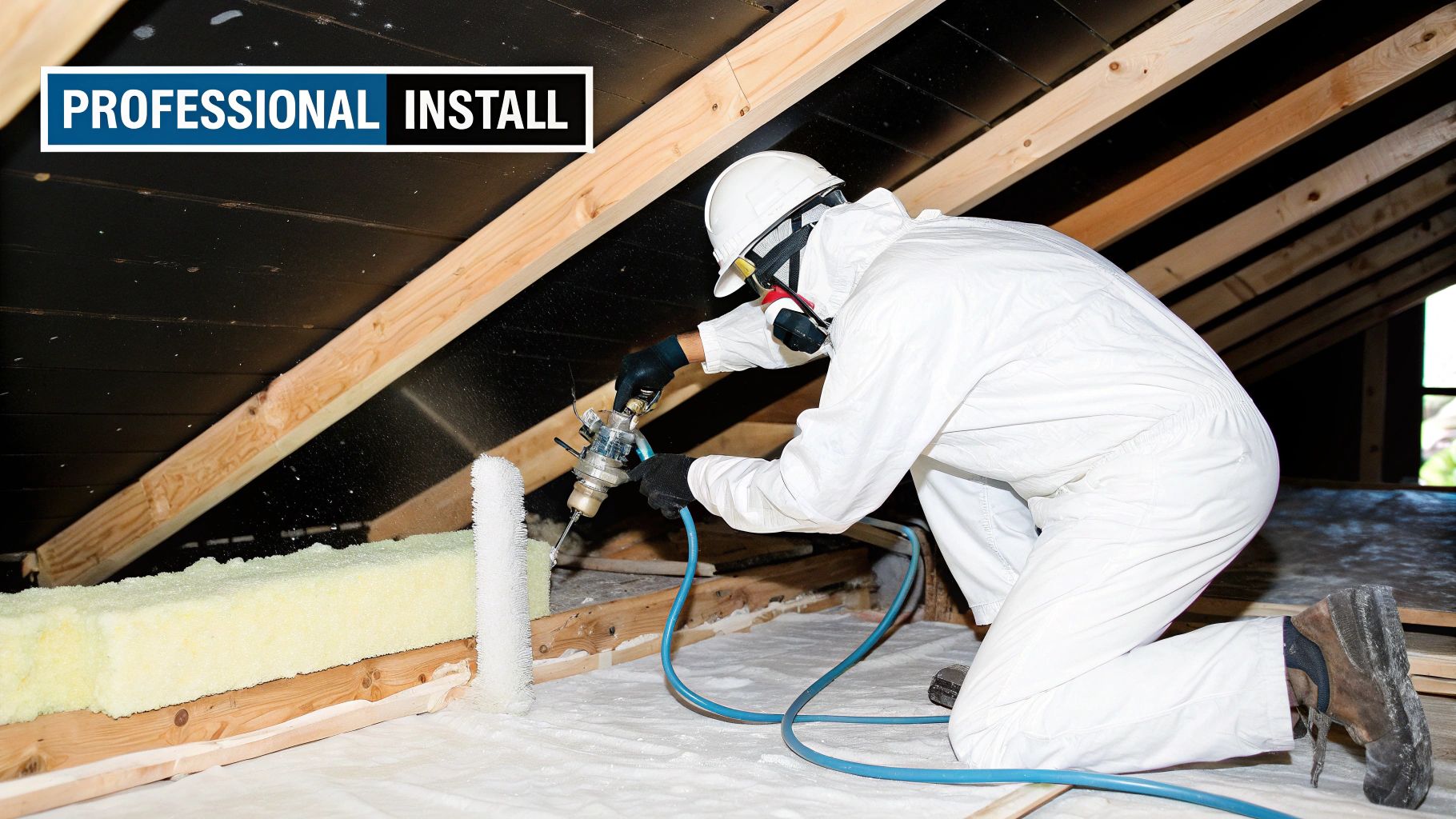
Even the tiniest mistake can create an acoustic weak spot, completely torpedoing your investment. A gap the size of a quarter can let in a shocking amount of noise, making the rest of the insulation almost useless for soundproofing. Professional installers are trained to hunt down and eliminate these exact problems before they happen.
A certified technician isn’t just pointing a hose. They’re following a strict, multi-step playbook designed to guarantee top-notch performance and safety from the moment they arrive. This process is how your sound proof insulation spray actually delivers on its promise of peace and quiet.
The key stages always include:
Choosing a professional installer isn't about convenience. It’s about making sure the chemical reaction happens correctly, the application is seamless, and the final product is a safe, high-performance acoustic and thermal barrier.
The equipment we use for spray foam is highly specialized, costs a fortune, and takes serious training to operate correctly. An amateur trying to wing it can lead to a long list of failures that completely compromise the sound barrier you’re trying to build.
Some of the most common DIY pitfalls are:
At the end of the day, the goal is to create a single, continuous, monolithic seal. That's what turns a standard wall into a real sound barrier. Only a trained pro has the equipment, the hands-on experience, and the knowledge to get it done right the first time, ensuring your insulation performs as an elite acoustic solution from day one.
Even after getting the facts, it’s completely normal to have a few more questions pop up. We get it. Here are the straight-up answers to the most common things we hear from homeowners around South Florida.
Let's be clear: while spray foam works wonders for reducing noise, no single product can make a room 100% soundproof. It's incredibly effective at knocking down airborne sounds—think traffic, neighborhood chatter, or a barking dog—because it creates a perfect air seal. No air leaks, no sound travel.
But if you’re looking for true isolation from things like deep bass from a sound system or the thud of footsteps from upstairs, spray foam is best used as a key player on a bigger team. For that level of quiet, you’d want to combine it with other strategies, like adding mass with an extra layer of drywall or decoupling the walls to stop vibrations in their tracks.
This is a great question, and the answer really depends on what kind of sound you’re trying to stop.
Open-cell foam is the hands-down champion for absorbing sound. Its soft, almost spongy texture is perfect for soaking up mid-to-high frequency airborne noises. This makes it our go-to for interior walls between a home office and a living room, or for creating a quiet media room. Closed-cell foam, on the other hand, is dense and rigid, making it better at dampening structural vibrations.
We have to be firm on this one: absolutely not. Installing spray foam is a job strictly for trained professionals. It requires very expensive, specialized equipment and, more importantly, extensive safety training and professional-grade personal protective equipment (PPE) to handle the chemicals safely.
A botched DIY job isn't just ineffective—it's a potential safety hazard. You won't get the acoustic or thermal benefits, and you could introduce harmful chemicals into your home. Professional installation is the only way to guarantee a complete, effective seal that performs like it should from day one.
Ready to dial down the noise and make your home the peaceful retreat you deserve? The team at Airtight Spray Foam Insulation has the hands-on experience to deliver the quiet comfort you've been looking for. Request your free, no-obligation quote today!