Imagine giving your roof a seamless, custom-fit protective layer that seals every single crack and gap. That’s the real idea behind spray foam roofing—it’s a liquid-applied system that creates a solid, waterproof, and insulated barrier right on top of your existing roof structure. It’s an approach that’s especially powerful for handling the unique challenges we face here in South Florida.
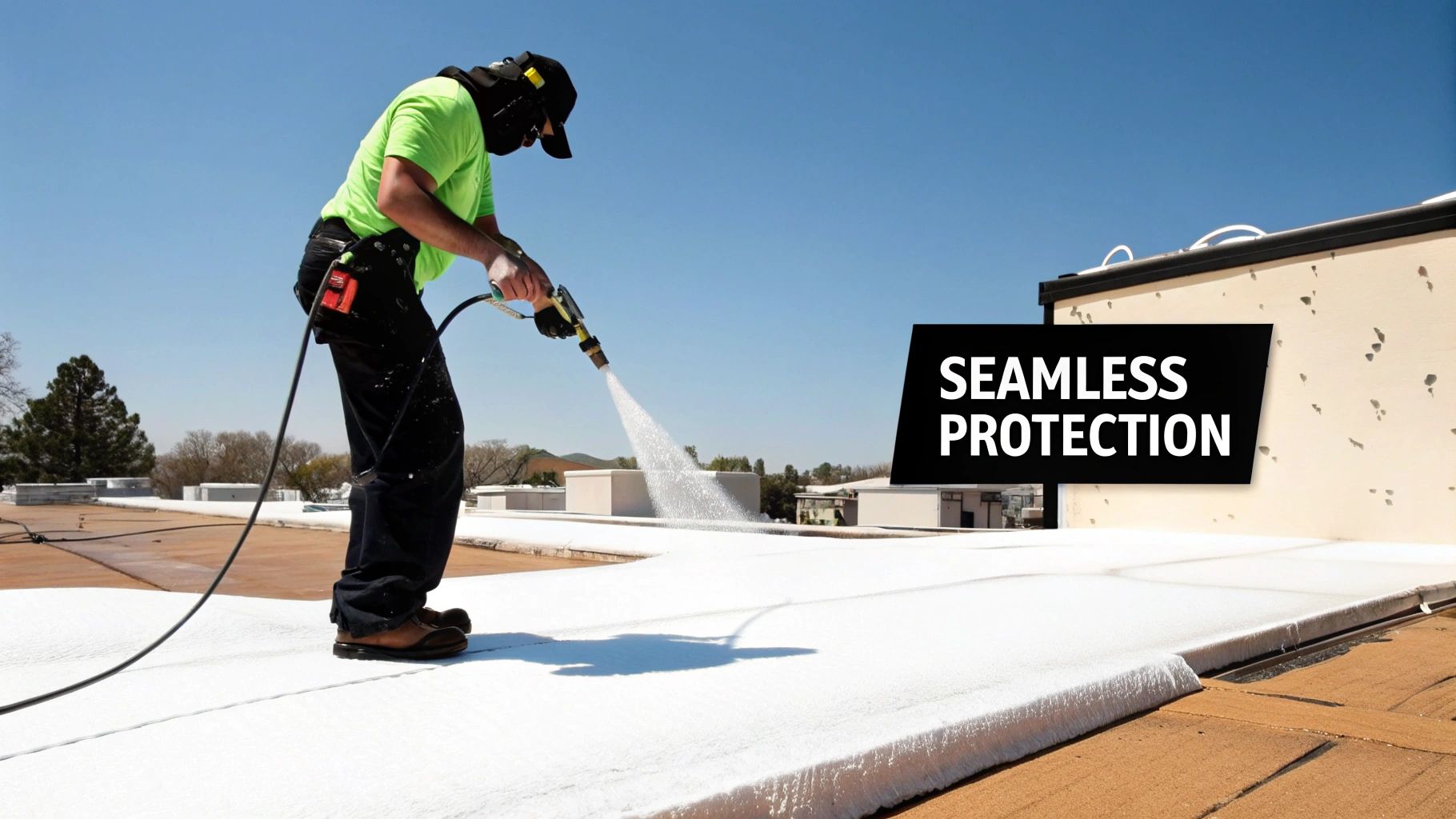
Think of spray foam roofing like a high-tech, waterproof jacket that’s been custom-tailored for your building. Instead of laying down pre-cut sheets or shingles riddled with seams, our technicians apply a liquid that expands the moment it hits the surface. This liquid is a two-part mixture of polyol resin and isocyanate, which combine to create Spray Polyurethane Foam (SPF).
Within seconds, this mixture expands to 30 times its original volume, hardening into a rigid, seamless layer that perfectly hugs every vent, pipe, and weird angle on your roof. This single, monolithic barrier leaves no seams, joints, or fasteners exposed—completely eliminating the weak spots where most traditional roofs eventually fail and start to leak.
Even with all its benefits, a lot of property owners have never even heard of this roofing technology. For example, a recent poll showed that a staggering 79% of respondents had never heard of spray foam roofing, which really highlights a major awareness gap. This is mostly because traditional roofing materials have massive marketing budgets and have just been around longer. You can dig into the details of that poll over on West Roofing Systems.
But the process doesn’t stop with just the foam. After the SPF layer cures, we add a final, crucial protective elastomeric topcoat over the entire surface. This coating does two very important jobs:
This combination of an insulating foam base and a durable topcoat creates a seriously robust system that can take whatever South Florida throws at it—intense sun, driving rain, and suffocating humidity. It’s a smart, forward-thinking way to protect your building that gets right to the source of common roofing problems. For those curious about how foam works inside the home, check out our general articles on spray foam insulation.
The real magic of spray foam roofing is its seamless application. By creating one continuous, solid layer, it completely eliminates the weaknesses found in conventional roofs, where thousands of feet of seams are just waiting to let water in.
Ultimately, this innovative method isn’t about patching problems—it’s about creating a holistic, integrated shield for your entire building. It tackles insulation, waterproofing, and structural integrity all in one go, making it a top choice for property owners who want long-term performance and genuine peace of mind.
When it comes to spray foam, it’s crucial to know that not all foams are created equal. For roofing, especially in a demanding climate like South Florida’s, there is one clear choice that stands head and shoulders above the rest for its raw performance and protective muscle: closed-cell foam.
The two main types you’ll hear about are open-cell and closed-cell, and their differences are what make or break a roofing project.
Imagine open-cell foam as a soft, everyday sponge. Its structure is made of tiny bubbles that are intentionally left open, making it light, flexible, and fantastic at muffling sound. It’s a great insulator for interior walls, but that sponge-like nature means it can also soak up water—the absolute last thing you want happening on your roof.
On the other hand, closed-cell foam is the non-negotiable gold standard for any spray foam roofing job. Don’t think sponge; think of a solid, dense block made of millions of microscopic, completely sealed air bubbles. Each tiny bubble is its own airtight container, trapping insulating gas and creating a structure that is incredibly strong and completely impermeable to moisture.
This dense, locked-down structure is what gives closed-cell foam its most critical roofing superpowers:
For any roofing system, the ability to completely block moisture isn’t just a nice feature—it’s the whole point. Closed-cell foam’s very structure makes it inherently waterproof, not just water-resistant, giving you unmatched protection against leaks.
To really see the difference, it helps to put the two types of foam next to each other. For a roof, the choice becomes crystal clear almost immediately. Only one is actually built to stand up to the elements day in and day out. The sheer rigidity and moisture-blocking power of closed-cell foam make it the only real candidate for protecting the outside of your building.
Here’s a direct comparison that shows exactly why closed-cell foam is the only smart choice for a tough, long-lasting spray foam roof.
| Characteristic | Open-Cell Foam | Closed-Cell Foam |
|---|---|---|
| Cell Structure | Interconnected, open cells | Independent, sealed cells |
| Density | Low (soft and light) | High (rigid and strong) |
| Water Permeability | Permeable (absorbs water) | Impermeable (blocks water) |
| Insulation (R-Value) | ~R-3.5 per inch | ~R-7.0 per inch |
| Structural Strength | Adds minimal strength | Adds significant strength |
At the end of the day, while both foams are great insulators, they operate in completely different worlds. Using open-cell foam on a roof would be like trying to build a boat out of sponges. It just wouldn’t work.
For a tough, waterproof, and energy-efficient roofing system that can handle Florida’s intense sun and hurricane-force rains, dense and rigid closed-cell foam is the only material that truly delivers.
Here in South Florida, a roof has to do a lot more than just keep the rain out. It’s your building’s first defense against a relentless combination of humidity, brutal sun, and the threat of hurricane-force winds. This is where spray foam roofing really proves its worth, offering a powerful set of benefits that old-school roofing just can’t touch.
Think about a traditional roof. It’s a patchwork of shingles, panels, seams, and fasteners. Every single one of those connection points is a potential leak waiting to happen. Over time, as materials expand and contract, those seams become weak spots for water to find its way in.
Spray foam roofing gets rid of that problem entirely. It’s applied as a liquid that expands and hardens into one solid, continuous layer across your entire roof. There are literally zero seams. It molds perfectly around every vent, drain, and edge, creating a seamless, monolithic shield that leaves no openings for moisture.
Beyond just being waterproof, a spray foam roof provides incredible strength against South Florida’s biggest threat: hurricanes. The foam doesn’t just lay on top of the roof deck; it chemically fuses to it, creating a bond that’s incredibly difficult to break. This turns your entire roof into a single, solid structure that is extremely resistant to wind uplift.
Instead of individual shingles that can be peeled off one by one by high winds, the whole system holds tight. This powerful adhesion provides a formidable defense when a storm is bearing down.
When a hurricane hits, the main reason roofs fail is wind uplift—the force that rips materials right off the deck. The adhesive power of SPF essentially “glues” the roof down, dramatically boosting its ability to survive extreme weather.
That kind of structural integrity gives you invaluable peace of mind when hurricane season rolls around, protecting your building and everything inside.
In a climate where the AC runs almost nonstop, energy costs are a huge deal. Spray foam roofing tackles this head-on by combining roofing and high-performance insulation into one system. Closed-cell spray foam delivers an impressive R-value of around R-6.5 to R-7 per inch.
This powerful thermal barrier stops the sun’s heat right at the roofline, preventing it from ever baking your attic and top floors. Your HVAC system no longer has to fight a losing battle against a superheated roof, which means it runs less, lasts longer, and saves you money. While the roofing benefits are clear, you can also see how spray foam compares to other materials inside the home by reading our guide on spray foam vs. blown-in insulation.
When you combine that insulation with a reflective white topcoat, the savings get even better. This “cool roof” creates a one-two punch against the heat:
This combination can cut your cooling costs by up to 30% or even more, delivering a real, measurable return on your investment every single month.
Finally, an SPF roof is a smart long-term investment. The dense, durable foam is protected by a tough topcoat that stands up to punishing sun, heavy rain, and foot traffic. But the real beauty is that it’s a renewable system.
Unlike traditional roofs that have to be torn off and sent to the landfill, an SPF roof can be easily maintained. With a simple recoat every 15-20 years, an SPF roof can last 30 years or more. This process is far cheaper and less disruptive than a full replacement, and it’s a much more environmentally responsible choice.
You can’t just slap a spray foam roof on and call it a day. Unlike laying down shingles, installing a spray foam roofing system is a precise science—a mix of chemistry, technique, and old-fashioned hard work. The final product’s success hangs entirely on the skill of the installers and a meticulous, step-by-step process.
It all starts long before any foam is actually sprayed. The prep work is, without a doubt, the most critical phase for guaranteeing the foam’s powerful bond and long-term performance.
Skipping this prep work isn’t an option. For the foam to create that unbreakable, watertight seal, it needs a clean, dry, and structurally sound surface to grab onto.
With the roof perfectly prepped, we lay down a specialized primer. Think of it like industrial-strength double-sided tape that locks the foam to the existing roof deck. This fusion is what gives the system its incredible resistance to wind uplift—a must-have in South Florida.
Now for the main event. Our trained technicians use specialized equipment to spray a two-part polyurethane liquid mixture directly onto the primed surface. The reaction is immediate. That liquid expands up to 30 times its original volume in a matter of seconds, hardening into a solid, seamless layer.
We apply the foam in passes, building it up to a thickness of at least one inch. This creates a continuous, insulated, and completely waterproof barrier that molds itself perfectly to every vent, pipe, and angle on your roof.
This infographic breaks down exactly what that seamless layer delivers.
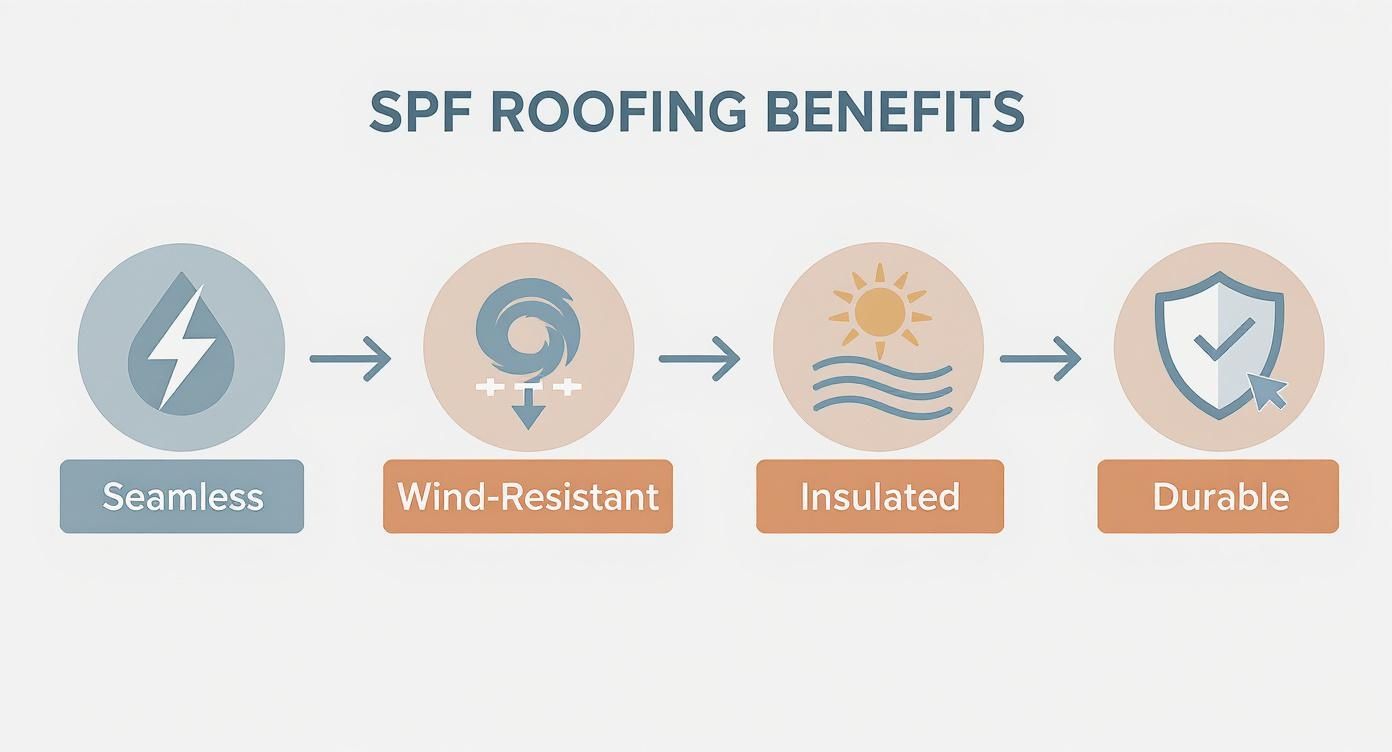
As you can see, the single, monolithic layer is the key to creating a roof that’s inherently waterproof, wind-resistant, and incredibly well-insulated.
The raw polyurethane foam is an amazing insulator, but it has one weakness: the sun. UV radiation will break it down over time. That’s why the final step is to apply a protective topcoat. This elastomeric coating, usually silicone or acrylic, is sprayed or rolled over the entire foam surface, sealing it from the elements.
This topcoat is the roof’s armor. It not only shields the foam from UV degradation but also provides a durable, weather-resistant, and often reflective surface that stands up to rain, impacts, and foot traffic.
This last layer is what completes the spray foam roofing system, locking in its performance for the next couple of decades. The whole process, from cleaning to coating, shows why you can’t trust this job to just anyone. The quality of the installation directly determines how long your roof will last and how well it will perform. Choosing the right contractor is every bit as important as choosing the right material.
Think of a spray foam roof less as a temporary cover and more as a long-term asset for your building. Unlike traditional roofs that have a built-in expiration date, a properly maintained spray foam roof is a renewable system. With the right care, it can genuinely be the last roof your building ever needs.
The secret is in its sustainable design. When a conventional roof wears out, you’re stuck with a costly, messy tear-off that sends tons of material straight to the landfill. A spray foam roofing system sidesteps that entire cycle. Instead of replacing it, you renew it—extending its life indefinitely for a fraction of the cost. This completely changes the game, turning a recurring expense into a lasting investment.
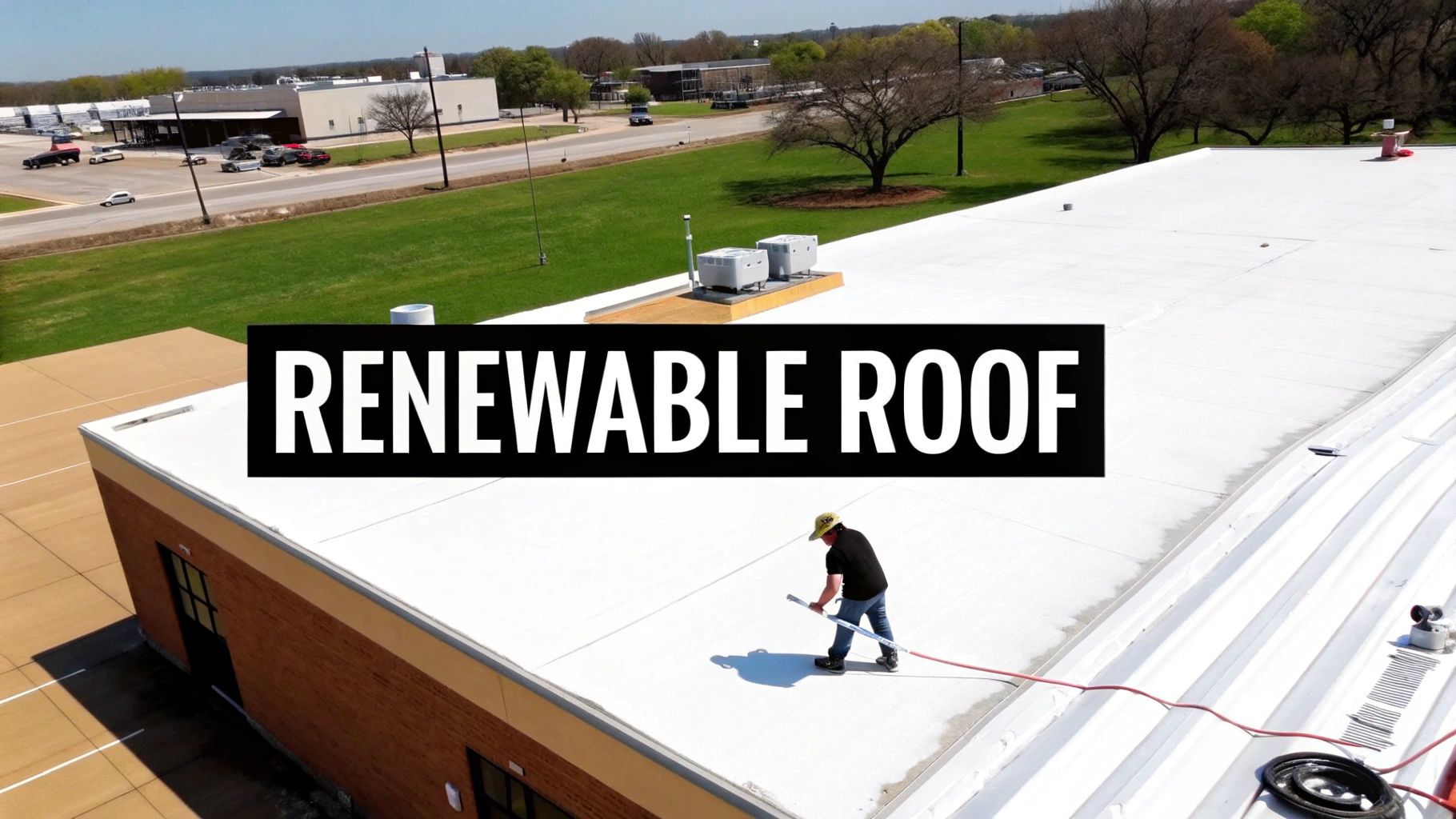
The key to this incredible lifespan lies in the protective topcoat. This elastomeric coating is your roof’s first line of defense, shielding the foam from UV rays and physical damage. Over time, this layer will naturally weather down, but the critical foam insulation underneath stays perfectly protected and intact. So instead of a full replacement, we just restore its armor.
Every 10 to 20 years—depending on the Florida sun and the original coating thickness—the roof gets a straightforward recoat. It’s a simple process:
This simple service basically hits the reset button, bringing your roof back to like-new condition without the headache and high cost of a total tear-off.
This renewable feature is the most powerful advantage of spray foam roofing. It shifts the entire paradigm from “replace” to “renew,” offering a sustainable and incredibly cost-effective path to long-term asset protection.
Between recoats, the annual upkeep for a spray foam roof is refreshingly simple. Because the system is seamless, there are no seams to check and no fasteners to come loose. The main goal is just making sure the protective coating stays in good shape.
A quick walk-through once a year is usually all it takes to keep things performing perfectly. You’re mainly looking for:
If you spot a small issue, it can usually be fixed in minutes with a tube of sealant. This proactive, minimal approach keeps the durable foam underneath protected, guaranteeing your roof will perform for decades to come.
While the upfront cost for spray foam can be higher than some older roofing types, its long-term performance makes it an incredibly smart investment. A well-maintained SPF roof can easily last 30 years or more, with the recoating process happening every 10 to 20 years. That blows the typical 15-to-20-year lifespan of most conventional flat roofs out of the water. You can find more details on spray foam roofing costs and benefits on westroofingsystems.com. By choosing a renewable system, you’re not just buying a roof—you’re securing decades of reliable, leak-free performance.
So, how do you know if spray foam roofing is the right call for your property? While it’s an incredibly flexible system, it really excels in a few key areas, especially when you’re up against the unique demands of the South Florida climate. Figuring out where it shines helps you decide if it’s the smart long-term investment you’re looking for.
For most commercial and industrial properties, the answer is a hard yes. Picture the huge, flat or low-slope metal roofs you see on warehouses, shopping centers, and factories. These buildings are famous for springing leaks around their thousands of seams and fasteners, and their massive surfaces bake under the sun all day long.
Spray foam tackles these problems head-on. The seamless application creates a single, monolithic waterproof barrier, getting rid of all those potential leak points in one go. At the same time, its high R-value dramatically cuts down on heat transfer, leading to serious savings on AC costs—a game-changer for any big commercial space.
Homeowners aren’t left out of the equation, either, especially those with the flat or low-slope roofs so common in Florida’s architecture. These roof designs are notorious for ponding water, which slowly breaks down traditional roofing materials and leads to stubborn, recurring leaks.
This is where spray foam’s unique application process makes all the difference. We can apply it in varying thicknesses, letting us build up low spots and engineer a subtle, effective slope right into the roof. This custom contouring actively channels water toward drains, eliminating ponding for good and protecting your home’s structure. It transforms a problem flat roof into a high-performance, self-draining asset.
The ability to custom-shape the roof surface is a unique advantage of spray foam. It doesn’t just cover problems like ponding water—it actively engineers a solution right into the roof itself.
Building something new? Spray foam roofing is an excellent choice to include from the ground up. When you integrate it from the very beginning, architects and builders can create a far superior building envelope right out of the gate. This ensures maximum energy efficiency and waterproofing are baked into the building’s DNA, not just tacked on later as a fix.
For anyone building with concrete, understanding the insulation value of concrete block is critical, and spray foam provides an outstanding thermal break that traditional systems can’t match.
The market is catching on, and fast. The global spray foam insulation market, which includes roofing, was valued at around USD 2.18 billion in 2025 and is on track to hit USD 4.45 billion by 2035. That kind of growth signals a clear industry shift toward more resilient and efficient building technologies.
If your building fits one of these profiles—a sprawling commercial space, a home with a flat roof, or a new construction project—then it’s a prime candidate for this advanced roofing technology.
Of course. Here is the rewritten section, designed to sound like an experienced human expert and match the provided examples.
Even after hearing about all the upsides, it’s completely normal to have questions before you make a big decision about your roof. When it comes to spray foam roofing, we find that most property owners are curious about the same things: cost, toughness, and long-term value. We’ve put together the most common questions we hear and answered them straight up to help you feel confident.
This isn’t your traditional roofing material, so it’s smart to get into the details. Understanding these points will make it crystal clear how a spray foam roof performs and what you can really expect from your investment over the long haul.
This is usually the first thing on everyone’s mind. The initial price for a new spray foam roof can be more than some traditional options, generally falling somewhere between $5.00 to $10.00 per square foot for a commercial project. But that number is just a starting point.
The final cost really depends on a few things:
It’s important to see this as a long-term investment, not just an expense. The upfront cost is often balanced out by major energy savings down the road and the fact that you won’t have to pay for a full roof tear-off in the future. Over its lifetime, it’s one of the most cost-effective systems out there.
Absolutely. A lot of people hear “foam” and think it must be soft or easy to damage. The reality is that closed-cell spray foam roofing cures into a solid, dense surface with some serious compressive strength—typically between 40-60 pounds per square inch (PSI). That’s more than enough to handle regular foot traffic from maintenance crews without a problem.
Now, that doesn’t mean it’s invincible. If someone drops a sharp, heavy tool, it could potentially puncture the topcoat and the foam underneath.
The great news? Repairs are incredibly simple. Unlike a big, spreading issue on a traditional roof, a small puncture can be fixed in minutes with a dab of specialized sealant. The waterproof seal is completely restored, just like that.
This easy repairability is a huge advantage, making it simple to keep the roof in perfect condition for decades.
This is where spray foam really shines. When it’s installed correctly and properly maintained, an SPF roof can last 30 years or even longer. The secret to its incredible lifespan is that it’s a renewable system. The foam itself is shielded from sun and weather by a durable, elastomeric topcoat.
Every 10 to 20 years, depending on wear, that topcoat just needs to be cleaned and reapplied. This simple process essentially hits the reset button on your roof’s lifespan for a fraction of what a full replacement would cost. It’s this sustainable cycle of renewal that makes it a true long-term asset.
Choosing spray foam roofing is also a move you can feel good about. The benefits go beyond just your property, contributing to a much greener approach to building and maintenance.
By picking a system that saves energy and cuts down on waste, you’re making a smart choice for your bottom line and for the environment.
Ready to see if spray foam roofing is the right solution for your South Florida property? The experts at Airtight Spray Foam Insulation can provide a detailed assessment and a no-obligation quote. Request your free estimate today and discover how to protect your building for decades to come.
Spray foam roofing is gaining popularity in Jupiter, FL thanks to its durability, wind uplift resistance, and ability to reflect heat. Airtight Spray Foam Insulation helps Jupiter property owners protect their homes and commercial buildings with high-performance foam roofing systems.
???? Explore spray foam services in Jupiter:
https://yourwebsite.com/spray-foam-insulation-jupiter/