Blog
A Guide to Insulation on Pipes for South Florida Homes

Adding insulation on pipes is one of those small upgrades that makes a massive difference for South Florida homeowners. It’s a proactive move that transforms your home’s plumbing from sweating, energy-wasting conduits into a dry, efficient, and protected system. It's how you stop condensation, prevent mold, and keep your water refreshingly cool—all while trimming your energy bills.
Why Insulating Pipes Is a Non-Negotiable in South Florida
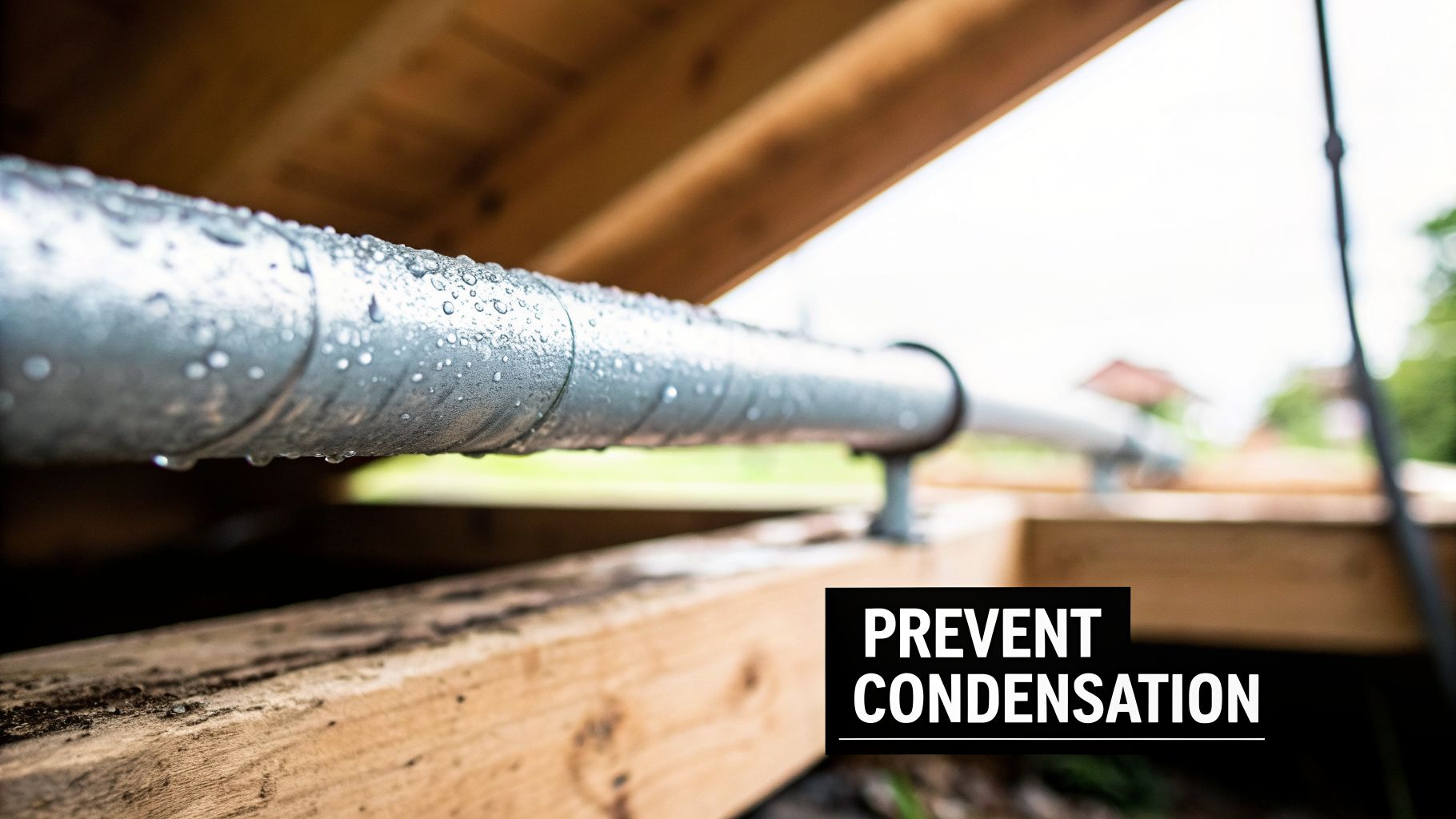
If you live here, you know our humidity isn't just an outdoor nuisance; it’s a force of nature that seeps into every nook and cranny of your house. Your plumbing system is especially vulnerable. Cold water pipes running through a hot, humid attic or crawlspace are ground zero for condensation.
Think of it like a glass of iced tea on a sweltering August afternoon. The second you take it outside, it starts sweating. The same thing happens to your uninsulated pipes, 24/7. That constant "pipe sweat" is the start of a whole cascade of expensive and unhealthy problems.
The True Cost of Ignoring Sweating Pipes
A few drips might not seem like a big deal, but that relentless moisture creates the perfect breeding ground for mold and mildew. This can tank your home’s air quality and trigger serious health issues.
Beyond the health risks, the water damage adds up. It drips onto drywall, soaks into wooden framing, and pools in your attic, promoting rot and decay that can compromise your home's structural integrity. Proactively installing insulation on pipes can help you avoid worst-case scenarios like flooding from burst pipes that require costly emergency cleanups.
Pro Tip: In my 25 years of fixing homes, I’ve learned that the most catastrophic issues often start small. I've seen a single, sweating pipe in an attic silently cause thousands of dollars in wood rot and mold remediation before the homeowner ever knew there was a problem.
It’s no surprise the pipe insulation market was valued at USD 5.27 billion in 2024 and continues to grow. Homeowners are catching on, and incentives like the 30% Energy Efficient Home Improvement Credit in the U.S. are making it an even smarter investment. When you consider that uninsulated pipes can lose 20-30% of their energy, it’s clear why this is such a focus.
More Than Just Damage Control
Stopping condensation is the main reason we insulate pipes in places like Wellington and Jupiter, but the other benefits are just as compelling.
For starters, insulating your cold water lines prevents "heat gain." This means the water that reaches your tap is still refreshingly cool, not lukewarm after traveling through a 130-degree attic. It's a small detail that adds a huge amount of comfort on a hot day.
Proper insulation on pipes also brings these key advantages:
- Lower Energy Bills: When your cold water pipes aren't radiating absorbed heat into your home, your AC doesn't have to work as hard to keep things cool.
- Improved Air Quality: Preventing mold at its source is the most direct way to ensure your family is breathing clean, healthy air. For total moisture control, you can also learn how to pair a vapour barrier with your insulation.
- Higher Home Value: A well-maintained home with smart moisture control measures is always more appealing to potential buyers.
At the end of the day, thinking of pipe insulation as a crucial investment—not just a repair—is the key to protecting your home and your wallet from the unique challenges of our South Florida climate.
Choosing the Right Pipe Insulation Materials and Tools
Walking down the insulation aisle at a hardware store can be overwhelming. You're hit with a wall of options, and in our South Florida climate, making the right choice isn't just about saving a few bucks on your energy bill—it's about preventing a moisture nightmare down the road.
The wrong material can fail fast, or worse, trap humidity and cause your pipes to rust and corrode from the inside out. Let's break down the most common options I see in homes every day: foam sleeves, fiberglass wraps, and spray foam.
Foam Sleeves: The Quick DIY Solution
Polyethylene or rubber foam sleeves are what most people grab first. They're cheap, easy to find, and come pre-slit with a self-sealing adhesive strip. For pipes under a kitchen sink or inside a climate-controlled space, they’re perfectly fine for a basic job.
But in the real world of South Florida attics and garages, their weaknesses show up quickly.
From Experience: I can't tell you how many times I've been in a sweltering attic and seen foam sleeves that have shrunk, cracked, or pulled apart at the seams. Humid air creeps into those gaps, hits the cold pipe, and condensation forms inside the sleeve. It creates a dark, damp, hidden space—the perfect recipe for corrosion and mold.
Fiberglass Wraps: For High-Heat Applications
Fiberglass insulation, the kind that comes in paper- or foil-backed rolls, is the traditional choice for hot water lines, especially right off the water heater, because it can handle high temperatures. You simply wrap it around the pipe and secure it.
The problem is, fiberglass is extremely vulnerable to moisture. As soon as it gets wet, its insulating ability tanks. Even worse, it acts like a sponge, holding water directly against the metal and speeding up rust. For fiberglass to have any chance of working against condensation here, it needs a perfectly installed and sealed vapor barrier—something that's very difficult to achieve.
Spray Foam: The Ultimate Moisture Barrier
This is where spray foam insulation changes the game, particularly when it comes to stopping condensation. Unlike sleeves or wraps that just cover a pipe, closed-cell spray foam is applied as a liquid that expands and hardens right on the pipe itself.
The result is a seamless, solid layer that bonds directly to the metal. There are absolutely zero gaps for humid air to sneak through and touch the cold pipe surface. Pipe sweating is completely eliminated. This is why it's the only real solution for pipes in tough-to-insulate areas like attics, crawl spaces, and garages. The initial work is a professional job, but the result is a permanent, waterproof seal that other materials just can't match. You can dig into the specifics in our guide comparing open-cell vs closed-cell foam to see why closed-cell is the champion for blocking moisture.
The industry is catching on. The pipe insulation market is projected to grow from USD 5.26 billion in 2024 to USD 8.33 billion by 2032, largely driven by high-performance polyurethane foams. In a climate like ours, proper foam insulation can stop up to 95% of heat loss from hot water pipes and slash cooling costs by 20-40% by preventing condensation and heat gain on cold lines.
Pipe Insulation Material Comparison for South Florida Homes
Choosing the right material really depends on where the pipe is and what you're trying to accomplish. This table breaks down the key differences to help you decide.
| Insulation Type | Best For | Pros | Cons | DIY Friendliness |
|---|---|---|---|---|
| Foam Sleeves | Accessible pipes in conditioned spaces (e.g., under sinks, inside closets). | Inexpensive, easy to find, and simple to install for basic jobs. | Prone to gaps, shrinkage, and trapping moisture in humid areas like attics; low durability. | High |
| Fiberglass | Hot water lines near the water heater where heat tolerance is critical. | High-temperature rating, effective for heat retention when dry. | Loses all insulating value when wet; holds moisture against pipes, promoting rust and mold. | Medium |
| Spray Foam | Pipes in unconditioned, humid areas (attics, garages, crawl spaces). | Creates a seamless, airtight, waterproof seal; eliminates condensation. | Higher upfront cost, requires professional installation and equipment. | Low (Pro Job) |
Ultimately, for the most challenging areas in your home, spray foam provides a permanent solution that sleeves and wraps can't compete with, especially when it comes to moisture control.
Essential Tools for the Job
Your tool list will change based on the insulation you choose. For a simple foam sleeve project, you won't need much.
For DIY Foam Sleeve or Fiberglass Installation:
- Tape Measure: Don’t eyeball it. Measure your pipe lengths carefully to avoid gaps.
- Utility Knife or Sharp Shears: A fresh, sharp blade makes all the difference for clean cuts.
- Insulation Tape or Zip Ties: Use a quality foil or acrylic tape made for insulation to seal seams and joints properly.
- Safety Gear: Always wear gloves, safety glasses, and a dust mask. This is non-negotiable when cutting fiberglass.
If you opt for a professional spray foam application, the technicians handle everything. They’ll arrive with the spray rig, hoses, and all the necessary personal protective equipment (PPE). Your only task is to make sure the work area is clear so they can operate safely and efficiently.
Alright, you’ve picked your materials. Now it’s time to get to work. This isn’t some overly technical manual; think of it as a practical walkthrough from someone who’s seen it all in the field. We’ll cover how to install your pipe insulation correctly and, more importantly, how to avoid the common mistakes that trip up so many homeowners.
The whole point here is to create a seamless, airtight seal around your pipes. Even the smallest gap becomes an open invitation for humid air to sneak in and form condensation, completely defeating the purpose of all your hard work. Let's make sure that doesn't happen.
Preparing Your Pipes for Insulation
Before you even think about cutting a piece of insulation, your pipes need to be prepped. This is a non-negotiable first step that sets you up for success. The surface must be clean, dry, and totally free of any dust or debris.
Start by giving the pipes a good wipe-down with a clean, dry cloth. If you feel any moisture or see "pipe sweat," make sure it's completely dry. For any stubborn grime or oily residue, a mild degreaser will do the trick, but you have to let the pipe dry 100% before moving on. Trapping moisture under new insulation is a surefire recipe for corrosion down the line.
A Quick Story From the Field: I was once called out to a home where the owner had perfectly insulated every pipe in his garage. Looked great. But a year later, he had major rust issues. The problem? He did the installation on a humid summer day while the cold water pipes were actively sweating. That trapped moisture just sat there and silently ate away at the copper. Always, always start with a bone-dry surface.
This is also the perfect time to give your plumbing a quick inspection. Check for any tiny leaks, drips, or signs of corrosion, paying close attention to the joints and valves. It is so much easier to fix a small drip now than it will be after it's hidden away under a layer of insulation.
Measuring and Cutting with Precision
When it comes to installing insulation on pipes, accuracy is your best friend. It doesn’t matter if you’re using foam sleeves or fiberglass wraps—precise measurements and clean cuts are what separate a professional job from a sloppy one.
- Measure Twice, Cut Once: It's a cliché for a reason. Use a flexible tape measure to get the length of each straight section you plan to cover. Do yourself a favor and write these numbers down.
- Mark Your Cuts: Always mark a clear, straight line on the insulation before you cut. This will guide your blade and give you a much cleaner edge.
- Use a Sharp Blade: A dull utility knife is your enemy here; it will tear foam and fray fiberglass. A fresh, sharp blade is absolutely essential for smooth, even cuts. Some pros I know even use a serrated bread knife or an electric carving knife for cutting foam sleeves to get perfectly square edges.
This diagram breaks down the main material options, and your choice here will really guide how you approach the cutting and fitting process.
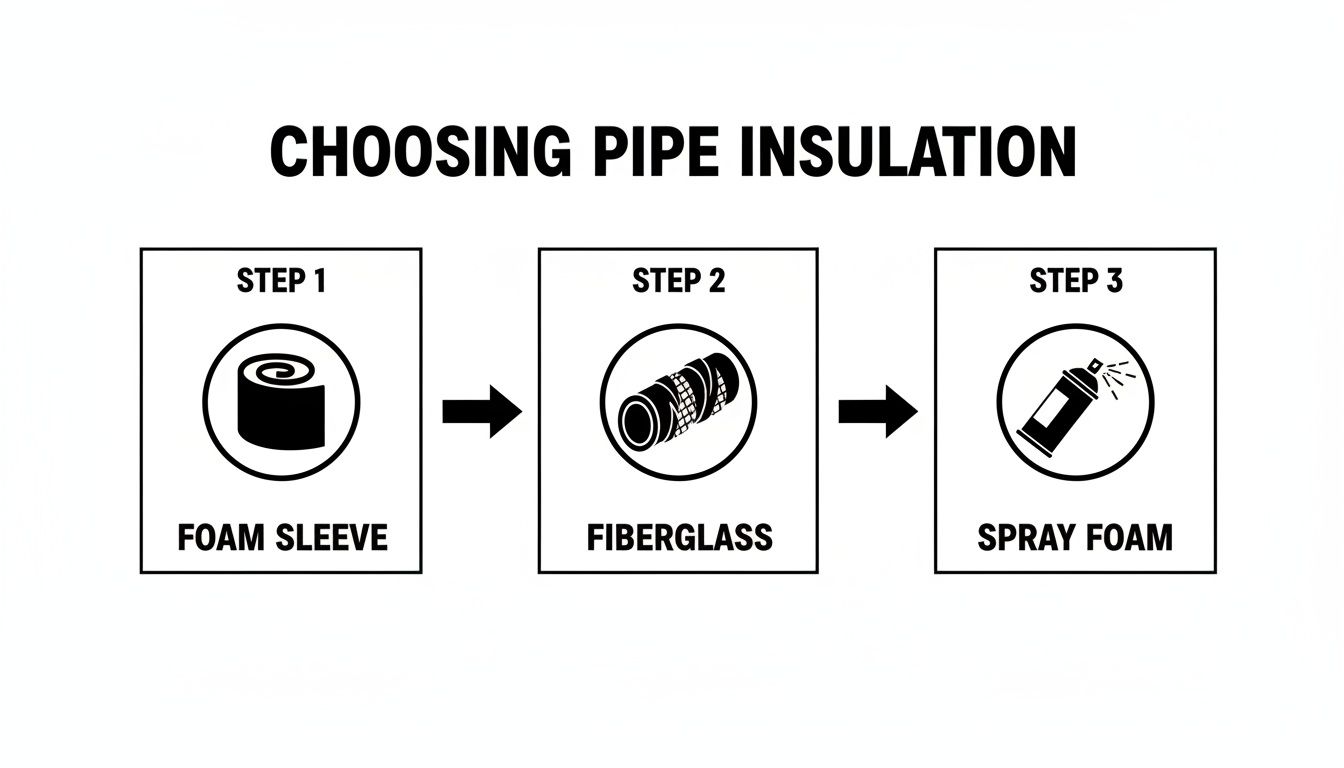
As you can see, each material—foam, fiberglass, and spray foam—is best suited for different situations, which in turn affects your installation technique.
Securing Different Insulation Types
With your pieces cut to size, it's time to fit and secure them. How you do this depends entirely on the material you chose.
With foam sleeves, you simply open the pre-cut slit and snap it right over the pipe. Peel the protective film off the adhesive strip and press the edges together firmly to get a tight seal. For extra peace of mind, especially here in South Florida, I always recommend adding a zip tie or a wrap of insulation tape every foot or two.
If you're using fiberglass wraps, pull the material snugly around the pipe. Don't compress it too much, though—that actually reduces its insulating R-value. The foil or paper backing should always face outward. Overlap the edges just a bit and use foil insulation tape to secure the entire length, being extra careful to seal every single seam.
Handling Tricky Spots Like Elbows and T-Joints
Let's be honest, the straight runs are the easy part. The real test of a good insulation job is how you handle the bends, valves, and T-joints. This is where most DIY projects fall short.
For 90-Degree Elbows with Foam Sleeves:
- Cut the ends of two pieces of foam insulation at a perfect 45-degree angle. This is called a miter cut.
- When you place these two angled pieces together over the elbow, they’ll form a clean 90-degree corner.
- Secure the joint tightly with insulation tape, making absolutely sure there are no air gaps.
For T-Joints:
- First, run the main piece of insulation straight across the "top" of the T.
- On that main piece, carefully cut out a hole right where the other pipe will intersect.
- Take the second piece of insulation and shape its end into a "saddle" cut—basically a curved notch that lets it fit snugly against the main pipe.
- Tape this joint thoroughly from every angle to make it airtight.
Valves can be a real headache. The best way to tackle them is to insulate right up to each side of the valve body. Then, use smaller scrap pieces of insulation and plenty of tape to build a custom-fit "box" around it, making sure you leave the handle accessible.
Properly insulating these complex fittings is just as critical as the straight pipes. This is an area where professional installers really earn their money, and it's a good reason to call an expert if your plumbing looks like a maze. If you’re curious about tackling other tricky areas in your home, you might find our guide on how to insulate ductwork in the attic helpful.
With a bit of patience and a sharp eye for detail, you can pull off a top-notch installation that will protect your pipes for years to come.
Mastering Condensation Control with Advanced Techniques
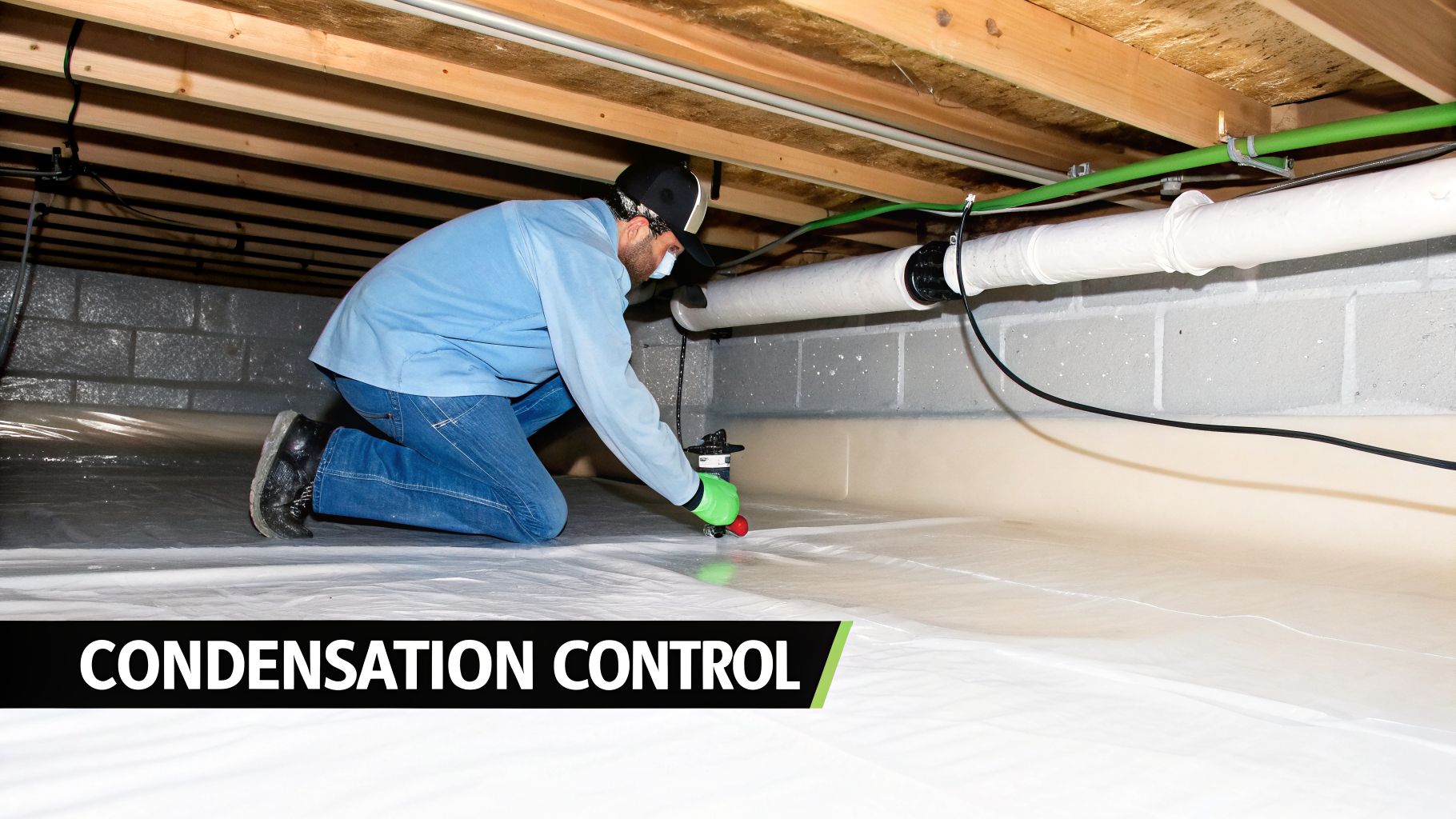
Now that you’ve got the basics down, it’s time to talk about what it really takes to win the war against condensation here in South Florida. Simply covering your pipes isn't enough. We need to stop the "sweat" before it ever starts, and that requires a deeper understanding of why it’s happening in the first place.
It all comes down to the dew point. When our thick, humid air hits a surface that's colder than the dew point, condensation is inevitable. Think about a pipe carrying 55°F water through a blistering 130°F attic. That’s a recipe for non-stop dripping, which leads straight to water damage and mold.
The Power of an Airtight Vapor Barrier
To stop this process dead in its tracks, you need a true air and vapor barrier—an unbroken shield that completely prevents humid air from ever touching that cold pipe. This is where most off-the-shelf solutions fail. Foam sleeves have seams that leak air, and fiberglass can actually soak up and trap moisture against the pipe, making the problem worse.
This is a job for closed-cell spray foam. When we apply it, the foam expands and hardens directly onto the pipe, creating a single, seamless block of insulation. It molds to every bend, valve, and fitting perfectly. There are zero gaps, zero seams, and zero chance for moisture to get in.
By molding directly to the pipe, closed-cell spray foam eliminates the air space where condensation forms. It’s not just covering the pipe; it’s becoming one with it, effectively making the pipe’s surface temperature irrelevant to the surrounding humid air.
This isn’t a new concept. The industrial world has known this for decades—uninsulated pipes in a commercial plant can waste 10-20% of the system's energy. Those same principles apply right here in your home. As green building gains traction, homeowners are seeing real results, often cutting their energy bills by 15-25% after a proper insulation job. You can see how this trend is growing by checking out the industrial insulation market's growth on PrecedenceResearch.com.
This level of protection is absolutely essential in the toughest parts of your home.
Targeting High-Risk Problem Areas
Some areas of a home are just plain brutal on your plumbing. Your attic, garage, and crawl space are the front lines in the battle against humidity, and they demand the best approach.
- Attics: The combination of extreme heat and humidity makes attic pipes the most vulnerable. I’ve seen countless systems fail up there. Spray foam is the only method I trust to create a permanent, durable seal that won’t break down in those conditions.
- Garages: Garages are usually unconditioned and open to the humid outside air, making them another hotspot. Insulating pipes here stops them from dripping all over your car, your tools, or creating a dangerous slip hazard on the concrete floor.
- Crawl Spaces: These dark, damp spaces are a perfect breeding ground for mold. Sealing pipes with spray foam is a crucial step in getting control over the moisture and protecting your home's foundation and air quality.
Insulating Hot Water Lines for Maximum Efficiency
While cold lines are all about fighting condensation, insulating your hot water pipes is about saving money and protecting your equipment. Every single foot of uninsulated hot water pipe is basically a small radiator, constantly dumping heat where you don't want it.
All that heat loss makes your water heater work overtime, cycling on and off just to keep the water at the right temperature. That extra work shows up on your energy bill and puts unnecessary wear and tear on the unit.
Key Benefits of Hot Water Pipe Insulation:
- Reduced Energy Consumption: When you stop the heat from escaping, your water heater doesn't have to work as hard. That means lower utility costs.
- Faster Hot Water Delivery: Insulated pipes keep the water hot all the way to the faucet, so you get hot water faster and waste less water waiting for it.
- Less Strain on Your Water Heater: A more efficient system means fewer cycles for your water heater, which can help extend its operational lifespan.
When you apply these techniques, insulation on pipes becomes more than just a simple fix. It becomes a complete system that actively protects your home, making it more efficient, comfortable, and resilient against South Florida’s relentless humidity.
DIY Project vs Professional Installation
So, should you insulate your pipes yourself or call in a professional? It’s an honest question every homeowner faces, and the right answer comes down to balancing your budget, your time, and the quality you expect from the finished job. The decision really hinges on how big the project is and, more importantly, which parts of your home you’re trying to protect.
A DIY approach can be a perfect fit for smaller, more manageable tasks. If you're just looking to insulate a few exposed pipes under a kitchen or bathroom sink, grabbing some foam sleeves from the hardware store is a fantastic weekend project. It’s a low-risk, high-reward job where you’ll see immediate benefits, and a few minor imperfections won't cause any major issues down the road.
When DIY Is a Good Choice
The DIY route makes a ton of sense when the pipes are easy to get to and the risk of serious moisture damage is low.
- Under Sinks: The pipes are right there in a climate-controlled space, making it a quick and easy job.
- Accessible Basements or Utility Closets: If you have plenty of room to work around straight runs of pipe, it's a very straightforward task.
- Small Hot Water Pipe Sections: Wrapping the first 5-10 feet of pipe coming off your water heater is a simple and effective way to save a little energy.
But the game completely changes once the project gets bigger or the pipes are located in those high-humidity danger zones we have here in South Florida.
The real value of a professional isn't just their speed—it's their ability to perfectly seal the complex, hard-to-reach areas where insulation matters most. An amateur job in an attic can fail within a year, while a professional one lasts a lifetime.
When to Call the Professionals
There are some very clear moments when calling for backup is the smarter long-term investment. A professional crew is non-negotiable for large-scale projects, tricky access points, and especially when you need the seamless, permanent seal that only spray foam can deliver.
You should seriously consider hiring an expert for these situations:
- Whole-Home Projects: Insulating every pipe in your house is a massive job. A professional team can knock it out efficiently and correctly.
- Attics and Crawl Spaces: These areas are often cramped, dangerously hot, and a real pain to work in. Pros have the right safety gear and the experience to handle these tough environments.
- Spray Foam Application: Applying closed-cell spray foam requires specialized equipment, safety protocols, and extensive training to get a perfect, even seal. This is absolutely not a DIY job.
Before you decide, it’s helpful to see a direct comparison of what you’re getting into.
Cost and Effort DIY vs. Professional Pipe Insulation
This table breaks down the estimated costs, time commitment, and expected results for both DIY and professional pipe insulation projects.
| Factor | DIY Project (Foam Sleeves) | Professional Service (Spray Foam) |
|---|---|---|
| Initial Cost | $50 – $200 for materials. Low upfront cost. | $1,500 – $4,000+ depending on scope. |
| Time Commitment | 2-6 hours for a small-to-medium sized job. | 4-8 hours (1 day) for a full-home project. |
| Tools Required | Tape measure, utility knife, zip ties/tape. | Professional-grade spray foam rig, safety gear. |
| Skill Level | Beginner. Basic cutting and fitting skills needed. | Expert. Requires certified training and experience. |
| Best For | Easily accessible pipes, small areas, budget projects. | Whole-home insulation, attics, crawl spaces, condensation control. |
| Effectiveness | Good for energy savings on hot water lines. | Excellent for energy savings and condensation prevention. |
| Durability | 5-10 years. Sleeves can degrade or shift over time. | Lifetime of the home. Forms a permanent, rigid bond. |
Ultimately, choosing a professional is about buying peace of mind. It’s an investment in getting the job done right the first time, protecting your home from the costly headaches of moisture and energy loss for decades to come. For homeowners looking at broader projects, understanding the full range of custom home building services can also provide valuable context for when and why professional expertise is critical.
Common Questions About Insulating Pipes in Florida
As an insulation pro here in South Florida, I've heard just about every question there is when it comes to pipes and our unique climate. Homeowners are right to be concerned. I want to clear up some of the common confusion and give you the straightforward answers I've learned from years in the field.
Think of this as practical advice aimed at one thing: protecting your home, from saving money on bills to preventing the nightmare of moisture damage.
Does Insulating Cold Water Pipes Really Save Money in Florida?
Yes, it absolutely does—just maybe not how you’d expect. You’re not trying to keep heat in like with a hot water pipe. Here, you’re preventing "heat gain." In our humid environment, an uninsulated cold pipe pulls warmth right out of the air, making your AC system work just a little bit harder to keep up.
But the real savings? That comes from avoiding catastrophic repairs. The main goal is stopping pipe sweating, period. By killing that condensation, you’re preventing the rot, water damage, and mold that can lead to some truly shocking repair bills. That’s where you’ll see the biggest financial win.
Can I Use the Same Insulation for All My Pipes?
Not a chance. The right material completely depends on where the pipe is and what it’s doing. For an easy-to-reach cold water line under your kitchen sink, those simple foam sleeves are fine. They’re a decent DIY fix for a controlled indoor space.
Hot water lines, though, need something with a much higher temperature rating, like fiberglass or a high-grade rubber foam, to work safely. But for pipes in the places that matter most—the attic, crawlspace, or garage where condensation is public enemy number one—closed-cell spray foam is the only solution I trust. It creates a seamless, airtight seal that other materials just can't match.
The right insulation material is entirely situational. A cheap foam sleeve might be perfect for under your sink but could fail miserably in a 130-degree attic, trapping moisture and causing the pipe to corrode from the outside in.
Is Spray Foam Insulation Safe for My Water Pipes?
Yes, provided it’s applied by a certified professional who knows what they're doing. Once modern closed-cell spray foam is fully cured, it becomes an inert, stable plastic. It doesn’t just avoid corroding pipes; it actively protects them.
By creating that monolithic, waterproof barrier, spray foam completely seals the metal off from the moisture and oxygen that cause rust and corrosion. Getting it done professionally is non-negotiable, though. Proper application ensures the foam is at the right thickness and temperature to provide decades of worry-free protection.
How Often Does Pipe Insulation Need to Be Replaced?
This all comes down to the material you chose and the environment it’s in. Those cheap, low-density foam sleeves you see at the big box stores can start to get brittle and fall apart in as little as 5-10 years, especially if they get any sun exposure or get bumped around. And if fiberglass insulation gets wet even once, its insulating value drops to zero and it needs to be torn out immediately.
Professionally installed closed-cell spray foam, on the other hand, is a permanent fix. It chemically bonds right to the pipe, so it won’t sag, absorb moisture, or break down over time. It’s truly a one-and-done investment designed to last the entire life of your home.
Ready to put an end to pipe sweating and high energy bills for good? The team at Airtight Spray Foam Insulation has the experience and high-quality materials to protect your home. Request your free quote today and discover how the Airtight Comfort System can transform your property.