Discover how our spray foam insulation solutions in Jupiter, FL help improve comfort, efficiency, and moisture control in South Florida homes.
Using spray foam insulation on cinder block walls is one of the single most effective ways to create a truly airtight, moisture-proof barrier that dramatically improves a home’s energy performance. Unlike old-school insulation methods, spray foam expands on contact, pushing its way into every tiny crack and pore of the block. The result is a seamless seal that puts a stop to air leaks and moisture intrusion—a non-negotiable for concrete homes in our South Florida climate.
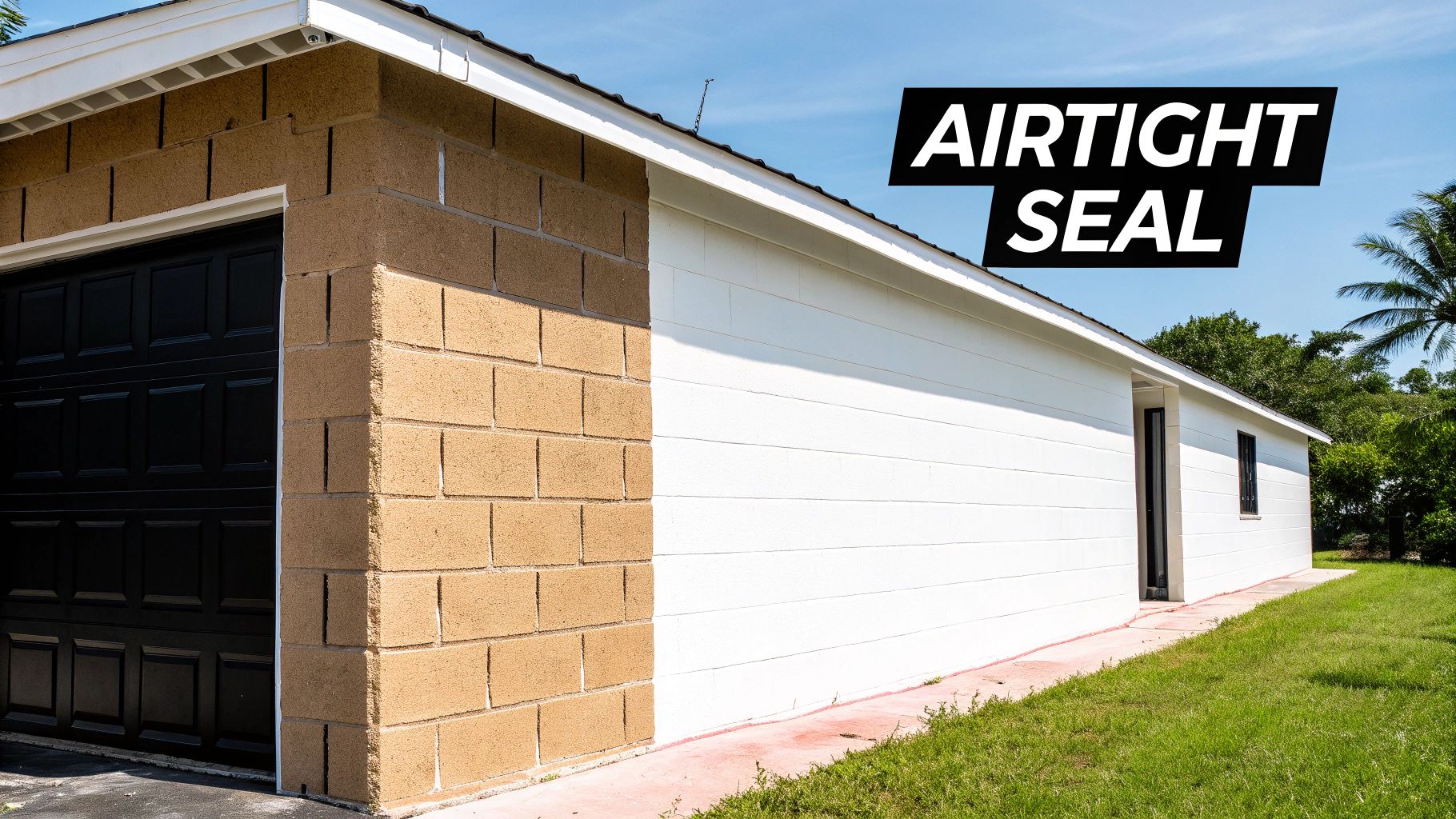
Cinder block walls are the backbone of most South Florida homes for a good reason—they stand up to hurricanes. But they have an Achilles’ heel: they’re porous. Concrete blocks are like sponges, soaking up moisture from our humid air while letting your expensive, conditioned air bleed right out. This forces your A/C to run constantly just to keep up.
This is where spray foam becomes more than just an upgrade; it’s a fundamental fix. Traditional insulation like fiberglass batts or rigid foam boards just can’t form a perfect seal against the rough, uneven surface of a block wall. You’re always left with small gaps that undermine the whole point. Spray foam, on the other hand, creates one solid, bonded layer.
The real magic of spray foam is that it’s an all-in-one solution. When we apply it correctly, it tackles several jobs at once, making it the perfect match for concrete masonry units (CMUs).
This technology has been around since the 1940s, first developed for military aircraft. But its value in construction really took off during the 1970s energy crisis. For South Florida’s concrete homes, it’s a game changer, slashing air changes per hour (ACH)—a measure of air leakage—from a leaky 10-15 down to as low as 5.6. Homeowners we work with in places like Palm Beach Gardens often see their utility bills drop by 20-30%.
Beyond comfort and energy savings, closed-cell spray foam actually adds structural integrity to your walls. Because it adheres so aggressively to the block and fills every void, it acts like a high-strength glue, reinforcing the entire wall assembly against wind load and other pressures.
For homes from Jupiter to Wellington, spray foam transforms a porous, inefficient wall into a high-performance building envelope. It’s the modern solution that directly addresses the unique challenges of our hot, humid, and storm-prone environment.
This comprehensive approach is why understanding the specific insulation value of concrete block helps you see the full picture. For more on how insulation fits into the bigger picture of your home’s thermal performance, you can find helpful general home insulation information to broaden your knowledge.
Picking the right spray foam for your cinder block walls isn’t just some technical detail—it’s probably the most important decision you’ll make for the whole project. Here in South Florida, we’re in a constant battle with heat and humidity. Your choice of foam directly impacts how comfortable your home is, what your FPL bill looks like, and whether you’ll have moisture problems down the road.
You’ve got two main options: open-cell and closed-cell foam. For our climate, one is the hands-down winner.
When it comes to insulating cinder block walls, especially exterior ones or those below ground, closed-cell spray foam is the only way to go. It’s non-negotiable. Its physical structure is what makes it so perfect for handling the specific challenges we face in this region.
Picture closed-cell foam as a solid mass of tiny, individual plastic bubbles all packed together. This structure gives it some serious advantages for concrete block walls.
First off, it packs a punch with a high R-value, typically around R-6.5 to R-7 per inch. This means you get powerful insulation without eating up a lot of interior space, which is a big plus in any home.
Second, its dense, rigid nature actually adds structural strength to the wall. It bonds to the block like a high-powered glue, reinforcing the entire wall against wind and external pressures.
But here’s the most critical part: closed-cell foam is a true vapor barrier. It’s completely impermeable to moisture and air. In a place like West Palm Beach or Stuart, where the air is practically dripping with humidity, this is a game-changer. It stops that dampness from seeping through the naturally porous cinder blocks, which is the number one cause of musty smells and mold. Open-cell foam, on the other hand, would act like a sponge, trapping moisture against the block and creating a nightmare scenario. If you want to dive deeper into how spray foam stacks up, this comparison between spray foam and blown-in insulation breaks it down even further.
For any exterior-facing cinder block wall in South Florida, using anything other than closed-cell spray foam is a costly mistake just waiting to happen. It’s the only product that delivers the thermal, air, and moisture control you need to protect your home.
Okay, so you know you need closed-cell foam. The next question is, how much? The thickness isn’t just a random number; it’s determined by local building codes and what you’re trying to achieve with your energy savings.
South Florida falls into Climate Zone 1 or 2, according to the International Energy Conservation Code (IECC). This code sets the minimum R-value requirements for wall assemblies to make sure homes are energy efficient.
A professional installer is going to calculate the right thickness based on a few key things:
A good contractor will look at your home’s specific situation—from which way the walls face to your family’s energy habits—to recommend the perfect thickness. This ensures you not only pass your inspection but actually get the best return on your investment through real comfort and long-term savings.
When you hire a professional crew to spray foam your cinder block walls, you’re paying for a lot more than just the foam itself. You’re investing in a precise, multi-stage process that guarantees safety, performance, and a final product that actually lasts. A quality job can transform a space, but it all starts long before the first drop of foam is ever sprayed.
Knowing what a real professional process involves helps you spot a quality contractor and ensures you get the energy efficiency and comfort you’re paying for. Honestly, it all comes down to one thing: preparation is everything. Without meticulous prep work, even the best spray foam on the market won’t perform the way it should.
The first thing a true professional crew does when they arrive isn’t suiting up and grabbing the spray gun. It’s inspecting and prepping the cinder block walls. The goal here is simple: create a clean, dry, and stable surface the foam can grab onto for good. Spray foam sticks like glue, but only if the wall is ready for it.
This prep phase always includes a few key steps:
Skipping this initial stage is the number one reason for delamination, where the foam literally peels away from the wall over time. It’s a non-negotiable step for any reputable installer.
With the walls prepped, the next focus is protecting your property. Any experienced team knows that overspray is a serious issue. That foam is incredibly sticky and a nightmare to remove once it cures.
Crews will carefully mask and cover absolutely everything that isn’t getting insulated. This means:
Creating this clean containment zone is the mark of a crew that respects your home and is committed to doing a clean, professional job.
The right insulation choice depends on things like your wall type and local climate. This visual breaks down the logic a pro uses to recommend the best foam for your home’s specific needs.
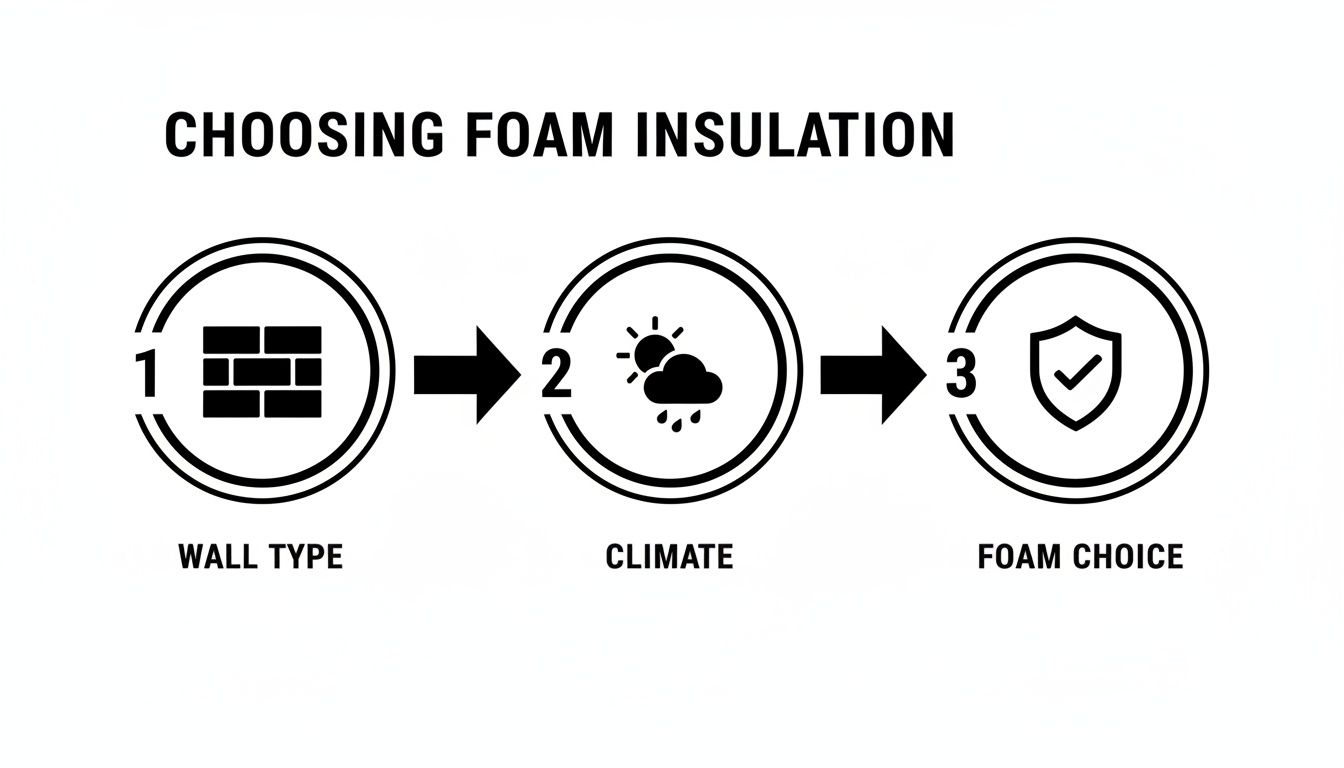
As you can see, the specific nature of your cinder block walls and the high humidity of our South Florida climate point directly to the ideal foam solution.
Before a single trigger is pulled, safety becomes the top priority. The chemical components in spray foam release vapors during application, which demands strict safety protocols to protect both the installers and anyone living in the home.
A professional crew will always arrive with full personal protective equipment (PPE). This means full-body suits, gloves, and—most importantly—fresh-air-supply respirators. They will also set up powerful ventilation systems, using fans to pull air from the work area and exhaust it directly outside.
You and your pets will need to be out of the house during the spraying and for a specific curing period afterward, which is typically 24 hours. This isn’t just a suggestion; it’s a critical step to ensure everyone’s safety and let the foam cure completely without off-gassing into your living space.
Finally, the spraying can begin. This is where an installer’s skill and experience really make a difference. Applying spray foam to cinder blocks isn’t just about blasting the wall. A skilled technician applies the foam in smooth, even layers, or “lifts,” usually about an inch thick at a time. This controlled method keeps the foam from getting too hot as it cures and ensures a strong, stable final product.
The goal is to get a uniform thickness across the entire wall, filling every last pore and crevice in the block. Once the foam has cured, any spots that expanded past the wall studs are carefully trimmed down. This is usually done with a specialized saw to create a perfectly flat surface, ready for drywall or another wall covering to be installed right over it.
The job isn’t done until a thorough cleanup is complete. The crew removes all the masking, sweeps and vacuums the area, and should leave your space cleaner than they found it. That attention to detail, from start to finish, is the hallmark of a job done right. To ensure the best long-term performance for your home, it’s always smart to work with a team that offers professional insulation installation, repair, and upgrade services and understands the unique demands of our climate.
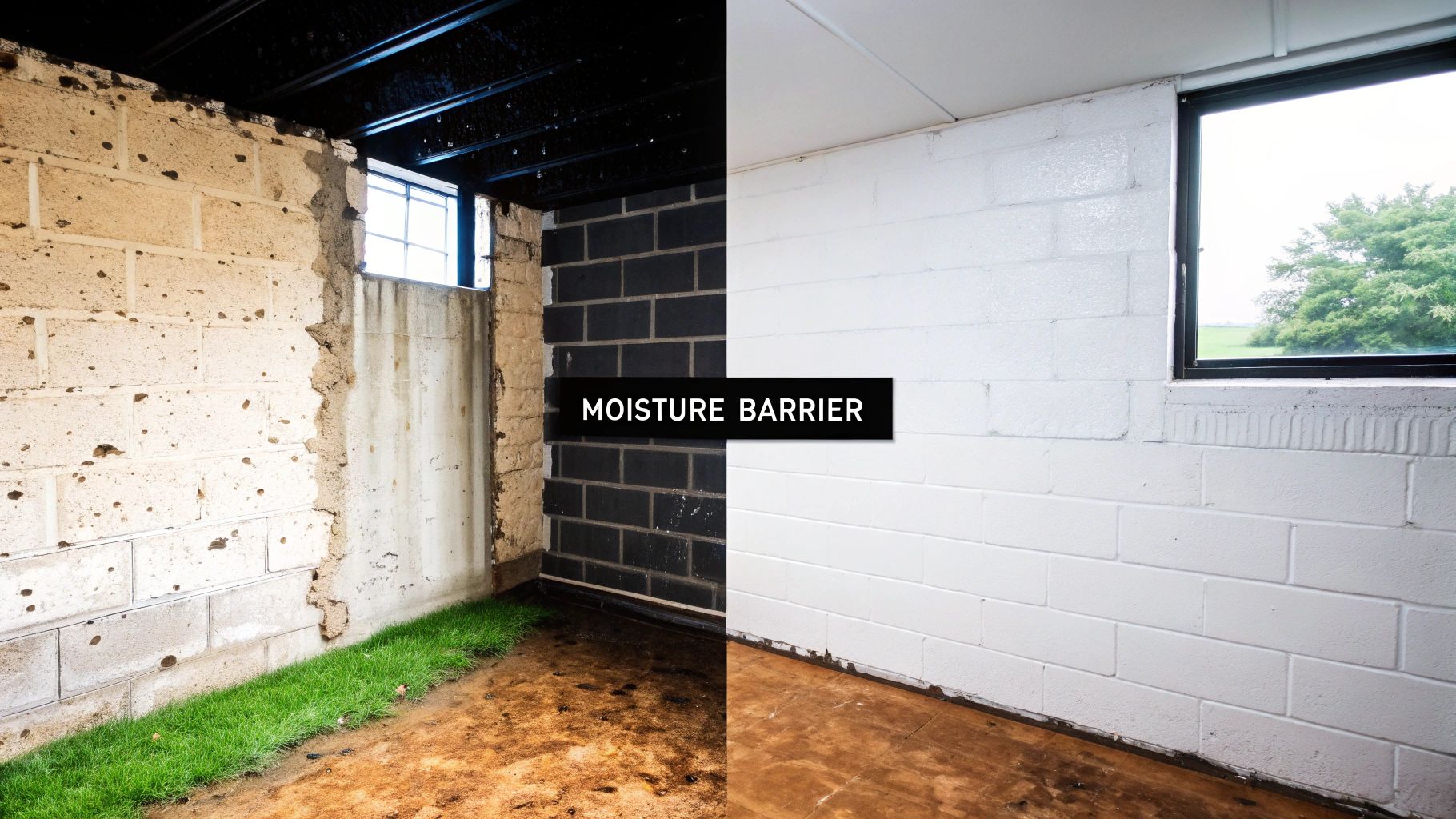
Here in South Florida, insulation isn’t just about keeping the heat out—it’s a constant fight against humidity. Cinder block walls are strong, but they’re also porous. They act like a sponge, pulling moisture right out of the humid air and ground. That’s what causes that familiar damp basement smell, peeling paint, and eventually, mold.
This is where a lot of traditional insulation just can’t keep up. But it’s exactly where closed-cell spray foam shines. It doesn’t just manage the symptoms; it transforms a vulnerable wall into a solid, waterproof barrier, solving the moisture problem for good.
The real power of closed-cell spray foam is in its dense, rigid structure. When we spray it directly onto a cinder block wall, it doesn’t just sit there. It expands, seeps into every crevice, and bonds directly with the masonry to create a single, continuous, non-porous layer. This monolithic seal acts as a Class II vapor retarder, which means it’s incredibly effective at stopping moisture vapor in its tracks.
Think about it this way: humid outdoor air is always trying to push its way into your cooler, air-conditioned home. With a bare block wall, that moisture-heavy air passes right through the concrete and condenses on the cooler interior side. That’s when the dampness and mold start.
Closed-cell spray foam brings this process to a dead stop. It creates a single shield that blocks both air and water vapor, completely eliminating the potential for condensation inside your wall.
Most mold problems in block walls start with condensation. It’s simple science: when warm, moist air hits a surface below the dew point, water droplets form. In our climate, this is the root cause of countless issues, from structural damage to poor indoor air quality.
By applying spray foam insulation to cinder block walls, you move that condensation point entirely outside the building. The foam keeps the interior surface of the block wall warm and dry, taking away the cold surface that moisture needs to condense.
This is why cinder block walls benefit so much from spray foam. It’s not just insulation; it’s a vapor barrier that keeps the concrete masonry units (CMUs) dry. That’s critical, since wet blocks are a breeding ground for mold. In a high-humidity market like South Florida, where 70% of homes are built with CMUs for storm resistance, spray foam cuts air leakage by over 90%. This stabilizes temperatures and slashes HVAC loads by a massive 30-50%. An in-depth analysis from Fine Homebuilding really dives into how foam keeps masonry dry and prevents these issues.
Picture a ground-floor bonus room in a Stuart home with exposed cinder block walls. Every summer, that room feels clammy. There’s a persistent musty smell, no matter how hard the A/C works. The problem is moisture wicking through the porous block from the damp soil and humid air.
Applying just two inches of closed-cell spray foam to those interior block walls would fix this permanently. The foam creates an airtight and watertight seal, completely cutting off the interior from outside moisture. The room would instantly feel drier, the musty odor would vanish, and the space would finally become a comfortable, healthy part of the home—all while making the A/C far more efficient.
Let’s get right to it: the investment. There’s no sugarcoating it—spray foam has a higher upfront cost than old-school insulation like fiberglass batts. It’s crucial, though, to understand what goes into that number. A quote for spray foam insulation on cinder block walls isn’t pulled out of thin air; it’s a detailed calculation based on the specific needs of your South Florida property.
But if you only look at it as an expense, you’re missing the big picture. This is a one-and-done upgrade that actively pays you back. With a lifespan that can stretch past 80 years, spray foam is a permanent investment in your home’s performance and structural health, not just another maintenance item on your to-do list.
Several key factors determine the final price of a professional spray foam job. Knowing what they are helps you see exactly where the value is.
The results speak for themselves. We’ve seen studies confirming a staggering 92-96% reduction in heat transfer through block walls with just a couple of inches of foam. Real-world blower door tests show air leakage (measured in air changes per hour, or ACH) dropping from a drafty 12 down to a tight 5.6 after a proper install. For homeowners in places like Wellington and Stuart, that translates directly into 25-40% lower cooling bills. If you’re interested in the history of this stuff, you can check out some great research on its development.
The real story here isn’t what you pay today, but what you gain for decades to come. This is where spray foam completely outclasses other options, offering real returns you can see and feel.
Spray foam insulation isn’t just an expense; it’s a strategic investment that pays for itself by creating a more efficient, durable, and valuable home. The financial benefits extend far beyond just the monthly utility bill.
Think about all the ways it puts money back in your pocket:
When you’re thinking about a major upgrade like spray foam insulation for cinder block walls, you’re going to have questions. It’s a big investment. From how it’s applied to critical safety rules, getting straightforward answers is key to feeling confident in your decision.
We’ve pulled together the most common questions we hear from homeowners and contractors right here in South Florida. Each answer comes from years of hands-on experience and a real understanding of building science in our humid, demanding climate.
Yes, you absolutely can. In fact, this is one of spray foam’s biggest strengths. It’s designed to stick like glue to clean, dry masonry surfaces like cinder blocks.
For the best, most permanent results—especially in our climate—we always use closed-cell foam for this. As it’s sprayed, the foam expands into every last crack, pore, and imperfection in the block. This creates a single, unbroken barrier against both air and moisture, something you’ll never get from rigid boards or fiberglass batts.
The secret to that lifelong bond is all in the prep work. It’s a step a true professional will never, ever skip.
It’s an outstanding choice. You could argue it’s the best solution for this exact situation. Garages with concrete block walls are notorious for feeling like ovens in the summer and being damp and musty all year. Closed-cell spray foam tackles both problems at once.
First, it insulates against the intense radiant heat that concrete soaks up all day, making the space drastically cooler. Second—and this is just as important in Florida—it acts as a powerful vapor barrier. This stops ground moisture from wicking up through the porous blocks, which prevents that musty garage smell and keeps mold from growing. It also perfectly seals the rim joist area where the walls meet the ceiling, a huge source of air leaks.
Applying spray foam transforms a miserably hot and humid garage into a usable, conditioned, and protected space. It not only makes the garage more comfortable but also cuts down the heat load on the rest of your home.
Costs can definitely vary, but it helps to have a realistic budget in mind. The final price tag depends on a few things: the total square footage, the type of foam (closed-cell is a must here, and it costs a bit more), and how thick we need to apply it.
On average, you can expect to see costs ranging from $2.00 to $5.00+ per board foot for a professional closed-cell foam installation. A board foot is just a one-foot by one-foot square that’s one inch thick.
While the initial investment is higher than something like fiberglass, the combination of powerful energy savings (often between 20-40%) and unbeatable moisture protection delivers a fast and significant return for Florida homeowners.
Yes. This is a non-negotiable safety requirement. Building codes are crystal clear on this point: any spray foam insulation installed in interior living spaces must be covered by an approved 15-minute thermal barrier.
The most common and accepted thermal barrier is 1/2-inch drywall. This rule applies to any interior space like a finished basement, a garage that shares a wall with your house, or any living area where the walls are exposed. In some non-living spaces, like certain attics or crawlspaces, a special ignition barrier coating might be allowed, but drywall is the gold standard for occupied areas. On a side note, the dense structure of the foam also provides excellent sound dampening. If you want to learn more, check out our guide on how insulation can be used as a sound barrier.
At Airtight Spray Foam Insulation, we provide clear, upfront answers and tailored solutions to protect your home. For a detailed, no-obligation estimate on transforming your cinder block walls, request a free quote today.